The Algorithm Moved. Did Your AI Ghostwriter Notice?
Every social media operator I know has the same quiet anxiety right now: the AI tools writing our drafts are confidently wrong about what works. I’ve watched Claude, ChatGPT, and a rotating cast of “viral hook” generators produce copy that reads beautifully and dies in the feed — because the model has no idea how your last twenty posts actually performed, or what the ranking system rewarded this week. That gap between “generally good writing” and “writing calibrated to a live distribution algorithm” is where most creator AI tooling quietly fails. So when a solo founder launches a tool whose entire pitch is closing that gap — feeding your real post results and the platform’s own published ranking code into the assistant you already use — my ears perk up. That’s LinkIntel, and I have thoughts.
What LinkIntel Actually Solves (And What It Doesn’t)
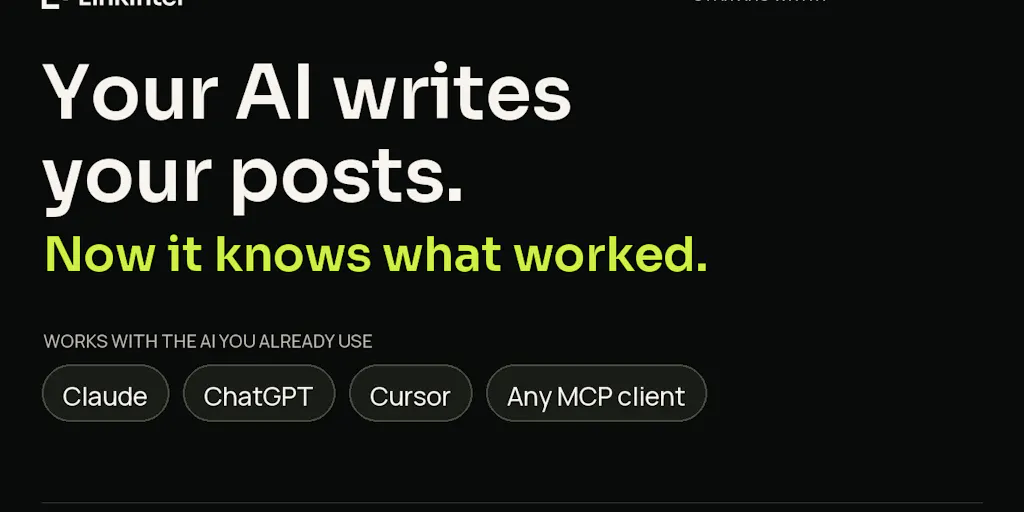
Let me describe what this thing is, precisely, because the Product Hunt listing is a little muddled. LinkIntel is an MCP server — a Model Context Protocol connector — built by UK solo founder Marcos Placona. You add one URL to the AI assistant you already use, and it gives that assistant three inputs it normally lacks.
First, your own X results: connect your X account once and LinkIntel records how your recent original posts perform, daily. Second, X’s ranking weights: X publishes its ranking code on GitHub, and LinkIntel re-reads it daily and flags every change, citing the commit as the receipt. Third — and this is the actual product — a brief with sources: you ask “what should I post next?” and your assistant answers from your results and those weights, showing what informed the answer.
That’s the whole loop. Notice what’s not in it: no scheduling, no analytics dashboard, no content calendar, no auto-posting. This is a context layer for your existing AI assistant, not a Buffer or a Hootsuite replacement. My take: that’s the smartest thing about it, and also the thing that will confuse half the people who land on the page.
The founder’s origin story is refreshingly honest and worth repeating because it’s the exact failure mode I described above. He writes most of his X drafts with Claude, and it kept telling him a post would do well “with total confidence, without ever having seen how a single one of my posts actually did.” Every draft started from the model’s general idea of “good.” That is the precise mechanism of the problem: a large language model’s notion of a good post is a statistical average of the internet, not a model of your audience’s behavior under this week’s ranking function.
The “receipts” detail is the real differentiator
Buried in the maker’s comment is the line that I think matters most: when X changed its ranking weights, LinkIntel caught it, his assistant drafted a post about it in his voice, and he published it. He also notes that “this week likes went up and the ‘not interested’ penalty got heavier.”
I want to be careful here — that’s the maker describing his own experience, not a verified audit, and I’m not going to pretend I’ve independently confirmed the weight shift. But the architecture he’s describing is genuinely different from what most “algorithm insight” tools do. Most of them say “the algo changed” with zero receipts, as one commenter on the launch put it. LinkIntel’s approach — diff the published ranking repo daily, surface the commit — is verifiable in a way that a vendor blog post about “the new algorithm” never is. If you’re a growth marketer who has ever had to explain to a client why reach dropped, you know how valuable a citable commit is versus a vibes-based theory.
How It Stacks Up Against the Incumbents
Here’s where I have to be blunt about the competitive landscape, because the Product Hunt page invites a comparison it doesn’t make itself.
If you want scheduling and cross-platform publishing, you’re looking at Buffer, Hootsuite, Later, or Metricool — mature tools with broad platform support and analytics dashboards. If you want AI-assisted drafting, Canva Magic Studio, CapCut for video, and a hundred GPT wrappers will happily oblige. If you want performance-informed AI drafting specifically, the closest analogues are the analytics-plus-AI features creeping into the big schedulers, and the “viral post predictor” tools that mostly train on public data rather than your own account.
LinkIntel sits in a fourth, narrower category: a retrieval layer that grounds your AI assistant in your own performance data and the platform’s published ranking logic. It doesn’t compete with Buffer on scheduling; it competes with the generic assistant you’re already using. That’s a different sales motion and a different buyer. The person who gets value here is already prompt-engineering their drafts in Claude or ChatGPT and frustrated that the model is flying blind.
Why X-first is a defensible wedge — and a ceiling
The X-first focus is smart for a solo founder because X is the rare major platform that publishes its ranking code openly on GitHub. That makes the “re-read it daily and flag changes” feature feasible without reverse-engineering. Instagram, TikTok, and LinkedIn do not publish their ranking systems, so the same trick doesn’t transfer cleanly. If you’re a TikTok creator optimizing for watch time, or a LinkedIn operator chasing dwell time on document posts, LinkIntel’s core “receipts” feature has nothing to read. That’s not a flaw in the product so much as a structural limit of the approach — and it’s why the launch’s LinkedIn-flavored branding is so confusing.
Which brings me to the naming problem, and it’s not trivial. The product is called LinkIntel, the launch is titled “LinkIntel LinkedIn Analytics,” and the description says “AI-Powered LinkedIn analytics dashboard for company pages.” But every substantive detail the maker shares — the X results, the X ranking weights, the X commit tracking — is about X. A commenter flagged this immediately: “The brand name is a bit odd. I would expect a tool for LinkedIn with such a name.” I’d bet the LinkedIn framing is either a roadmap signal or a launch-day SEO play, but as a trust matter it’s a real problem: a social media manager landing from that headline expecting LinkedIn company-page analytics will bounce hard. When I evaluate a tool for my own stack, mismatched positioning is the first yellow flag, because it tells me the maker hasn’t fully decided what the product is yet.
What Creators and Social Teams Should Steal From This
Even if you never install LinkIntel, the pattern it embodies is one of the most useful things a content operator can adopt this year, and I want to spell out the workflow because it generalizes.
The pattern is: close the loop between your AI drafting and your actual performance data, and anchor algorithm claims to a primary source. Most creators run a broken loop — they draft with AI, publish, glance at likes, and then draft the next thing with the same uncalibrated AI. The model never learns. LinkIntel’s contribution is making that loop explicit and machine-readable: results in, ranking logic in, brief out with citations.
You can approximate this manually this week without any new tool. Export your last 30 posts’ performance from your platform’s native analytics, paste the top and bottom performers into your assistant’s context with a note like “these are my real results; here’s what the winners have in common,” and ask it to draft against that pattern rather than its generic prior. It’s clunkier than an MCP connector, but it’s the same idea, and in my experience it measurably changes the drafts — the model stops reaching for generic hooks and starts matching your actual voice and format winners.
The repurposing angle nobody’s talking about
Here’s a secondary use I’d test immediately: use the grounded assistant to translate a winning X post into a Threads or LinkedIn draft with the performance context attached. The reason most cross-platform repurposing underperforms is that operators strip the post of the context that made it work and hand a naked paragraph to a scheduler. If your assistant knows why the original performed — the hook structure, the specific claim, the timing — it can adapt rather than flatten. LinkIntel doesn’t advertise this, but it’s the natural extension of a tool that already holds your results and your voice.
Where the math breaks
I have to flag the sample-size problem, because it’s the thing that separates a useful signal from a confident hallucination. A solo founder posting a handful of times a week accumulates a thin dataset. Ranking-weight diffs are clean and citable; “your posts with question hooks outperform your posts with stat hooks” is not, when you’ve got twelve posts. The tool can’t manufacture statistical power that isn’t there, and the maker doesn’t claim it does — but users will over-read small-sample patterns, because that’s what humans do. My advice: treat the ranking-weight diffs as high-confidence signal and the personal-performance patterns as hypotheses to test, not laws. If you’re running a brand account posting daily across formats, your dataset gets meaningful much faster — which is exactly why social teams may get more out of this than lone creators.
Where My Judgment Says It Falls Short
Balanced assessment time, because a launch page is marketing and you deserve the other side.
Platform coverage is the big one. The launch is X-centric despite LinkedIn branding, and the comment thread shows users already asking whether they can point it at other accounts in their niche to compare, and whether LinkedIn is on the list “since that’s where most of our B2B stuff goes.” The maker confirms you can point it at other accounts and even specific posts that worked well, and that it tracked them all — which is a genuinely useful competitive-benchmarking feature I wish were in the main description. But on LinkedIn itself, the answer is not clearly disclosed in the source. If your business lives on LinkedIn or Instagram, verify coverage before you build a workflow around it.
It’s a context layer, not a control panel. If you want a dashboard, a calendar, approval workflows, or auto-publishing, this is not that, and the “analytics dashboard” framing will set the wrong expectation. It augments an assistant; it doesn’t replace your scheduler.
MCP is still early-adopter territory. Adding an MCP server to your assistant is trivial if you’re technical and mildly annoying if you’re not. The “one URL to add” pitch undersells the setup friction for a non-technical social manager. This is a tool for operators who are already comfortable in the assistant’s guts.
Pricing, user counts, and revenue are not disclosed on the page, so I can’t tell you whether it’s a bargain or a stretch, or how many people are actually running it. Twenty-two reviews at launch is a signal of interest, not of retention.
And the honest caveat on the whole premise: grounding an AI in published ranking code tells you what the scoring function rewards, not what your audience wants. Those overlap, but they aren’t identical. A post can be optimally ranked and still be forgettable. The tool improves the odds; it doesn’t replace taste. I’d bet the operators who get the most from LinkIntel are the ones who already have strong editorial judgment and just want the model to stop fighting it.
What I’d Watch / Test Next
If you’re curious, here’s what I’d actually do this week rather than just reading launch pages.
First, audit your own loop: pull your last 30 posts’ performance, identify your three best and three worst, and paste them into your assistant with a one-line instruction to draft against the winners’ pattern. That’s a free test of whether grounded drafting changes your output before you pay for anything. Second, if you’re X-active, try LinkIntel’s MCP connector and specifically test the ranking-weight diff feature — ask it what changed recently and check the cited commit yourself. That’s the claim most worth verifying, and the one that would earn my trust. Third, watch the roadmap on LinkedIn and cross-account benchmarking, since the comment thread suggests both are live or near-live and they’d change the tool’s value for B2B teams materially. Fourth, pressure-test the small-sample problem on your own data: ask the assistant for a pattern, then count how many posts actually support it. If the number is under twenty, file it as a hypothesis, not a rule. The tools are getting better at reading the algorithm; the operator’s job is still to read the room.