Why a VC’s Pitch Deck Analyzer Is Secretly a Lesson for Every Creator Who’s Ever Been Ghosted
There’s a moment every social media operator knows too well. You spend a week on a campaign — the hooks are sharp, the creative is on-brand, the captions are tight. You schedule it across five platforms, watch the analytics dashboard like a hawk, and then… nothing. A flat engagement rate. A handful of saves. No comments, no shares, no algorithm push. You never find out why.
The platform doesn’t tell you. The algorithm doesn’t explain itself. You just get a polite, silent “no” in the form of a low view count.
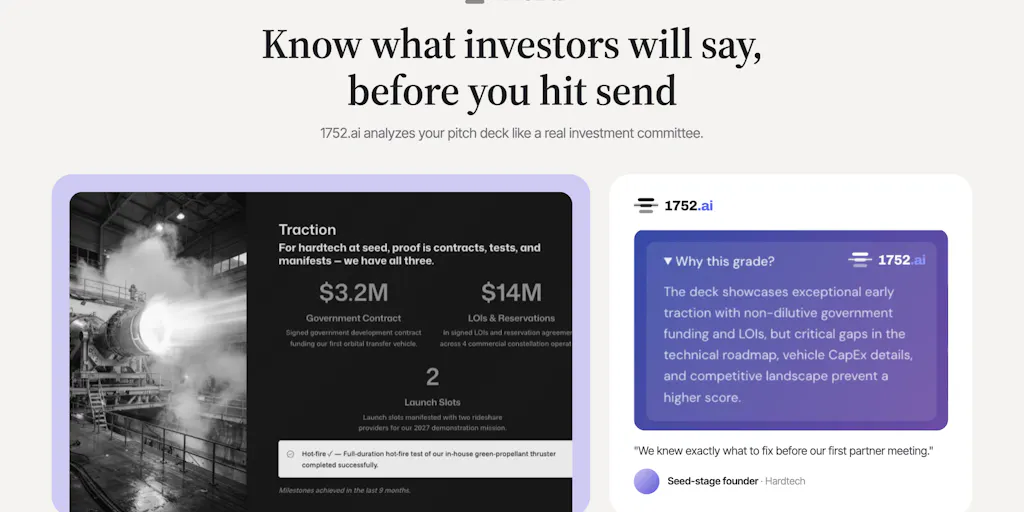
That’s the exact feeling 1752vc’s Pitch Deck Analyzer is built to eliminate for founders — and it’s why, as a creator-economy observer, I found this launch far more interesting than its niche premise suggests. On the surface, this is a tool for pre-seed startups polishing their fundraising materials. But underneath, it’s a case study in something every content operator desperately needs: feedback loops that tell you why, not just what.
When I scheduled 30 posts across 5 platforms last month, I was flying blind on at least three of them. The analytics told me what underperformed. Nothing told me why. The 1752vc team — Taissa Maleh and Lucas Pols of the GTM-focused VC and accelerator — has built a tool that tries to solve that exact problem for a different audience. And the operational lessons buried in their launch thread are worth stealing for your content workflow.
The Problem It Actually Solves: The “Polite No” Economy
Let me translate the core pain point here, because it’s not really about pitch decks.
The 1752vc team says they receive 4,000+ applications every year. Most decks get passed on. Almost none of the founders are told why. The makers’ explanation is refreshingly honest: “There’s simply no version of the job where you write thousands of pieces of real feedback a year, so the honest reason stays in the room and the founder only gets a polite no.”
Swap “decks” for “content” and “founders” for “creators,” and you’ve just described the modern social media feedback loop.
When your Reel underperforms, Instagram doesn’t tell you whether the hook failed, the retention curve dipped at second three, or the CTA confused viewers. When your LinkedIn post flatlines, the algorithm doesn’t explain that you buried the insight under three paragraphs of throat-clearing. You get a polite “no” in the form of impressions that stall out at 200.
The analyzer’s thesis is that this silence is the real killer — not lack of talent, not bad ideas, but the absence of actionable diagnosis. The tool reads a deck slide by slide the way an investor does, scored across 3,000+ investor attributes and trained on 25,000+ real decks. It’s not giving you a grade; it’s giving you a map of where the argument breaks.
My take: This is the exact mental model creators need to adopt. Stop treating analytics dashboards as verdicts and start treating them as incomplete feedback that needs a diagnostic layer on top. The platforms know why your content failed. They’re just not telling you.
What Actually Makes This Different From the Incumbents
There’s no shortage of tools that promise to grade your content. Buffer will schedule your posts. Hootsuite will give you engagement analytics. Metricool will track your competitors. Canva will make your graphics prettier. None of them tell you that your argument contradicts itself on slide seven.
The 1752vc team’s key differentiation claim is that the analyzer is calibrated on investor decisions, not design opinion. They say only 2% of what it flags is cosmetic. “Nobody has ever passed on a company because of a font.”
That’s a meaningful distinction, and it’s one most content tools miss. The default mode of most AI content feedback tools is aesthetic — “make this more engaging,” “add a stronger hook,” “use more emojis.” That’s the font-level feedback of the creator economy. It’s noise.
What the analyzer apparently does instead is flag structural problems: claims that don’t survive contact with the next slide, market sizing logic with no connective tissue, financing logic where the ask doesn’t buy enough runway to hit promised milestones. In the launch thread, maker Lucas Pols describes how it “flags when those pieces don’t add up to a fundable story — e.g. a raise that doesn’t buy enough runway to hit the milestones you’re promising.”
My take: Compare that to what you get from most social media analytics tools. “Your engagement rate dropped 12% this week.” Okay. Why? Was it the hook? The posting time? The platform’s algorithm shift? The content format? Most tools can’t tell you, because they’re measuring output, not diagnosing input.
The closest analog in the creator space might be the newer generation of AI content review tools, but even those tend to optimize for engagement metrics rather than internal coherence. The 1752vc tool is interesting because it’s checking whether the argument holds together — whether the deck is “arguing against itself,” which the team identifies as what quietly costs founders the meeting.
That’s a concept creators should steal immediately. How many of your posts argue against themselves? You claim in the hook that this is a “game-changing strategy,” then spend the body walking it back with caveats. You promise “5 secrets” in the thumbnail and deliver 3 with filler. The algorithm doesn’t need to read your mind — it can see the drop-off when viewers realize the content doesn’t deliver what the packaging promised.
What Creators and Social Media Teams Can Steal From This Launch
Here’s where I want to get practical, because the value of watching a launch like this isn’t the tool itself — it’s the operational philosophy underneath.
The Severity-Tiered Feedback Model
The analyzer separates issues by severity and ties them to the slide that caused them, so founders aren’t “polishing the cover slides while the financials sink you.” The average deck comes back with a dozen flags, and they are not equal.
When did you last triage your content problems by severity? Most of us don’t. We see a dip in engagement and immediately start tweaking thumbnails, captions, and posting times — the cosmetic layer. Meanwhile, the structural issue — your content has no clear point of view, or you’re posting in a saturated niche with nothing differentiating you — sits untouched.
My take: Build a severity framework for your content. Load-bearing issues are things like: no clear hook in the first three seconds, no coherent argument structure, no CTA that matches your funnel goal. Cosmetic issues are: font choice, color palette, caption emoji usage. Most creators spend 80% of their optimization energy on the cosmetic 20%.
The “Deck Arguing Against Itself” Diagnostic
This is the single most valuable concept in the entire launch thread. The team says the thing that costs founders the meeting isn’t design, market size, or even traction — it’s the deck arguing against itself. A claim in one slide that doesn’t survive the next.
Creators do this constantly. Your Instagram bio says “I help busy professionals find time for fitness,” but your content is 80% workout routines for advanced lifters. Your LinkedIn posts promise “actionable growth strategies,” but you never actually give away the steps — you just tease them and ask people to book a call. Your YouTube video title says “I tried this viral productivity method for 30 days,” and then you admit in minute two that you actually gave up after a week.
The platform sees this mismatch. More importantly, your audience sees it. And the algorithm is trained on audience behavior, so the two are linked. When viewers bounce because your content doesn’t deliver what it promises, the algorithm learns to show your stuff to fewer people.
My take: Run a coherence audit on your last 10 posts. Does the hook match the body? Does the body deliver the promise? Does the CTA make sense given what you actually provided? If you find contradictions, those are your load-bearing issues.
The Free-Tier-as-Data-Collection Strategy
The team is offering 5 free deck reviews with a promo code, no credit card needed. They reported that 2,000 founders ran their decks through the analyzer during alpha — before any public announcement. And within a couple hours of the Product Hunt launch, ~100 more had used it.
That’s not just generosity. That’s a data flywheel. Every deck they analyze trains the model further. Every founder who runs a deck and gets feedback becomes a potential investor pipeline lead. The tool is both the product and the customer acquisition mechanism.
My take: Creators should steal this. How many of you are sitting on a content library that could be a feedback tool for your audience? A free template, a free audit, a free checklist — not as a lead magnet that goes nowhere, but as an actual useful diagnostic that collects data about what your audience struggles with and positions you as the expert who can fix it. The 1752vc team isn’t just building a tool; they’re building a relationship with 2,000+ founders who now know exactly what their deck is missing — and who need exactly what 1752vc sells.
Why TikTok Creators Should Care More Than LinkedIn Ones
If you’re a LinkedIn thought-leader posting text-based content, the 1752vc model is less directly transferable. Your platform is more forgiving of structural incoherence — long-form text gives you room to wander and still land somewhere useful. The algorithm rewards dwell time and comments, not narrative tightness.
But if you’re a TikTok or Instagram Reels creator, the stakes are different. You have seconds to establish a promise and hold attention. The platform’s algorithm is ruthlessly optimized for retention — if viewers drop off in the first two seconds, your content dies. There’s no room for a deck that argues with itself because there’s no room for a video that takes 30 seconds to make its point.
The 1752vc model of slide-by-slide diagnosis maps directly to second-by-second video analysis. What’s your hook slide? What’s your market-size slide (the part where you establish the stakes)? What’s your financials slide (the part where you deliver the actual value)? If those pieces don’t connect, your retention curve will show it — but only if you’re looking at it second-by-second, not just checking the total view count.
Where the Math Breaks: Limitations and Open Questions
I want to be balanced here, because every tool has a dark side, and the launch thread actually surfaces one of the most interesting critiques.
The Skeptic’s Take
One commenter, rick segal, who claims 9 years as a VC and 3 startup exits, posted a takedown that’s worth reading carefully. His argument: it’s five core slides — problem, size, solution, revenue, why you — and everything else builds on that. His advice: “Don’t pay for this stuff.” Build the MVP instead of obsessing over slides. Get customers. “A ‘try it’ email trumps 5 or 50 slides every single day.”
He also raises a sharper point: the VC firm isn’t doing this out of pro bono love. “Ben wants deal flow. Nothing wrong with that. You, the new founder, should go into this process with your eyes wide open.”
My take: He’s right, and it’s a good reminder for creators too. Any free tool from a company is a funnel. The 1752vc analyzer is a funnel for deal flow — the team explicitly says that for decks that clear the bar, the road leads to investments from them. That doesn’t make the tool bad. It makes it a business development strategy disguised as a utility.
The same applies to every “free” content tool you use. Canva is free until you need the Pro features. CapCut is free until you want to export without a watermark. Understand what you’re paying with — data, attention, or deal flow — before you adopt a tool.
The Training Data Question
The team says the analyzer is “trained on 25,000+ real decks and the decisions that followed them.” That’s a strong claim, but it raises questions the launch page doesn’t answer. What was the decision distribution? If the training data is mostly pre-seed decks that got rejected, the model might be better at flagging failure patterns than identifying what actually works. The team does say it’s “calibrated on investor decisions, not design opinion,” which suggests they weighted outcomes, but the specifics aren’t disclosed.
My take: For creators, this is a reminder to check the training data of any AI tool you use for content feedback. If the tool was trained on viral content, it might over-index on clickbait patterns. If it was trained on average content, it might not push you far enough. The 1752vc team’s claim is strong, but the underlying data distribution is not fully transparent.
Who This Is NOT For
This is not for creators who are happy with their current content performance. If your engagement rates are healthy and your audience is growing, you don’t need a diagnostic tool — you need to keep doing what you’re doing.
It’s also not for creators who are looking for a magic bullet. The analyzer doesn’t write your deck for you. It doesn’t fix your content. It tells you what’s broken and where. The fixing is still on you. The launch thread makes this clear: “Knowing what’s wrong only matters if you fix it and go back out.”
And it’s explicitly not for anyone who can’t handle honest feedback. One founder in the thread shared their result: Pre-seed deck. 28 slides. Graded C. 8 critical issues, 4 quick wins. That’s brutal. Most creators would unfollow a tool that gave them a C on their content. But that C is the most valuable feedback they’ll get all year — if they act on it.
The Deeper Lesson: Feedback Loops Are the Creator Economy’s Missing Infrastructure
Here’s the meta-point I keep circling back to. The creator economy has built incredible infrastructure for distribution — scheduling tools, repurposing workflows, analytics dashboards. But we have almost no infrastructure for diagnosis. When something underperforms, we’re left guessing.
The 1752vc team identified this gap in venture and built a tool to close it. The specific application is pitch decks, but the underlying insight applies everywhere: the most valuable feedback is the feedback that tells you why, not just what.
Platform algorithms are getting better at understanding content — but they’re optimizing for their own goals (retention, watch time, ad revenue), not yours. A tool like this, whether it’s for decks or content, is an attempt to build a feedback loop aligned with your goals.
My take: I’d bet we see more of this in the creator space within the next 12 months. Tools that don’t just tell you “your engagement dropped” but actually diagnose the structural reasons — your hook doesn’t match your content, your CTA is unclear, your niche positioning is muddy. The 1752vc analyzer is an early signal of that trend.
What I’d Watch / Test Next
If you’re a creator or social media operator, here’s what I’d do this week — not to fundraise, but to borrow the operational logic:
1. Run a coherence audit on your last 10 posts. Look for places where your content argues against itself — hook vs. body, promise vs. delivery, CTA vs. actual value provided. Flag the load-bearing issues first, not the cosmetic ones.
2. Build a severity tier for your content problems. What are the structural issues that actually cost you reach and retention? What are the cosmetic issues you’re over-indexing on? Redirect your optimization energy accordingly.
3. If you’re raising money or pitching anything — a brand partnership, a media feature, a client — actually run your deck through the 1752vc Pitch Deck Analyzer. The team is offering 5 free reviews right now. Even if you’re not fundraising, the feedback on how you present your work is transferable to how you present yourself in content.
4. Watch how 1752vc monetizes this. The team says they’re “a fund, not a tool company.” The analyzer is a means to an end — deal flow. That’s a model creators should study. Your free content isn’t your product; it’s the diagnostic that builds trust and routes people to your paid offering.
5. Test the 1752vc analyzer against your own judgment. The maker Taissa Maleh asks founders to check whether the feedback tracks with what investors actually told them. Do the same with any AI content tool you use. If the feedback doesn’t match what your analytics show, trust your data, not the tool.
The platform economy runs on silence. The tools that break that silence — whether they’re built for pitch decks or Reels — are the ones worth paying attention to.


