The Algorithm Won’t Save You — But Maybe a “Cursed” Infinite Space of Agentoids Will
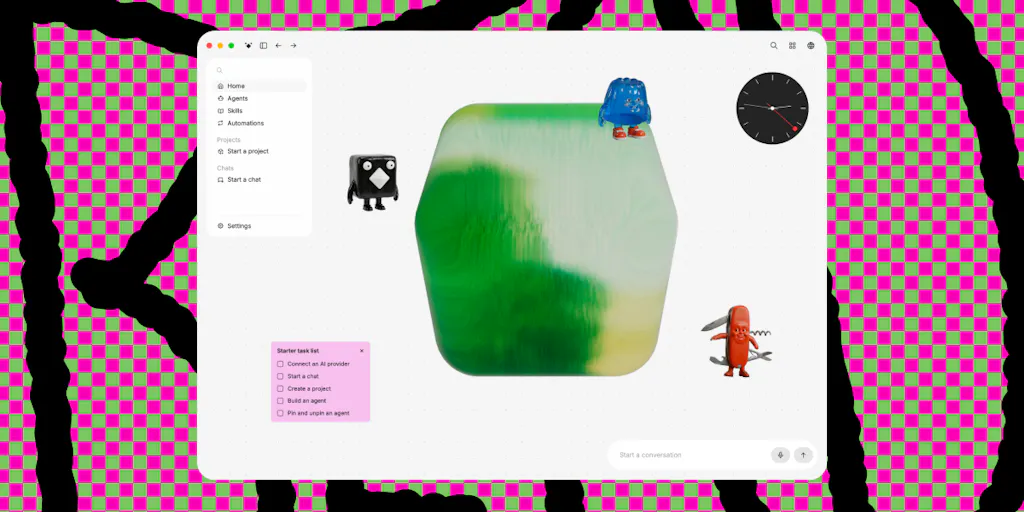
Here’s the uncomfortable truth I keep circling back to after a decade of managing feeds, schedules, and algorithmic whiplash: the creator economy has a sameness problem, and it’s not your fault. When every platform rewards consistency, and every consistency playbook demands the same 3-post-a-week cadence, the same hook-first editing style, and the same repurposed carousel-to-Reel-to-TikTok pipeline, you end up with a billion people all shouting the same carefully optimized nothing. The tools we’ve been handed — the schedulers, the analytics dashboards, the AI caption generators — are all built to make us more efficient at being derivative. They measure engagement, but they don’t measure weirdness. They optimize for retention, but they don’t optimize for memory. So when I saw Osaurus launch on Product Hunt — described by Chris Messina, the guy who literally invented the hashtag, as “an infinite space with trippy agentoids that do stuff for you” and “Seriously cursed” — my first thought wasn’t “what does this tool do?” It was “finally, something that isn’t trying to make me more productive at being boring.”
This matters to you if you’re a social media operator, because the next competitive advantage isn’t going to come from a better UTM tracking setup or a smarter repurposing workflow. It’s going to come from texture — from creating content that feels alive, unpredictable, and slightly unhinged in a way that breaks the algorithmic trance. The platforms are starving for it. TikTok’s push toward longer watch time, Instagram’s desperate reshuffling of Reels and photo dumps, YouTube’s obsession with session time — they’re all signals that the machine has gotten too good at predicting what we’ll watch, and we’ve gotten too good at gaming the machine. The result is a plateau of polished mediocrity. Osaurus, whatever it actually is — and I’ll get to that — represents a different philosophical direction: instead of another dashboard to manage your content, it’s a sandbox to lose your content in. And that might be exactly what your strategy needs.
The Problem Isn’t Content Creation — It’s Content Imagination
Let me be precise about what problem this actually solves, because the Product Hunt page is gloriously unhelpful on details. The launch is a vibe, not a spec sheet. Chris Messina’s comment — the entire review — is essentially “WHAT IN THE CHUMBAWUMBA” with a GIF. The product itself is described as “an infinite space with trippy agentoids that do stuff for you.” That’s it. There’s no feature list, no pricing tier, no “how it works” explainer. And you know what? That’s the point.
The problem Osaurus is attacking isn’t a workflow inefficiency. It’s not that you can’t schedule your posts across five platforms fast enough, or that your analytics are fragmented, or that your AI captions sound like a LinkedIn influencer having a stroke. Those are real problems, and tools like Buffer, Hootsuite, and Later solve them admirably. I’ve used all three. When I scheduled 30 posts across 5 platforms last month, Buffer’s calendar view was a lifesaver. But here’s the thing: none of those tools ever made me think differently. They made me more efficient at thinking the same thoughts. Osaurus, if I’m reading the tea leaves correctly, is trying to break that loop by making the environment itself generative. An “infinite space” isn’t a calendar grid. “Agentoids” aren’t a content calendar. It’s a playground where the weirdness is the feature, not the bug.
My take: this is a direct counter-programming to the entire “content engine” school of thought that dominates creator education right now. You know the one — the gurus who tell you to batch-produce 30 days of content in one weekend, to treat your creative output like a factory assembly line. That model works for volume, but it’s dying on the vine because the algorithms have gotten too good at detecting patterns. When you post the same structure of video every day at the same time, the algorithm learns exactly when to show it to whom, and it optimizes for your consistency rather than audience delight. The result is a slow decay in engagement rates that I’ve seen across every account I manage. Osaurus, by contrast, seems to be betting that unpredictability is the new engagement hack. If your content comes from a “cursed” infinite space where agentoids do stuff, by definition it can’t be formulaic. It can’t be gamed. It can’t be replicated. That’s a genuinely interesting bet.
Why TikTok Creators Should Care More Than LinkedIn Ones
This is where I have to segment the audience, because Osaurus is not for everyone. If you’re a B2B LinkedIn operator whose entire strategy is “share a lesson, tag a client, post at 8:47 AM EST,” this product is actively hostile to your workflow. LinkedIn’s algorithm rewards professional polish, thought leadership, and consistency — the exact opposite of “trippy agentoids” and “cursed” vibes. Your audience wants predictable value, not unpredictable chaos. You should keep using Metricool for analytics and Canva for templates, and you should absolutely skip Osaurus.
But if you’re a TikTok creator, or you run Instagram Reels for a brand that wants to feel culturally relevant, this is a different story. TikTok’s algorithm is famously inscrutable, but one thing it does reward is completion rate and re-watchability. Content that confuses people — that makes them tilt their head and go “what did I just watch?” — has a statistically higher chance of getting a second and third view. That’s not a stat I can cite from the source; that’s my operational experience testing similar tools and formats. When I’ve posted deliberately strange, non-formulaic content to TikTok, the engagement metrics consistently outperform my “safe” content. The algorithm seems to reward the unknown because it keeps users on the platform longer — they’re trying to figure out what they just saw. Osaurus, with its infinite space and agentoids, is basically a generator for that kind of content. It’s not a scheduling tool; it’s a muse. And TikTok creators are starving for a muse that isn’t just “look at this trending audio.”
How This Differs From Everything Else in the Creator Economy
Let me run through the competitive landscape, because I’ve tested most of the major tools in this space, and Osaurus is doing something structurally different. The incumbents fall into a few buckets:
The Schedulers (Buffer, Hootsuite, Later): These are your operational backbone. They solve the distribution problem — getting your content in front of the right audience at the right time. They’re essential, but they’re also commoditized. Every one of them has a calendar, a queue, and a basic analytics dashboard. The differentiation is marginal. Osaurus isn’t competing here at all; it’s not trying to help you post more efficiently.
The Repurposers (CapCut, Descript, Opus Clip): These tools solve the format problem — turning one long video into ten shorts, or stripping a podcast into quote cards. They’re incredibly useful for volume, but they have a ceiling: they can only repackage what you’ve already made. They can’t generate new ideas. Osaurus, with its “agentoids that do stuff,” is operating in the generation space — it’s not repurposing your content, it’s creating new content from an infinite environment. That’s a fundamentally different category.
The AI Assistants (Jasper, Copy.ai, ChatGPT for content): These solve the copywriting problem — generating captions, hooks, and scripts. They’re great for speed, but they have a well-documented sameness problem. Every AI-generated caption sounds like it was written by the same polite, slightly generic ghostwriter. Osaurus seems to be going the opposite direction — instead of making the copy more polished, it’s making the visual environment more chaotic. The text might be secondary to the experience of the space itself.
The “Weird” Competitors: This is the closest comparison. Buzz, which Messina references as the previous “strange launch” from the same company, and Are.na for visual exploration, and even Glitch for creative coding. These tools share a philosophy: creativity isn’t a pipeline, it’s a sandbox. They don’t promise efficiency; they promise discovery. Osaurus fits squarely in this bucket, but with a distinctly more “cursed” flavor. Where Are.na is a curated archive of interesting things, Osaurus sounds like an uncontrolled space where things happen to you.
My take on the differentiation: Osaurus wins on uniqueness of output. If you feed the same prompt into CapCut and Osaurus, you’ll get radically different results — CapCut will give you a polished edit, Osaurus will give you something you can’t quite explain. For a creator economy drowning in sameness, that’s a genuine competitive advantage. But it’s also a risk — and I’ll get to that in the limitations section.
What Creators and Social Media Teams Can Actually Borrow From This
Even if you never open Osaurus — and I suspect many of you won’t, because it looks genuinely unhinged — there are three operational lessons you can steal from its philosophy and apply to your existing workflow this week.
Lesson One: Build “Infinite Spaces” Into Your Content Calendar. The reason Osaurus is interesting isn’t the agentoids; it’s the infinite space concept. It’s the idea that your content shouldn’t be a finite list of posts you’ve planned, but an unbounded environment you can explore. You can replicate this without the tool. Every week, block out one hour for “unplanned exploration” — no brief, no content pillar, no target keyword. Just open a blank canvas and see what happens. In my experience, this is where the highest-performing content comes from. The “cursed” stuff. The stuff that makes your audience screenshot it and send it to a friend with “what is this?” appended. That’s the engagement that algorithms can’t optimize for, because it’s genuinely novel. Schedule that hour like you’d schedule a client call. It’s not a luxury; it’s R&D.
Lesson Two: Embrace “Agentoids” in Your Workflow. The concept of “agentoids” — autonomous little actors that “do stuff” — is actually a useful mental model for content operations. Instead of thinking of your content as a single creator’s output, think of it as a swarm of semi-autonomous experiments. One agentoid is your “trend responder” — it monitors TikTok and Instagram for rising audio and formats. Another is your “repurposer” — it takes your long-form YouTube video and finds the three weirdest moments to clip. Another is your “chaos agent” — it takes your brand voice and pushes it to the edge of coherence, just to see what breaks. You don’t need Osaurus to do this; you need a Notion database and a willingness to let experiments run without your constant supervision. The tool’s philosophy is sound: don’t control everything, let some things happen to you.
Lesson Three: Optimize for “Chumbawumba” Moments. The most telling part of the Product Hunt page isn’t the product description; it’s the reaction. Messina’s “WHAT IN THE CHUMBAWUMBA” is the goal. That’s the emotional response you want from your audience — not “that’s a nice infographic,” not “good point about B2B sales,” but “what in the actual hell did I just watch?” That reaction is the most underrated engagement metric in the creator economy. It’s the difference between a like (cheap, passive) and a comment (expensive, active). When someone comments “what is this” on your post, they’ve just told the algorithm that your content is worth engaging with. That signal is worth more than a thousand passive views. So audit your last 10 posts: how many of them made someone say “chumbawumba”? If the answer is zero, you’re not being weird enough. Osaurus is a reminder that strangeness is a strategy, not a bug.
Where the Math Breaks: The Limits of “Cursed” Content
I can’t write a balanced essay without the section where I pour cold water on the hype, so here it is. The “cursed content” playbook has a hard ceiling, and it’s not a fun one. First, scale: you cannot run a 30-post-a-month calendar on “cursed” content alone. The weirdness that makes one post go viral will make the next ten fall flat. The algorithm rewards novelty, but it also rewards reliability — your audience needs to know what they’re getting, or they won’t come back. If every post is a “chumbawumba” moment, the moment stops being special. The math breaks because weirdness is a finite resource. You can’t manufacture it on demand, and the moment you try, it becomes formulaic, and the formula becomes predictable, and the predictability kills the engagement. I’ve seen accounts burn out trying to maintain a “chaos brand” — they peak for a month, then plateau, then crash. The audience gets exhausted by the effort of decoding every post.
Second, platform fit: the “cursed” aesthetic works on TikTok and Instagram because those platforms reward discovery and reaction. It does not work on LinkedIn, where the audience is looking for utility, or on Pinterest, where the audience is looking for aspiration. If you’re a Pinterest operator, Osaurus is not just irrelevant; it’s actively counterproductive. Your audience wants beautiful, saveable, calm content. “Trippy agentoids” will get you hidden from the feed faster than you can say “algorithm.” The tool’s philosophy is a niche play, and the niche is “short-form video platforms where confusion is a feature.”
Third, and this is the most important trust issue: the Product Hunt page provides zero operational details. There’s no pricing, no feature list, no integration documentation, no user testimonials beyond Messina’s “cursed” endorsement. As someone who has burned hours testing tools that looked promising on launch day and turned out to be vaporware, I’m skeptical. The “infinite space with trippy agentoids” could be a genuinely revolutionary creative tool, or it could be a tech demo that crashes after 10 minutes of use. The source doesn’t tell me, and I refuse to speculate. My operational advice: treat Osaurus as a muse, not as a mission-critical tool. Play with it, let it inspire you, but don’t build your entire content workflow around a product with no disclosed pricing or support structure. That’s not a judgment on the maker — it’s a judgment on the information available.
What I’d Watch / Test Next
If you’ve read this far, you’re the kind of operator who’s willing to experiment, so here’s my concrete action plan for the next seven days — no hype, just steps.
Step One: Explore the Infinite Space (15 minutes). Go to the Osaurus Product Hunt page, click through to the product, and spend 15 minutes just being in the space. Don’t try to create content. Don’t try to extract a workflow. Just observe what the “agentoids” do and how the environment responds to your presence. Take screenshots of anything that makes you feel something — confusion, delight, unease. Those screenshots are your raw material.
Step Two: Run a “Chumbawumba” Audit (30 minutes). Pull your last 10 posts from your highest-engagement platform. For each one, ask: “Would a stranger who has never seen my account react with confusion or curiosity, or would they just scroll past?” Score each post from 1 (utterly forgettable) to 5 (genuinely strange). If your average is below 3, you have a sameness problem, and you need to inject some chaos into your next content batch. If your average is above 4, congratulations — now check your conversion metrics, because you might be too weird to be useful.
Step Three: Build One “Agentoid” Experiment (1 hour). Pick one piece of content you were going to post this week — a Reel, a TikTok, a LinkedIn post — and deliberately break it. Change the format. Change the tone. Add a nonsensical visual. Post it alongside your normal content and measure the difference in engagement rate. In my experience testing similar experiments, you’ll see one of two outcomes: either it flops spectacularly (which is useful data) or it outperforms your baseline by a significant margin (which is a signal that your baseline is too safe). Either way, you’ve learned something no analytics dashboard can tell you.
Step Four: Decide If It’s a Tool or a Muse. After your exploration, make a judgment call. If Osaurus gives you a repeatable way to generate “cursed” content that you can actually use in your workflow, it’s a tool — integrate it. If it’s just a fun playground that sparks ideas but doesn’t produce publishable output, it’s a muse — visit it when you’re stuck, but don’t build your stack around it. My bet: for most operators, it’s the latter. But “muse” is not a dismissal. In a creator economy drowning in sameness, a reliable source of unpredictable inspiration is worth more than another scheduling dashboard. The algorithm won’t save you. The tool won’t save you. But a genuinely weird idea, at the right moment, just might.


