The creator economy’s real AI problem isn’t generation — it’s provenance
Every social media operator I know is drowning in AI-generated output right now. Scheduling tools will happily draft your captions, CapCut will auto-cut your Reels, and half the LinkedIn feed reads like it came off the same model. The bottleneck stopped being can we make content and became can we trust, verify, and defend what we publish. That’s why a small Product Hunt launch called CodaBridge caught my attention this week — not because it’s a social tool (it isn’t), but because its maker, Hyunil Kim, built it inside the GPT-6 Astra Challenge around a question every content team should be asking: how do you let a powerful model interpret your data without letting the explanation outrun the evidence? For creators staring down AI Overviews, brand-safety reviews, and audiences that increasingly fact-check screenshots, that’s not an academic question. It’s the next operational headache.
What CodaBridge actually is (and why a whale tool matters to your content stack)
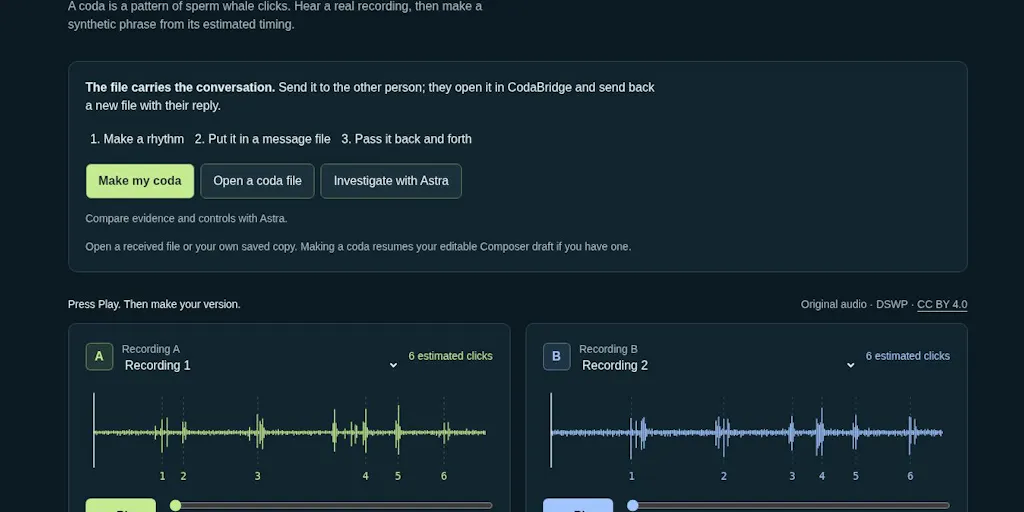
Let me be precise about what the product is, because the framing matters. CodaBridge is built around real sperm whale recordings. Users can listen to them, shape a personal synthetic coda, compare timing patterns, and then step into something called Context Lab to inspect annotated exchanges, controls, and prediction results. The maker is explicit that this is not a whale translator — the goal is AI-assisted exploration where the path from evidence to interpretation stays inspectable.
That sounds niche. It is niche. But the architecture is the story. In his launch comment, Kim describes how Astra changed CodaBridge “from a listening and timing-comparison tool into an interactive investigation environment” that can “inspect source evidence, compare observed pairings with controls, and explain alternative interpretations while citing what it used.” He says the design keeps “the source data, measurements, alternative explanations, and uncertainty” visible separately from the generated interpretation.
Now translate that to your world. When you ask ChatGPT or Claude to write a campaign recap, a competitor teardown, or a trend analysis for your Monday standup, you get a confident paragraph with no audit trail. When a client asks “where did this number come from?” you’re reverse-engineering your own prompt history. CodaBridge’s bet — that interpretation should be a separate, inspectable layer sitting on top of visible evidence — is exactly the discipline most social teams are missing. My take: the specific domain is a proof of concept, but the pattern is portable, and it’s the pattern that matters.
Why TikTok creators should care more than LinkedIn ones
Here’s the asymmetry. A LinkedIn thought-leadership post citing a vague “studies show” gets a few skeptical comments and moves on. A TikTok creator who posts a data-driven hook — “we tested 47 hooks and here’s what won” — gets duetted, stitched, and publicly corrected within 48 hours if the methodology doesn’t hold up. Short-form video’s remix culture is a peer-review system whether you opted into one or not. Tools that force you to keep evidence, controls, and uncertainty visible aren’t just ethically nicer; they’re defensively smarter for anyone whose face is on the content.
The real problem: AI content has a provenance crisis, and scheduling tools aren’t solving it
Walk through the current stack with me. Buffer, Hootsuite, Later, and Metricool have all bolted AI caption generation onto their composers over the past two years. Canva and CapCut handle the visual side. Notion AI drafts your content calendar. Every one of these tools optimizes for throughput — more posts, faster, in your brand voice. Almost none of them optimize for traceability. When the AI writes your caption, you get a suggestion box. When it writes your analytics summary, you get a paragraph with no citations.
That gap has real consequences. UTM parameters get hallucinated. Attribution windows get described incorrectly. A model confidently tells you Reels watch time is the dominant ranking signal when the platform has since shifted weight toward sends and shares. If you can’t see which evidence produced the claim, you can’t catch the error before your client or your audience does.
CodaBridge’s contribution — and I want to be careful not to overclaim here, since the source is a single Product Hunt page and the maker’s own comments, with user counts, pricing, and general availability not disclosed — is a working demonstration of the alternative. The model investigates through the tool’s evidence layer. The generated explanation cites what it used. Alternative interpretations get surfaced rather than flattened. Uncertainty stays visible. Whether the implementation scales beyond whale codas is an open question, but the design principle is sound and, frankly, overdue.
Where the math breaks
There’s a reason no major scheduler has shipped this. Provenance is expensive. Every claim your AI makes needs a pointer to a source row, a timestamp, a control group. That means storing more, indexing more, and slowing down generation. Buffer’s value prop is that you can batch 30 posts in an afternoon. If every caption required an evidence trail, that afternoon becomes a week. The honest answer is that provenance-heavy AI will first land in high-stakes content — research, journalism, regulated industries, scientific communication — and only trickle into everyday social posting once the infrastructure gets cheap. CodaBridge sits at the high-stakes end. That’s not a weakness; it’s a beachhead.
What social teams can steal from this launch today
You don’t need CodaBridge to adopt its discipline. Here’s what I’d actually port into a social workflow this month.
Separate the interpretation layer from the evidence layer in your own docs. When you run a monthly performance review, put raw exports — Instagram Insights, TikTok Analytics, YouTube Studio CSVs — in one tab, and the AI-written narrative in another. Never merge them. The moment they live in the same cell, you lose the ability to tell which is which.
Force citations in your AI prompts. Instead of “summarize last month’s performance,” try “summarize last month’s performance and quote the exact metric and date range for every claim.” It’s not a real audit trail, but it surfaces hallucinations fast.
Keep alternative explanations on the page. CodaBridge surfaces “alternative interpretations” alongside its conclusions. Your campaign post-mortems should do the same. “Reach dropped 18%” has at least three plausible causes — algorithm shift, posting-time change, creative fatigue — and a good analyst names all three instead of picking the most flattering one.
Treat uncertainty as a feature, not a hedge. Audiences and clients trust operators who say “I’m not sure yet” more than ones who always have a number. This is the same instinct that makes CodaBridge’s maker explicitly disclaim the whale-translator framing. That disclaimer is the credibility.
A quick note on the Astra angle
The launch lives inside the GPT-6 Astra Challenge, which is worth watching as a signal of where model capabilities are heading. Kim’s comment that Astra let him “aim beyond a demo” — turning a timing-comparison tool into an investigation environment — tells you the models are getting good enough to reason over structured evidence with controls. For social operators, that means the next wave of AI tools won’t just write your captions; they’ll interrogate your analytics. The teams that build provenance habits now will be the ones who can actually use those tools without getting burned.
Where I think this falls short (and who it’s not for)
Honest limitations, in order of how much they’d matter to a social team.
It’s not a social tool, and it doesn’t pretend to be. There’s no scheduling, no publishing, no cross-platform analytics, no UTM builder. If you’re looking for a Buffer or Later replacement, this isn’t it. The relevance is conceptual, not functional.
The evidence layer is domain-specific. CodaBridge’s Context Lab is built around annotated whale exchanges and timing patterns. Porting that architecture to, say, Instagram Reels performance data would require rebuilding the evidence schema from scratch. The maker hasn’t announced any such expansion — and I’d bet the roadmap, if there is one, stays in scientific and research domains for a while.
Pricing, user counts, and general availability are not disclosed. I can’t tell you whether this is a free experiment, a paid product, or a research demo. That’s a real gap for anyone evaluating whether to follow the project.
The “not a whale translator” framing is refreshing but also a signal. When a maker leads with what their product isn’t, it usually means the underlying capability is impressive enough to be overhyped and the team is trying to pre-empt it. That’s admirable. It’s also a reminder that “AI reasons over your data” is still a claim that needs verification per use case.
Who it’s not for: solo creators who just need to ship Reels faster. Community managers optimizing for engagement rate. Anyone whose primary AI need is volume. This is for the operator who’s been burned by a confident-sounding AI summary and wants to see the receipts.
What I’d watch / test next
Three concrete things I’d do this week, in order of effort.
First, audit your last AI-assisted content brief or performance recap and try to trace every factual claim back to a source. If you can’t, you’ve just found your provenance gap. Write down how many claims were untraceable — that number is your baseline.
Second, add a “sources and uncertainty” section to your next client deliverable, even if it’s just bullet points. Watch how clients respond. In my experience, most will treat it as a trust signal, not a sign of weakness.
Third, follow the GPT-6 Astra Challenge submissions for the next few weeks. CodaBridge won’t be the last entry built around evidence-grounded AI, and the pattern is what you’re shopping for — not the whale recordings. When a tool eventually applies this architecture to social analytics or content performance data, you’ll want to recognize it on day one.


