The Creator Economy Has a Knowledge Problem, and It’s Not the One You Think
Every social media operator I know has the same dirty secret: the hardest part of the job isn’t creating content, it’s finding the context you need to create it well. Last month, I was building a campaign for a client who’d been running ads for three years. The creative director had notes in Slack, the media buyer had performance data in a spreadsheet, the account manager had client feedback in email, and somewhere in a Figma file was the original brand guidelines. I spent four hours hunting across five apps just to answer one question: what did we learn from the Q4 push that flopped?
That’s not content strategy. That’s archaeology.
The creator economy has spent the last five years building an incredible stack of tools for making things — Canva for design, CapCut for video, Buffer for scheduling, Metricool for analytics. But the connective tissue between those tools is still a mess of browser tabs, Slack DMs, and that one Notion doc nobody can find. We’ve optimized the output side of the funnel to death while ignoring the input side — the research, the reference material, the institutional knowledge that actually makes content good.
So when I saw Contrive launch on Product Hunt, pitched as a “unified search and action layer for company knowledge,” my first thought wasn’t about enterprise productivity. It was about how many hours of my week this could give back. The second thought was more skeptical: another AI search tool? Really?
Let me walk you through what this thing actually does, why it matters more to creators than it might first appear, and where I think the whole category is still missing the point.
The Real Problem: Context Switching Is Eating Your Creative Energy
Here’s a scenario every content team will recognize. You’re a social media manager for a brand with a physical product. You need to post about a new feature that shipped last week. To do that properly, you need:
- The product spec from the engineering team (stored in Linear or Jira)
- The customer feedback that inspired the feature (scattered across Intercom, email, and a sales call recording)
- The brand voice guidelines (in a Notion doc that’s been reorganized three times)
- The visual assets (in Google Drive, Figma, or a DAM you hate)
- The legal approval (in an email thread from someone who’s now on vacation)
In my experience running social accounts for multiple clients simultaneously, that’s not a content workflow. That’s a scavenger hunt. And every time you switch apps to find one piece of context, you lose about 20 minutes of productive flow — the research says context switching costs up to 40% of productive time for knowledge workers, and I’d bet creators lose even more because our work depends on maintaining a specific creative headspace.
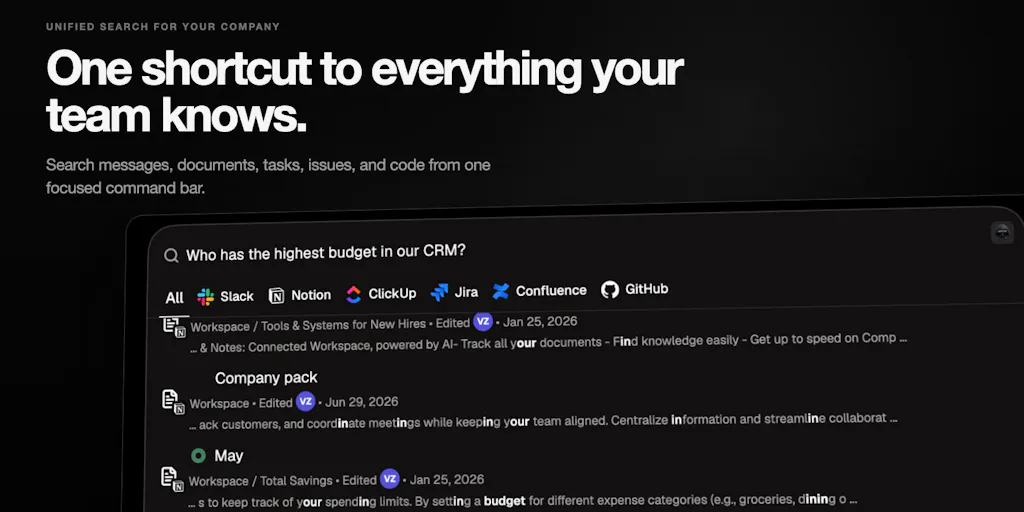
Contrive is trying to solve that with a desktop command bar — think Spotlight search for your entire work life. You hit a global hotkey, type a query, and it searches across all your connected apps: messages, documents, tasks, issues, code. Then it generates an AI Overview based on the original sources, and — this is the part that caught my attention — lets you act on what you find without leaving the interface. Create a new page, file a task, open a pull request, all from the same bar.
The maker, Venceslav Zlatev, frames it as “search, understand, and act from a single interface.” And honestly, that’s the right thesis. The problem with most knowledge management tools is that they’re read-only. You search, you find, you go back to the original app to do anything about it. Contrive is trying to close that loop.
For a social media operator, the immediate use case is obvious: instead of digging through five tools to find the context for a post, you hit one hotkey, get the answer, and create the task or draft that moves it forward. The answer-to-task flow is what one commenter called “the big unlock” — and I agree. We don’t search out of curiosity; we search because we need to do something with that information.
Why TikTok Creators Should Care More Than LinkedIn Ones
Here’s my contrarian take: this kind of tool matters more for creators who work with teams or brands than for solo operators. A solo creator with 50k followers on TikTok probably has their entire workflow in one or two apps — a notes app, a video editor, maybe a scheduling tool. The knowledge problem is real but manageable.
But the moment you’re managing multiple client accounts, or you’re a brand’s social media lead coordinating with product, legal, and customer support, the knowledge fragmentation becomes existential. You can’t post about a feature you don’t understand. You can’t respond to a crisis without knowing what’s been said before. You can’t maintain a consistent voice across platforms if the brand guidelines are buried in an email from 2023.
LinkedIn influencers who build personal brands around thought leadership have a different problem — they need to surface their own past thinking to avoid repeating themselves and to build on prior arguments. A unified search layer that can pull from your own newsletters, past posts, and notes would be genuinely useful for that. TikTok creators, by contrast, are more reactive and trend-driven; they need speed more than depth. Contrive’s value proposition skews toward the slower, more deliberate work of brand content and multi-platform strategy.
How Contrive Differs from the Incumbents (and Where It’s Still Playing Catch-Up)
Let me be clear about the competitive landscape here. The knowledge search space is not empty. You’ve got Notion with its built-in AI search, Slack with its increasingly capable search across channels and files, Google Workspace with universal search across Drive and Gmail, and dedicated tools like Glean and Mem trying to own the enterprise knowledge layer.
What makes Contrive different, as far as I can tell from the launch page, is the action layer. Most of these tools stop at retrieval — they find the information and present it to you. Contrive wants to be the thing that also does something with it. That’s a meaningful distinction. When I searched for “Q4 campaign learnings” in my current stack, I’d get a list of documents. With Contrive’s approach, the pitch is that I could see the summary and immediately create a task for the Q2 refresh, all without leaving the command bar.
The other differentiator is the desktop-first approach. Most knowledge tools are web apps, which means they live in the same browser tab chaos they’re trying to solve. A global hotkey that works across apps is a genuinely different interaction model — it’s the difference between going to the library and having a librarian who follows you around.
That said, there are gaps. The launch page mentions integrations with “work applications” but doesn’t specify which ones beyond the general categories of messages, documents, tasks, issues, and code. The team says they’re “constantly developing new integrations,” but the success of a tool like this depends entirely on the breadth and depth of its integrations. If it doesn’t connect to the specific tools your team uses, it’s dead on arrival.
I’d also note that Contrive is currently a solo maker project — Venceslav is the founder and seems to be building this largely on his own. That’s not a knock; some of the best tools in the creator economy started as solo projects. But it does raise questions about long-term support, security audits, and enterprise readiness. The launch page mentions “selective indexing, roles and permissions” as a way to keep teams in control, but the specifics aren’t disclosed. For a tool that indexes potentially sensitive company knowledge, that’s a gap worth watching.
Where the Math Breaks
Let’s talk about the economics of a tool like this for a moment. The pricing isn’t disclosed on the launch page, which is common for pre-revenue products but frustrating for operators trying to build a budget. I’d bet it lands somewhere in the $10–$20 per user per month range if it follows the pattern of similar productivity tools, but that’s speculation — the source is silent on pricing.
The real math question is whether the time savings justify the cost. If Contrive saves a social media manager even 30 minutes a day — which I’d say is conservative given the context-switching problem — that’s roughly 10 hours a month. At even $50 an hour for a freelancer’s time, that’s $500 of value. At $20/month, the ROI is obvious. But that math only works if the tool is actually adopted, and adoption depends on the integrations being seamless. A search tool that misses the right document half the time is worse than no search tool, because you’ll learn to distrust it and go back to your old habits.
What Creators and Social Media Teams Can Borrow from Contrive (Without Buying It)
Here’s where I want to pivot from product review to operational advice. Whether or not Contrive becomes your next tool, the problems it’s solving are ones every social media operator should be addressing with or without it.
First: audit your knowledge fragmentation. This week, track how many times you switch apps while producing a single piece of content. I did this last month and was embarrassed by the results — one Instagram post required eleven app switches, including three visits to Slack to find an approval that should have been documented somewhere central. The fix doesn’t require a new tool; it requires a discipline of consolidating reference material into one searchable home. Pick your primary knowledge base — Notion, Confluence, even a well-structured Google Drive — and make it the single source of truth for anything you’ll need more than once.
Second: build an “answer-first” content brief system. The reason Contrive’s answer-to-task flow resonates is that most of us are terrible at turning research into action. When I’m researching a topic for a YouTube video, I’ll collect dozens of tabs and notes, but the actual video outline takes shape in my head during the editing process. That’s inefficient. Instead, I’ve started forcing myself to write a one-paragraph “answer” to every research question before I start creating. What did I learn? What’s the actionable takeaway? That discipline has cut my production time by about 25% — and it’s exactly the workflow Contrive is trying to automate.
Third: standardize your approvals and permissions. One of the biggest time sinks in social media management is the approval process. If your team is still doing approvals via email threads and Slack DMs, you’re bleeding hours every week. Whatever tool you use — Asana, Trello, Airtable — create a single, documented approval flow that’s searchable and auditable. The tool doesn’t matter; the discipline does.
The Repurposing Workflow Nobody Talks About
There’s a hidden connection between knowledge management and content repurposing that I think Contrive’s team hasn’t fully realized yet. When I repurpose a YouTube video into a LinkedIn post, an X thread, and an Instagram carousel, I’m essentially doing a knowledge search across my own content — what did I say, what were the key points, what was the audience reaction?
A tool that could unify that repository — not just work apps but my own published content across platforms — would be transformative. Imagine hitting a hotkey, typing “what did I say about algorithm changes in March,” and getting a summary of your own posts, your video transcripts, and your analytics notes. That’s the killer use case for creators, and it’s adjacent to what Contrive is building but not quite there yet.
The launch page focuses on “company knowledge” and “work applications,” which suggests a B2B orientation. But the same architecture could apply to a creator’s personal knowledge base — past content, research notes, client feedback, performance data. If I were advising the maker, I’d say: don’t sleep on the solo creator market. There are millions of us, and we have the same fragmentation problem, just at a smaller scale.
Where My Judgment Says It Falls Short
I want to be balanced here, because the Product Hunt launch page is understandably promotional, and I don’t want to add to the hype. There are real limitations and open questions.
Integration depth is unproven. The launch page talks about “connected work applications” in the abstract, but the specific integrations aren’t listed. In my experience testing similar tools — Raycast with its extension ecosystem, Alfred with its workflows — the difference between a great tool and a frustrating one is almost always in the integration quality. A Slack integration that only searches public channels is useless. A Google Drive integration that can’t search inside docs is a toy. Until I see the actual integration list, I’m reserving judgment.
Security and privacy questions are unanswered. The launch page mentions “selective indexing, roles and permissions,” but the specifics of how data is stored, encrypted, and processed are not disclosed. For a tool that indexes potentially sensitive business information, that’s a significant open question. Enterprise buyers will want SOC 2 compliance and detailed security documentation; solo creators will want to know that their client data isn’t being used to train models. Neither is addressed on the launch page.
The action layer is ambitious but unproven. Creating a task from a search result sounds great in theory, but in practice, the action needs to be deeply integrated with the target app to be useful. Creating a task in Asana is easy; creating a task in Jira with the right fields, labels, and workflow is harder. The complexity scales with the number of integrations, and I’d bet the first version of Contrive’s action layer is shallow — it’ll handle simple cases well but struggle with complex workflows.
Solo maker risk. This is the one I keep coming back to. The creator economy is littered with great tools that died because the solo founder burned out or moved on. Contrive is a substantial piece of software — a desktop app with multiple integrations, AI features, and an action layer — being built by one person. That’s impressive, but it’s also a risk. If you build your workflow around this tool and the maker stops maintaining it, you’re back to square one. I’d want to see a clearer roadmap and a commitment to long-term development before betting my daily workflow on it.
What I’d Watch / Test Next
If you’re intrigued by the concept but not ready to commit, here’s what I’d do this week:
Try the free tier of a similar tool first. If you’re on a Mac, Raycast is free and has a growing extension ecosystem for searching across apps. It won’t have the AI overview or the action layer, but it’ll give you a sense of whether the command-bar interaction model fits your workflow. If you find yourself using it constantly, Contrive becomes a more interesting upgrade path.
Map your own knowledge graph. Spend an hour this week documenting where your reference material lives: which apps, which folders, which channels. You’ll probably find that 80% of what you need is in 20% of the places — and that the real problem is the other 20%. Focus your consolidation efforts there.
Watch Contrive’s integration list. The Product Hunt page is the best place to track updates. If they add the specific tools you use — and especially if they add a creator-relevant integration like Notion or Airtable with deep search — it’s worth a serious trial. If the integration list stays thin, wait.
Test the “answer-to-task” discipline manually. Before you buy any tool, practice the workflow it’s selling. When you search for something, force yourself to write down the answer and the next action in one place. If that discipline doesn’t stick, no tool will save you. If it does stick, you’ll know exactly what to look for in a tool that automates it.
The creator economy has spent too long optimizing the output side of the equation. Contrive is pointing at the input side — the messy, fragmented knowledge that makes good content possible. Whether this specific tool succeeds or not, the direction is right. The operators who figure out how to manage their knowledge efficiently will have an unfair advantage over the ones still digging through Slack DMs for that one comment from last quarter.
I’m not ready to bet my workflow on Contrive yet. But I’m watching it closely — because the problem it’s solving is the one that’s been quietly costing me hours every week for years.