Why a Recruiting AI Should Matter to Every Cross-Border Seller Who Hires—or Sources
If you run a DTC brand, manage an Amazon catalog, or operate across Shopify and TikTok Shop, you probably just scrolled past a recruiting tool launch and thought “not my problem.” I’d urge you to pause. The core insight behind CrustRecruiter—that judgment is the asset you should own, not rent—maps directly onto the way sellers find products, vet suppliers, rank keywords, and even hire freelancers. Every cross-border operator I know spends real money on tools that apply generic logic to their specific taste: Helium 10’s Black Box, Jungle Scout’s product database, the countless AI listing optimizers that all return the same “high demand, low competition” nonsense. That rented judgment leaves you competing on the same shelf as everyone else who fed the same prompt. CrustRecruiter and its underlying data layer from Crustdata offer a blueprint for what happens when you let AI internalize your proprietary rules. Whether you ever hire a single software engineer through it is almost irrelevant. The architecture—customizable AI skills running on fresh, multi-source data, with feedback loops that train your clone—is exactly what cross-border e-commerce needs next.
The Problem CrustRecruiter Actually Solves (And Why It’s Not Just for Recruiters)
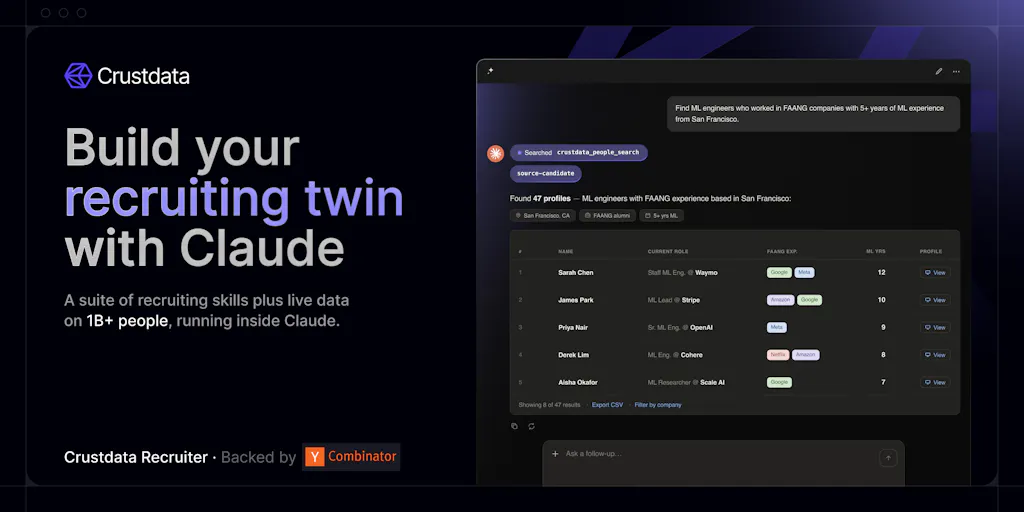
The Product Hunt launch frames the pain bluntly: “The problem with every sourcing tool we’ve used is that the candidate ranking is the same for everyone. Your competitors type the same role into the same box and see the same list.” Replace “candidate” with “product” or “supplier” and you’ve described the state of product research in e-commerce today. Every seller on Amazon has access to the same Helium 10, the same Keepa charts, the same TikTok Shop analytics dashboard. The tools don’t encode your taste—your aversion to fragile packaging, your preference for suppliers with ISO 13485 over generic BSCI, your rule that any product with “as seen on TV” packaging is automatically disqualified. You either memorize those filters or keep a spreadsheet. CrustRecruiter solves this by letting you teach your own AI agent what matters, in plain language, and then it applies those rules across a dataset of 1B+ people and 60M+ companies refreshed in near real-time.
The specific workflow the team describes is instructive. A recruiter tells Claude: “Never anyone from big aerospace” or “A 3-month internship doesn’t count as PCB experience.” Those rulings get saved and applied to the next search. For a cross-border seller, imagine telling an AI: “Never any supplier that only lists a mobile number on Alibaba” or “A 100-review product with a 4.8 rating on Amazon Japan doesn’t count as validated demand unless it has at least 50 reviews in the last three months.” That’s the kind of judgment that separates a winning product launch from a shelf-sitter.
CrustRecruiter runs on top of Crustdata’s broader infrastructure—the same People Dataset and Web Search API that feed AI agents with accurate, real-time profiles from 15+ sources including research papers, patents, and developer profiles. For an e-commerce operator, that data architecture should get your attention, even if the use case differs. The ability to query a live, multi-source database through an AI agent that remembers your rules is the same stack you’d want for competitive intelligence, influencer vetting, or supplier discovery.
How This Differs from the Incumbents You Already Use
Let’s compare CrustRecruiter’s approach to the tools cross-border sellers actually touch.
vs. Keyword and Product Research Tools (Helium 10, Jungle Scout, Viral Launch)
Those tools give you a static snapshot of demand, competition, and estimated revenue. They don’t learn your criteria. You can’t tell Helium 10’s Black Box “exclude any product with a buy box price under $15 and fewer than 300 reviews that was launched before 2023.” You can apply filters, but they’re one-off. CrustRecruiter’s “Claude skill” persists your judgment across all searches. The maker explains that “Claude keeps the context from your previous searches saved in the skill,” so it adapts within “the first few searches” if you provide clear feedback. That’s not how any Amazon product research tool works today. You’re essentially renting the tool’s default logic, which is the same logic your competitors rent. CrustRecruiter flips that by making your logic the engine.
vs. Supplier Discovery Platforms (Alibaba, ThomasNet, Kompass, Maker’s Row)
These marketplaces have search filters but zero learning. Every time you hunt for a new category—say, switching from silicone kitchen tools to pet travel accessories—you start from scratch. You re-type “BSCI certified, 15+ employees, export to EU,” and you scroll through generic listings. CrustRecruiter’s approach would let you build a “supplier sourcing twin” that remembers your non-negotiables, your red flags, and your weighting for quality proxies (like number of trade assurance orders vs. response time). The data layer matters here: Crustdata ingests data from “the open web, places where people publicly list their own work history, projects, research,” and detects “any change events (job switches, promotions, title changes) in real-time.” An equivalent for companies would be even more powerful—imagine knowing the moment a factory lands a new OEM client for a competitor, or when a supplier’s key engineer leaves.
vs. Freelance and Talent Platforms (Upwork, Fiverr, Toptal)
If you’re a DTC operator who hires VAs, copywriters, or media buyers, you already know the pain of typing the same brief into a search bar and getting the same pool of generic profiles. CrustRecruiter’s pitch to executive search—“the pool is small and your judgement is vital”—applies just as much when you’re looking for a Vietnamese sourcing agent who understands EU compliance or a Klaviyo specialist who doesn’t blast abandoned cart flows at 2 AM local time. The ability to encode “never anyone who lists ‘Amazon PPC’ without mentioning specific ACOS results” is exactly the kind of rule that saves you hours of bad interviews.
Where CrustRecruiter’s “Data Sustainability” Question Echoes in E-commerce
One commenter on the launch page asked a pointed question: “if you are pulling candidate data from a job board then you are potentially skipping the need for a recruiter to have a licence for that job board… how do you compensate your data sources?” The maker replied that their data comes from the open web, not gated job boards. For cross-border sellers, this is a direct analogy to how you source product data. You can scrape Amazon publicly, but the moment you lean too heavily on Amazon’s own API or on paid data from a tool that scrapes in their gray area, you risk rate limits, lawsuits, or data cutoffs. Crustdata’s model—aggregating public sources plus real-time change events—may be more sustainable than the typical scraper-based tool. That matters because your business processes should not depend on a fragile data pipeline.
Why Amazon Sellers Should Care More Than Shopify Ones
Shopify store owners often control their own product data and customer base. They don’t rely as heavily on a third-party marketplace’s database. Amazon sellers, by contrast, live inside Amazon’s data moat. You need to understand search volume, conversion rates, buy box ownership, and competitor pricing—all data Amazon controls. You rent access to that data via tools like SellerSprite or Keepa. Those tools are powerful, but they don’t learn your playbook.
CrustRecruiter’s architecture suggests a future where an Amazon seller could train an AI agent on their specific category logic: “I only source products with a premium price elasticity, meaning I want a margin above 40% after Amazon fees, and I avoid categories where the top three brands own 70%+ of the market share.” That agent would then scan product databases, supplier directories, and social proof signals—combining Amazon search volume data (say from Helium 10) with TikTok trend data and supplier quality signals—and return a ranked list with reasons. No tool today offers that. The closest is Jungle Scout’s Opportunity Finder, but it still applies its own scoring, not yours.
Section Sidebar: “Where the Math Breaks”
The practical challenge is that Amazon’s data is both gated and noisy. Even if you had a perfect judgment-copying AI, the input data would still be sampled from Amazon’s limited public surface. Crustdata’s data pipeline for people is broad—patents, papers, social posts—but for companies, e-commerce lacks an equivalent open web. Supplier information is often behind login walls or forum threads. A CrustRecruiter-style tool for sourcing would need to pull from customs manifests, freight forward data, and review aggregators that aren’t freely available. The Japanese export trade data (JETRO) or Chinese customs data (China Customs Statistics) are not scrape-friendly. So the “data freshness” advantage Crustdata touts (“we keep pulling data from the web in real-time”) may be harder to replicate for product sourcing than for candidate sourcing, because the web is less public for companies.
Still, the concept of owning your judgment is so compelling that even a partial implementation would be valuable. You could, for example, build a “supplier qualification twin” using Crustdata’s company database combined with your internal past reviews. The 60M+ company profiles already include firmographic data. Add your own rejection rules—only companies with a website that loads in under 3 seconds, only those that have at least one English-language employee on LinkedIn—and you’ve got a filter that no out-of-the-box tool provides.
What Cross-Border Sellers Can Borrow from CrustRecruiter Right Now
You don’t need to wait for a productized version of this for e-commerce. You can start cobbling together the principles with the tools you already have.
Build Your Own “Judgment” Document
Start by writing down 10–15 rules that define your sourcing taste. Be specific: “I will not source any product that requires a patent license unless the supplier provides proof of freedom-to-operate.” “I exclude all categories that have more than 1000 reviews on Amazon but fewer than 10 in the last month.” Then, when you use any research tool, apply those rules manually—or better, encode them into a simple AI prompt. If you use Claude or GPT-4o, paste your product research output and your rules into a conversation and ask for a filtered list with reasons. That’s a crude version of CrustRecruiter’s “Claude skill.” The more you do it, the more you refine your rules. The key is that the rules are yours, not the tool’s.
Use Crustdata’s API for Competitive Intelligence
If you’re technically inclined or have a developer on your team, consider testing Crustdata’s Web Search API for monitoring competitors. You could set up a webhook that fires when a competitor’s LinkedIn page shows a new hire in supply chain, or when a specific company publishes a new patent in your category. That’s exactly the kind of “change event” detection the makers described: “We also detect any change events (job switches, promotions, title changes) in real-time.” For a seller, knowing that a competitor just hired a former procurement manager from your top supplier is actionable intel.
Apply the “Twin” Concept to Your Most Repetitive Research Tasks
Pick one task you do weekly—perhaps checking for new product trends on TikTok Shop or vetting potential affiliates. Spend 30 minutes building a structured prompt in Claude with your rules. Then, instead of doing the same search each week, just run the prompt against fresh data. That’s your “research twin.” It won’t be as polished as CrustRecruiter’s recruiting skills, but the feedback loop works the same. Each time you correct an output, you improve the prompt. Over a few weeks, you’ll have a tool that behaves markedly differently from a generic Google search or a standard tool query.
Where My Judgment Says CrustRecruiter Falls Short
I’m bullish on the concept, but the product as launched has clear limitations for cross-border use.
No company-specific data depth. Crustdata’s 60M+ company profiles are powerful, but they’re primarily built from public web data. For sourcing, you need factory audit reports, export registry data, and real-time shipping volumes. Crustdata doesn’t seem to offer that. The Q&A on the launch page confirms their candidate data comes from “the open web,” and company data likely follows suit. That means you’ll miss the kind of deep signals that matter in cross-border supply chains.
Pricing is opaque and likely high. A reviewer noted that “pricing will be an issue for startups & small businesses.” The CrustRecruiter skill runs on Crustdata’s API and Claude’s inference costs. For a two-person recruiting agency, the economics might work (2.5 hours per full day of sourcing saved). But for a seller doing ad hoc product research, a monthly API bill plus Claude Pro might quickly exceed the cost of a dedicated research tool. The maker mentioned you can get “an API key with free credits” to test, but sustainable use for a solo operator is unproven.
The learning curve for “judgment transfer” is real. Teaching an AI your taste requires a lot of upfront feedback. The maker says it “starts feeling personal within the first few searches,” but later clarifies “it really depends on the feedback, if you tell it why someone is or isn’t a fit.” That’s fine for a dedicated recruiter who cares about quality. A busy Amazon seller who just wants a yes/no on a product may not have the patience to train their twin. The tool’s value compounds over time, but most sellers switch tools long before that happens.
No integration with e-commerce tooling. CrustRecruiter pushes outreach into an ATS. For a seller, you’d need to push data into your sourcing tool, your listing software, or your supplier CRM. There’s no Shopify app, no Amazon API connector, no Keepa integration. You’d have to build those yourself. That’s a blocker for less technical operators.
What I’d Watch / Test Next
The most actionable takeaway is not “buy CrustRecruiter for hiring.” It’s “start building your own judgment layer this week.” Here are three concrete steps:
Create a “Sourcing Rules” document and paste it into a new Claude project. Next time you run a product search, take the raw output (a CSV from Helium 10 or a list of TikTok Shop trending products) and ask Claude to rank it according to your rules, with reasons. Do this for five searches and refine the rules each time. You’ll have a prototype of your own research twin by Friday.
Monitor Crustdata’s API for relevant use cases. Grab a free API key and test their web search endpoint for a query like “companies hiring supply chain managers in Shenzhen” or “patents filed by [competitor name].” See if the data freshness matches your needs. If it does, it could become a component in your competitive intel stack.
Watch for a product research tool that adopts this model. The incumbents are all vulnerable to a “judgment-first” competitor. If Helium 10 or Jungle Scout ever introduces “personalized scoring based on your past decisions,” that’s the moment to jump. Until then, you’re better off building your own thin layer on top of their data—using Claude, a spreadsheet, or a simple automation in Zapier.
CrustRecruiter isn’t built for cross-border e-commerce. But its core thesis—that owned judgment is the only defensible advantage in a world of AI-accessible data—is the most important lesson you can take from a recruiting tool launch. Rent tools, own your taste.


