The Creator Economy’s Real AI Problem Isn’t Generation — It’s Verification
Every social media operator I know is drowning in the same contradiction: AI made it trivially easy to produce content, and impossibly hard to trust any of it. We’ve spent two years bolting generative tools onto our workflows — ChatGPT for captions, CapCut for edits, Canva for graphics — and the output volume has gone up while the credibility has gone sideways. When a brand account posts a statistic pulled from a hallucinated citation, the damage isn’t a bad post; it’s a trust tax that compounds across every future post. So when I see a tool built specifically around verifying claims against primary sources rather than generating more of them, my ears perk up — even if it wasn’t built for creators at all. That’s the lens I want to use on Curie, a research-focused AI tool from developer Víctor Madarnás that launched on Product Hunt and, in my view, contains a workflow lesson the social media industry desperately needs to steal.
What Curie Actually Is (And Why It’s Not a Creator Tool)
Let me be clear about the framing up front, because I think it matters for how you read the rest of this. Curie is not a social media scheduler, a caption generator, or a repurposing engine. It’s a scientific research assistant, built over more than a year in collaboration with the University of Barcelona and several European research institutions, and opened to the public in September. The maker describes it as his first solo Product Hunt launch and “one of the first real products I’ve built” — a detail I appreciate because it signals a builder who’s still close to the problem rather than a growth team shipping a feature.
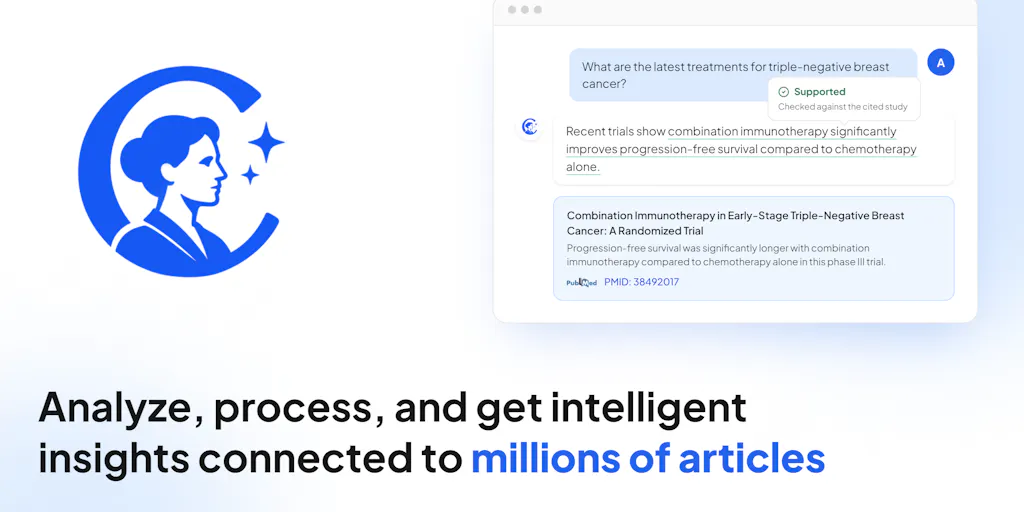
The problem it solves, per the maker’s own framing, is cognitive overload in literature review. Researchers reading dense scientific papers have to hold entire articles in their heads to draw conclusions, and generic AI tools make this worse because they hallucinate plausible-sounding answers that aren’t grounded in actual literature. Curie’s pitch is the inverse: it searches across multiple scientific databases at once, verifies every claim against its source, and extracts structured data with the exact supporting quote behind each value.
That’s the whole product in one sentence. Now here’s why I think it’s worth your time even if you’ll never read a peer-reviewed paper in your life.
The Verification Layer Is the Product
When Richard Kaplan asked in the launch comments how Curie compares to Consensus — a well-known AI search engine for research papers — the maker’s answer was the most revealing thing on the page. He didn’t claim Curie was a better search tool. He said: “Curie is more about what happens after the search.” Each claim in the answer is checked against source text, you can see the exact supporting quote (or confirm there isn’t one), it extracts structured data with the quote behind every value, and it runs full systematic reviews — protocol, screening, PRISMA — with the user approving each decision.
That’s a meaningful architectural distinction. Consensus, Elicit, and Scite have largely competed on retrieval quality: how well can we find the relevant papers? Curie is competing on provenance: can you trace every assertion back to a verifiable source, and can you see when there’s no source at all? The maker explicitly frames the differentiator as trust and reuse — “if you need to trust and reuse what comes back, that’s where Curie is aimed.”
I’d argue that’s the exact axis the creator economy is about to compete on too, and most of us are on the wrong side of it.
The Creator Parallel Nobody’s Talking About
Here’s my take, and I’ll flag it clearly as opinion: the single biggest credibility risk facing social media operators in the next 18 months isn’t platform algorithm shifts or engagement rate decline. It’s citation integrity. We’ve all watched a brand account post a viral stat that turned out to be fabricated, or a LinkedIn thought leader attribute a quote to someone who never said it, or a TikTok creator cite a “study” that doesn’t exist. The Reuters Institute and other media research organizations have documented rising public skepticism toward AI-generated content, and platforms have started experimenting with AI-content labeling. The direction of travel is obvious: provenance is becoming a distribution factor.
So when I look at what Curie does mechanically, I see a workflow that every serious content operation should be running internally, even without the tool. Let me break down the three mechanics that transfer.
Claim-Level Verification, Not Document-Level
Most content teams verify at the document level: “Did this article come from a reputable source?” That’s insufficient. A single reputable article can contain a misread statistic, an outdated figure, or a claim the original researchers explicitly hedged. Curie’s model is claim-level: each assertion gets checked against source text, with the supporting quote surfaced or the absence of one flagged.
In my own experience running content for a B2B brand, the failure mode was never “we cited a bad source.” It was “we cited a good source but the specific number we pulled was from a different section and meant something else.” Claim-level verification catches that. If you’re publishing stats-driven content — and on LinkedIn and X especially, stats drive engagement — this is the difference between a credible post and a liability.
Structured Extraction With Quote-Backed Values
The second mechanic is structured data extraction where every value carries its supporting quote. This is a subtle but powerful idea. When you extract “engagement rate: 4.2%” from a report, you should also be able to see the sentence it came from, because context changes meaning. A 4.2% engagement rate on a niche B2B newsletter is excellent; on a meme account it’s catastrophic. Curie’s insistence on pairing every extracted value with its quote is a design principle that content teams should copy manually, even in a spreadsheet.
Human-in-the-Loop Approval at Every Step
The third mechanic is the one I’d bet most creators will overlook, and it’s the most important. Curie’s systematic review workflow — protocol, screening, PRISMA — requires the user to approve each decision. That’s not a limitation; it’s the trust mechanism. The tool doesn’t pretend to replace judgment. It accelerates the mechanical parts and forces you to own the interpretive parts.
For social media operators, this maps directly onto AI-assisted content workflows. The teams that get burned by AI are the ones that let it run end-to-end. The teams that win use it to draft, then apply human approval at the specific decision points where brand risk lives: factual claims, statistics, quotes, and anything that could be construed as advice.
Where the Comparison to Creator Tools Breaks Down
I want to be balanced here, because it would be easy to write a breathless “this changes everything” post, and that would be dishonest. Curie is not built for social media teams, and the maker doesn’t claim it is. Let me be specific about where the analogy holds and where it doesn’t.
Why TikTok Creators Should Care More Than LinkedIn Ones
This might sound counterintuitive, so let me explain. LinkedIn is where citation culture is most explicit — you’re expected to link sources, and a bad stat gets called out in comments within hours. That’s a social verification layer that already exists. TikTok is the opposite: fast, visual, low-friction, and structurally hostile to citations. A creator can state a statistic in a 30-second video and it travels 500,000 views before anyone checks it. The verification gap is widest on TikTok, which means the risk is highest there — and the value of a verification habit is highest there too.
In my experience, the creators who survive long-term on TikTok are the ones who develop an internal fact-check reflex, because the platform won’t do it for them and the audience eventually will.
Where the Math Breaks
Here’s the honest limitation: Curie’s value proposition depends on there being a verifiable source to check against. Scientific literature is unusually well-suited to this because papers, citations, and databases form a structured corpus. Social media content lives in a much messier information environment. If you’re citing a platform’s own analytics — Meta Business Suite, YouTube Studio, TikTok Analytics — there’s no external database to verify against. The number is whatever the platform says it is.
So the transferable lesson from Curie isn’t “use this tool for your social content.” It’s “adopt the verification discipline this tool embodies, and accept that in some domains you’ll have to build the source-of-truth yourself.”
What Social Media Teams Can Actually Borrow
Let me get concrete, because abstraction is where most tool-analysis posts lose their value. Here are the operational patterns I’d pull from Curie’s design and apply to a content workflow this week.
Build a claim ledger. Every factual assertion in your content calendar gets logged with its source, the exact quote, and the date. This is Curie’s structured extraction, done manually. It sounds tedious; it takes maybe 15 minutes per post and it saves you from the one post that tanks your credibility.
Separate retrieval from verification. Most AI content tools conflate these. They find something and present it as fact. Curie’s architecture keeps them distinct — retrieval finds candidates, verification confirms them against source. When you evaluate AI writing tools, ask which side of that line they sit on.
Make approval a feature, not a bottleneck. Curie’s PRISMA workflow forces human approval at each decision point. Most content teams treat review as friction. I’d reframe it: the review step is where your brand’s judgment enters the pipeline. Automate retrieval and drafting; never automate the final factual sign-off.
A Note on the Incumbent Landscape
If you’re shopping for AI research tools, the honest competitive set includes Consensus, Elicit, Scite, and Semantic Scholar. Each has a different emphasis: Consensus on fast evidence synthesis, Elicit on structured extraction workflows, Scite on citation context (whether a paper is supported or contradicted by later work), Semantic Scholar on broad corpus search. Curie’s positioning — quote-backed verification and full systematic review with human approval — sits in a narrower niche, and the maker is upfront that Consensus is “a strong pick” for general use. That kind of competitor acknowledgment is rare on launch pages and, to me, reads as a trust signal rather than a weakness.
Where My Judgment Says It Falls Short
I want to be transparent about the limits of what I can assess from a launch page and comment thread, because that’s the honest position.
Pricing is not disclosed. The launch page doesn’t state a price, a free tier, or a usage limit. For a tool aimed at researchers — a notoriously price-sensitive audience — that’s a material unknown. I’d want to see this before recommending it to anyone.
Scale and accuracy claims are unverified. The maker says Curie searches multiple scientific databases and verifies every claim, but the page doesn’t specify which databases, what the verification error rate looks like, or how it handles conflicting sources. Those are the questions I’d ask before trusting it with a literature review.
The “likely AI” comment problem. One commenter on the launch thread is tagged “Likely AI,” which is Product Hunt’s own flagging system. I’m not going to make claims about any specific commenter, but it’s a reminder that launch-page engagement is not a reliable quality signal. Judge the product on its mechanics, not its comment count.
It’s not for most creators. If you’re a solo creator posting lifestyle content, Curie solves a problem you don’t have. Be honest about that. The value here is the workflow philosophy, not the tool itself, for the vast majority of social media operators.
What I’d Watch / Test Next
If you want to act on this rather than just read about it, here’s what I’d do this week. First, audit your last ten published posts for factual claims — statistics, quotes, study references — and check whether you can trace each one to a specific source with a specific quote. I’d bet most teams can’t, and that gap is your risk exposure. Second, if you publish research-adjacent content, create a free Consensus or Elicit account and run one of your recent claims through it to see what verification actually feels like. Third, watch whether Curie publishes pricing and database details — that’s the signal that it’s maturing from a research project into a product. And fourth, steal the pattern regardless of the tool: retrieval, verification, human approval, in that order. The creators who build that discipline into their pipeline now will be the ones whose audiences still trust them when the next wave of AI-generated noise hits. The tool is optional. The discipline isn’t.


