The Agent-Readable Web Is a Social Problem Before It’s a Dev Problem
Every social media operator I know has spent the last two years optimizing for one audience: the algorithm. We tune hooks for the TikTok FYP, rewrite captions for LinkedIn’s feed, chase watch-time on YouTube Shorts, and obsess over the first three seconds because that’s where retention lives or dies. But there’s a second audience quietly arriving at the same door — autonomous AI agents that browse, compare, and buy on behalf of humans — and almost nobody in the creator economy is optimizing for it. That’s why Dedica, a new agent-readiness auditing tool from Prajwal Paloju and Prathmesh Bhalekar, caught my attention this week. It’s framed as a developer tool, but the underlying shift it’s responding to — that a growing share of traffic to your landing pages, link-in-bios, and storefronts may never be human — is a content and growth problem long before it’s a code problem. If your funnel breaks silently for an agent, you don’t get an error log. You get a customer who never existed.
What Dedica Actually Does (and What It Doesn’t)
Let me strip the launch-page gloss and describe the mechanics plainly, because the mechanics are where the interesting implications live.
Dedica runs 125 checks across four buckets — Discovery, Access, Usability, and Payments — modeled on how agents like Muse, Instinct, or GrokBot reportedly navigate a site. You get a score out of 100 plus the fixes that move it most, free, in under a minute, no signup. For $30 (launch price, normally $50, one-time per site), the “fix kit” gives you one instruction file per issue — each says what to change and how to verify it worked — ready to drop into Claude Code, Codex, Cursor, or Copilot. There’s also a public API and an MCP server so your own agent can run checks itself.
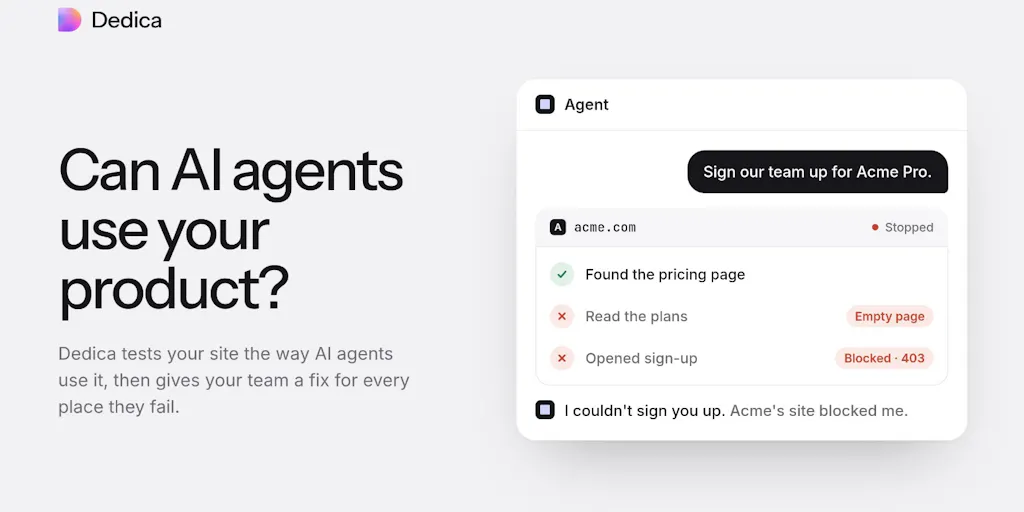
The origin story is genuinely instructive. The maker describes watching an agent try to sign a team up for a SaaS tool: it found the pricing page, got an empty render because the plans only loaded via JavaScript, then hit a bot check on sign-up and gave up. It didn’t throw an error to anyone — it just told the user “I couldn’t do that.” That’s the silent failure mode that should terrify anyone running a conversion funnel. In my experience running paid landing pages, a broken checkout produces a spike in support tickets and a dip in a dashboard you’re watching. A broken agent checkout produces nothing. You find out months later when a competitor’s agent-friendly flow is eating your comparison-shopping traffic.
The distinction the makers keep drawing — and it’s the right one
The most useful thread in the comments is the pushback from a user who asks how Dedica differs from “a regular site audit.” The maker’s answer is the crux: a regular audit does SEO/GEO to help agents discover your site; Dedica also checks whether agents can see, use, and pay once they land. That’s a real distinction. Tools like Ahrefs and Semrush tell you whether you’re indexable and crawlable. Dedica is asking a different question: once an agent arrives, can it complete a task? Discovery without task-completion is a leaky bucket — you rank, you get visited, and the visit converts to nothing because a custom dropdown never exposes its options in the DOM or a button is really a div with an onclick.
That last example came from a commenter, and it’s the kind of edge case that separates a real audit from a checklist. The maker’s response — that the score is a composite of static checks and real agents actually trying to use the site — is the part I’d want to verify hands-on. Static checks are cheap and reproducible; live agent runs are expensive and non-deterministic. How they weight the two, and how stable the score is run-to-run, is the whole ballgame. Not disclosed on the page.
Why This Lands in the Creator Economy’s Lap
Here’s where I diverge from the launch page’s framing. Dedica is being sold to developers and site owners, and most of the comment thread is engineers asking about Next.js components and Webflow integrations. Fair. But the people who will feel this shift first aren’t pure dev shops — they’re the solo founders, course creators, and creator-commerce operators who run their entire business on a link-in-bio, a Stan Store, a Gumroad, a Beehiiv newsletter, or a Shopify storefront. These are exactly the people with the least engineering bandwidth and the most to lose from a silent agent failure.
Think about the actual journeys. A creator sells a $49 notion template. A buyer asks their AI assistant to “find me a good project-management template under $50 and buy it.” The agent lands on the creator’s Gumroad page, the buy button is a JavaScript-only widget, the agent bails, the user hears “I couldn’t do that,” and the creator never knows a sale was attempted. Multiply that across every product page and every comparison-shopping query and you have a slow, invisible tax on creator commerce. My take: within a year or two, “agent-readable checkout” will be table stakes the way “mobile-responsive” became table stakes — and the creators who move early will quietly out-convert the ones who don’t.
Why TikTok and Instagram creators should care more than LinkedIn ones
This is counterintuitive, so let me argue it. LinkedIn’s audience is professionals who mostly still click through and read themselves; the agent layer there is thin. But short-form creators funnel enormous intent into commerce — TikTok Shop links, Instagram link-in-bios, Pinterest shopping pins. Those are exactly the high-intent surfaces where a buyer is most likely to delegate the “go find and buy this” step to an assistant. A Pinterest user who saves a product pin and later asks an agent to “get me that lamp” is a live agent-commerce transaction. If the destination storefront fails the agent, the pin did its discovery job and the conversion died at the door. Short-form creators are sitting on the most agent-exposed funnels in the economy and, in my experience, thinking about it the least.
What Creators and Social Teams Can Borrow From This
Even if you never buy Dedica, the thinking behind it is a useful audit framework for your own content operations. Here’s what I’d steal.
1. Treat every link in your funnel as a task, not a destination. The four buckets — Discovery, Access, Usability, Payments — map cleanly onto a creator funnel. Discovery is your SEO and your llms.txt and your sitemap. Access is whether bots and agents can reach you past Cloudflare or CAPTCHA (the makers confirm these are among the most common blockers they flag). Usability is whether your page renders without JavaScript gymnastics. Payments is whether checkout completes. When I scheduled 30 posts across 5 platforms last month, I spent hours on UTM tracking and zero minutes asking whether the destination was agent-completable. That’s the gap this tool exposes in my own workflow.
2. Verify your discovery files actually point somewhere. The single most concrete, actionable comment on the whole page: a user ran Dedica on his site, got a 50, and discovered it reported “no MCP server and no OpenAPI spec” — even though he had both. They just lived on an app subdomain and nothing on the main domain pointed to them. The fix was trivial (a link in llms.txt is enough, per the maker). That’s a five-minute win any operator can chase this week: does your root domain actually advertise the machine-readable endpoints you’ve built? If you’ve invested in an API, an OpenAPI spec, or an MCP server, and nothing at the root links to them, you’ve built a door with no handle.
3. Separate “we’re discoverable” from “we’re usable.” Most creator SEO advice stops at rankings. The Dedica framing forces a second question: once found, can the task be finished? For a newsletter creator, that means: can an agent subscribe? For a course seller, can it apply a coupon and check out? For a podcaster, can it find and follow the RSS? These are the agent-era equivalents of “is the CTA above the fold.”
4. Use the fix-kit model for your own content QA. The clever bit isn’t the score — it’s the “one instruction file per issue, tells you what to change and how to verify it worked” format. That’s a template worth copying for any recurring audit you run, from accessibility to metadata hygiene. A score with no verification step is just anxiety.
Where My Judgment Says It Falls Short
Now the balanced part, because a launch page is a sales page and I don’t write press releases.
Price friction is real. A commenter flat-out says the price is too high and asks for a discount; the maker offers the $30 launch rate. For a solo creator running one storefront, $50 per site for a one-time audit is defensible if it catches a real leak — but “one-time per site” means it doesn’t re-check after you ship fixes unless you re-buy or use the API. For an agency running dozens of client sites, the per-site model gets expensive fast. Not disclosed: whether there’s volume or agency pricing.
Framework-agnostic is a double-edged sword. A Next.js developer asked whether the fix kit tells Cursor exactly which component or file to change. The answer: it’s framework-agnostic. That’s fine for a capable coding agent, but it means the specificity of the fixes depends heavily on the model you’re driving. In my own tests of similar “instruction file” approaches, a vague instruction handed to a weaker agent produces vague diffs. The quality of the output is partly a function of the tool you pipe it into — which the launch page doesn’t say.
The live-agent scoring is the unverified heart of the product. The makers claim the score reflects real agents navigating your site, which is what would make it more than a static linter. But live agent runs are non-deterministic — run the same site twice and you may get different scores. How much run-to-run variance exists, and whether the “single biggest thing holding you back” is stable, is not disclosed. I’d want to re-run the same domain three times before trusting the number.
Webflow integration is on the roadmap, not shipped. A commenter explicitly asks for a pre-publish Webflow audit; the makers confirm it’s “in the pipeline” but not available — right now you audit the live URL. For teams that want to catch issues before publishing, that’s a real gap today.
And the honest scope limit: Dedica audits the destination, not your content. It won’t tell you whether your hook is good, your caption converts, or your posting cadence is right. It’s a funnel-integrity tool wearing a growth-tool costume. If your problem is reach and engagement, this is the wrong purchase.
Who this is NOT for
If you’re a pure content creator whose monetization runs entirely through platform-native tools — TikTok Shop’s in-app checkout, YouTube’s built-in memberships, Instagram’s native shop — you have less surface area to fix, because the platform owns the checkout. Dedica matters most when you own the destination: your own storefront, your own SaaS, your own course platform. If you don’t own a conversion surface, you don’t have much for this to audit.
What I’d Watch / Test Next
Here’s what I’d actually do this week, whether or not you touch Dedica.
Run the free audit on your single highest-intent URL — not your homepage, your checkout or pricing page. The free scan needs no signup and takes under a minute; the score plus “biggest thing holding you back” is worth knowing even if you fix it yourself. Then run it a second and third time and compare. If the score moves materially between runs, you’ve learned something important about how much to trust live-agent scoring — and so has everyone reading this.
Audit your discovery pointers manually. Open your root domain and ask: does anything here tell an agent where my API spec, MCP server, or llms.txt lives? The commenter who found his endpoints were orphaned on a subdomain is the cautionary tale. Fix the link; it’s free.
Separate your dashboards. Add a line item to your analytics review for “agent/automated traffic” — even a crude filter for known bot user-agents — so you’re at least aware of the non-human share of your funnel. The maker’s own open question in the forum — “are you seeing AI agents visiting your website yet?” — is the right question to be asking your own data.
And watch the pricing and the roadmap. If Dedica ships the Webflow pre-publish integration and adds agency/volume pricing, it becomes far more interesting to teams. Until then, treat it as a cheap diagnostic for owner-operated funnels, run the free scan first, and keep your skepticism calibrated to the fact that the most important number on the page — how stable the live-agent score actually is — is the one the launch page doesn’t tell you.


