The Creator Economy’s Real Bottleneck Isn’t Content — It’s Focus
Every social media operator I know is running the same experiment right now: how much of the work can be delegated to software without losing the thing that makes the account worth following. We’ve spent three years bolting AI onto our workflows — CapCut for auto-cuts, Buffer and Later for scheduling, Metricool for cross-platform analytics — and the result is that publishing is easier than ever while learning anything from what we publish has gotten harder. The feed is louder, the hooks are shorter, and the attention window keeps contracting. So when a tool shows up that isn’t trying to help me post more but to help me retain more, my ears prick up. That’s the lens I want to use for Dictoterix, a language-learning service that launched on Product Hunt and that, on the surface, has nothing to do with social media. Stay with me — the mechanics underneath it are more relevant to creators than the pitch suggests.
What Dictoterix Actually Is (and Why the Mechanism Matters)
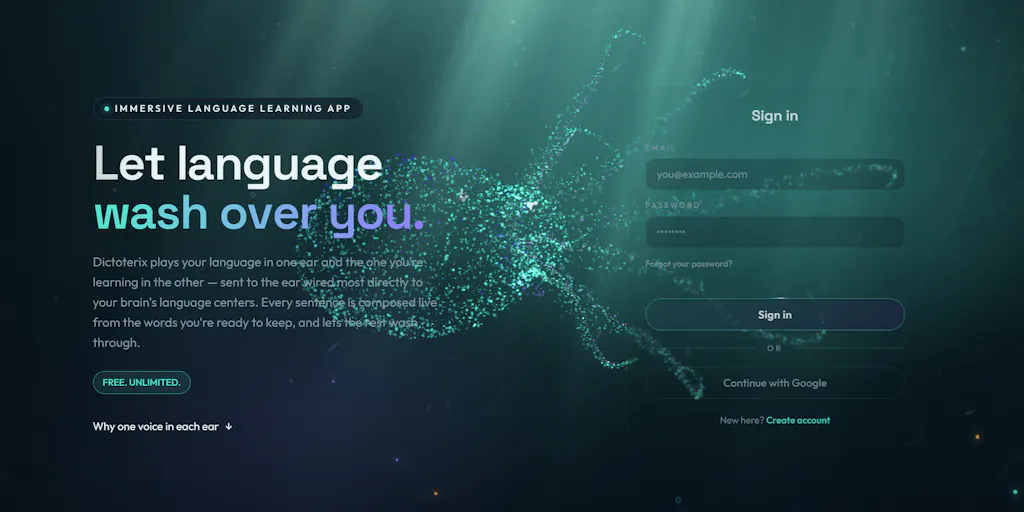
Dictoterix is the work of a solo maker, Leonid Plekhanov, who describes himself as the creator and sole developer of the service. He’s candid that he built it for himself first — to learn languages in a way that suited his own brain — and only later decided to invite other people in. That origin story matters, because it shapes what the product optimizes for.
The standout feature, in his own words, is a “dichotic bilingual learning engine.” It generates phrases in two languages — your native language and your target language — converts them to audio via text-to-speech, and then routes the sound to your headphones so that each language plays in a separate channel. One language in the left ear, the other in the right. The system starts with individual words, and once you’ve mastered enough of them (or after a few sessions if you start above A1), it constructs complete sentences using vocabulary appropriate to your level. The maker says he did some research and found “some scientific evidences to its efficiency” — I’d treat that phrasing as a claim from the maker rather than an independently verified finding, because the launch page doesn’t link to specific studies. That’s not a knock; it’s just the honest way to read a Product Hunt post.
Spanish and English are currently the only languages available. The maker has also built out a pedagogical layer: the sequence of introducing and reviewing vocabulary follows what he calls best practices, and a grammar module is integrated directly into the learning flow. There’s also a live practice mode — described as a sort of social network for language learning, with an anonymous mode included — which the maker himself admits is “entirely optional” and will “likely become interesting once more people start using the service.” That’s a refreshingly honest way to frame a feature that, on most launch pages, would be hyped as a core pillar.
The system is deployed on Vercel, specifically the Vercel Pro plan with Next.js hosting and functions, according to the maker’s comment on the launch thread. He notes that deployment is easy — a push from his IDE followed by routine checks — and that he’s selected Vercel for other projects in his pipeline. The UI is already mobile-friendly, though a native mobile app is described as the next step after the service proves viable. Pricing is not disclosed on the launch page.
Why a Social Media Operator Should Care About a Language App
Here’s where I connect the dots, because I know some of you are already scrolling. The reason Dictoterix is interesting to me isn’t the language-learning market — it’s the mechanism. Dichotic listening, dual-channel audio, spaced vocabulary introduction, grammar woven into the flow rather than bolted on as a separate module. That’s a content architecture. And content architecture is exactly what most creator teams are bad at.
Think about how you currently repurpose a single long-form video into shorts. You cut it, caption it, maybe run it through an AI tool to generate a hook, and then you push it to TikTok, Instagram Reels, YouTube Shorts, and Threads. What you’re doing is broadcasting the same signal on every channel. What Dictoterix does is the opposite: it sends different but complementary signals to each channel simultaneously, and lets the brain do the integration. That’s a fundamentally different model of multi-channel distribution, and I think there’s a real lesson in it for anyone running accounts across five or more platforms.
In my own experience running repurposing workflows, the biggest drop-off in performance happens when a piece of content is duplicated verbatim across platforms. The algorithm on each platform is trained to reward native behavior — LinkedIn rewards dwell time and comments from your network, TikTok rewards watch-through and rewatches, Pinterest rewards saves and outbound clicks. When you paste the same asset everywhere, you’re optimizing for none of them. The Dictoterix principle — send a different signal to each channel, designed for that channel — is the correct mental model. Most teams just don’t have the bandwidth to execute it.
Where It Sits Against the Incumbents
Let’s be clear about the competitive set, because “language learning app” is a crowded category and the launch page doesn’t do much positioning. The obvious comparisons are Duolingo, Babbel, Rosetta Stone, and Anki for the spaced-repetition crowd. Each of those has a different theory of learning. Duolingo is gamified habit formation — streaks, leaderboards, bite-sized lessons. Babbel is structured curriculum with a conversational bent. Rosetta Stone is immersion via image-word association. Anki is raw spaced repetition with no pedagogy layer at all.
Dictoterix’s differentiation, as described by the maker, is the audio channel separation plus the on-the-fly sentence generation tied to your vocabulary level. That’s a narrower, more technical bet than any of the incumbents are making. It’s also, frankly, a harder sell — because the value proposition depends on you wearing headphones and committing to a specific listening posture, whereas Duolingo works on a phone speaker on the bus.
The maker acknowledges this directly: the service is “primarily designed for use with headphones (to separate audio channels),” though there’s a simplified mode for standard speakers. That’s the kind of honest scoping that I wish more launch pages had. It tells me the maker knows exactly who the product is for and isn’t pretending otherwise.
The Solo-Developer Advantage and Its Ceiling
One thing I want to flag as a genuine strength: this is a solo-built product, and the maker is in the comments answering questions in his own voice. He notes he’s in the Mexico City time zone and will address comments as soon as he can. That kind of direct access is rare, and for early adopters it’s worth a lot. You can tell him what’s broken and he’ll hear it.
But it’s also the ceiling. A solo developer can ship a focused, opinionated tool. A solo developer cannot easily build a content library, a community, a mobile app, a payment infrastructure, and a support operation simultaneously. The maker says the mobile app is “the next step after viability proof/check” — which is the right sequencing, but it also means that for now, you’re using a mobile-friendly web app, not a native experience. For a product whose core interaction is audio routing through headphones, a web app is a real constraint. Browser audio APIs on iOS are notoriously finicky, and I’d want to test whether the left/right channel separation holds up reliably across Safari, Chrome, and the various Android browsers before I committed to a daily practice habit.
What Creators and Social Teams Can Actually Borrow
Strip away the language-learning specifics and there are three transferable ideas here that I think are worth stealing for your own content operation.
1. Design for simultaneous, differentiated input
The dichotic model — two signals, two channels, one brain integrating them — is a useful metaphor for how you should think about your platform mix. Instead of asking “how do I get this one asset onto every platform,” ask “what is the native version of this idea for each platform, and how do those versions reinforce each other?” A YouTube long-form video, a TikTok hook, a LinkedIn text post, and a Pinterest pin can all be derived from the same core insight, but they should each be built for the channel they live on. The integration happens in the audience’s head, not in your scheduling tool.
2. Sequence your content like a curriculum
The maker emphasizes that the sequence of introducing and reviewing vocabulary follows best practices. That’s a curriculum design principle, and most content calendars ignore it completely. If you’re building an audience around a topic — fitness, finance, design, whatever — you should be thinking in terms of progression, not just volume. What does the audience need to know first? What builds on that? What’s the review moment? A creator who sequences content like a curriculum builds retention; a creator who posts random tips builds a slot machine.
3. Be honest about what’s optional
The maker calls the live practice mode “entirely optional” and admits it’ll only be interesting once more people use it. That’s a trust signal. When you’re launching a product, a newsletter, or a new content series, resist the urge to oversell every component. Telling your audience “this part is the core, this part is a nice-to-have, this part isn’t ready yet” builds more credibility than pretending everything is essential.
Where My Judgment Says It Falls Short
I want to be balanced here, because the launch page is genuinely well-written and the maker is clearly thoughtful. But there are open questions I’d want answered before recommending this to anyone.
First, the evidence base. The maker says he found “some scientific evidences” for dichotic listening’s efficiency, but the launch page doesn’t cite them. Dichotic listening has a long history in cognitive psychology — it’s been used to study selective attention and hemispheric lateralization since the 1950s — but its application to language acquisition specifically is a narrower claim, and I’d want to see the actual studies before treating it as settled. This is a “my take” moment: I’m skeptical of any learning method that leads with a neurological mechanism before it leads with measured outcomes. Show me retention curves, not just a clever audio trick.
Second, the language pair limitation. Spanish and English only, for now. If you’re a creator targeting a global audience and you want to learn, say, Portuguese or Japanese, this isn’t for you yet. The maker doesn’t disclose a roadmap for additional languages, which is understandable for a solo project but worth noting.
Third, the social layer feels premature. The maker himself says it’ll become interesting “once more people start using the service.” That’s a chicken-and-egg problem, and building a social network inside a learning app is a classic trap — it adds surface area without adding core value until you have density. I’d bet the live practice mode is the first thing to get cut or deprioritized if the maker needs to focus.
Fourth, pricing and monetization are not disclosed. For a solo developer, that’s the difference between a hobby and a business. I’d want to know whether this is freemium, subscription, one-time, or free-forever before I invested my own practice time in it.
Who This Is Not For
If you’re looking for a gamified, phone-speaker, five-minutes-a-day habit, this is not your tool — go use Duolingo. If you need a structured classroom-style curriculum with live tutors, go use Babbel or italki. If you’re a social media manager who wants a scheduling tool, this is obviously not that. Dictoterix is for a specific kind of learner: someone who already has decent vocabulary in a target language, is willing to wear headphones for focused sessions, and wants a more technical, less gamified approach. That’s a real niche, but it’s a niche.
What I’d Watch / Test Next
If you’re a creator or operator and you want to extract value from this launch — whether or not you ever open Dictoterix — here’s what I’d actually do this week.
First, audit your own platform mix for the “same signal everywhere” problem. Pull your last ten pieces of content and check whether each platform got a native version or a copy-paste. If it’s copy-paste, you’ve found your biggest repurposing opportunity. Pick one piece and rebuild it four ways — one for each of your top four platforms — and watch which one outperforms.
Second, if you’re curious about Dictoterix specifically, go read the launch thread and ask the maker directly about the evidence base and the roadmap. He’s answering questions in the comments and he’s in the Mexico City time zone. That’s a rare chance to get a straight answer from a solo builder before you commit.
Third, steal the curriculum sequencing idea. Map out your next month of content as a progression rather than a list. What’s the foundational post? What builds on it? Where’s the review? You don’t need a language-learning app to think like a curriculum designer.
Fourth, watch whether Dictoterix ships a native mobile app. That’s the signal that the maker has found product-market fit and is investing in the core experience. Until then, treat it as an interesting experiment with a genuinely novel mechanism — one that’s worth studying even if you never install it.


