The Creator Economy Has an Infrastructure Problem, and It’s Not the One You Think
Every social media manager I know has hit the same wall. You’re running five platforms, each with its own algorithm, its own posting cadence, its own content format that refuses to be repurposed cleanly. You’ve got the analytics spreadsheet that’s become a Frankenstein of UTM parameters and engagement-rate formulas. And somewhere in the middle of all that, you realize the actual bottleneck isn’t creativity — it’s the plumbing. The scheduling tool that glitches at 2 AM. The API rate limit that kills your batch upload. The repurposing workflow that takes longer than making the original content.
So when I see a Product Hunt launch for a cloud agent API called Epho, my first instinct as someone who’s spent a decade in this industry isn’t to think about code. It’s to think about what this means for the creator economy’s growing operational burden. Because here’s the uncomfortable truth: the next wave of creator tools isn’t going to be better editing software or smarter hashtag suggestions. It’s going to be infrastructure that lets AI agents do the tedious, repetitive work that currently eats your week — and Epho is betting that the way to deliver that is by making agents as easy to spin up as a POST request.
This matters to you, the social media operator, because the same architectural decisions being made in developer tools right now will determine what your content workflow looks like in 18 months. Whether you ever write a line of code or not, understanding how cloud agents work — and where they fail — tells you which tools to bet on and which to skip.
What Epho Actually Solves (and Why It’s Not Just for Developers)
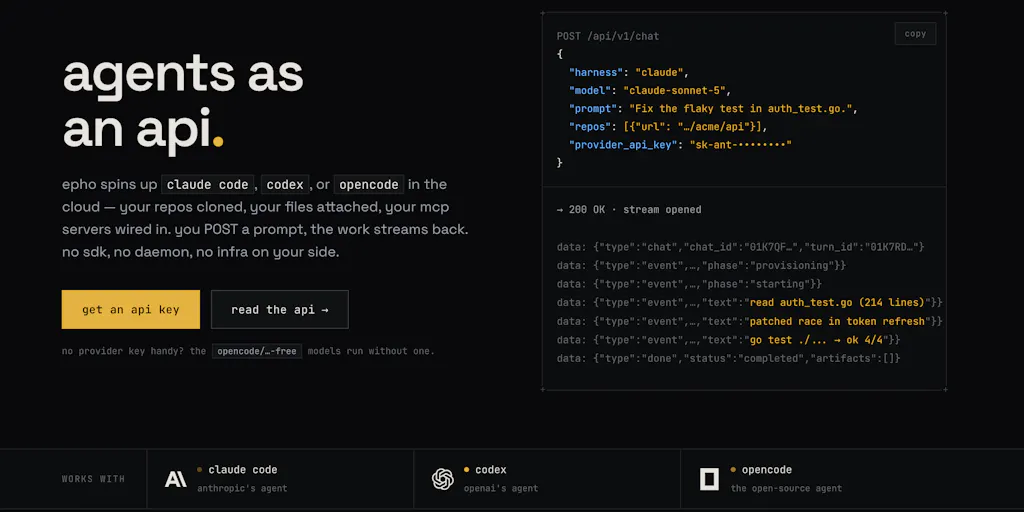
Let me translate the launch page from developer-speak into creator-speak. Epho is, in the maker’s words, a “cloud agent API” — you send a request, it spins up a sandbox with Claude Code, Codex, or OpenCode pre-configured, connects your repos, and streams back results. The team behind it, Bruin, built it out of their own struggles with creating an AI analyst. They were tired of configuring bare machines, dealing with agents that each behaved differently, and babysitting sandbox providers that weren’t reliable.
Here’s the part that should make every social media operator sit up: the maker’s pitch is that this should be a “primitive” — a basic building block. Send a POST request, get events streaming back. That’s it. No infrastructure management, no multi-provider strategy, no logging setup. The team claims it handles automatic fallbacks across providers, manages auth, and clones your repos so the agent starts with context instead of a blank workspace.
Now, I’ve tested enough AI content tools to be skeptical of the “just send a request” framing. But let me tell you why this specific approach matters for what you do.
When I schedule 30 posts across five platforms in a month, the recurring nightmare is the same: something breaks silently. A video fails to transcode, a caption gets truncated, a link’s UTM parameters get mangled. The tools I use — Buffer, Hootsuite, Later — all have their own quirks, and none of them talk to each other. The AI content generation tools are even worse; they’re silos that produce output but don’t integrate with the distribution layer.
What Epho represents is a different philosophy: instead of building another monolithic tool, expose the agent itself as an API. For a creator or small team, that means you could theoretically build your own content pipeline where an agent drafts, another agent repurposes, and a third agent schedules — all orchestrated through simple API calls. The infrastructure headaches — which provider is up, which agent handles which task, how to log everything — are handled by the platform.
The team claims you get $10 free for signing up and verifying your email, and you can run “many hours of compute” on that. You can even use Opencode’s free models without an API key to play around. That’s a low-friction entry point, and in my experience, that’s exactly how tools like this get adopted — not through enterprise sales, but through creators and indie founders who want to experiment without committing a credit card.
How This Differs From the Incumbents (and What They’re Missing)
Let me name the elephants in the room. If you’re a social media operator, you’ve probably heard of Canva for design, CapCut for video editing, and Metricool for analytics and scheduling. These are the tools that dominate the creator workflow. They’re excellent at what they do — but they’re all application-layer tools. They assume you’ll do the work in their interface, and they each hold your content in their own little ecosystem.
Epho is coming at this from a totally different angle. It’s not trying to be your content creation suite. It’s trying to be the layer underneath — the thing that lets you build your own tools on top of agent infrastructure. The launch page makes this explicit: “Epho aims to bring cloud agents into your products easily.” Not into your workflow — into your products.
This is a meaningful distinction. When I look at the current AI content tooling landscape, I see two camps. There are the all-in-one platforms that try to do everything (generate, schedule, analyze) and end up being mediocre at all of it. And there are the point solutions that do one thing well but don’t integrate with anything else. What’s missing is the connective tissue — the ability to orchestrate multiple AI agents across different tasks without building your own infrastructure.
The maker’s comment about “each agent behaves differently” resonates with me. I’ve used Claude for long-form drafting and OpenAI for shorter, punchier copy. They have different strengths, different failure modes, different API quirks. If I wanted to build a workflow that uses both — say, Claude for the newsletter draft and GPT for the Twitter thread — I’d have to write custom integration code for each. Epho’s pitch is that it abstracts that away.
There’s also the pricing model, which the commenters on the launch page noticed immediately. One commenter, Dorina-Maria Anton, called out the “infra per second instead of used tokens” approach as interesting. Another, Lucas Pols, noted that “the keys stay yours and the bill is compute by the second rather than tokens.” This is a real differentiator. Most AI tools charge per token, which means you’re paying for the model’s thinking time regardless of whether it’s productive. Epho charges for infrastructure — the sandbox, the compute — while using your own API keys for the actual model calls.
In my experience, this is a more honest pricing model for heavy users. When I’m running a content batch through an AI tool, I don’t want to worry about token burn on failed attempts or re-runs. I want to pay for the time the work actually takes. That said, it shifts the cost structure — if you’re doing a lot of compute-heavy work, per-second billing could add up faster than per-token in some scenarios. The team hasn’t disclosed specific pricing beyond the free tier, so I’d want to see a calculator before committing.
What Creators and Social Media Teams Can Borrow From This Right Now
Here’s where I shift from product review to practical advice. You don’t need to be a developer to extract value from the philosophy Epho is pushing. There are three operational lessons I’m taking from this launch that apply to any social media operation:
The “Start With Context” Principle
The most insightful comment on the launch page comes from Shabnam Katoch, who said: “The repo context part is what stands out. An agent that can start with the right context is much more useful than a blank workspace.”
This is exactly the problem with most AI content tools I’ve tested. They give you a blank text box and expect you to prompt your way to good content. But the best content comes from context — your brand voice, your past performance data, your audience demographics, your competitor analysis. When I set up my own AI workflows, the first thing I do is build a context file: brand guidelines, tone examples, content pillars, past post performance metrics. Tools that let me inject that context upfront produce dramatically better output than tools that make me re-explain everything in every prompt.
Epho’s approach — clone the repo, start with context — is the same principle applied to code. For content, the equivalent is: don’t start from a blank canvas. Start from your content library, your analytics, your brand book. The tools that win in the next year will be the ones that make context injection effortless.
The Orchestration Mindset
The second lesson is about orchestration. The maker’s core insight is that you shouldn’t have to build integrations with each agent individually — the platform should handle that. For social media operators, this translates to a workflow question: are you using tools that talk to each other, or are you manually copying content between platforms?
I see this all the time. A creator drafts in Google Docs, moves it to Canva for graphics, exports to CapCut for video, then manually uploads to each platform. That’s not orchestration — that’s manual labor. The tools that will save you hours are the ones that automate the handoffs. If you’re not using a Zapier or Make workflow to connect your content pipeline, you’re leaving time on the table.
The Reliability Argument
The third lesson is about reliability. The maker mentions that “sandbox providers are not very reliable” and that they built multi-provider fallbacks to avoid failures. This is something every social media operator understands deeply — the panic of a scheduled post that doesn’t go out, the analytics report that fails to generate, the video that doesn’t process.
When you’re evaluating tools, ask about their reliability architecture. Do they have fallbacks? What happens when their API goes down? How do they handle rate limits? The tools that take reliability seriously — and build for failure — are the ones you can build your business on.
Why TikTok Creators Should Care More Than LinkedIn Ones
Let me get specific about who benefits most from this infrastructure shift. TikTok creators are dealing with a platform that changes its algorithm constantly, rewards volume and consistency, and demands native content for each slice of the platform. The operational burden is enormous — you’re not just creating content, you’re managing a distribution machine.
LinkedIn creators, by contrast, can get away with repurposing a single thoughtful post across a week. The volume is lower, the algorithm is more forgiving, and the audience expects depth over frequency. The infrastructure burden is real but manageable.
If you’re a TikTok or Instagram creator, tools that let you orchestrate AI agents for content repurposing, trend analysis, and cross-platform adaptation are going to be transformative. The ability to spin up an agent that watches trends, drafts a script, generates the video, and schedules it across platforms — without you manually coordinating each step — is the difference between posting three times a week and posting three times a day.
Where My Judgment Says This Falls Short
I’ve been enthusiastic about the potential here, but let me be clear about the limitations. First, this is a developer tool. The launch page is written for engineers, not creators. If you’re a solo content creator without any coding ability, Epho is not something you can use directly. You’d need a developer to build on top of it, or you’d need to wait for someone to wrap it in a user-friendly interface.
Second, the pricing model, while interesting, is not fully transparent. The team mentions $10 free on signup and per-second infra billing, but they don’t disclose the actual per-second rate. The commenter Jay Janarthanan raised a practical concern: “For my code to run, the environment needs to have software installed (For example. NET). How do you handle this?” The answer isn’t clear from the launch page — which suggests the configuration story isn’t fully baked yet.
Third, there’s a trust question. Using your own API keys means you’re paying for the model calls yourself, on top of the infrastructure fees. That’s a double cost. And while the team claims to handle auth and security, any time you’re sending your API keys to a third-party service, you’re introducing a new attack surface. For a creator with a small operation, that might be acceptable. For a larger team, you’d want to see a security audit before committing.
Fourth — and this is my biggest concern — the reliability claim is unproven. The maker says they built this because sandbox providers are unreliable, but they’re now in the business of providing sandboxes themselves. The same reliability problems they faced are now their problem to solve. In my experience testing similar tools, the first few months are usually rocky. I’d want to see uptime stats and incident reports before building a critical workflow on top of this.
Where the Math Breaks
Let’s do some rough math on the pricing model. The team claims you get $10 free, which they say is “many hours of compute.” If a typical agent run takes 10-30 minutes of compute, that’s maybe 20-60 runs on the free tier. That’s enough to experiment, but not enough to build a production workflow.
Once you’re past the free tier, you’re paying for infra per second plus your own API token costs. For a heavy user running agents daily, that could easily run into hundreds of dollars a month. Compare that to a tool like Metricool which has a flat monthly fee, and the cost structure becomes less predictable. The team’s response would probably be that you only pay for what you use — but for a creator with variable workloads, that unpredictability is a feature and a bug.
What I’d Watch / Test Next
If you’re intrigued by this approach — and I think you should be, even if you’re not a developer — here’s what I’d do this week:
Claim the $10 free tier on Epho and run a simple test. Even if you’re not a coder, find a developer friend or a freelancer who can spin up a basic agent. Test whether the “start with context” claim holds — give it a repo or a content library and see if the output is meaningfully better than a blank-prompt approach.
Audit your current content pipeline for manual handoffs. Where are you copying and pasting between tools? Where are you re-entering the same information? Those are the spots where agent infrastructure could save you time. Even without Epho, you can start building automation with Zapier or Make to eliminate the worst bottlenecks.
Watch how the AI content tooling space evolves over the next quarter. The fact that Epho launched with support for Claude Code, Codex, and OpenCode — three different agent harnesses — tells me the multi-agent orchestration trend is real. The tools that win will be the ones that make it easy to use multiple AI models in a single workflow. Start thinking about which of your tasks could be automated, and which need a human touch.
Set up a cost-tracking spreadsheet for your AI tooling. If you’re using AI for content generation, you should know exactly what each workflow costs per month. The per-second pricing model Epho uses is a reminder that AI costs can be variable — and that you need visibility into that variability before it becomes a surprise.
The creator economy is entering its infrastructure phase. The tools that win won’t be the ones with the best filters or the cleverest caption generators — they’ll be the ones that make the machine run smoothly. Epho is an early bet on that thesis, and even if it doesn’t become the dominant player, it’s worth watching as a signal of where things are heading. The agents are coming. The question is whether you’ll be orchestrating them or being replaced by them.


