The competitor research half-day is the real creator bottleneck
If you run social for a living, you already know the drill. Monday morning, someone on the leadership call asks what the competition is doing, and you spend the next four hours opening tabs: Ahrefs for rankings, the Meta Ad Library for creative angles, the Google Ads Transparency Center for messaging, a competitor’s blog, their pricing page, a Reddit thread from 2022. By the time you’ve assembled the picture, two of the numbers have already moved and you still have to turn the whole mess into something a human can act on. That gap — between “I have data” and “I have a decision” — is the actual job, and it’s the gap Figo is trying to close. Not with a dashboard, but with a Monday briefing written in sentences. For creators and social operators who are now expected to be part strategist, part analyst, part ad buyer, that’s a more interesting proposition than another scheduling tool.
What Figo actually does, in operator terms
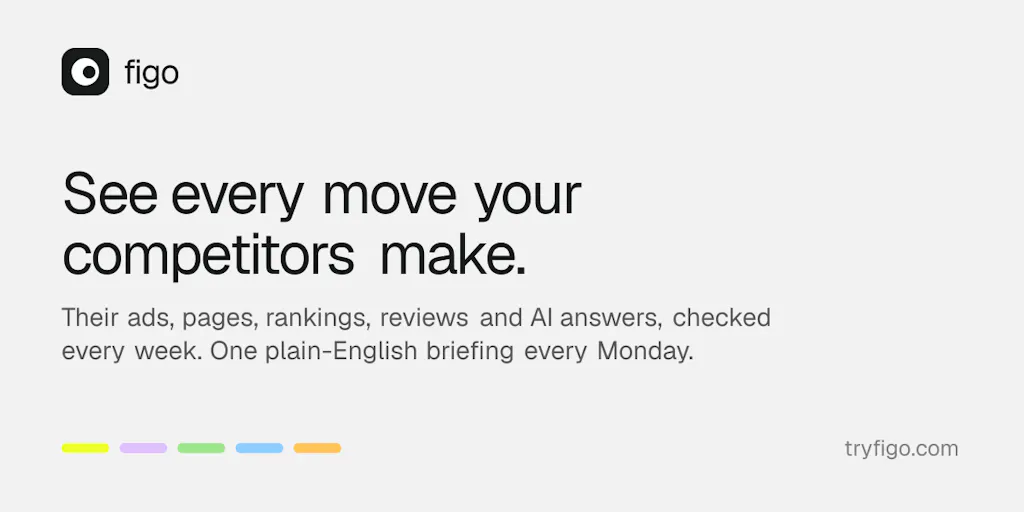
The pitch from maker Ned Mehic is narrow and specific: you give Figo your website, it identifies your competitors from search data, then checks nine signals for each one — rankings and traffic, new pages, blog posts, Google Ads, Meta ads, TikTok ads, Instagram, Facebook, and Reddit mentions. On top of that, it queries ChatGPT, Claude, Gemini, and Perplexity with the questions your buyers actually ask, and records which businesses get named in the answers.
The output is a weekly briefing. Not a chart wall — sentences. The example the maker shared from a live run: “Flatrate Moving runs 25 Meta ads, you run 0. Open the Meta Ad Library, write down the three offers they repeat, then decide if one fits your 5.0 rating and 530 reviews.” That’s the whole thesis in one line. It’s not telling you the competitor has 25 ads. It’s telling you what to do about it, using your own review count as the justification.
My take: this is the correct shape for the product. Most competitor tools fail not because the data is wrong but because the data is inert. You look at a comparison table, you nod, you close the tab. A briefing that ends in a verb has a much higher chance of changing what you publish this week. That’s the difference between a research tool and a workflow tool, and it’s the difference creators should care about.
Why this matters more to TikTok and Meta advertisers than to LinkedIn-first founders
If your growth channel is organic LinkedIn thought leadership, competitor ad monitoring is a nice-to-have. If your growth channel is paid social — TikTok Spark Ads, Meta Advantage+ campaigns, Instagram Reels boosts — then knowing that a competitor is running 25 ads against a specific offer while you run zero is not trivia. It’s the single highest-leverage input you can get before you brief your next creative batch. The Meta Ad Library has been public for years, but almost nobody operationalizes it weekly. Figo’s value proposition is essentially “we operationalize the boring public data you keep meaning to check.”
The same logic applies to the AI-visibility piece. If you’re a creator or founder building a personal brand, the questions buyers ask ChatGPT and Perplexity are increasingly the first touchpoint in your funnel. Being absent from those answers is the 2025 equivalent of not ranking on page one in 2015. Tracking whether you get named — and with what citations — is a legitimate new KPI. I’d bet most social teams will be asked about “AI share of voice” by a client or a CMO within the next twelve months, whether they’re ready or not.
How it differs from the incumbents you’re already paying for
Let me be direct about the competitive landscape, because this is where most launch posts get vague.
Ahrefs and Semrush are the incumbents for SEO-side competitor intelligence. They are deeper, more expensive, and built for people who already know what to do with a keyword gap report. They will not write you a sentence telling you to open the Meta Ad Library. SpyFu does paid-search competitor tracking well but stops at Google. AdSpy and BigSpy cover social ad libraries but are essentially searchable databases — you still have to do the thinking. Brand24 and Mention handle social listening, but they track mentions of you, not strategic moves by competitors.
On the AI-visibility side, the field is newer and messier. Tools like Profound and Peec AI are attacking the “are we cited by LLMs” question from different angles, and the measurement methodology is genuinely unsettled. Figo’s approach — ask the same buyer questions every Monday, track share of answers where each business is named, count citations separately — is one defensible method among several. It is not obviously the right one, and the maker openly asks for feedback on it, which I read as a good sign rather than a weakness.
Where Figo sits, then, is not “Ahrefs killer.” It’s closer to a weekly operator’s briefing that stitches together five or six tools you’d otherwise check manually. The honest comparison is not to Semrush. It’s to the half-day you currently spend doing this yourself, or the junior hire you’d need to do it consistently.
The repurposing angle most creators will miss
Here’s the part I think is underexploited. A weekly competitor briefing is not just an internal document. It is raw material for content.
If Figo tells you a competitor is running 25 Meta ads and you’re running zero, that’s a LinkedIn post. If it surfaces that a rival is getting named in ChatGPT answers and you’re not, that’s a short-form video script. If it flags a competitor’s new blog cluster on a topic you’ve ignored, that’s a newsletter issue. The briefing is a content calendar seed disguised as an analytics report. Most social operators I know are starved for specific, timely hooks — not generic “5 tips” content. This kind of report generates exactly those hooks, weekly, with numbers attached.
That’s the workflow I’d actually recommend testing: treat the Monday briefing as a content ideation input, not just a strategy input. One briefing, three posts, one ad test. That’s the loop.
Where the math breaks, and where I’d push back
Now the limitations, because a tool like this lives or dies on trust and there are real open questions.
The most important one was raised in the Product Hunt comments by Gal Dayan, and it’s sharp: LLM answers are not stable. Ask ChatGPT the same question twice and you may get different businesses named. If Figo takes a single snapshot per week, the “AI visibility” metric could swing on model randomness rather than any real change in how the assistants perceive your brand. Dayan’s point — that a briefing flipping on noise is worse than no briefing — is correct, and the maker did not publicly answer it in the thread I can see. Whether Figo runs each question multiple times to smooth variance is not disclosed. Until that’s answered, I’d treat the AI-visibility section as directional, not decision-grade.
Second, coverage is uneven by platform. The nine signals include Instagram, Facebook, TikTok, and Reddit, but LinkedIn — where a huge share of B2B creators and founders actually compete — is not on the list. Carli Chovick asked directly whether LinkedIn posts and ads are tracked, and I don’t see a public answer in the thread. For B2B operators, that’s a meaningful gap.
Third, the “one account covers five businesses” agency shape is a reasonable default, but it’s a shape decision that will not fit every workflow. A solo creator running one brand doesn’t need five seats. An agency running twenty clients needs more than five. Pricing is not disclosed in the source, which makes it hard to judge value against Ahrefs, Semrush, or a VA.
And a softer concern: the sample briefing shown is good, but it’s one example. The risk with any LLM-generated briefing is that it degrades into vague platitudes once the underlying data is thin — “consider increasing your social presence” type filler. The maker asks the community whether the briefing is specific enough to act on, which suggests he knows this is the make-or-break question. My take: the Flatrate example is specific because the underlying signal (25 ads vs. 0) is unambiguous. The test is what the briefing looks like when the signals are murky.
Who this is not for
If you’re a solo creator with one channel and no real competitors — a personal brand, a niche newsletter, a single-product indie hacker — this is probably overkill. You can check your two closest rivals manually in twenty minutes. If you’re an enterprise SEO team with a dedicated analyst and existing Ahrefs + Semrush contracts, Figo’s value is the briefing layer, not the data layer, and you may find the underlying signals shallower than what you already have. And if your entire growth motion is paid search, you’re better served by SpyFu or the Google Ads Transparency Center directly.
The sweet spot is the operator who is expected to produce competitor intelligence but doesn’t have a dedicated analyst — the agency account manager, the in-house social lead, the founder who is also the marketer. That’s a large and underserved group.
What I’d watch / test next
Three concrete things to do this week.
First, if you’re curious, run a manual version of Figo’s workflow before you pay for anything. Pick three competitors. Check the Meta Ad Library for active ads, the Google Ads Transparency Center for search messaging, and ask ChatGPT and Perplexity five buyer questions to see who gets named. Time yourself. That number — probably two to four hours — is the baseline Figo has to beat. If it beats it and the briefing is actionable, it’s worth a trial.
Second, stress-test the AI-visibility metric yourself. Ask the same question to the same model five times and see how much the named brands vary. If they vary a lot, any single-snapshot tracking tool is measuring noise. That’s a five-minute test that will tell you whether to trust this category of metric at all.
Third, watch the maker’s answers in the thread. The LinkedIn question and the variance question are the two that determine whether Figo is a serious operator tool or a clever demo. How he responds — with specifics or with deflection — is the signal.
I’d also keep an eye on whether Figo opens an API or a Zapier integration. A weekly briefing is useful. A weekly briefing that pushes a Slack message, creates a Notion task, or drops a draft into your content calendar is a different category of product. That’s the version I’d actually pay for.


