The Creepy, Compelling, and Completely Inevitable Rise of the AI Sender
If you run social media for a living, your entire day is a war for attention fought in ten-second increments. You schedule the TikTok at 9 AM, reply to the LinkedIn comment at 9:15, and by 10 AM you’re deep in a DMs rabbit hole trying to remember if the person asking about your content package is a real lead or a bot. We obsess over algorithms, watch time, and engagement rate, but the most fragile link in the entire creator economy chain is the human one: you. You are the bottleneck. Every time you stop drafting a caption to answer a text from your mom, or pause a YouTube edit to reply to a collaborator, your creative flow state shatters. It takes minutes to recover, and those minutes compound into lost output by the end of the week.
We’ve built elaborate automation stacks for the public-facing content—the scheduling, the repurposing, the cross-posting—but the private, conversational layer has remained stubbornly manual. That’s why the launch of GhostReply on Product Hunt caught my eye. It’s not another dashboard for analytics or a new editing suite. It’s a tool that dares to touch the final frontier of our digital lives: the intimate, one-on-one text message. For a creator, this isn’t just a convenience tool; it’s a potential psychological release valve. But it also opens a Pandora’s box of ethical and strategic questions that we, as operators, need to think through before we let an AI ghost write our personal correspondence. This essay isn’t a review of a gadget; it’s a field guide to the implications of handing over your voice.
The Problem Isn’t Scheduling, It’s The Interruption Spiral
For years, the narrative in our industry has been that efficiency equals better scheduling. We bought into Buffer, Hootsuite, and Later to queue up a month of content in an afternoon. We use tools like Metricool to find the perfect posting time. But anyone who has actually run a brand account or a personal page knows the dirty secret: the scheduling is the easy 20%. The remaining 80% of your cognitive load is spent on reactive communication. It’s the sponsor who DMs you “Quick question?” and then takes 45 minutes to reply. It’s the fan who asks a question you answered in a story three weeks ago. It’s the collaborator who wants to “jump on a quick call” that inevitably isn’t quick.
These interruptions are the silent killers of creative depth. When I’m in the zone editing a video or writing a newsletter, a single notification chime can cost me ten minutes of lost context. I’ve tested “Do Not Disturb” modes, but that creates a different anxiety—the fear of missing a time-sensitive opportunity or a crisis that needs immediate damage control. The problem isn’t that we don’t have time to reply; it’s that the context switching is destroying our ability to do deep work.
GhostReply enters this arena not as a scheduler, but as a filter. The maker, Harrison Rampell, describes it as a way to handle “the small iMessage replies that interrupt a day without sounding like a generic assistant.” This is a fundamentally different value proposition. It’s not about broadcasting your message to the world; it’s about protecting your cognitive space from the world. It’s about maintaining the illusion of availability while actually being unavailable. For a solo creator or a lean social media team, this is potentially more valuable than any analytics suite, because it directly protects the asset that algorithms can’t replicate: your unique human output.
How GhostReply Actually Works (And Why It’s a Big Deal)
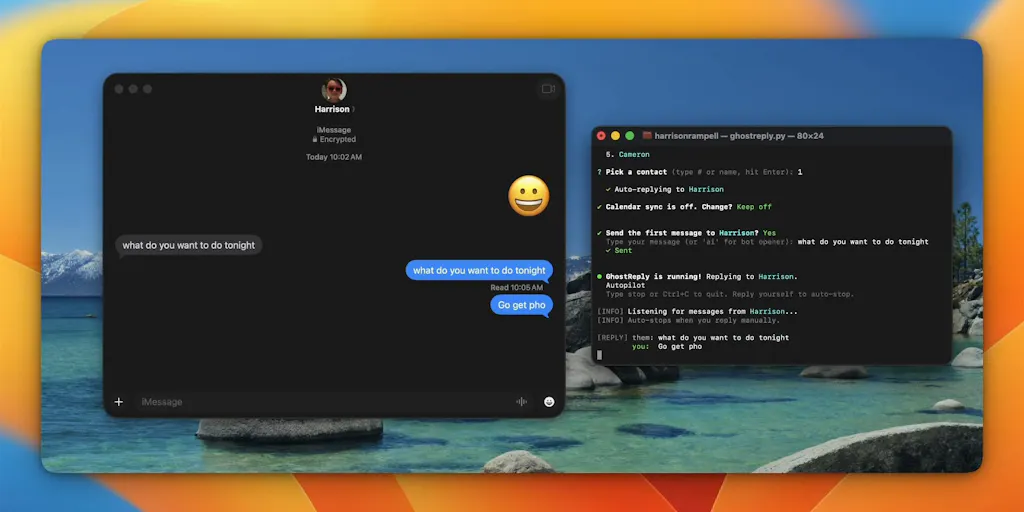
Let’s get into the mechanics of this specific tool, because the implementation details tell us a lot about where the market is heading. GhostReply is not a cloud-based SaaS that you log into. It is a macOS-native application that runs in your Terminal. This is a significant architectural choice. It signals a move away from the “everything in the browser” model toward local-first, privacy-conscious utilities that live on your hardware.
According to the launch page, the setup process is deceptively simple: it reads your message history locally to learn how you text each person. You then select which contacts it should handle and choose a “reply mode.” From that point, it watches for new iMessages and writes responses in your style. If you decide to reply manually, it steps aside. This isn’t a chatbot that uses generic templates; it’s a mimicry engine designed to clone your linguistic tics, your punctuation habits, and your conversational rhythm.
The most significant shift in this “2.0” release is the move to hosted AI. The earlier version required users to bring their own API key from a service like OpenAI. This presented a massive barrier to entry for non-technical users—the fear of API costs, the confusion of setting up an account, the dread of a surprise bill at the end of the month. Now, as the maker explains, you can “install it with one command, try 10 replies free, and start without creating any external AI account.” This is a masterclass in product-led growth. By removing the friction of external setup, they lower the activation energy to near zero. It’s a one-command install, a free trial of ten replies, and no subscription required. For a utility tool, this “one Mac, one Terminal app, iMessage, and no subscription” model feels refreshingly antithetical to the bloated monthly fees we see elsewhere.
Why This Is Different From Your Standard “AI Assistant”
We’ve seen a wave of “AI SDRs” and “AI receptionists” that promise to handle emails. But those tools operate in the professional sphere, where formality is expected. GhostReply is different because it operates in the personal sphere. It is designed to replicate the informal, often chaotic, language of close friends and family. This is a far more complex AI problem. When I tested similar “style mimicry” tools for email, they often fell into an uncanny valley—too formal, or too randomly informal. The nuance required to understand inside jokes, sarcasm, and the specific shorthand you use with a sibling versus a business partner is immense.
The tool’s ability to learn from your “message history locally” is key to its potential success. This isn’t just about grammar; it’s about the data that makes you, you. It learns that you always reply to your friend Dan with a single “😂” or that you never use periods in texts to your partner because it sounds too aggressive. This local processing also sidesteps the privacy nightmare of sending your entire message history to a third-party server for training. It implies a level of trust and data security that cloud-based tools simply cannot offer. This is a distinct competitive advantage that I suspect larger players like Google or Apple will find difficult to replicate quickly, due to their cloud-centric architectures.
What Creators Can Steal From This (Beyond Just Replying)
Even if you don’t use iMessage or don’t want a Terminal app, the philosophy behind GhostReply is a treasure trove of strategic ideas for any content creator. The core insight is contextual personalization. We spend so much time trying to game the algorithm with trending audio or hashtags, but we often ignore the relationship layer. This tool is built on the premise that the most effective communication is the most personalized communication.
The first thing you should borrow is the idea of “style cloning” for your audience. Imagine if, instead of writing a generic “link in bio” response to every comment, you could train an AI on your top 100 comments to understand your tone and reply to your most engaged followers in your specific voice. While platforms like TikTok and Instagram are cracking down on “engagement bait,” they are simultaneously rewarding authentic interaction in the comments section during the first hour of a post. A tool that helps you maintain that authentic voice at scale, without the cognitive load of typing out 50 unique replies, could be a game-changer for boosting your engagement rate. It’s not about robotic spam; it’s about volume with a personalized touch.
Secondly, consider the “interruption filter” for your team. If you manage a social media team, you know the pain of your community manager being pulled in ten directions. What if you could set up a system where an AI triages incoming DMs? It could handle the “What’s your pricing?” queries with a pre-approved rate card, while flagging the “We have a partnership opportunity” messages for human review. GhostReply does this for one person’s iMessage; the concept is directly transferable to your social inbox. It’s about defining the boundaries of what constitutes a “high-value interaction” that requires your unique human input, and what is a “low-value interaction” that can be handled by a well-trained bot.
Why TikTok Creators Should Care More Than LinkedIn Ones
The value of a tool like GhostReply isn’t uniform across platforms. For a LinkedIn thought leader, the interactions are often public, asynchronous, and heavily curated. A comment on a LinkedIn post is a public endorsement or a professional query—it feels weird to have an AI write that reply because it’s part of your public professional brand. It has a long shelf-life and contributes to your “personal brand” search results.
But for a TikTok creator or an Instagrammer, the DM is the lifeblood of the operation. It’s where the hardcore fans live, where collaborations are born, and where micro-communities form. The volume is immense, and the conversation is ephemeral and fast. If an AI can draft a few responses to the “What’s this song?” or “Where’s your jacket from?” comments in your DMs, it frees you up to focus on the actual creative act—filming the next video. The risk of a slightly off-tone AI reply is much lower in the fast-moving, less-archival world of TikTok DMs than it is on LinkedIn, where a business partner might screenshot a weird reply. In my experience, the creators who win on short-form video are those who engage heavily during the critical first two hours after posting. GhostReply, or tools like it, could be the difference between a creator who burns out answering the same three questions for the 100th time, and one who maintains their energy for the next shoot.
Where The Math Breaks: Limitations and The Uncanny Valley
Now, let’s pump the brakes and look at this with a critical, operator’s eye. This is a tool that is ripe for disaster if used incorrectly. The most glaring issue is the contextual failure mode. While the AI learns from your history, it doesn’t truly understand the nuance of a live conversation. If a friend texts you “I’m so sorry about your dog,” the AI might reply with a cheerful “No worries! Thanks for checking in!” if it doesn’t correctly parse the sentiment of the incoming message. This is a catastrophic failure that could damage real-world relationships. The reliance on “style mimicry” is a double-edged sword; it can replicate your tone, but it cannot replicate your situational empathy.
Furthermore, let’s talk about the “reply mode” feature. The launch page mentions you choose the contacts and the reply mode. But what are the options? Is it “auto-pilot” where it replies to everything? Or “suggestive” where it drafts a reply for you to approve? If it’s the former, you are placing a massive amount of trust in an LLM to handle sensitive interpersonal communication. I’ve seen the “hallucination” problem with AI—it confidently states things that are false. If that happens in an iMessage to a client or a close friend, the damage to trust is immediate and severe. The product page is silent on the granularity of these controls, which makes me nervous.
Finally, the platform limitation is real. This is iMessage only. For a global creator economy that thrives on WhatsApp, Telegram, IG DMs, and Discord, this is a very narrow slice of the pie. It feels like a “lifestyle” product for a Western, Apple-centric audience rather than a tool for the global creator. The maker even acknowledges this, asking for feedback on “where it feels useful, strange, or too far.” That is a clear signal that they know they are walking a tightrope. The “creepy” factor is high. The idea that my phone is sending messages without my knowledge, even to a small list of contacts, gives me a slight chill. It requires a level of trust in the technology that I don’t think the general public is ready for yet.
Who This Is NOT For
This is not a tool for the social media manager who runs a brand account for a multinational corporation. The legal and compliance implications of an AI sending messages to customers or stakeholders without oversight are a nightmare. It’s also not for the creator who has a chaotic personal life or high-stakes negotiations happening over text. If a misunderstanding could cost you a brand deal or a job, you don’t want a mimicry engine in the middle. And finally, it’s not for the person who finds joy in the act of texting. Some of us use texting as a primary way to maintain friendships. Outsourcing that emotional labor to a machine feels like a dereliction of duty. It’s for the specific use case of a high-volume, low-stakes conversational stream—the “how are you?” “what’s up?” “saw your story” messages that clutter your notification center.
What I’d Watch / Test Next
I’m not going to run out and install this today, but I am watching the space closely. The underlying technology—localized, personalized AI—is the future. Here’s what I’d suggest you test this week, even if you skip GhostReply itself:
- Audit Your Interruption Load: For 48 hours, track every time you stop a deep-work task to reply to a personal or semi-professional text. Categorize them: “Critical,” “Nice to have,” and “Pure Noise.” You’ll likely find that 60%+ fall into the “Pure Noise” category. This is the workload you need to automate or eliminate.
- Test “Tone Cloning” in a Safe Space: If you have a side project or a secondary account, try using a tool like Jasper or Copy.ai to draft responses to your audience. Feed it your past replies and see if the tone matches. This will show you the potential and the limitations of AI mimicry without risking your primary relationship channel.
- Check Your Platform APIs: Watch the developer blogs for WhatsApp and Telegram. If they open up more robust APIs for local AI processing, we will see a flood of GhostReply clones for the global market. The moat for GhostReply is currently very shallow because it’s tied to iMessage.
The launch of GhostReply is a signal. It tells me that the next battleground for creator efficiency isn’t in the cloud—it’s on the lock screen. The tools that win our loyalty won’t just help us publish; they’ll help us protect our humanity by managing the digital noise. The question isn’t whether we’ll use AI to write our texts; it’s whether we’ll be smart enough to know when not to let it. For now, I’ll keep my fingers on the keyboard, but I’ll be watching where this experiment goes.