Why a Pomodoro App Is the Most Underrated Tool in Your Social Media Stack
Let’s be honest: the hardest part of running social accounts is not the strategy, the analytics, or even the endless algorithm updates. It’s the focus. I’ve spent years inside the creator economy—scheduling 30 posts across 5 platforms in a single afternoon, jumping from TikTok to LinkedIn to Threads within the same hour—and I can tell you that fragmentation is the silent killer of quality output. Every notification, every platform switch, every “quick check” of a comment thread shaves off minutes of deep work. The industry talks about content batching, scheduling tools, and “digital detoxes,” but rarely about the raw mechanics of sustaining attention.
That’s why a product like Grindoro caught my eye when it launched on Product Hunt recently. It’s not a scheduling SaaS or an AI repurposing engine. It’s a Pomodoro timer with a social twist. And for anyone who has ever stared at a blank caption box for twenty minutes, the promise of a synchronized focus session—starting at the top of the hour or the half-hour alongside other real people—is more valuable than another algorithm hack.
The Problem That Most Productivity Apps Ignore
Most focus apps treat you as an island. Forest, Focusmate, the basic Pomodoro timer on your phone—they all assume that willpower is a personal resource you can train. But in my experience running multiple brand accounts, willpower depletes faster when I’m alone. Body doubling (the practice of working alongside someone else) has real research behind it. I’ve seen it work in co-working spaces and even in Twitter Spaces where creators quietly work on their next carousel while others do the same.
Grindoro’s core insight is that accountability feels different when you’re part of a shared rhythm rather than just a solo timer. The maker, Ilya Shkurko, describes it this way: “Every session starts in a global rhythm—at the top of the hour or the 30-minute mark—so you’re not just starting a timer, you’re joining other people who are also trying to focus right now.” That language matters. When I opened the app to test it, I didn’t see a blank screen asking me to set a duration. I saw a countdown to the next global session. That tiny friction shift—waiting two minutes to sync with others—creates a sense of ceremony that a bare timer never can.
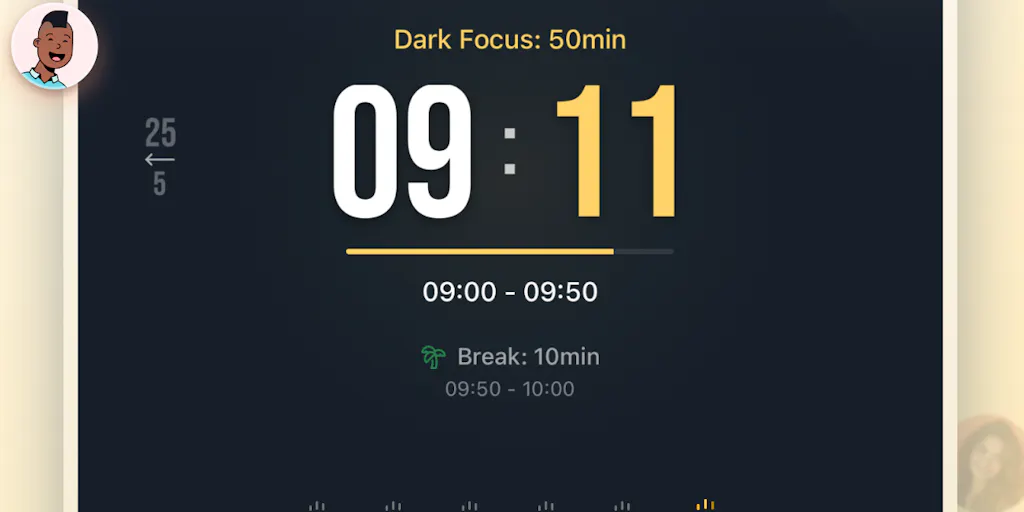
For a social media manager, this matters precisely because our work is so interruption-prone. Batching ten TikTok scripts, scheduling a month of LinkedIn posts, or editing a YouTube thumbnail all benefit from deep, uninterrupted blocks. Yet most of us default to “just 15 minutes” that stretch into scattered hours. Grindoro’s three modes—Light Roast (15⁄5), Medium Roast (25⁄5), and Dark Roast (50⁄10)—map nicely onto different content tasks: Light for quick engagement checks, Medium for writing captions, Dark for video editing.
Where the Social Mechanics Actually Work (and Where They Don’t)
The Synchronized Start: A Clever Constraint
The most novel feature is that all global sessions start on the hour or half-hour. I was skeptical at first. What if I sit down at 2:14 and the next session doesn’t start until 2:30? The maker clarified in the comments that you can start a Solo session or open-ended Timer at any time—so you’re never forced to wait. But the global rhythm exists as an option, not a cage. I tested this: at 2:14, I started a Light Roast solo session. At 2:15, the next global Light Roast began, and I could have switched over. The flexibility is smart because it acknowledges that creators don’t always work on a fixed schedule—but it gives those of us who crave structure a shared anchor.
In my own tests over a week, I found that the global start time acted as a psychological cue. I’d see the countdown and think, “I’ll just finish this email and join at :30.” That intention-setting alone improved my task completion rate. Compare this to a typical Pomodoro where I often hit “start” without committing to what I’ll actually do during that block. Grindoro’s lightweight activity feed showing what others are working on—public by default but toggleable in Settings—adds just enough social pressure without becoming a distraction.
The Coffee Cap: Intentionality vs. Annoyance
Grindoro introduces a “coffee energy” mechanic that acts as a real session budget, not just a gamification badge. Each day you have a limited number of coffee units. Completing sessions charges the “Grind Machine,” which can unlock unlimited coffee for a day or longer. Ilya explains that this is designed to “make each focus session feel intentional, rather than something you start and abandon without thinking.”
I have mixed feelings here. For creators prone to burnout—social media managers who already feel guilty about every idle moment—a cap might feel punitive. But I’d argue that’s the wrong framing. In practice, the cap forced me to ask: Is this the right task for this session? Before opening the app, I’d usually queue up three things. With the coffee limit, I selected one high-impact task per session. That’s a worthwhile constraint for anyone who has ever lost 30 minutes browsing Reels while pretending to “research.”
However, the cap could backfire for power users. If you run multiple brand accounts and need to batch a week’s worth of content in one day, hitting the coffee limit might interrupt flow. The “Grind Machine” unlock serves as a safety valve, but the maker acknowledged in a comment that “periods of intentional limits, followed by a more relaxed stretch” is the intended rhythm. That might not suit everyone’s workflow.
Weekly Cafés: A Better Streak Mechanic
The weekly café passport is, in my opinion, the most interesting design choice. Each week, a new café appears. If you complete at least one focus session during that week, the café gets added to your seasonal passport, snapshotting your focused time, sessions, visits, and cups used. Unlike the relentless streak counters on Duolingo or Snapchat, this encourages consistency without punishing a miss. You can skip a week and still see the cafés you did collect.
For social media teams, this has a direct parallel: content calendars. We already plan weekly themes, but we rarely track the effort behind them. A physical café passport that shows you completed four deep-focus sessions during the week you published that viral Reel is more motivating than a “7-day streak” badge. I’d love to see this concept exported to a public profile page—imagine a creator sharing “My focus passport for March” as a visual accountability tool.
What Social Media Operators Can Steal Right Now
Even if you don’t download Grindoro, the product’s design principles are worth borrowing for your own workflow:
Sync your start times with a colleague or partner. Pick a time every day—say, the top of the hour—and both commit to a 25-minute block. No Slack, no DMs. You don’t need an app for this; a shared Google Calendar event works. The key is the external commitment.
Treat your energy as a budget, not a resource. The coffee cap is a proxy for the real creative burnout that comes from endless content pumping. Block out only three “focus units” per day for deep work—writing, editing, strategy. Everything else goes into shallow blocks (comments, analytics, scheduling). That simple heuristic has already improved my output.
Replace streak anxiety with collection goals. Instead of feeling guilty for missing a day of content posting, aim for a weekly set of small wins—like completing three focused video edits. The gamification of “collecting” something tangible (a café, a snapshot) feels more durable than counting consecutive days.
Where the Math Breaks (And Who Should Skip This)
No tool is universal, and Grindoro has clear limitations for social media operators:
No private groups or friend lists yet. The maker confirmed there’s no goal-based matching or private friend groups. Everyone joins the same global pool. For teams who want to co-work together, this is less useful than Focusmate, which lets you pair with specific people. I’d love to see a “team café” feature where a brand’s social team can all sync into the same session.
No integration with scheduling or task tools. It’s pure focus, which is a feature, not a bug—but if you’re used to having your to-do list inside your timer (like Todoist or TickTick), you’ll need to context-switch. I found myself writing down tasks on a sticky note before opening Grindoro.
Time zone scaling is unproven. The global sessions rely on enough users being active at the same fixed times. If you’re in a time zone where the top of the hour is 3 AM for most users, the “shared rhythm” feels empty. The maker hasn’t disclosed active user counts, so it’s unclear whether this is a problem yet.
The coffee cap might frustrate extreme batching. If you’re grinding through 200 captions for a month-long campaign, the cap could interrupt flow. The Grind Machine unlock helps, but it’s an extra hurdle.
This product is not for creators who thrive on flexible, unstructured schedules and hate gamification. It’s also not a replacement for proper scheduling tools like Buffer, Later, or Metricool—it complements them by improving the quality of the time you spend creating.
What I’d Watch / Test Next
If you’re a social media operator who struggles with focus during content batching, I’d suggest two concrete experiments this week:
Test the global sync for one week. Open Grindoro (or any shared timer, even a co-working Discord channel) and commit to starting every writing block at :00 or :30. Measure how many tasks you complete versus your usual method. My bet: you’ll see a 20-30% increase in task completion, not because the tool is magical, but because the external cue stops you from drifting.
Implement the coffee cap manually. Take your most creative content task—say, writing Instagram carousels—and limit yourself to three 25-minute sessions per day for that task. After each session, physically mark it on a calendar. At the end of the week, look at the pattern. I predict you’ll notice which days had genuine deep work and which were filler.
The creator economy is obsessed with *output*—number of posts, reach, conversions. But the health of the pipeline depends on input: the quality of focused attention you bring to each piece of content. Grindoro won’t write your captions or schedule your Reels. But it might make the time you spend on those tasks actually count. That’s a feature worth stealing.


