The real social media lesson hiding in a developer-tool launch
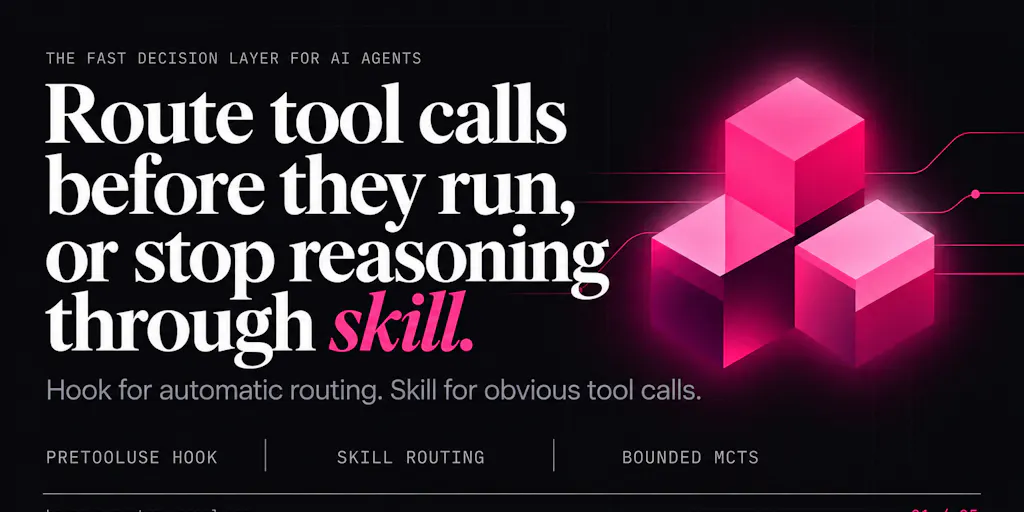
Most Product Hunt launches are irrelevant to the people who actually run social accounts — they’re developer plumbing, and the overlap with a creator’s daily workflow is close to zero. This one is different, and not because you should go install it. Harness Router, built by Kamil Mosciszko, is a routing layer for AI agents: it decides which tool an agent should call before it calls it, using a fast path for obvious choices and heavier reasoning for ambiguous ones. If you’ve ever watched an AI content tool burn twenty minutes and a pile of tokens “thinking” about which of your connected accounts to post to, you already understand the problem. The thesis of this essay: the routing problem is your problem too, whether or not you ever touch an MCP server.
What Harness Router actually does — and why a social operator should care
Here’s the maker’s own framing, straight from the launch page: models spend too much time, tokens, and money deciding which tool to call. The proposed fix is tiered — “obvious calls take the fast path, ambiguous calls can use Jev, and harder multi-step decisions can use bounded MCTS.” Integration options are a direct routing layer, exposure through MCP, or Codex hooks so tool selection is checked automatically before execution. With SessionStart plus PreToolUse, the maker says Codex can discover available tools once and route or re-plan calls transparently. It’s framework-agnostic and fully open source. A Claude hook was added the day after launch.
My take: strip away the agent jargon and this is a dispatch problem. You have a pile of possible actions, a small budget of attention and money, and a need to pick the right action fast. That is exactly the job of a social media manager on a Tuesday morning — except your “tools” are platforms, formats, and posting windows, and your “tokens” are hours.
The tiering idea maps onto your content calendar better than you’d think
Think about how you actually decide what to post. Ninety percent of the time it’s the fast path: it’s Tuesday, the carousel goes out, done. Occasionally it’s genuinely ambiguous — do we chase the trending audio or protect the brand voice? That’s the “Jev” tier. And a few times a quarter you’re doing multi-step planning: a launch sequence across five platforms with dependencies. That’s the MCTS tier, and it’s where creators waste the most time because they treat every decision as if it were tier three.
In my experience running accounts, the biggest operational win isn’t a better tool — it’s refusing to over-deliberate on low-stakes calls. If an agent framework needs an explicit router to enforce that, so does your team.
How it compares to what’s already in your stack
The honest comparison set here isn’t social tools — it’s the orchestration layer. If you’re using Zapier or Make to wire “new blog post → draft social captions → queue to scheduler,” you’ve built a crude router. It’s deterministic: if X, then Y. Harness Router’s premise is that deterministic branching breaks down when the decision itself is fuzzy, which is why it adds a reasoning tier rather than more if-statements.
The same logic shows up in scheduling. Buffer, Hootsuite, Later, and Metricool all make you choose the destination manually or via fixed rules. That’s fine — it’s a different problem. But the moment you bolt AI caption generation or AI clip selection onto those tools, you inherit the routing problem: which platform gets which variant, at what length, with what hook. Most tools solve it with a template. Templates are the fast path. They’re great until they’re wrong.
Where the math breaks
The maker’s claim is about saving time, tokens, and money. The team claims this routing reduces waste — I’d want to see the actual cost curves before repeating that as fact. Not disclosed on the launch page: benchmarks, latency numbers, pricing, or user counts.
Here’s where I’d expect the math to break, and this is my judgment, not a sourced claim. Routing overhead is only free if the router’s decision is cheaper than the decision it replaces. For a two-option choice, a router is pure overhead. The tiered design only pays off when the decision space is large and the cost of a wrong call is high. In social terms: choosing between Instagram and TikTok for a vertical video is a coin flip you should just make yourself. Choosing which of forty clips from a two-hour livestream becomes the hero Short — that’s a real routing problem.
What creators and social teams can borrow from this
You don’t need to run an MCP server to steal the architecture. Four things transfer directly.
1. Separate discovery from execution. The SessionStart hook discovers available tools once, then PreToolUse checks the choice before it fires. Your equivalent: audit which platforms and formats you actually have capacity for, once a quarter, and write it down. Then every post decision is a lookup, not a research project. Most creators re-litigate “should I be on Threads?” every single week. That’s a discovery task masquerading as an execution task, and it’s why your calendar slips.
2. Build an explicit fast path. Name the calls you never need to think about. For me it’s: repurpose the long-form into three short-form cuts, publish to the two platforms where that format actually performs, log the UTM, move on. Anything on the fast path should be automated or delegated. If you’re still manually approving fast-path posts, you’ve built a router with a human bottleneck.
3. Reserve the heavy reasoning for genuinely ambiguous calls. Bounded MCTS — a search that explores options but stops before it runs away — is a good mental model for a launch week. You want to explore variants, but you don’t want to explore forever. Set a bound: three hook variants, tested for 48 hours, then commit. Unbounded testing is how creators end up with a folder of drafts and nothing published.
4. Make the routing auditable. The whole point of a PreToolUse check is that you can see what was chosen and why. Your version: a one-line note in your scheduler for why this platform got this variant. When something underperforms, you need the reasoning, not just the result.
Why TikTok creators should care more than LinkedIn ones
The routing problem scales with decision frequency and format volatility. A LinkedIn operator posting three times a week from a stable format set has a tiny decision space — the fast path covers almost everything. A TikTok creator is making dozens of micro-decisions a day: sound, hook, cut, caption, posting window, and whether to ride a trend that may be dead in six hours. That’s a large decision space with a high cost of a wrong call, which is precisely the shape where tiered routing earns its keep.
If you’re on the TikTok side of that spectrum, the lesson isn’t “buy an agent framework.” It’s that you should stop making every one of those decisions from scratch. CapCut templates and Canva brand kits are dumb routers — they collapse a hundred micro-decisions into a handful. That’s the same principle, applied at the asset layer instead of the logic layer.
Where I think this falls short — and who it’s not for
Let me be clear about scope. This is a developer tool for people building coding agents, MCP servers, and Codex workflows. The maker says exactly that: feedback is wanted from people building tool-heavy agent systems. It is not a social media scheduler, and it does not claim to be. If you’re a solo creator looking for a better way to queue posts, this is the wrong tab to have open.
Three open questions I’d flag before anyone gets excited:
- No published benchmarks. The efficiency claim is the entire value proposition, and the launch page doesn’t quantify it. Not disclosed: latency, token savings, or accuracy versus a naive router.
- Maturity. A Claude hook landed one day after launch. That’s a fast follow, which is good, but it also tells you the integration surface is still moving. Early adopters should expect breakage.
- Pricing and licensing specifics. Open source is stated; the actual license terms and any hosted offering are not disclosed in the source material.
And the honest meta-caveat: I haven’t run this in production. My read is based on the launch description and my own experience with agent tooling and social workflows. Treat the architectural lessons as the takeaway and the product itself as something to evaluate on your own terms.
What I’d watch / test next
This week, do the version of this that costs nothing. Write down your last twenty posting decisions and tag each one fast-path, ambiguous, or multi-step. I’d bet the distribution is lopsided — most of your time going to the tier that deserves the least of it. Then pick one fast-path decision and automate or template it. If you’re technical and building agent tooling for content, the Harness Router launch page is worth a read, and the maker is explicitly asking where routing breaks — that’s a useful signal in itself.
Longer term, I’d watch whether routing layers like this get absorbed into the schedulers you already pay for. Buffer and Later have every incentive to add an AI dispatch tier; whoever ships the first one that’s actually auditable will have a real moat. Until then, the architecture is free to steal — and for most social teams, that’s the part that matters.