The render problem nobody warns you about until your agent ships a garbled logo
If you run social for a living, you’ve already felt the gap between “AI can write anything” and “AI still can’t reliably make a branded image.” Your caption drafts itself in seconds. Your carousel, your OG card, your chart screenshot, your certificate — those still route through a human in a design tool, or they come back from a generative model with six fingers and a logo that reads like a ransom note. That gap is where the interesting tooling is moving in 2025, and it’s why I paid attention to imejis.io, a template-based image engine with an MCP server from makers Dharmendra Jagodana and his twin brother Dharmik. This is not another “AI image generator.” It’s a deterministic renderer that agents can drive — and for anyone building content pipelines across Instagram, LinkedIn, TikTok, YouTube, and X, that distinction matters more than the launch copy suggests.
What imejis.io actually solves — and why “renderer, not diffusion model” is the whole point
Strip away the launch-day framing and the core claim is simple: agents can now write almost anything, but when you ask one for a finished visual, you get a screenshot, a description, or an AI image with a garbled logo. The team says they kept running into that wall themselves, so they gave agents a real design tool instead of a prompt box.
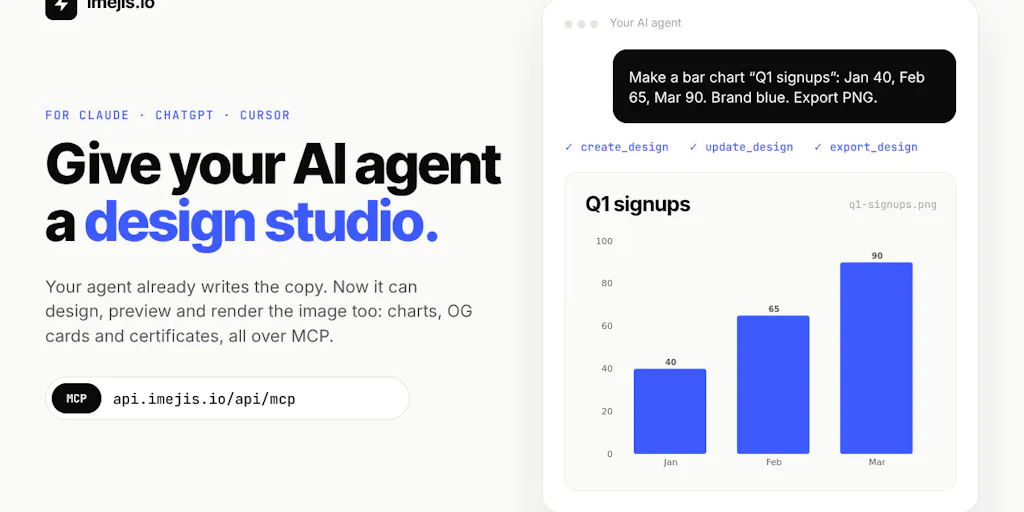
That’s the entire thesis, and it’s a good one. The product is a template-based image engine with an MCP server. You connect Claude, ChatGPT, or Cursor to https://api.imejis.io/api/mcp, sign in once, and the agent can create, edit, preview, and render real designs. The output types listed are practical rather than flashy: OG images, social cards, certificates, QR codes, and barcodes, plus 22 chart types including candlestick, treemap, sankey, funnel, and KPI tiles. Renders land on permanent URLs, so one template can produce an image for every row of your data.
Here’s the operational detail that actually matters to a social team: “It’s a renderer, not a diffusion model. The same input gives the same pixels every time, so your fonts, logo and numbers come out right.” That single sentence is the pitch. If you’ve ever tried to get a diffusion model to place your wordmark in the top-left corner of a 1200×630 card, you know that “the same input gives the same pixels” is not a nice-to-have — it’s the difference between a tool you can put in a scheduled pipeline and a toy you babysit.
Why deterministic output is a bigger deal than it sounds
Think about how your content actually gets produced at volume. A weekly LinkedIn carousel, a batch of 30 OG images for blog posts, a set of KPI tiles for a client report, a certificate for a course cohort — these are templated assets. The layout doesn’t change. The logo position doesn’t change. Only the text and the numbers change. Diffusion models are structurally wrong for that job because they re-imagine the whole frame every time, and any brand-critical element (font, logo, exact figure) is a coin flip.
A renderer inverts that. You define the template once, then feed it data. Same template plus same data equals same pixels. That’s how you get from “AI made me a nice image” to “AI generated 200 on-brand images overnight and I spot-checked five of them.” For social operators juggling multiple clients or multiple platforms, that’s a workflow shift, not a feature.
The makers also note the engine isn’t only for agent users: there’s a visual editor, a REST API, and integrations with Zapier, Make, and n8n. And they say it already powers image generation for platforms like topmate.io. Pricing is 100 free renders a month, no card needed.
How it stacks up against the tools already on your stack
This is where I want to be careful, because “AI image tool” is a crowded shelf and most of it is not competing with imejis.io at all. Let me draw the lines as I see them.
Against Canva: Canva is where most social teams live, and it’s genuinely great for human-driven design. But Canva is a canvas-first product — a person opens it, picks a template, edits, exports. It has APIs and bulk-create features, but the mental model is still “a designer drives the tool.” imejis.io flips the driver: the agent drives, the human defines the template. My take: these are complements, not substitutes. I’d still build the template in something visual, then hand the rendering to an API.
Against CapCut and video-first tools: Different lane entirely. CapCut owns short-form video editing, and nothing here touches video. If your bottleneck is TikTok edits, this launch is irrelevant to you.
Against generative image models (Midjourney, DALL·E, Adobe Firefly, Ideogram): These are the tools imejis.io is implicitly arguing against for structured assets. The maker’s own framing — “you get a screenshot, a description, or an AI image with a garbled logo” — is a direct shot at that category. For hero art, mood boards, and concept visuals, diffusion still wins. For a 1200×630 OG image with your logo top-left and your exact headline, a renderer wins on every axis that matters: accuracy, repeatability, and cost per asset.
Against Bannerbear, Placid, and APITemplate.io: This is the closest real comparison, and it’s the one the launch page doesn’t make. Those are established template-based image APIs with Zapier and Make integrations — the exact space imejis.io is entering. The differentiator the makers are betting on is the MCP server: the ability for Claude, ChatGPT, or Cursor to call the engine directly as a tool, rather than you wiring up a webhook yourself. Whether that’s a durable moat or a six-month feature gap is an open question, and I’d flag it as such rather than pretend the incumbents don’t exist.
Why TikTok and Instagram creators should care more than LinkedIn ones
Here’s a pattern I’ve watched play out repeatedly: the platforms with the highest posting cadence and the lowest tolerance for off-brand visuals are the ones that benefit most from templated rendering.
TikTok and Instagram Reels creators ship multiple assets a day — thumbnails, cover frames, carousel slides, story cards. At that volume, you cannot hand-design every one, and you cannot afford a diffusion model that renders your handle wrong one time in five. Deterministic templates are the only sane path.
LinkedIn is the opposite. Posting cadence is lower, assets are fewer, and a human in Canva is often perfectly adequate. So if you’re a LinkedIn-first operator, this tool is a nice-to-have. If you’re running a TikTok or Instagram content machine — especially one where the same template needs to produce dozens of variations — it’s closer to a missing piece.
The same logic applies to YouTube thumbnail testing. If you’re running A/B tests on thumbnails, you want the only variable to be the text or the image, not the accidental font shift a generative model introduces. Determinism is what makes a clean test possible.
What creators and social teams can borrow from this — regardless of whether you adopt it
Even if you never connect an agent to imejis.io, the launch points at a workflow principle worth stealing this quarter: separate your template layer from your content layer.
Most social teams do the opposite. They treat each post as a one-off design task. Someone opens Canva, duplicates last week’s post, swaps the text, exports, uploads. It works, but it doesn’t scale, and it doesn’t automate, because there’s no clean boundary between “the design” and “the data.”
The template-engine model forces that boundary. You define: - The layout (fixed) - The brand elements — logo, fonts, colors (fixed) - The variable fields — headline, number, chart data, URL (fed in)
Once that boundary exists, everything downstream gets easier. You can batch-generate. You can trigger renders from a spreadsheet, a CMS, a Notion database, or an agent. You can hand the same template to three clients and just swap the brand kit. You can wire it into Buffer, Later, or Metricool scheduling flows without a human touching the file.
The MCP angle, explained without the hype
MCP — Model Context Protocol — is the interface that lets an AI assistant call external tools. If you’ve used Claude or ChatGPT with connectors, you’ve used the concept. The practical upshot here: instead of you manually generating an image and uploading it, you tell your agent “make a 1200×630 OG image for my post ‘How MCP works’ with our logo top-left, and export it as PNG” — the exact example the makers give — and the agent calls the render engine and returns the asset.
For social operators, the interesting part isn’t the novelty. It’s that this collapses a step in your pipeline. Today, an AI-written post still needs a human to make the image. With an MCP-connected renderer, the same agent that wrote the post can also produce the visual, using your locked template. That’s one fewer handoff, and handoffs are where publishing schedules slip.
I’d bet the near-term value here is less about fully autonomous posting and more about drafting at volume. Let the agent produce 20 candidate cards, then a human picks the five that go out. That’s a realistic workflow today, not a 2027 fantasy.
Where the math breaks
Determinism has a cost, and it’s worth naming. A template engine can only render what the template anticipates. If your content strategy depends on novel, unplanned visuals — meme formats, reaction images, trend-jacking art — a renderer gives you nothing. You’re back to diffusion or a human.
There’s also a ceiling on complexity. Chart types and card layouts are well-served. A bespoke, art-directed campaign visual with layered illustration is not. I’d treat this as infrastructure for the repetitive 70% of your visual output, not the creative 30%.
Where my judgment says it falls short
Let me be the skeptic for a section, because launch pages rarely are.
First, the competitive picture is understated. The launch copy positions imejis.io against diffusion models, which is a favorable framing. The harder comparison is against established template-image APIs — Bannerbear, Placid, APITemplate.io — several of which already have Zapier, Make, and n8n integrations and years of production hardening. The MCP server is the differentiator, but MCP support is a fast-moving feature, not a moat. I’d want to see how quickly the incumbents ship their own MCP endpoints.
Second, the team size is both a selling point and a risk. The makers are transparent that two people ship all of this: the backend (auth, workspaces, multi-tenant infrastructure) runs on buildbase.app, their own SaaS backend platform, with Stripe for billing, Next.js on Vercel for the app, and Google Cloud for rendering at scale. That’s a lean, modern stack and genuinely impressive for two people. It’s also a bus-factor of two. If you’re routing client deliverables through this, you should think about that. Not disclosed: uptime SLAs, team size beyond the two founders, or funding.
Third, the free tier tells you who it’s for. 100 free renders a month, no card needed. For a solo creator testing the waters, that’s generous. For an agency rendering thousands of assets, it’s a rounding error — and pricing beyond the free tier is not disclosed on the launch page. You’ll want to check that before you build a pipeline on it.
Fourth, the “agents can write anything” premise cuts both ways. If your agent is generating the copy and the image, you’ve now automated both halves of a process that used to have two human checkpoints. Deterministic rendering protects your brand assets, but it doesn’t protect you from publishing something off-tone at scale. My take: keep a human approval step in the loop, at least until you’ve run a few hundred renders through it.
Who this is NOT for
- Video-first creators. No video rendering here. If TikTok edits are your bottleneck, look elsewhere.
- Designers who want creative control per asset. This is a system, not a canvas. If every post is bespoke, you’ll fight it.
- Teams with no template discipline. If your brand kit isn’t codified — fonts, colors, logo placement — you have to do that work first. The tool won’t do it for you.
- Anyone who needs enterprise guarantees today. Two-person team, no disclosed SLA. Fine for indie and small-team use; risky for a large agency’s client pipeline without a fallback.
What I’d watch / test next
Concrete moves for this week, whether or not you adopt imejis.io:
- Audit your visual output for templatability. Pull your last 30 posts across your main platforms. How many are variations on 3–5 layouts? That number is your automation ceiling. If it’s high, a template engine is worth evaluating.
- Codify one brand template properly. Pick your most-repeated asset — OG image, carousel cover, KPI tile — and define the fixed vs. variable fields. This is the work that makes any renderer useful, including the incumbents.
- Test the free tier with a real task. 100 free renders a month, no card needed. Connect an agent to the MCP endpoint and try the makers’ own example prompt. See how the output holds up against your brand.
- Benchmark against one incumbent. Run the same template through Bannerbear or Placid and compare output quality, API ergonomics, and pricing. Don’t adopt on launch-day enthusiasm alone.
- Watch for MCP parity from competitors. If the incumbents ship MCP support within a quarter, the differentiator narrows and the decision becomes about price and reliability. That’s the signal to watch.
The broader story here isn’t imejis.io specifically. It’s that the creator toolchain is quietly bifurcating: generative models for the creative frontier, deterministic renderers for the production line. Most social teams are still doing the production line by hand. The teams that fix that first will out-publish everyone else — not because they’re more creative, but because they stopped letting a garbled logo eat their Tuesday.


