The feedback layer creators didn’t know they were missing
Every social media operator I know runs the same broken loop: a client or stakeholder watches a draft, then sends their notes through WhatsApp, Slack, or a 47-message email thread, and somebody on the team retypes those notes into a prompt, a brief, or a caption edit. The prototype era made this worse, not better — the faster we can ship a landing page, a carousel mockup, or a short-form video concept, the faster the feedback fragments across six channels. Inflight is a small, pointed bet that feedback should live on the artifact itself and reach the AI agent from there. That’s a design-tool launch on the surface. For anyone who publishes across seven platforms, it’s a preview of how review workflows are about to change — and a useful mirror for how sloppy our own content approval loops still are.
What Inflight actually is, and the problem it’s solving
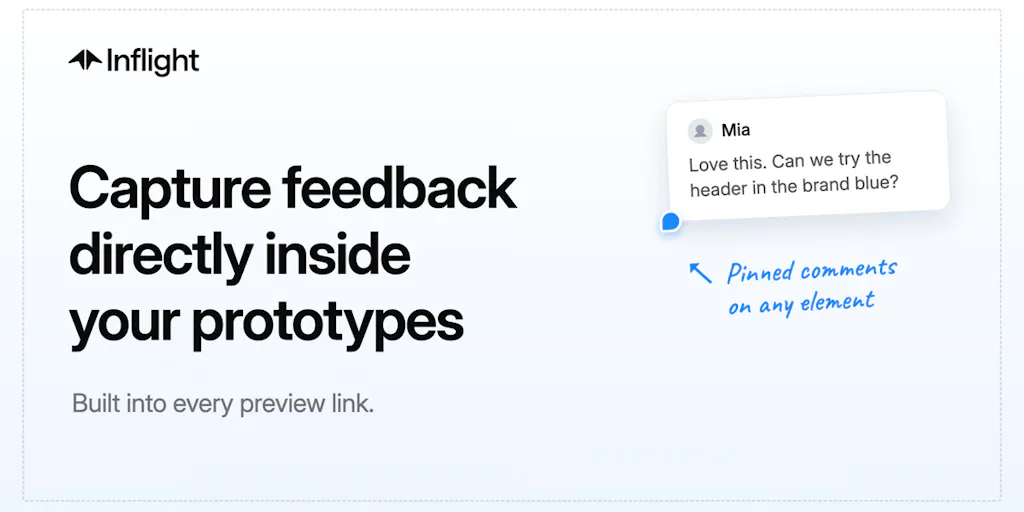
The maker’s pitch, from co-founder Tommy Geoco in the launch thread, is refreshingly specific: “prototype feedback scattered across channels, then someone retypes it into a prompt so the agent can fix it.” The team — Tommy, Kyle, Ridd, and Veer, with three design co-founders and one engineer — built a layer where you share a preview link or an HTML prototype, reviewers pin comments to real elements or record video on the running app, and a coding agent (Cursor, Claude Code, Codex) pulls those comments in over MCP as next steps.
That’s the whole product in one sentence. No dashboard sprawl, no “all-in-one workspace” ambition. The launch page is thin on pricing, user counts, and integrations beyond the MCP handshake — all not disclosed — which I read as a deliberate early-stage posture rather than an oversight.
Why this matters more to content teams than it first appears
On paper this is a product-design tool. In practice, the workflow it fixes is identical to the one most social teams run every week. When I scheduled 30 posts across five platforms last month, the bottleneck wasn’t Buffer or Later — the scheduling layer is solved. The bottleneck was the three rounds of “can you move the logo up” and “the hook doesn’t land” that arrived as screenshots in three different apps, then got manually translated into CapCut edits and Canva revisions. Inflight’s core insight — pin the note to the element, let the machine read the note where it lives — is exactly the repurposing workflow problem, just aimed at code instead of captions.
How it differs from the tools you already pay for
The obvious comparison set is review-and-annotation software: Figma comments, Filestage, Markup.io, Frame.io for video. Those tools solved “collect feedback in one place” years ago. What they didn’t solve is the last mile: getting structured feedback into an AI agent without a human retyping it. Inflight’s differentiator is the MCP pipe — the agent pulls the pinned comments directly as actionable steps. That’s a genuinely different architecture from “export a PDF of comments and paste them into a chat window.”
The second comparison is to the scheduling/automation incumbents — Hootsuite, Metricool, Sprout Social. Those platforms own publishing and analytics; none of them own the review loop on a live artifact. My take: Inflight isn’t competing with them, it’s exposing a gap they’ve left open. If you’ve ever wished your Notion content calendar could receive element-level notes on a draft reel and hand them to an editing agent, you’re the person this launch is quietly speaking to.
The MCP detail is the whole ballgame
MCP — the Model Context Protocol — is the reason this launch is more than a niche annotation tool. It’s the same plumbing that lets Claude, Cursor, and other agents reach into external systems. The maker’s one ask in the thread is telling: “if you connect the MCP, reply here with the first next step your agent pulled in and whether it got it right.” That’s a team testing whether the handoff is reliable, not just possible. In my experience testing similar agent integrations, the demo always works and the edge cases — ambiguous comments, conflicting notes, elements that moved since the comment was pinned — are where these tools live or die.
Where the math breaks
One commenter asked the sharpest question on the page: what happens when two reviewers request opposite changes before the feedback reaches the agent? The maker didn’t answer in the visible thread. That’s not a knock — it’s the honest open question. Any operator who has run a content approval loop knows conflicting notes are the norm, not the exception. An agent that faithfully executes both instructions produces garbage. The product’s usefulness depends entirely on how it resolves, flags, or escalates contradictions, and the launch page doesn’t say. I’d bet resolution logic is on the roadmap; I’d also bet it’s harder than the pinning itself.
What creators and social teams should borrow from this
Even if you never touch Inflight, the launch is a template worth stealing. Three things stand out.
First, feedback belongs on the artifact, not in a chat thread. When a client sends “make the hook punchier” as a WhatsApp voice note, you lose the timestamp, the frame, and the context. Pinning a note to a specific element — a caption line, a frame at 0:03, a CTA button — is a discipline any team can adopt today with Loom timestamps and Figma comments, no new tool required. The lesson is the workflow, not the software.
Second, the retyping tax is real and it’s where your hours go. The maker’s framing — “someone retypes it into a prompt so the agent can fix it” — describes a hidden cost most teams never measure. Every manual translation step between feedback and execution is a place where intent degrades. If you’re using AI for captions, thumbnails, or edit suggestions, audit how many human copy-paste steps sit between the note and the model. Cutting those is free ROI.
Third, agent integrations are becoming table stakes. The fact that a small design team shipped MCP support at launch, not in “coming soon,” tells you where the tooling market is heading. Raycast hunter Chris Messina flagged the launch and pointed to an interview with the maker about how it came to be — the kind of signal that suggests the MCP angle is the story, not the annotation UI. For social operators, the practical read: when you evaluate your next scheduling or analytics tool, ask whether it exposes an API or MCP endpoint your agents can reach. If the answer is no, you’re buying a dead end.
Why TikTok and short-form teams should care more than LinkedIn ones
Short-form review is the messiest feedback loop in social. A 30-second reel has hooks, captions, on-screen text, audio, and pacing — five dimensions a reviewer can comment on, usually across three apps. LinkedIn posts are text; feedback is a comment on a doc. The more dimensions an artifact has, the more value element-level pinning delivers. If Inflight-style workflows spread to video review, short-form teams are the biggest beneficiaries, because they currently run the most fragmented approval process of anyone.
Where my judgment says it falls short
Balance matters here, so let me be direct about the gaps.
The launch page is thin on proof. No pricing, no user numbers, no named customers, no case study — all not disclosed. The comments are warm but come from design-tool peers (Magic Patterns, ion design) rather than social or content teams. That’s normal for a Product Hunt day, but it means the social-media use case is my extrapolation, not the team’s claim. Flagging that clearly.
It’s built for prototypes, not published content. Inflight reviews a running app or HTML prototype. It does not review a scheduled Instagram carousel, a TikTok draft, or a YouTube thumbnail. The workflow analogy is strong; the product fit for a pure social team is indirect today. I’d bet an integration with scheduling tools is a year out at best.
The client-account problem is unresolved. Another commenter raised the killer objection: “clients won’t sign up for one more tool just to leave three comments” — which is why feedback ends up in WhatsApp. The maker didn’t visibly answer. If Inflight requires reviewers to create accounts, it inherits the exact adoption problem it’s trying to solve. If it doesn’t, that’s the feature worth shouting about, and the page doesn’t shout about it.
Who it’s not for: solo creators who approve their own work, teams already happy with Figma comments plus a manual prompt, and anyone whose bottleneck is distribution or analytics rather than review. This is a tool for teams with a human-in-the-loop review stage and an AI agent downstream. Everyone else can watch and wait.
What I’d watch / test next
This week, run a small experiment on your own workflow. Take your next draft post or reel and collect feedback with element-level pinning — Loom timestamps or Figma comments will do — instead of a chat thread. Count how many manual steps sit between the note and the final edit. That number is your retyping tax, and it’s the metric Inflight is built to shrink.
Then watch three things about the product itself: whether the team publishes conflict-resolution logic for opposing reviewer notes, whether reviewer accounts are required (the adoption make-or-break), and whether an integration with a scheduling or video tool appears. If those land, this stops being a design-tool curiosity and becomes infrastructure for the content approval loop. If they don’t, it stays a smart niche tool — useful, but not yet the feedback layer social teams actually need.


