The multi-channel inbox is the real product; the AI agent is just the excuse
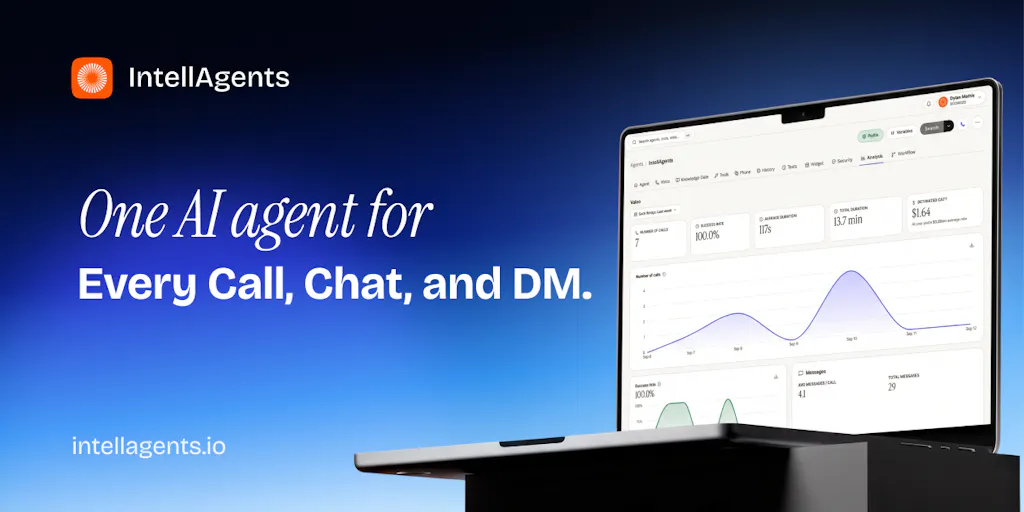
If you run social for a small brand, you already know the dirty secret of “omnichannel”: it’s a lie you tell in your bio. The DMs live in Instagram, the questions live in WhatsApp, the complaints live in Facebook comments, the “do you ship to X” lives in a website chat widget, and the actual paying customers keep calling a phone number nobody wants to staff. Every one of those is a separate tab, a separate login, a separate mental queue. So when a team like IntellAgents.io shows up on Product Hunt claiming one AI agent across calls, WhatsApp, Instagram, Facebook, Telegram, and web chat, the interesting question for a social media operator isn’t “is the AI good.” It’s “does this collapse the operational surface area I actually hate?” That’s the lens I want to use here, because most coverage of agentic AI for SMBs misses it.
What problem this actually solves (and for whom)
The maker’s framing, from the launch thread, is blunt: small businesses get inbound on five channels, each channel historically required its own tool, its own setup, and a human watching it. The pitch is that you configure a knowledge base once, and one agent handles voice calls, WhatsApp, Instagram, Facebook, Telegram, and website chat — 24⁄7, in up to 36 languages, per the maker’s claim. The team explicitly positions this against “five bolted-together integrations pretending to be unified.”
That last phrase is the whole thesis. I’ve stitched together enough chatbot stacks to know the pattern: a WhatsApp bot from vendor A, a voice agent from vendor B, a website widget from vendor C, and a Zapier duct-tape layer in the middle that breaks every time one API changes a field name. The failure mode isn’t that any single bot is bad — it’s that the customer experience is fragmented and the operator experience is worse. A customer messages on WhatsApp, gets no reply, calls the number, and starts from zero. From the customer’s POV, your brand has amnesia.
So the real product here, if it works, is shared memory across channels — not the AI. The AI is the delivery mechanism. That distinction matters, and it’s exactly what Gal Dayan of Dial pushed on in the comments: if someone messages on WhatsApp, doesn’t get what they need, then calls the same number, does the voice agent pick up that thread’s context, or does the call start cold? That’s the actual promise of “one agent” versus “five bots sharing a knowledge base.” As of the launch thread, that question wasn’t answered by the maker — which is worth flagging, because it’s the difference between a real product and a marketing claim.
Why this is a social media story, not just a support story
Here’s where I’d push back on the framing that this is “customer support software.” For most small brands I’ve worked with, the Instagram DM is the sales funnel. The WhatsApp thread is the lead qualification. The Facebook comment asking “how much?” is a conversion event waiting to happen. Support and social have collapsed into the same inbox, and the teams running them are usually one or two people. If a tool can genuinely hold context across those surfaces, it’s not a support tool — it’s a revenue tool that happens to look like support. That’s the framing I’d use if I were evaluating it for a client.
How it stacks up against what’s already out there
Let me name the incumbents honestly, because “AI agent for SMBs” is a crowded category and the launch copy doesn’t do a great job of placing itself.
On the social inbox side, you have ManyChat, Chatfuel, and the native automation inside Meta Business Suite. These are strong at Instagram and Facebook DM automation, weaker at voice, and generally not designed to share context with a phone line. On the voice side, you have Dial (whose founder showed up in the comments, which is a good sign for the space), plus a long tail of AI receptionists like Bland and Retell. These tend to be phone-first and channel-isolated by design. On the unified-inbox side, you have Gorgias, Zendesk, and Intercom — mature, expensive, and mostly built around email/ticket workflows rather than conversational DMs and voice calls. And on the “AI layer on top of everything” side, you have Chatbase, Voiceflow, and a dozen YC-batch clones.
My take: IntellAgents.io is trying to sit in the gap between ManyChat (great at DMs, no voice) and Dial (great at voice, no DMs). That’s a real gap. But it’s also the hardest gap to defend, because the two sides require genuinely different engineering — which brings us to Igor Gurovich’s comment.
The voice-vs-chat rendering problem nobody wants to talk about
Igor Gurovich, who works on voice AI, made the sharpest technical point in the thread: a knowledge base tuned for chat reads terribly out loud. A three-bullet answer that scans fine in WhatsApp becomes forty seconds of monologue on a call, and people hang up. He asked whether the team kept one source of truth with a voice-specific rendering layer, or whether makers have to write separate short answers for the phone channel.
This is not a nitpick. It’s the central engineering problem of “one brain, multi-channel.” In my own tests of similar tools, the failure mode is always the same: the chat bot answers in tidy paragraphs, the voice agent reads those paragraphs verbatim in a flat TTS voice, and the caller hangs up within 15 seconds. Watch time on a phone call is the brutal metric — there’s no scroll-past, no “I’ll read the rest later.” You either land the answer in the first sentence or you lose the call.
The maker’s response to this in the thread is, as of the scrape, not present. So I’d treat the “one knowledge base, all channels” claim as aspirational until someone demonstrates the rendering layer. If IntellAgents.io has solved it, that’s a genuine moat. If they haven’t, they’re shipping a chat bot with a phone number attached, and the voice side will underperform the DM side badly.
Where the math breaks
Let me do the operator’s math, because this is where most “AI agent” pitches fall apart for small teams.
If you’re a solo founder or a 2-person social team, you’re not paying for a tool that might handle voice well. You’re paying for a tool that reliably handles the 80% of inbound that is repetitive — hours, shipping, pricing, availability, “do you do custom orders.” The 20% that requires judgment still lands on you. So the ROI calculation isn’t “replace a night shift” (the maker’s framing). It’s “reduce the number of times I context-switch into a channel I wasn’t watching.” That’s a real but smaller win than the pitch implies, and it’s worth being honest about.
Also: 36 languages sounds impressive, but for most small brands, the realistic language set is two or three. The number is a flex, not a feature. I’d rather see the maker publish accuracy benchmarks per channel than a language count.
What creators and social teams can borrow from this, regardless of whether they buy
Even if you never touch IntellAgents.io, the launch is a useful mirror for how you’re running social right now. Three operational lessons I’d pull out:
1. Audit your inbound surface area this week. List every place a customer can message you: IG DMs, IG comments, FB Messenger, FB comments, WhatsApp, Telegram, website chat, phone, email, X DMs, TikTok comments, LinkedIn DMs. I’d bet most operators I know would find 8–12 surfaces, not 5. The point isn’t to unify them all — it’s to notice which ones you’re silently ignoring, because ignored DMs are the cheapest revenue leak in the creator economy.
2. Separate your knowledge base from your channel rendering. This is the transferable lesson from Igor’s comment. If you’re using ChatGPT or Claude to draft DM replies, you’re already doing this implicitly — but you should do it explicitly. Write your brand’s core answers once (pricing, shipping, hours, policies), then write channel-specific renderings: short and punchy for DMs, slightly longer for email, and much shorter for anything that might be read aloud. The “one source of truth” idea is good; the “one rendering” idea is a trap.
3. Treat cross-channel memory as the metric that matters. If you’re evaluating any AI inbox tool in 2025, the first question to ask a vendor is: “if a customer switches channels mid-conversation, does the agent know?” If the answer is vague, the tool is a chatbot, not an agent. This applies whether you’re looking at IntellAgents.io, ManyChat, Gorgias, or anything else.
Why TikTok and Instagram creators should care more than LinkedIn ones
If your audience lives on LinkedIn, they’ll email you. If your audience lives on TikTok or Instagram, they’ll DM you, comment on a Reel, and then — if they’re serious — try to find a phone number. That’s the funnel. So the value of a unified agent is highest for consumer-facing creators with high-volume, low-ticket inbound (coaching, merch, courses, services) and lowest for B2B creators whose leads are already routed through email and calendar tools. If you’re a B2B creator, this category is probably not for you yet. If you’re a consumer creator doing 200+ DMs a week, it’s worth a serious look.
Where I think this falls short (and what’s still unanswered)
A few honest limitations, some from the source and some from my own read:
The cross-channel memory question is unanswered. As of the launch thread, the maker hasn’t responded to Gal Dayan’s question about WhatsApp-to-voice continuity. Until that’s answered, the core differentiator is unproven.
The voice rendering question is unanswered. Same deal with Igor’s question. The maker’s response is not in the scrape. That’s two of the three hardest technical questions in the thread, unanswered on launch day.
Pricing is not disclosed. The Product Hunt page doesn’t list pricing, tiers, or usage limits. For an SMB tool, that’s a big omission — small businesses need to know whether this is $29/mo or $299/mo before they invest setup time.
No user counts, no accuracy benchmarks, no uptime claims. Not disclosed. I’m not going to invent them. But for a tool handling customer conversations, “how often does it get it wrong” is the only question that matters, and the launch doesn’t address it.
Platform API realities. Instagram, WhatsApp, and Facebook messaging all run through Meta’s Graph API, which has strict rate limits, review requirements, and policy constraints — especially around automated messaging. Any tool claiming to handle all three at scale is subject to those limits, and the launch copy doesn’t mention how it navigates them. Not a knock on IntellAgents specifically; a knock on the whole category’s marketing.
Who it’s NOT for: solo creators with under ~50 inbound messages a week (the setup cost won’t pay back), B2B creators whose leads flow through email, and anyone in a regulated industry (health, legal, finance) where AI-generated responses carry compliance risk. Also: anyone who needs deep CRM integration — the launch doesn’t mention HubSpot, Salesforce, or Pipedrive connections, and for a tool touching sales conversations, that’s a gap.
The “one brain” claim deserves more skepticism than it’s getting
The maker’s proudest claim — “genuinely one agent, one brain, one knowledge base — not five bolted-together integrations” — is also the claim I’d test hardest. In my experience, “unified” tools often mean “one UI over five backends,” and the seams show up exactly where you don’t want them: when a customer switches channels, when a knowledge base update propagates unevenly, when one channel’s API goes down and the agent silently stops responding there. The only way to know is to run a real test: same question, five channels, same moment, and see if the answers match. If they do, the claim holds. If they don’t, it’s marketing.
What I’d watch / test next
If you’re an operator evaluating this category — IntellAgents.io specifically or any competitor — here’s what I’d do this week:
- Run the five-channel test yourself. Pick one question (“do you ship internationally?”). Ask it via Instagram DM, WhatsApp, Facebook Messenger, website chat, and a phone call. Compare answers for consistency, tone, and length. If the voice answer is a paragraph read aloud, that’s your verdict.
- Test the channel-switch scenario. Start a conversation on WhatsApp, abandon it, then call the number. Does the agent reference the prior thread? This is the single best proxy for whether “one brain” is real.
- Ask the vendor two questions before you demo: “How do you handle voice-specific rendering of chat knowledge?” and “What’s your accuracy rate on the channels I care about?” If they can’t answer both, wait a quarter.
- Map your own inbound surfaces. Before buying anything, count where your customers actually message you. You may find the problem is smaller than the pitch — or bigger, and in a channel no tool covers yet.
- Watch the comment thread. If the maker answers Gal’s and Igor’s questions in the coming days, that’s a strong signal they’re building seriously. If the thread goes quiet, that’s a signal too.
The multi-channel inbox is the real product here, and it’s a genuinely good problem to solve. Whether IntellAgents.io is the team that solves it depends on two answers that, as of launch day, don’t exist yet. I’d bookmark it, not buy it — and I’d steal the “one knowledge base, many renderings” discipline for my own social workflow regardless.


