The quiet infrastructure problem behind every creator’s back office
If you run social for a living, you already know the content side is the fun part. The part nobody warns you about is the paperwork that piles up around the content: sponsorship contracts, brand deal invoices, affiliate statements, platform payout summaries, tax forms, usage-rights PDFs, and the endless stream of receipts your accountant wants in a folder by Friday. Most creators I know are still doing this by hand — downloading a PDF, squinting at a table that spans three pages, copying numbers into a spreadsheet, and praying the tax ID in the footer didn’t get mangled. That’s the actual reason a document-parsing launch matters to this audience, even though it looks like a developer tool on the surface. When Invofox opened its self-serve tier, the interesting story wasn’t the OCR pipeline — it was that the same extraction infrastructure enterprises guard behind six-figure contracts is now reachable with a signup form.
What Invofox actually solves (and why it’s not just a dev tool)
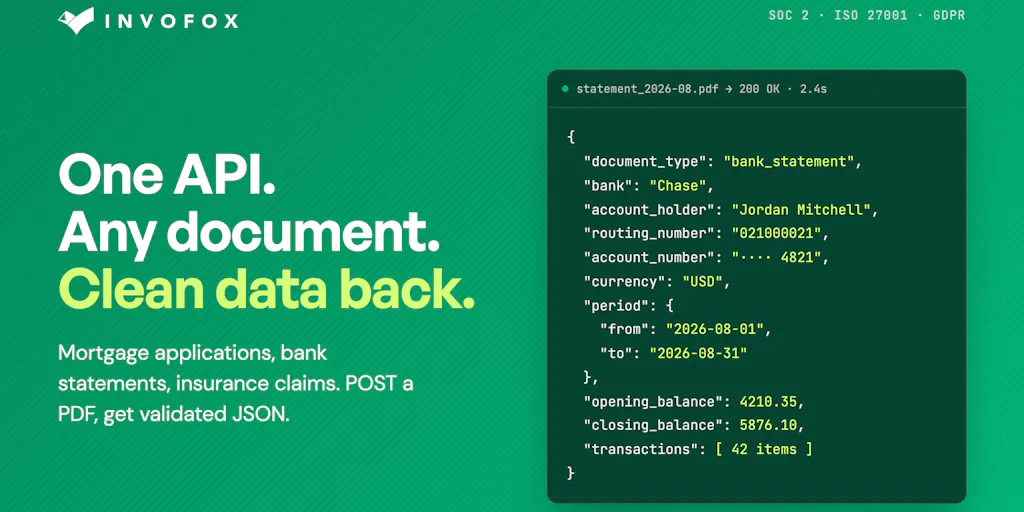
The maker’s framing is blunt and, frankly, refreshing: engineering teams were losing entire quarters to document processing. The weekend prototype works fine until real documents show up — scanned faxes, multi-document PDFs, tables that break across pages, tax IDs hiding in footers. At that point, per the launch post, two engineers end up maintaining an OCR pipeline instead of building the actual product. Invofox’s pitch is that they built that pipeline once, properly: intake, dual-pass OCR, splitting, classification, extraction, cross-field validation, confidence scoring, provenance, and a feedback loop that improves on your specific documents. You POST a file to one endpoint and get validated JSON back.
That’s the developer-facing summary. Here’s why I think creators and social media operators should read past it.
The creator back-office is a document pipeline you never named
Think about what actually flows through a mid-tier creator’s business in a month. A brand sends a campaign brief as a PDF. The signed contract comes back as a scan. The invoice you issue references a PO number buried in an email thread. The platform payout report is a CSV that doesn’t match the invoice total because of a currency conversion. Your accountant wants all of it reconciled. If you’re a solo operator, you’re the pipeline. If you’re a small team, someone on the team is the pipeline — and that person is usually also the one scheduling posts, cutting clips, and answering DMs.
The reason this matters more in 2026 than it did three years ago is volume. Creator businesses have gotten more complex: multi-platform revenue, affiliate networks, licensing deals, and sponsorship contracts with usage windows and exclusivity clauses. Every one of those generates a document. The creator economy has professionalized on the content side and stayed stubbornly manual on the admin side. I’d bet that’s where a lot of the next wave of creator tooling gets built — not another scheduler, but the unglamorous plumbing underneath.
Where the math breaks
Here’s the honest caveat. Most individual creators do not have enough document volume to justify wiring up an API. If you process ten invoices a month, a spreadsheet and a PDF reader are fine, and no amount of “validated JSON” changes that. The economics only flip when you hit one of three thresholds: you’re a team with shared finance workflows, you’re an agency running dozens of creator accounts, or you’re building a product that ingests documents on behalf of creators. That last category is the one to watch — it’s where the API model actually earns its keep.
How it differs from the tools you already pay for
Let me be precise about the comparison, because “AI document extraction” is a crowded category and the differences are structural, not cosmetic.
The obvious incumbent in the creator-adjacent world is Zapier, which many operators use to glue tools together. Zapier can move data between apps, and it has document-related integrations, but it isn’t an extraction engine — it’s a router. If your PDF is messy, Zapier will happily route the mess. The same logic applies to Make and similar automation platforms: they’re the pipes, not the refinery.
Then there’s the horizontal AI layer — tools like ChatGPT or Claude can read a document and pull fields out if you paste it in. I’ve done this myself for one-off contracts. It works surprisingly well for a single clean PDF. It falls apart the moment you need consistency across hundreds of documents, a defined schema, confidence scores, or an audit trail. Chat interfaces are not pipelines.
The closer comparison is the enterprise document-AI space — players like Google Document AI, AWS Textract, and Azure AI Document Intelligence. These are real, mature products. They’re also cloud-platform-shaped: you configure them inside an existing cloud account, and the pricing and setup assume you have engineering resources. Invofox’s differentiator, per the launch, is that it’s the same pipeline with a signup form instead of a sales call — and that accuracy is written into the SLA, with any document they get wrong being free. That last detail is the one I’d underline. It’s a pricing model that only makes sense if you’re confident in your extraction, and it shifts the risk off the buyer.
Why TikTok creators should care more than LinkedIn ones
This is a heuristic, not a rule, but it holds up in practice. TikTok-native creators tend to monetize through high-volume, low-ticket deals — affiliate links, brand campaigns, creator funds, gifting arrangements. That means lots of small documents: statements, payout reports, campaign invoices. Volume is exactly where manual processing breaks. LinkedIn-first creators, by contrast, tend to run fewer, larger B2B engagements — a consulting retainer, a sponsored series, a speaking fee. Fewer documents, higher stakes, more likely to involve a lawyer and an accountant who already have their own systems. If you’re in the first camp, the ROI on automating extraction is real. If you’re in the second, you probably don’t need this yet.
What social teams can borrow from the architecture
Even if you never touch Invofox, the way it’s described is a useful mental model for anyone running content operations at scale. The pipeline stages — intake, splitting, classification, extraction, cross-field validation, confidence scoring, provenance, feedback loop — map almost one-to-one onto a content repurposing workflow. Intake is your source asset. Splitting is cutting a long video into clips. Classification is tagging by platform and format. Extraction is pulling the hook, the CTA, the caption. Cross-field validation is checking that the caption matches the on-screen text and the hashtags match the platform. Confidence scoring is your own gut check on whether a clip will land. Provenance is knowing which source asset a clip came from so you can trace performance back. The feedback loop is your analytics review.
I’ve run repurposing workflows that skipped the provenance step, and it’s a mistake I’d flag to anyone: when a clip performs, you want to know instantly which long-form asset it came from so you can mine that source again. Teams that track this compound their wins. Teams that don’t are guessing.
What creators and social media teams can actually borrow
Three concrete things, in order of how quickly you can act on them.
First, treat your back office as a pipeline and name its stages. You don’t need software to do this — you need a shared doc that says: here’s how a brand deal goes from brief to signed contract to invoice to payment to reconciliation. Most creators I’ve talked to have never written this down. Writing it down is the prerequisite for automating any of it.
Second, separate routing from extraction in your own stack. If you’re already using Buffer, Hootsuite, Later, or Metricool for scheduling, you’ve outsourced the routing layer of your content. Do the same audit on your admin layer. Which parts are just moving data around, and which parts require actually reading a document? The second category is where a tool like Invofox fits; the first is where your existing automation already works.
Third, look at the free tier as a forcing function. The launch offer is 500 pages with no credit card, plus 1,000 extra for Product Hunt signups — the maker clarified in the comments that it’s actually 1,500 pages during the launch. That’s enough to run a real test on your messiest documents. The maker explicitly invited people to bring “the one that broke your last parser.” I’d take that invitation seriously, because the failure cases are where you learn whether a tool is actually useful or just good at demos.
The repurposing angle nobody talks about
Here’s a use case the launch didn’t mention but that I think is underexplored: extracting structured data from your own content archives. If you’ve been publishing for years, you have a graveyard of old assets — transcripts, scripts, carousel copy, thumbnail text. Running those through an extraction pipeline to build a searchable database of hooks, CTAs, and formats is a legitimate repurposing play. It’s not what Invofox is built for, and I’d flag that as my own extrapolation rather than a supported use case. But the underlying capability — turning unstructured documents into structured, queryable data — is exactly what a mature content operation needs.
Where my judgment says it falls short
Let me be direct about the gaps, because the launch page is a launch page and it’s doing launch-page things.
The pricing is described as per-page, going down with volume, with no credit system. That’s a clean model, but the actual numbers are not disclosed. For a creator trying to decide between this and, say, doing it manually, the missing number is the whole decision. I’d want to see the per-page rate at low volume before recommending anyone commit.
The accuracy claim is the headline, but the benchmarks aren’t public yet. A commenter asked for real-world benchmarks comparing extraction accuracy across invoices from different countries and formats, and the maker said they’re building exactly that and will release it publicly. Until that lands, the accuracy claim rests on the SLA and the free-if-wrong guarantee — which is a meaningful signal, but not the same as a published benchmark. I’d treat “accuracy is part of our SLAs” as a strong commitment and “we’re the most accurate” as unproven until the data shows up.
On data handling, the maker confirmed support for zero data retention and on-premise deployments when asked about sensitive information. That’s the right answer for anyone handling contracts with personal data or financial details. But it’s worth noting that on-premise deployment is a sales conversation, not a self-serve feature — so the “signup instead of a sales call” promise has an asterisk for the most security-sensitive users.
Finally, the integration story is thin in the source. There’s no mention of native connectors to the tools creators actually use — Notion, Airtable, Google Sheets, QuickBooks, Stripe. The API-first model means you can build those connections yourself, but “you can build it” and “it’s built” are different products. For a solo creator, that gap is the difference between useful and not.
Who this is NOT for
If you’re a solo creator doing under, say, a few dozen documents a month, this is probably overkill. If you don’t have anyone on your team who can write a POST request or configure a no-code automation to hit an endpoint, the API-first model is a wall, not a door. And if your document workflow is already handled by an accountant or a bookkeeper who has their own system, adding a layer on top may create more reconciliation work than it removes. My take: the sweet spot is small teams and agencies with real volume and at least one technical person, plus product builders who need extraction as a feature rather than a workflow.
What I’d watch / test next
If you want to act on this week rather than file it away, here’s what I’d do. First, count your documents. Actually count them — contracts, invoices, statements, receipts — for the last 30 days. If the number is under 30, close the tab and move on. If it’s over 100, you have a real problem worth solving. Second, pick your three messiest documents — the scanned ones, the multi-page tables, the ones with fields in weird places — and run them through the free tier. The 1,500-page launch offer is enough to test properly, and the free-if-wrong guarantee means a failure costs you nothing but time. Third, watch for the public benchmarks the maker said are coming; that’s the data point that will tell you whether the accuracy claim holds up across the invoice formats you actually receive. Fourth, if you’re building anything that touches creator finance — a dashboard, an agency tool, a repurposing pipeline — evaluate the API as infrastructure rather than as an end-user product. That’s where the model makes the most sense.
The broader takeaway is bigger than one launch. The creator economy has spent a decade building better cameras, better editors, better schedulers, and better analytics. It has spent almost no time building better back-office plumbing. The tools that win the next phase won’t be the ones that make content prettier — they’ll be the ones that make the business behind the content less stupid. Document extraction is a boring answer to an exciting question. Boring is usually where the leverage is.


