The instructional-design gap is the next frontier for creator content — and Keet is a useful provocation
Every social media operator I know is quietly fighting the same problem: they can produce content at industrial scale, but they can’t make it stick. A Reel gets 40,000 views and three saves. A carousel gets screenshotted and never opened again. The algorithm rewards reach; the audience rewards retention; almost nobody rewards learning. That gap — between content that performs and content that teaches — is where a product like Keet becomes interesting to me, not as a consumer learning app, but as a signal about where creator tooling is heading. The maker, Tommy Tsai, frames it plainly: they built Keet because self-teaching via YouTube or AI chat “lacked instructional design,” and progress was “slower and more difficult to measure.” That sentence is the whole thesis of the next two years of creator-economy tooling, and it’s worth unpacking for anyone who runs accounts for a living.
What Keet actually is, and what problem it’s really solving
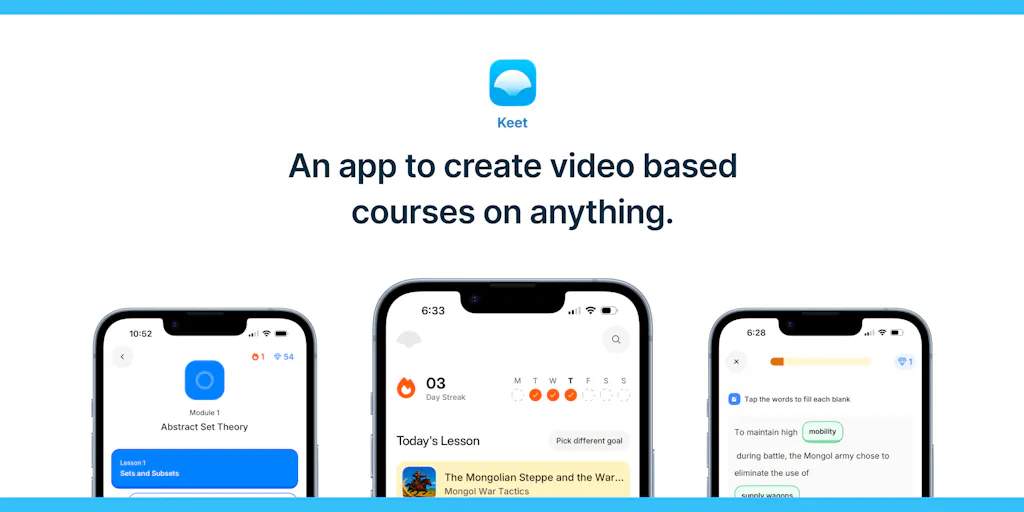
Let me strip the launch-page gloss. Keet is a mobile app — available on the App Store — that teaches “anything using videos.” The distinguishing claim, per the maker, is that its courses “mirror a real curriculum to help you learn over an extended period of time.” In other words, it’s not a video library and not a chatbot; it’s a sequenced learning path with video as the delivery mechanism.
That sounds modest. It isn’t, if you’ve ever tried to learn something non-trivial from short-form video. The failure mode of YouTube-as-classroom is well documented anecdotally: you watch a 22-minute explainer, feel informed, and retain almost none of it because there’s no spaced repetition, no assessment, no prerequisite chain. The failure mode of AI chat as tutor is the opposite — infinite patience, zero curriculum. You ask good questions and get good answers, but you never know what you don’t know, because you’re the one steering. Keet’s pitch is that it sits between those two: the autonomy of self-directed learning, wrapped in a structure that makes progress legible.
A commenter, Nika, described it as applying “the Duolingo model… to a wider scope of knowledge.” That’s the cleanest one-line framing anyone produced on the thread, and it’s the right mental model. Duolingo’s genius was never its content — it was the streak, the unit progression, the daily cadence, the way it turned an unbounded skill into a bounded, checkable loop. Keet is betting that same loop works for topics beyond language.
Why this matters more to short-form creators than to course sellers
Here’s where I’ll put my operator hat on. If you’re a creator who monetizes through a Teachable or Kajabi course, Keet is not your competitor — it’s a distribution channel you should be studying. The reason: short-form platforms have trained audiences to expect atomic content, and long-form course platforms still expect monolithic content. The gap in the middle — bite-sized, sequenced, video-first, measurable — is underserved. If Keet gains traction, it becomes a place where a creator’s existing TikTok or YouTube catalog can be recompiled into a curriculum without re-shooting anything. That’s a repurposing workflow, and repurposing workflows are where creator margins live.
I’ve run this experiment manually. When I took a 40-video YouTube series on a niche topic and re-cut it into a 12-part email course with a weekly cadence, completion rates were meaningfully higher than the same content delivered as a “watch the playlist” link — not because the content changed, but because the container changed. Keet is trying to productize that container. My take: the container is the product. The videos are commodity.
How it stacks up against the incumbents you already use
The honest comparison set isn’t other learning apps. It’s the tools creators and social teams already pay for, and whether Keet does anything they can’t.
- YouTube — free, infinite, zero structure. Keet’s entire wedge is the structure YouTube refuses to impose.
- Duolingo — the gamification benchmark. Keet borrows the model but claims a wider scope. Whether it executes the streak/retention mechanics as well is not disclosed and, frankly, is the whole ballgame.
- Coursera and Udemy — curriculum-first, but heavy, credentialed, and slow. Keet is mobile-native and lightweight by comparison.
- Khan Academy — the closest philosophical cousin: sequenced, mastery-based, free-at-scale. Keet is a paid mobile app (pricing not disclosed on the launch page), so the comparison is instructive about where the value is assumed to sit.
- Notion / Obsidian — where a lot of self-directed learners actually keep their “curriculum.” Keet’s bet is that a notes app can’t teach you; it can only store what you taught yourself.
For social media operators specifically, the more useful comparison is to scheduling and analytics tools like Buffer, Hootsuite, Later, and Metricool. Those tools optimize for output — more posts, more platforms, more reach. None of them optimize for outcome. That’s the asymmetry Keet is implicitly pointing at, and it’s the same asymmetry that AI content tools like Jasper and Copy.ai have created on the writing side: we got very good at producing, and no better at measuring whether any of it landed.
Where the math breaks
Here’s my skepticism, stated plainly. A curriculum requires a defined endpoint. “Learn anything” is a marketing phrase, not a curriculum. Duolingo works because “Spanish” is bounded — there’s a CEFR ladder, a vocabulary ceiling, a test at the end. “Anything” has no ladder. If Keet’s courses are user- or AI-generated, the sequencing quality is only as good as the prompt behind it, and I’ve seen enough AI-generated syllabi to know that most of them are a list of topics wearing a trench coat. The maker’s claim is that courses “mirror a real curriculum” — I’d want to see who authors them, how prerequisites are enforced, and whether there’s any assessment layer at all. None of that is disclosed on the launch page. Until it is, I’d treat “curriculum” as an aspiration, not a spec.
What creators and social teams should steal from this launch
Even if you never open Keet, there are three transferable moves in its positioning that I think every social media operator should run this quarter.
1. Stop publishing atoms. Start publishing arcs.
The single biggest upgrade most accounts can make is converting a feed of standalone posts into a sequenced series with a beginning, a middle, and a payoff. This is what MrBeast does at the video level and what Duolingo does at the app level. On Instagram, it looks like a 7-part carousel series with a numbered visual system. On TikTok, it’s a pinned “start here” video that links to a playlist. On LinkedIn, it’s a recurring column with a running thread. The mechanics differ; the principle is identical — give the audience a reason to come back that isn’t just “the algorithm showed them another one.”
2. Instrument for retention, not just reach.
Most social teams I’ve audited track impressions, reach, and follower growth — the vanity layer. Almost none track completion or return rate. If you’re publishing a 60-second Reel, what percentage watch to the end? If you’re publishing an 8-slide carousel, how many swipe to slide 8? If you’re publishing a YouTube video, what’s the average view duration as a share of total? These are the metrics that separate content that teaches from content that merely appears. Keet’s entire premise is that “progress was slower and more difficult to measure” on unstructured platforms. That’s a measurement problem, and measurement problems are solvable with the tools you already have — YouTube Studio, Meta Business Suite, TikTok Analytics, and third-party layers like Metricool or Sprout Social all expose retention data you’re probably ignoring.
3. Treat your back catalog as a curriculum, not an archive.
This is the one I’d act on this week. Pull your last 50 posts. Group them by theme. Ask: if a new follower wanted to go from zero to competent in your niche using only your content, in what order would they watch? That ordering is a curriculum. You don’t need Keet to ship it — you need a pinned post, a landing page, or an email sequence. But Keet’s framing is a useful reminder that the archive is an asset, and most creators treat it as landfill.
Where I think Keet falls short — and who shouldn’t bother
Let me be balanced, because the launch thread was almost entirely congratulatory and that’s not useful to anyone evaluating it.
First, platform. It’s iOS-only, per the App Store link. Android users — which is a large share of the global learning market — are locked out for now. If you’re a creator thinking about building curriculum-style content for a Keet-shaped audience, you’re building for a subset of a subset.
Second, pricing and business model are not disclosed on the launch page. I don’t know if it’s subscription, one-time, freemium, or ad-supported. That matters enormously for whether it becomes a serious distribution channel or a hobby app.
Third, the “learn anything” claim is doing a lot of work. Duolingo works because the domain is narrow and the pedagogy is researched. A general-purpose learning app has to solve curriculum generation, sequencing, assessment, and motivation across every subject simultaneously. That’s a hard problem — arguably harder than anything the scheduling tools I use daily have ever attempted. I’d bet the early experience is excellent for a handful of well-curated topics and thin for everything else. That’s normal for a v1, but it’s worth naming.
Fourth, it’s not a social media tool. If you came here hoping for a scheduling or analytics upgrade, this isn’t it. Keet is a consumer learning app. Its relevance to you is strategic — it’s a signal about audience expectations — not tactical.
Who it’s not for: teams whose entire content motion is awareness and reach; anyone whose audience lives on Android; anyone who needs a curriculum they can white-label and sell. Keet isn’t that, at least not yet.
A sidebar for anyone building in the creator-tools space
The most interesting thing about this launch isn’t the app. It’s the comment thread. Every response was a version of “I like how X is applied to Y” — the Duolingo model applied to general knowledge. That’s the current playbook for consumer products: take a proven retention mechanic from one category, port it to another, and let the mechanic do the heavy lifting. I’d watch for the same pattern in creator tooling: the Duolingo streak applied to posting cadence; the Spotify Wrapped applied to creator analytics; the Strava segment leaderboard applied to community engagement. The products that win the next cycle won’t invent new mechanics. They’ll transplant old ones into categories that never had them.
What I’d watch / test next
Three concrete things I’d do this week, regardless of whether you ever install Keet.
One: audit your own retention data. Open YouTube Studio and sort your last 20 videos by average view duration, not views. Open Meta Business Suite and look at carousel swipe-through. The pattern will tell you which of your content is actually teaching and which is just performing. I’d bet the two lists are almost entirely non-overlapping.
Two: build one sequenced series. Pick a topic you’ve already covered in scattered posts. Reorder them into a 5–7 part arc. Publish it with a numbered visual system and a pinned “start here” entry point. Track completion across the series versus your baseline. This is the lowest-cost way to test whether the “curriculum” thesis holds for your specific audience.
Three: watch Keet’s next 90 days. Specifically: does it ship Android, does it disclose pricing, and does it publish anything about who authors its courses and how progress is assessed? Those three signals will tell you whether it’s becoming a real distribution channel for creator content or staying a well-intentioned v1. The Product Hunt page is where that news will land first.
The broader lesson for social media operators is uncomfortable but useful: we’ve spent five years getting better at distribution and almost no time getting better at instruction. The platforms rewarded the former. The audiences are starting to demand the latter. Keet is one small bet on that shift. I wouldn’t bet my content strategy on it — but I would absolutely bet my content strategy on the shift it’s pointing at.


