Why a Vibe-Coding Architecture Tool Matters to People Who Never Write Code
Let me be blunt: if you run social accounts for a living, you probably don’t care about visualizing code architecture. You care about shipping content, growing audiences, and keeping the algorithm from eating your reach alive. But here’s the thing — the creator economy runs on tools now, and the smartest operators I know are building their own small automations, scraping their own analytics, and yes, vibe-coding their way through custom dashboards that Buffer and Hootsuite can’t give them. When I started scripting my own content repurposing pipelines last year, I hit a wall that had nothing to do with creativity and everything to do with not understanding what the AI had actually generated. That’s where Lucid Train enters the conversation — not as another shiny toy for developers, but as a window into a problem every serious social media operator is about to face: trusting AI-generated work you didn’t write and can’t fully see.
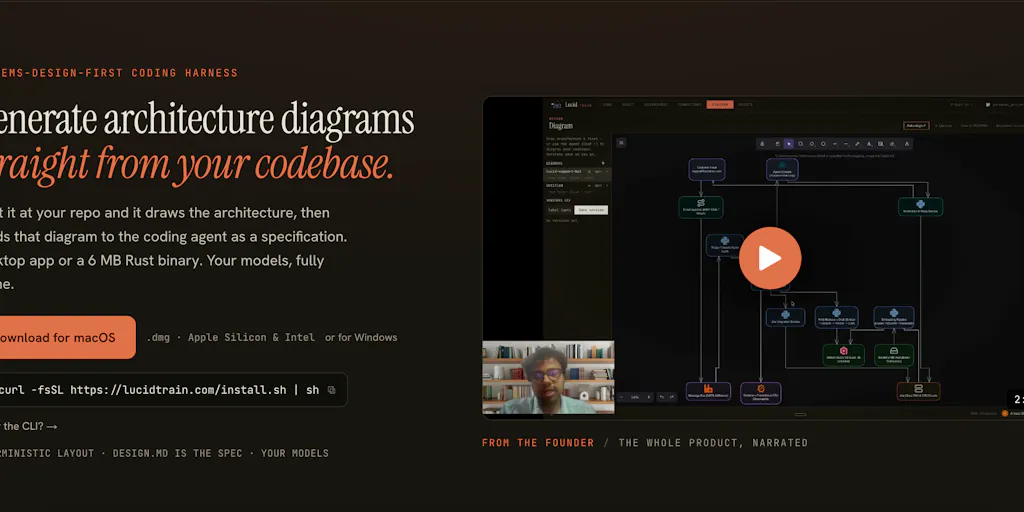
The maker, Arnab Bhattacharya, built this because he wasn’t sure what Claude or Codex wrote during his own vibe-coding sessions. That’s a confession most tool builders won’t make publicly. And his solution — generating system specs offline before handing them to an AI agent — is the kind of operational discipline that translates directly to how we should be running our content operations. We’re all about to be managing AI that drafts our captions, edits our video, and schedules our posts. The question isn’t whether we’ll use it; it’s whether we’ll understand what it’s doing well enough to catch the disasters before they go live.
The Actual Problem: You Can’t Fix What You Can’t See
Here’s a scenario that will feel familiar if you’ve been in the content game for more than a year. You’re running a brand account across Instagram, TikTok, and YouTube Shorts. You’ve got a content calendar that’s 90% planned, and you’ve started using AI tools to draft hooks, write caption variations, and even generate thumbnail concepts. You’re saving hours. But then one Tuesday, a draft goes out that’s subtly off-brand — the voice is wrong, the call-to-action is confusing, and you can’t figure out why because you didn’t write it and you don’t have visibility into how the AI arrived at that output.
That’s the exact problem Lucid Train is trying to solve, except for code instead of content. The maker’s insight is simple: when you’re vibe-coding — which is just the developer version of what we do when we prompt an AI to write a caption or generate a content brief — you’re handing over control without visibility. You’re trusting that the output is correct, but you have no map of the system that produced it. For developers, that means architecture you can’t visualize. For creators, it means content workflows you can’t audit.
The tool generates system specs offline before you hand them to an AI agent. That’s a workflow shift that matters more than the specific product features. In my own tests of similar AI-assisted workflows, the biggest time sink isn’t the generation — it’s the review. I’ve spent hours reading through AI-generated content trying to figure out if it’s on-strategy, only to realize I don’t have a clear framework for what “on-strategy” means in that specific context. The same thing happens to developers who hand a vague prompt to Claude and get back a mess of code that sort of works but nobody fully understands.
What Lucid Train does differently is force you to define the system before you generate it. You create the spec first, then the AI fills in the implementation. That’s a fundamentally different approach from the “prompt and pray” method most of us are using right now. For social media operators, the lesson is transferable even if the tool isn’t directly useful: define the content system before you let AI generate the content. Know what your brand voice is, what your content pillars are, what your posting cadence should be — then let the AI execute against that spec rather than inventing it from scratch.
Why TikTok Creators Should Care More Than LinkedIn Ones
The short-form video platforms are where vibe-coding culture meets content culture most directly. TikTok’s algorithm rewards experimentation, and creators who are testing new formats every week are essentially vibe-coding their content strategy — throwing things at the wall, seeing what sticks, and iterating fast. The problem is that when something does work, you often can’t replicate it because you don’t understand why it worked. You had a video that hit 500K views, but was it the hook, the pacing, the sound choice, or just luck? Without a system spec — a documented framework for what you’re trying to do and how each element contributes — you’re just gambling.
LinkedIn creators, by contrast, are more deliberate. They’re building personal brands around specific expertise, and their content is more formulaic by nature. They might benefit less from this kind of visualization tool because their workflows are already more structured. But for TikTok and Instagram Reels creators who are moving fast and iterating constantly, the ability to see the architecture of what you’re building — even if it’s just a content framework rather than code — is genuinely valuable. The tool itself is for developers, but the philosophy behind it is directly applicable to anyone who’s using AI to generate content at scale.
How This Differs From the Incumbents
If you’re a social media operator, you’re probably thinking: “Okay, but I already have Canva for design, CapCut for video editing, and Buffer for scheduling. Why do I care about a code visualization tool?” That’s fair. But the comparison isn’t between Lucid Train and the content creation stack — it’s between this tool and the AI coding assistants that are becoming part of every operator’s toolkit.
Tools like GitHub Copilot, Cursor, and the various AI coding agents that have exploded over the past year are all “prompt and pray” in their default mode. You describe what you want, the AI generates it, and you either trust it or spend hours debugging. Lucid Train takes the opposite approach: generate the architecture first, validate it, then let the AI fill in the details. It’s the difference between asking a contractor to build you a house without blueprints versus handing them a detailed spec and saying “build exactly this.”
One commenter on the launch page noted that this approach is “a game-changer for working with legacy code” because you can generate system specs offline before handing them to an agent. That’s a real pain point. Anyone who’s tried to onboard an AI agent to an existing codebase knows the struggle — the AI doesn’t understand the architecture, makes assumptions that are wrong, and produces code that doesn’t fit the existing patterns. The same thing happens when you try to onboard an AI content assistant to your existing brand voice. It doesn’t know your tone, your audience, or your content pillars unless you explicitly tell it — and most of us don’t have that spec written down.
Another commenter highlighted that Lucid Train lets you use any AI model of your choice, not limited to Claude or Codex. That’s a significant differentiator in a market where most tools are locking you into their preferred model. For social media operators, this is a reminder that model choice matters. Different AI models have different strengths — some are better at creative writing, some at structured analysis, some at understanding nuance. If you’re building a content operation around AI, you want the flexibility to use the best tool for each job, not be locked into whatever the platform defaults to.
What Creators and Social Media Teams Can Borrow From This
Let me give you the practical transferable lessons, because I don’t think you should rush out and buy a code visualization tool if you’re not a developer. But the philosophy behind Lucid Train has direct applications to content operations.
First: write your content spec before you let AI generate anything. Most of us are treating AI like a magic box — we type a prompt, get output, and then edit it. That’s backwards. The right approach is to define your content system first: what are your content pillars, what’s your brand voice, what are your posting cadences, what are your engagement goals? Write that down, make it a document, and then feed that document to the AI as context before you ask it to generate anything. This is exactly what Lucid Train does for code — it creates the system spec first, then hands it to the AI. You should do the same for content.
Second: audit your AI-generated content against your spec. The maker of Lucid Train built this tool because he wasn’t sure what the AI had written. That’s the same distrust we should have for AI-generated content. Before you schedule that batch of 30 posts across 5 platforms (which I did last month, by the way), check each one against your spec. Does it match your brand voice? Does it serve your content pillars? Does it have the right call-to-action? Most of us skip this step because it takes time, but it’s the difference between using AI as a tool and being used by it.
Third: build your own “offline spec” workflow. The offline aspect of Lucid Train is worth noting — the maker emphasizes generating system specs offline before handing them to an agent. For content operations, this means doing your strategic thinking without AI assistance first. Map out your content calendar, define your themes, outline your posts — then use AI to fill in the details. This keeps you in control of the strategy while using AI for execution. It’s a small workflow change that makes a huge difference in output quality.
Where the Math Breaks
Here’s where I have to be honest about the limitations. Generating system specs offline is great when you have a clear understanding of what you want to build. But content creation is messier than software development. Your content strategy evolves based on what’s working, what the algorithm is rewarding, and what your audience is responding to. You can’t always spec that out in advance because you don’t know what’s going to work until you try it.
The same critique applies to Lucid Train itself. If you’re building something genuinely novel, you might not have a clear architecture in mind — you’re exploring. The tool’s approach works best when you know what you want and need help implementing it, not when you’re still figuring out what’s possible. For creators, this means the spec-first approach works for batch content — the weekly Instagram carousels, the recurring YouTube formats — but not for experimental content where you’re testing new ideas. You need both modes in your workflow.
Where My Judgment Says It Falls Short
Let me be direct about the limitations of Lucid Train as a product, because I’m not here to hype something I haven’t tested. The launch page is sparse on specifics — there’s no pricing information, no user count, no detailed feature list. The maker’s description is a single sentence: “I was not sure what claude or codex wrote during my vibe coding sessions. So I developed an app that can be used to visualize the architecture of the not so sloppy code 😅.” That’s a personal pain point, not a product roadmap.
The comments are positive, but they’re also from a small sample size — three comments at the time of the scrape. One user praised the “local-first approach” and generating system specs offline before handing them to an agent, which suggests the tool does have a thoughtful design philosophy. Another noted that you can use any AI model of your choice, which is a real advantage. But there’s no information about how the visualization works, what platforms it supports, or whether it integrates with existing development workflows.
My honest assessment: this is an early-stage tool from a maker who identified a real problem and built a solution for himself. That’s exactly how good tools start. But it’s not yet a mature product that I’d recommend to non-developers, and even for developers, I’d want to see more evidence that it works at scale before building my workflow around it. The philosophy is sound; the execution is unproven.
For social media operators specifically, this tool is probably not something you’ll use directly unless you’re also doing development work. But the approach — spec first, then generate, then audit — is something you should adopt immediately. And if you’re building custom tools for your content operation, this is worth watching as it matures.
What I’d Watch / Test Next
Here’s what I’d do this week if I were you, regardless of whether you ever touch Lucid Train itself:
First, write your content spec. Spend 30 minutes documenting your brand voice, content pillars, target audience, and posting cadence. Make it concrete enough that someone else could generate on-brand content using only your spec. This is your “system spec” — the document you’ll hand to any AI tool before asking it to create content.
Second, test the spec-first workflow with your existing AI tools. Pick one content format — say, Instagram carousels — and write a detailed spec for what a good carousel looks like in your brand. Then feed that spec to your AI tool of choice and see if the output is better than your usual prompt-and-pray approach. I’d bet you’ll see a noticeable improvement in quality and consistency. Track the results over a week and compare engagement rates against your previous content.
Third, audit your AI-generated content against your spec before publishing. For the next 10 posts you generate with AI assistance, check each one against your spec before it goes live. Note where it deviates and why. This will tell you where your spec is incomplete and where the AI is making assumptions you didn’t intend. That audit trail is your version of visualizing the architecture — it shows you what the system is actually producing, not just what you asked for.
Fourth, keep an eye on how Lucid Train evolves. The maker is clearly thinking about the right problems, and the local-first approach is a good sign for anyone concerned about privacy and data control. If it gains traction, it could become a standard part of the AI development workflow — and the lessons it teaches about system visualization will apply to content operations as well.
The creator economy is about to get flooded with AI-generated content, and the operators who win will be the ones who can maintain quality and consistency at scale. That requires visibility into what your AI tools are actually doing, not just blind trust in their output. Lucid Train is a small tool with a big lesson: before you let AI build anything, make sure you understand the architecture you’re asking it to create. Apply that lesson to your content operations, and you’ll be ahead of most of your competitors within a month.


