The “first useful reply” window is the real distribution channel now — and almost nobody is staffing it
If you run social for a product, a creator brand, or an agency client, you already know the dirty secret of the last two years: the highest-intent traffic you’ll ever get doesn’t come from a scheduled post. It comes from a stranger asking a question in a public thread at 11pm, and someone on your team happening to be awake, scrolling, and fast enough to answer before the thread dies. Kevin Wang’s framing of this on Product Hunt is the cleanest I’ve seen: “The first two or three people who reply with something useful get the click. By the next morning the thread is done.” That’s not a growth-hack observation, it’s an operational one. It means your distribution model has a staffing problem, not a content problem. lurk is Wang’s attempt to solve the staffing half — and it’s worth dissecting, because the underlying pattern applies whether or not you ever install it.
What lurk actually does, and what it deliberately refuses to do
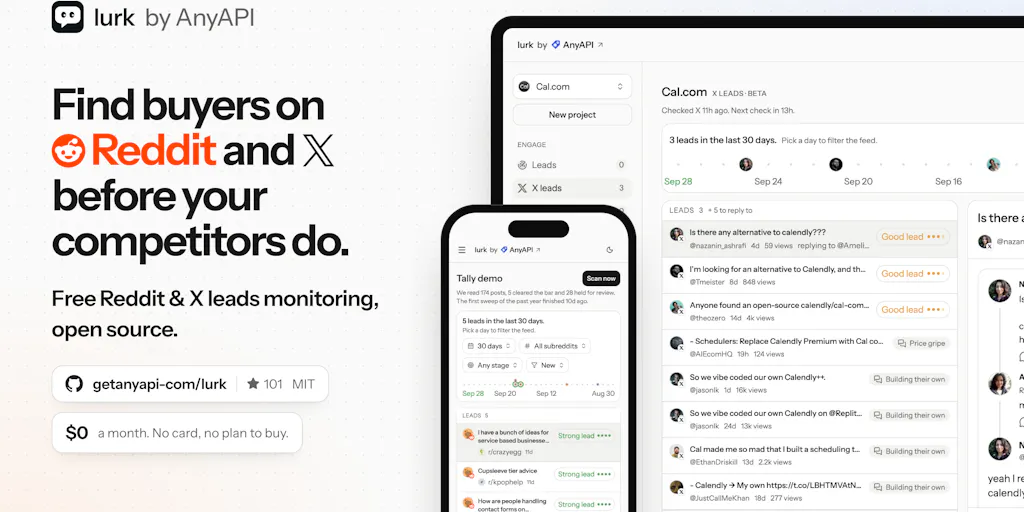
The pitch is narrow on purpose. You paste your URL, lurk works out who buys your product and where those people post, then it watches Reddit and X and surfaces posts with a one-sentence explanation of why each one is worth your time. Wang says every post is read by “Jev” before it reaches you — an AI classification/scoring layer, which he later credits alongside AnyAPI as the reason the product can be free at all. Leads land in email, Slack, or Discord.
The part I find genuinely interesting isn’t the monitoring. Plenty of tools monitor keywords. It’s the explicit refusal: “It never posts or drafts replies for you. It finds the conversation; the words are yours.” In a market where every AI social tool is racing to auto-generate comments, auto-DM, and auto-reply, that’s a contrarian product decision, and I think it’s the right one — more on why below.
The commercial model is also unusual. It’s free, there’s no paid plan, and it’s MIT-licensed — docker compose up and, per Wang, “there are no limits at all.” That’s a self-hostable, open-source positioning you basically never see in the social listening category.
The mechanics that matter more than the marketing copy
Strip away the launch-day framing and lurk is three systems bolted together:
- A scraper/ingestion layer pulling Reddit and X data cheaply enough to give away (Wang’s stated reason the economics work).
- An ICP inference step — “it works out who buys and where they post” — which is the hard, fuzzy part. Get this wrong and you’re monitoring the wrong subreddits forever.
- A relevance classifier that compresses each candidate post into one sentence of justification.
That third piece is the actual product. Keyword alerts are commodities; the reason they fail is signal-to-noise. As one commenter, Sofia Clerici, put it, “keyword alerts alone turn into noise after a couple days.” A one-line “why this matters to you” is the difference between a tool you check daily and a tool you mute in week two.
How it stacks up against what you’re probably already paying for
Here’s where I’d push back on treating lurk as a drop-in replacement for anything. It isn’t, and Wang doesn’t claim it is.
If you’re a social media manager running brand accounts, your stack is probably some combination of Buffer, Hootsuite, Later, or Metricool for publishing and analytics, plus maybe Brand24 or Mention for listening. Those tools solve a different problem: they help you broadcast and measure. lurk doesn’t publish, doesn’t schedule, doesn’t give you engagement rate or UTM-attributed conversions. It sits upstream of all of that — it’s a demand-signal detector, not a channel manager.
The closer comparison is actually SparkToro for audience research or a hand-rolled F5Bot setup for Reddit keyword pings. F5Bot is free too, but it’s pure keyword matching — no ICP inference, no relevance scoring, no “why this post” summary. lurk is essentially F5Bot with a judgment layer on top, plus X coverage and a self-host path.
Why TikTok and Instagram creators should care less than Reddit-native founders
I want to be honest about the audience fit, because I think a lot of creators will read this launch and get excited for the wrong reasons.
If your growth engine is short-form video on TikTok or Instagram Reels, lurk is close to useless to you. There is no “first useful reply wins” dynamic on a For You Page. Discovery there is algorithmic, watch-time-driven, and largely decoupled from whether you showed up early in a comment section. The platforms lurk watches — Reddit and X — reward timing and text, not production value.
Where it flips: if you sell a tool, a course, a newsletter, or any product with a searchable problem statement, Reddit and X threads are where high-intent buyers actually type their questions. That’s especially true for LinkedIn B2B operators who’ve watched organic reach on the feed compress and are quietly moving effort into community channels. And it’s true for indie founders on Product Hunt itself, where the same “first useful reply” pattern plays out in launch comment threads every single day.
My take: the platform you post on and the platform you listen on are increasingly different, and most social teams haven’t split those budgets yet.
The strategic lesson creators can steal, tool or no tool
Even if you never touch lurk, the launch is a useful mirror for how you’re allocating attention. Three things I’d pull out.
You cannot schedule your way into a conversation
Scheduling tools optimized the output side of social — batch a month of posts, queue them, forget it. That’s fine for brand presence. It is structurally incapable of capturing conversational demand, because conversations are timestamped and perishable. If your entire social operation is a content calendar in Buffer with zero human monitoring of relevant communities, you’re running a megaphone and calling it a strategy. I’ve watched teams spend six figures a year on content production and zero dollars on “who is answering the questions our buyers are asking right now.” That ratio is backwards for most early-stage products.
The one-sentence justification is a workflow primitive worth copying
The single best idea in lurk isn’t the scraping — it’s forcing every surfaced item to come with a reason. I’d steal that pattern for internal triage even without the tool: whenever you route a lead, a comment, or a DM to a teammate, require a one-line “why this matters.” It kills the “here’s a link, figure it out” handoff that makes social teams slow. In my experience running multi-platform accounts, the bottleneck is rarely finding opportunities — it’s the friction of deciding which ones deserve a human.
Human-in-the-loop is a feature, not a limitation
Wang’s insistence that lurk “never posts or drafts replies for you” runs against the entire auto-engagement category — the tools that mass-comment on posts to farm visibility. I think he’s right to draw that line, and here’s the operator’s version of the argument: automated replies on Reddit and X get accounts nuked, get brands ratioed, and produce the kind of hollow engagement that converts nobody. The value of a tool like this is finding the moment. The value of a human is being the moment. If you automate both halves, you’ve built a spam cannon with a scoring function.
Where I think it falls short, and who shouldn’t bother
Now the honest part, because a launch thread is not a product review and I’d rather you go in clear-eyed.
Reddit access is the elephant. The very first comment on the launch, from Chip Hunnicutt, is the right question: “Reddit has clamped down on bot access. Is this able to get around that?” Wang’s reply is reassuring but vague — “Yup, and we only give you the leads that you decide you want to interact with.” He doesn’t explain how the access works, and that’s the load-bearing detail. Reddit’s API pricing and anti-scraping posture have broken a lot of listening tools. If lurk’s ingestion depends on scraping that Reddit can throttle or block at any time, the product’s reliability is rented, not owned. I’d want to know the failure mode before I built a daily habit on it. (Not disclosed in the thread.)
Self-hosting isn’t a feature for most social teams. The MIT license and docker compose up story is genuinely generous, but when someone asked whether the open-source version updates alongside the main product, Wang’s answer was “Not automatically but you can pull the new containers when there’s updates.” For a solo technical founder, that’s fine. For a social media manager or an agency without a dev on staff, that’s a non-starter — you’re dependent on the hosted version and on the maintainer’s cadence. “Free and open source” and “operationally low-effort” are not the same promise, and this product is clearly the former.
It’s a top-of-funnel signal tool, not a growth engine. lurk tells you where conversations are. It does not tell you what to say, doesn’t track whether your reply converted, and doesn’t close the loop into your CRM or analytics. If you’re expecting it to move a metric, you’re expecting the wrong thing. It moves your attention, and attention only becomes revenue through a human who shows up and writes something good.
The launch itself had a tell. Commenter Josh Marchand noticed the marketing site shipped with three alternative designs live — “potentially a leftover AI artifact.” Wang owned it with good humor (“Ship so fast that you leave the variants in!”). It’s a charming moment and it says something real about the product’s maturity stage: this is a fast, scrappy, solo-operator build, not an enterprise-grade listening platform. Calibrate your expectations to that.
Who this is actually for
- Indie founders and technical solo marketers who live in Reddit and X anyway and want to stop refreshing searches manually. Strong fit.
- B2B and dev-tool teams whose buyers ask questions in public forums. Strong fit.
- Agencies with a technical person who can self-host and wants a free listening layer. Decent fit.
- Consumer short-form creators whose growth is video-first. Poor fit.
- Non-technical social managers who need a turnkey, supported, SLA-backed tool. Poor fit today — you’d be beta-testing someone’s side project.
What I’d watch / test next
If the “first useful reply wins” pattern resonates, here’s what I’d actually do this week — tool or no tool.
First, run a manual version before you automate. Pick the three communities where your buyers genuinely ask questions, and for five days, spend fifteen minutes a day just reading new posts and noting which ones you would have answered. That tells you whether the opportunity volume justifies a tool at all. If you find two or three worth-your-time threads a day, you have a real channel; if you find none, no software will fix that.
Second, if you want to try lurk, start with the hosted version and a narrow ICP definition — one product, one clear buyer. Vague inputs produce vague leads, and Wang explicitly asked for feedback on “the bad leads too,” which tells you the scoring is still being tuned. Treat the first two weeks as calibration, not conversion.
Third, pressure-test the Reddit dependency before you rely on it. Watch whether leads keep flowing consistently over a couple of weeks, and keep a fallback like F5Bot running in parallel so you’re not blind if ingestion breaks.
Fourth, steal the workflow even if you skip the tool: whatever listening setup you use, make every routed opportunity carry a one-line reason, and keep a human on the reply. The finding is automatable. The being-there isn’t — and that’s exactly why it still works.