The email stack nobody wants to own — and why social operators should care
If you run social for a living, you probably think email infrastructure is somebody else’s problem. It isn’t. Every DM automation, every newsletter-to-Instagram funnel, every “link in bio” capture form eventually dumps a human being into an inbox — and that inbox is usually three disconnected tools duct-taped together. When deliverability breaks, the person who gets blamed is whoever touched the campaign last, which is often the social or content lead. That’s why Mailyte, a new open-source email platform from Techies Africa, is worth ten minutes of your attention even if you never send a transactional email in your life. It’s a small launch with a big thesis: stop paying three vendors for one job.
Let me be clear about scope before I go further. Mailyte is not a social scheduling tool. It doesn’t post to Instagram, it doesn’t touch TikTok, and it won’t replace your Buffer queue. What it does is collapse team inboxes, app-triggered transactional mail, and marketing campaigns into one product on your own domain — the same category that Mailchimp, Postmark, Brevo, and Resend currently split between them. If your growth stack has a “newsletter” line item and a “transactional email” line item and a “shared inbox” line item, this is aimed squarely at you.
What problem Mailyte actually solves
The maker’s framing is refreshingly specific: teams live in Google Workspace, their product fires mail through Postmark, Brevo, or Resend, and their campaigns run in Mailchimp — “three different tools, three different bills, and none of them talk to each other.” That’s a real pain I’ve felt. In my own experience running lean teams, the worst part isn’t the money, it’s the identity fragmentation. Your newsletter comes from one subdomain, your password reset comes from another, your support replies come from a shared Gmail alias, and your DMARC alignment is a mess nobody wants to audit.
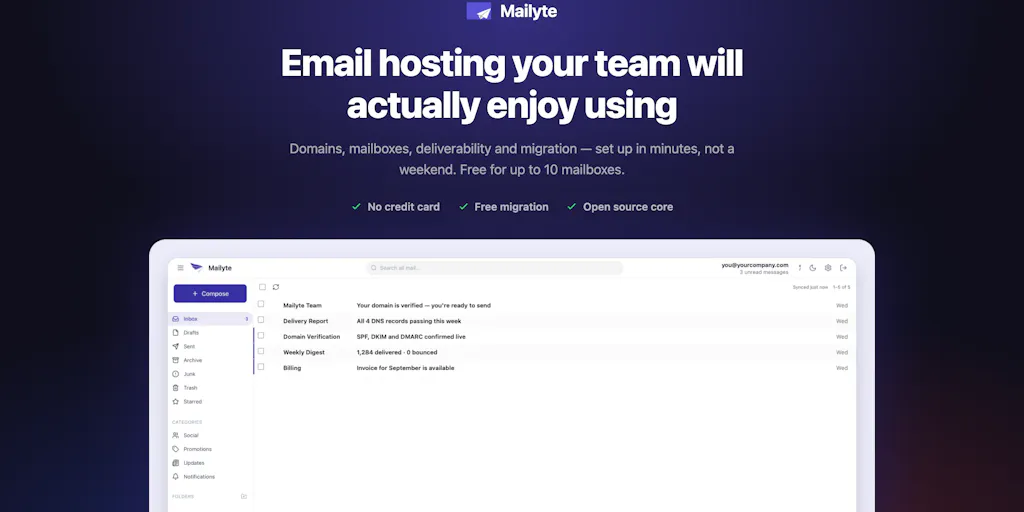
Mailyte’s pitch is to consolidate all three on your own domain. The headline features, per the launch post, are:
- Open source under AGPL-3.0, so you can self-host for free or pay the team to run it — “same product, no lock-in either way.”
- Deliverability “built in, not bolted on” — SPF, DKIM, DMARC, and a live view into whether your mail is actually landing.
- Free for up to 10 mailboxes, no credit card required.
That last bullet is the one I’d underline for creators. Ten free mailboxes is genuinely useful for a small studio or a creator with a VA and an editor. It’s not a trial; the maker presents it as a standing free tier. Pricing above that threshold is not disclosed in the source, and neither is the managed-hosting cost, which is the number I’d actually want before recommending this to anyone.
Why this matters more to newsletter operators than to app developers
Here’s the thing social media managers keep learning the hard way: your email list is the only audience you own outright. Algorithm shifts on Instagram and TikTok can halve your organic reach in a quarter, and you have no recourse. Your list doesn’t do that. But the moment your list is split across a transactional provider and a marketing provider, you lose the ability to see the full picture — who opened, who bounced, who marked you as spam, and whether your sending domain’s reputation is being dragged down by one bad campaign.
If you’re a creator running a paid newsletter or a lead magnet funnel, the consolidation argument is stronger than it looks. One domain, one reputation surface, one place to check authentication. That’s not glamorous, but it’s the difference between landing in the inbox and landing in promotions.
How it stacks up against the incumbents
I’ve spent enough time in this category to be skeptical of “all-in-one” claims, so let me be concrete about where Mailyte sits.
Against Mailchimp: Mailchimp is a marketing platform that has spent years bolting on automation, CRM, and e-commerce features. It’s expensive at scale and its transactional offering has historically been a separate product. Mailyte’s bet is that you don’t want the bolt-ons — you want campaigns and transactional in the same pane of glass. My take: for a 5,000-subscriber newsletter, the Mailchimp bill is the line item founders complain about most, so the wedge is real.
Against Postmark and Resend: These are developer-first transactional providers with excellent deliverability reputations. They are not trying to be your team inbox or your campaign tool. If you’re a solo creator who only sends a weekly newsletter, Postmark is overkill and Mailchimp is fine. Mailyte’s advantage only appears once you have all three needs simultaneously.
Against Google Workspace: Workspace gives you the inbox but not the transactional or campaign layer. Mailyte isn’t replacing Workspace so much as trying to be the thing you’d otherwise stitch around it.
Against open-source alternatives: There are established self-hosted options in this space, but the launch post doesn’t name them, so I won’t either. The AGPL-3.0 license is the notable choice here — it’s a strong copyleft license, which signals the team is serious about the “no lock-in” claim rather than using “open source” as marketing garnish.
Where the “no lock-in” promise gets tested
Self-hosting is only as good as your ability to actually run it. The maker says you can “self-host it for free on your own hardware” — but running a mail server is a different beast from running a web app. You need a VPS, you need to manage DNS records, you need to monitor blacklists, and you need to handle the fact that a misconfigured server can get your domain flagged in hours. For a creator with no ops background, the managed option is the realistic path, and that’s where the pricing opacity hurts.
What creators and social teams can borrow from this
Even if you never sign up, there are three operational lessons in this launch worth stealing.
1. Audit your sending domains this week
Open your DNS provider and check whether every tool that sends mail on your behalf has aligned SPF, DKIM, and DMARC records. In my experience, most small teams have at least one tool sending from a subdomain that isn’t properly authenticated. That’s a deliverability tax you’re paying silently. Mailyte’s “live view into whether your mail is actually landing” is the feature I’d want most from any provider — and you can approximate it today with free tools like Google Postmaster Tools and MXToolbox.
2. Separate reputation surfaces on purpose
If you run a large newsletter and a transactional product, consider whether they should share a domain. Sometimes yes, sometimes no. The point is to make it a decision rather than an accident. Mailyte’s consolidation pitch assumes one domain is better; for high-volume senders, splitting marketing and transactional can actually protect your transactional deliverability. This is a judgment call, not a rule — flag it as my opinion, not the maker’s.
3. Treat “free tier” as a real evaluation window
Ten free mailboxes with no credit card is a low-friction way to test whether a consolidated stack fits your workflow. If you’ve been meaning to migrate off a legacy provider, this is a legitimate excuse to run a parallel test — keep your current provider live, route a small segment through the new one, compare open rates and spam complaints over two weeks. That’s how I’d evaluate it, not by reading the landing page.
Where I think Mailyte falls short
I want to be fair, because the launch has an obvious soft spot that the comments surfaced immediately.
A user named Dennis Lewis reported that a support request sent through the company’s own website bounced back with a delivery failure — and pointed out the irony for “a company that only does email.” That’s a bad look on launch day, and it’s the kind of thing that makes a deliverability-focused product look untested. To the team’s credit, the comment is visible and unanswered in the scrape, which tells me they either hadn’t gotten to it or didn’t have a good answer. Either way, it’s a trust signal worth weighing.
The more substantive concern comes from Gal Dayan, who asked the question I’d have asked: with self-hosting, “is Mailyte doing anything to help warm up a new sending domain’s reputation, or is that entirely on the user to manage?” The maker’s reply isn’t captured in the source, so I can’t tell you the answer. That’s a real gap. Postmark and Mailchimp spend enormous effort keeping shared infrastructure out of spam folders — that’s a big part of what you’re paying for. If you self-host, you inherit that entire burden. Not disclosed is the honest status of Mailyte’s answer here.
Other open questions:
- Pricing above the free tier: not disclosed.
- Managed hosting cost and SLA: not disclosed.
- Deliverability benchmarks or uptime data: not disclosed.
- Migration tooling from Mailchimp/Postmark: not mentioned.
- Team size, funding, or roadmap: not disclosed beyond the Lagos-based studio context.
Who this is NOT for
If you send under a few thousand emails a month and you’re happy with your current provider, there is no urgent reason to switch. If you have no appetite for DNS or server management, the self-hosted path will hurt you. And if you need enterprise-grade compliance documentation, SSO, or a mature support org, this is early-stage software — treat it accordingly.
What I’d watch / test next
If this caught your interest, here’s what I’d actually do this week, in order:
- Run the domain audit first. Before evaluating any provider, check your current SPF, DKIM, and DMARC alignment with MXToolbox or Google Postmaster Tools. You may find the problem isn’t your vendor.
- Sign up for the free tier and send a test campaign to a small segment of your own list — not your whole list. Watch where it lands: inbox, promotions, or spam. That single test tells you more than any feature comparison.
- Ask the team directly about domain warm-up support and managed-hosting pricing before you commit anything production-critical. The Product Hunt thread is the right place; they said they’d be in the comments.
- Keep your incumbent running in parallel for at least a month. Migration regret in email is expensive and slow to reverse.
- Watch the open-source repo for commit activity. A healthy AGPL project with regular commits is a very different bet than a launch-day repo that goes quiet in three weeks.
My honest read: Mailyte is solving a real, unglamorous problem that most social and content teams feel but never name. The consolidation thesis is sound, the open-source license is a genuine differentiator, and the free tier is a smart wedge. But the launch-day support bounce and the unanswered warm-up question are exactly the kind of early signals I’d want resolved before I moved a client’s sending infrastructure onto it. Worth watching, worth testing on a small segment, not yet worth betting your whole funnel on.


