The Long-Form Video Gap Is Real. Whether a Mobile Agent Closes It Is Another Question.
Every social media operator I know has the same quiet bottleneck: the format with the highest payoff per post — long-form video — is also the one that eats the most production hours. Short-form is now mostly a scheduling and repurposing problem. Long-form is still a filmmaking problem: scripting, shot planning, voice timing, scene assembly, revision. That asymmetry is why so many creator accounts stall at 60-second clips and never build the watch-time flywheel that YouTube and, increasingly, in-feed long video rewards. So when a tool claims it can turn “a rough thought” into a finished long-form video through conversation alone, on a phone, I pay attention — skeptically. That’s the lens I brought to MOVO AI, the mobile-first “long-form video agent” from maker Edward Chen. Here’s what it actually promises, where it fits against the incumbents, and where I think the story gets thin.
What MOVO Is Actually Selling (And What Problem It Really Solves)
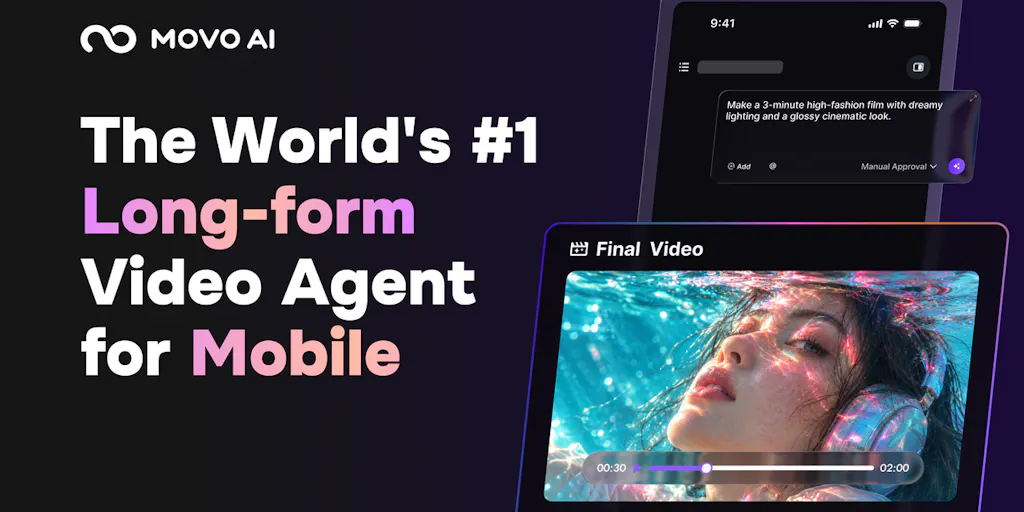
Strip away the launch-day framing and MOVO is an agentic wrapper around AI video generation, delivered as a mobile app. You talk to it the way you’d talk to a director: you bring a rough idea, a script, a reference, or a few assets, and it structures the story, sets characters and visual direction, generates scenes, takes feedback, and composes a cohesive video. The team’s own shorthand, per the maker’s post, is “Codex for video” — you direct outcomes instead of writing per-scene prompts.
Two design choices matter more than the marketing:
1. It’s conversational, not prompt-engineered. The pitch is that you never need to know “the technical name of every shot.” That’s a real workflow claim, not a feature bullet. In my experience testing prompt-based video tools, the hidden labor isn’t generation — it’s prompt maintenance: keeping a consistent visual grammar across dozens of clips, re-specifying the same character, re-describing the same location. MOVO’s answer is project-level memory: within one project you can start Episodes 2, 3, and 4 in new sessions without re-entering characters, products, locations, or creative direction. The maker states character consistency is handled automatically across scenes and carried across episodes.
2. It runs in the cloud, asynchronously. This is the detail most people skim past. The agent keeps working when you lock your phone or switch apps, and it notifies you only when a draft is ready or it needs input. If a render fails, the agent attempts to fix it and re-checks before bothering you — unless you’ve enabled credit-spend approval, in which case it asks before every credit-consuming action. Video quality is identical regardless of device because generation happens server-side.
Why this is a workflow product, not a generation product
Here’s the distinction I’d hammer if I were advising the team. The AI video market is crowded with generators — you type, you get a clip. MOVO is betting that the scarce resource isn’t clips, it’s continuity and delegation. A creator running a serialized format (a founder’s build-in-public series, a store’s product-story episodes, a creator’s narrative arc) doesn’t need one good clip. They need Episode 7 to look like Episode 1 without re-briefing a model from scratch every time. That’s a project-state problem, and it’s the same problem that makes Notion sticky for writers and Figma sticky for designers: the artifact lives somewhere persistent. If MOVO genuinely holds that state, it’s solving something most generators ignore. If it doesn’t, it’s a chat UI on top of a render farm.
How It Stacks Up Against the Incumbents
I’d place MOVO in three overlapping competitive sets, and it behaves differently in each.
Against desktop AI video tools (the Runway / Pika class of product): those are powerful but desk-bound and hands-on. You’re iterating at a keyboard, often shot by shot. MOVO’s counter-position is explicitly “agent-first mobile”: delegate, step away, come back. The maker was direct in the comments that other tools “may require more hands-on work at a PC,” while MOVO lets you guide and check progress from your phone. That’s a real differentiator for operators who are not sitting at an editing bay — which is most social media managers I know, who are triaging comments and DMs between shoots.
Against mobile editing apps (CapCut and its many clones): those assume you have footage. MOVO mostly generates scenes rather than cutting your camera roll. A commenter asked exactly this — does it cut my own footage or generate? — and the maker confirmed it mostly generates. That’s a critical fork: CapCut is for people with raw material; MOVO is for people starting from an idea. If your workflow is “I filmed 40 minutes of B-roll, make it sing,” MOVO is not your tool.
Against conversational AI assistants (the ChatGPT / Claude generalists): those can write your script and storyboard but can’t render a cohesive multi-scene video with persistent characters. MOVO is the specialized vertical slice of that.
Why short-form-native creators should care more than you’d think
The obvious objection: “I post Reels and TikToks, why do I need long-form?” Two reasons. First, long-form is the repurposing source, not the destination — a coherent 8-minute story yields a dozen short clips, and a tool that maintains character and visual continuity makes those clips feel like one brand instead of twelve unrelated experiments. Second, the platforms are pushing watch time harder than ever; YouTube has spent years rewarding session duration, and in-feed long video on other platforms is a live experiment. The operators who can produce coherent long-form cheaply will have a structural advantage in repurposing. My take: the repurposing pipeline is the real prize here, not the long video itself.
What Creators and Social Teams Should Borrow From This
Even if you never touch MOVO, its design choices are a playbook worth stealing.
Delegate the production layer, own the story layer. The maker’s most interesting admission is that professionals valued the conversational interface as much as beginners — not because they couldn’t write prompts, but because they wanted their attention on “story, structure, pacing, characters, and emotion.” That’s the correct division of labor for a social team in 2025: humans own narrative judgment and brand voice; agents own assembly. If your team is still spending senior creative time on shot lists and render babysitting, you’re misallocating your most expensive attention.
Build for asynchronous review, not synchronous creation. The “notify only when it matters” pattern — draft ready, input needed, failure that couldn’t self-heal — is how you make AI output fit into a real operator’s day. When I scheduled 30 posts across 5 platforms last month, the killer feature wasn’t generation speed, it was not having to watch the sausage being made. Any tool that pings you only at decision points respects your calendar. Demand that from every AI tool you adopt.
Treat continuity as a first-class asset. The episode-to-episode memory is the thing I’d test hardest. If it works, it changes how you plan content: you stop thinking in posts and start thinking in seasons, which is exactly the mental model that makes serialized channels compound. That’s a strategic upgrade disguised as a feature.
Where My Judgment Says It Falls Short
Now the honest part, because a launch post is a sales document and you deserve the caveats.
The voice-timing problem is acknowledged, not solved. A commenter — someone who makes short videos with desktop AI agents — flagged the hardest part: cutting to the rhythm of a voice. The maker’s answer was candid: getting cuts to match voice timing and rhythm is “an important challenge,” and they believe AI editing will increasingly align with human taste. That’s a belief statement, not a shipped guarantee. In my experience, voice-to-cut timing is where AI video falls apart most visibly — a technically clean video with dead air or rushed lines reads as amateur instantly. I’d bet this is MOVO’s biggest quality ceiling right now.
“Mostly generates” is a real limitation for footage-rich workflows. If your content depends on real people, real products, or real locations, generated scenes may not cut it — literally. The maker confirmed MOVO mostly generates rather than editing your camera roll. For a founder doing a talking-head product demo, that’s a mismatch. For a storyteller building an animated or stylized world, it’s fine.
Pricing, speed, and cost are not disclosed. A commenter asked directly about speed and cost versus tools like Liblib, and the answer was essentially “try it and see.” The maker did note there’s “no fixed limit” on movie length “as long as you have enough credits” — which tells you the model is credit-metered but not what a credit costs. That’s a genuine unknown, and for a team budgeting content production, an undisclosed cost model is a yellow flag. Don’t plan a season around it until you’ve measured cost-per-finished-minute yourself.
Team collaboration is a roadmap item, not a feature. Asked about live team sessions, the maker described a future vision — one lead per session, multiple sessions collaborating on a shared project — and explicitly framed it as something they “hope to bring to a future version.” So for agencies and multi-person social teams, MOVO today is closer to a solo-operator tool.
And the platform-fit question is unanswered. MOVO produces long-form. Most social distribution is vertical, short, and captioned. The tool’s value to a social operator depends entirely on a repurposing step it doesn’t appear to own. That’s not a flaw in MOVO — it’s a gap you have to fill with your own pipeline.
Who this is not for
If you’re a footage-first editor, a team that needs shared workspaces today, a brand with strict compliance review on every asset, or an operator whose entire output is 15-second vertical clips — MOVO is probably not your next subscription. It’s aimed at idea-first creators, solo founders, and storytellers who want a persistent creative world without a production crew. The maker’s own origin story — building it for his sixty-something parents who post for the love of it, and for introverted founders who freeze on camera — is the clearest signal of intended user. That’s a genuine, humane market. It’s just not everyone’s market.
What I’d Watch / Test Next
This week, if I were evaluating MOVO seriously, I’d do three things. First, run the continuity test: build Episode 1 with a defined character and location, then start Episode 2 in a fresh session and see whether the visual grammar actually holds without re-briefing — that’s the entire thesis, and it either works or it doesn’t. Second, measure cost-per-finished-minute against a control: take one idea, produce it in MOVO, and compare the credit spend and wall-clock time to producing the same idea in a desktop tool like Runway or by hand in CapCut. Third, stress the voice-timing seam specifically — feed it a script with deliberate pauses and see whether cuts land on the beat or drift. On the industry side, I’d watch whether MOVO ships the team-collaboration model it described, and whether it publishes real pricing. My take: the conversational, continuity-first, mobile-async framing is the right bet, and it’s the direction the whole category is heading — but the voice-timing ceiling and undisclosed economics are the two things that will decide whether this becomes a workflow staple or a clever demo. Test it on your own project before you build a season around it; the maker’s own advice to “try MOVO with a project of your own” is, for once, the honest answer.


