The Creator Economy Has a Throughput Problem, and It’s Not the One You Think
If you run social media for a living, you’ve felt the squeeze that engineering leaders are only now waking up to. We publish more content than ever — 30 posts across five platforms in a single week, repurposed from one long-form video, each cut tweaked for vertical aspect ratios and hooked in the first 1.5 seconds — yet the dashboard barely moves. More output, same engagement. More spend on AI tools, same growth curve. We blame the algorithm, the platform shift, the saturation. But the real culprit is closer to home: we’re measuring the wrong things, and we’re measuring them the way we always have, even though the production process has fundamentally changed.
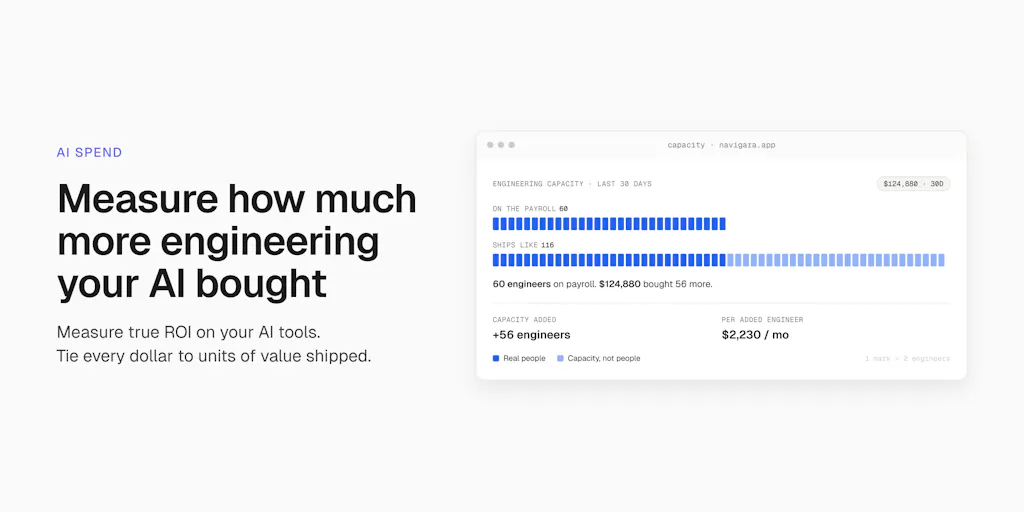
That’s why the launch of Navigara caught my attention — not because it’s a social tool, but because it’s a mirror held up to a problem we all share. Navigara is an engineering analytics platform that reads your commit history, uses an LLM to understand what each code change actually did, and scores the complexity of merged work — not lines, not commits. It then connects token spend (the money you’re burning on AI coding tools) to roadmap delivery, and tells you what share of your engineering spend actually turned into work that was on the roadmap. The founder, Jirka Bachel, tells a story that should sound familiar to anyone who’s ever had to justify a content budget: a CFO asked whether Claude was producing real value for almost $150k a month or just producing invoices, and the honest answer was “we think so.”
Sound familiar? Replace “Claude” with “CapCut” or “Canva” or “our AI content repurposing stack,” and you’ve just described every social media manager’s quarterly review. We’re spending more on AI tooling, producing more assets, and crossing our fingers that the metrics eventually catch up. Navigara’s thesis is that the metrics won’t catch up — because we’re measuring the wrong things. And for social media operators, that’s the most valuable lesson in this entire launch.
What Navigara Actually Solves: The “We Think So” Problem
Let me translate Navigara’s pitch into social media terms, because the underlying problem is identical. The founder’s origin story is about being a CTO who trusted velocity charts and cycle times — the standard engineering metrics — until he realized they told a story he couldn’t back up. The same thing happens in social media every single day. We track follower growth, impressions, engagement rate, saves, shares. We report these numbers in weekly meetings. But when someone asks “what did this actually do for the business?” — not in terms of vanity metrics, but in terms of pipeline, revenue, or brand lift — the honest answer is usually “we think so.”
Navigara’s answer to this problem is what they call Engineering Throughput Value, or ETV. The methodology is spelled out publicly: it reads your commit history, uses an LLM to understand what each change did, and scores how complex the merged work was. The key insight is that refactoring 400 lines down to 40 scores higher than shipping 400 more lines. It’s not about volume of output — it’s about the value of the work, categorized into Features, Maintenance, and Documentation, measured against your team’s own pre-AI baseline.
The social media translation is almost too easy. We’re drowning in content volume — more posts, more stories, more TikTok cuts, more LinkedIn carousels — and we’re scoring ourselves on the volume. A 40-second vertical video that took 20 minutes to cut from a longer piece scores the same as a 40-second video that took three hours to script, shoot, and edit from scratch. A well-researched LinkedIn post that drives 15 qualified leads scores the same as a throwaway meme that gets 2,000 likes from people who will never buy anything. We’re counting lines of code when we should be counting roadmap delivery.
The team claims that across the public commit history of Microsoft, Google, Cloudflare, OpenAI, Meta, and Vercel, ETV per engineer rose 116% between Q1 2025 and Q1 2026, measured across 676 contributors. That’s a striking number — and I’d flag it as the maker’s claim, not independently verified data. But the direction of the finding matches what I’ve seen in my own content operations: AI tools have massively increased output volume, but the relationship between that output and actual business outcomes is murky at best. We’re generating more, but are we generating better? Are we generating what the roadmap actually needs?
The second half of Navigara’s pitch is where it gets really interesting for social media operators: they connect token spend to the roadmap. They look at whether work is aligned with initiatives, epics, and tickets — and they put a dollar number next to work that’s unaligned. This is the part that should make every social media manager sit up straight. When was the last time you could tell your CFO what share of your content budget went to work that was actually on the marketing roadmap, versus work that just had a ticket without an initiative, versus work that was completely unaligned?
In my experience, the answer is: never. We have a content calendar, but the connection between that calendar and the company’s actual strategic priorities is often fuzzy. We’re creating content because the algorithm rewards consistency, because competitors are posting daily, because “we should be on Threads now.” Navigara’s approach — putting a dollar amount on unaligned work — is exactly the kind of clarity that social media teams desperately need.
How It Differs From Existing Options: The Sentry for Processes Analogy
Navigara’s founder describes the product as “like Sentry, but for engineering processes.” That’s a useful analogy, and it points to a real gap in the market. Sentry tells you when your code is broken in production. Navigara tells you when your engineering process is broken — when work isn’t aligned with the roadmap, when AI spend is going to the wrong things, when the team is slowing down as it grows. The difference between monitoring outputs and monitoring processes is the difference between checking your engagement rate and understanding why your content is or isn’t resonating.
The existing options in the social media analytics space are numerous and mature. Buffer and Hootsuite give you scheduling and basic analytics. Later and Metricool offer more granular performance data. Canva and CapCut handle the creative production side. But none of these tools answer the question that Navigara is asking: what share of your production spend actually turned into work that was on the roadmap?
The closest analogue in the social media space is probably the shift toward UTM tracking and attribution — tools like Google Analytics or Attribution that try to connect content performance to actual business outcomes. But even these are output metrics. They tell you which pieces of content drove conversions, but they don’t tell you whether the content you created was the right content in the first place. They don’t tell you what share of your production budget went to work that was aligned with your strategic priorities versus work that was just filling the calendar.
Navigara’s innovation is to move the measurement earlier in the process. Instead of measuring what happened after you shipped content (engagement, conversions, revenue), it measures what happened before — whether the work you did was the right work. This is a fundamentally different question, and it’s one that no social media analytics tool I’m aware of is currently asking.
Why TikTok Creators Should Care More Than LinkedIn Ones
The roadmap-alignment question hits differently depending on which platform you’re optimizing for. TikTok creators — and I include myself in this bucket — are the most exposed to the “volume over value” trap. The algorithm rewards consistency and frequency in a way that LinkedIn, for example, does not. You can post three times a day on TikTok and see your reach fluctuate wildly based on factors you can’t fully control. The pressure to produce more is relentless, and the connection between that production and any kind of strategic roadmap is often nonexistent.
LinkedIn, by contrast, rewards depth and thought leadership. A single well-crafted post can outperform a week of daily posting. The roadmap-alignment question is easier to answer on LinkedIn because the content is more clearly tied to business goals — building authority, generating leads, establishing expertise. TikTok is where the “we think so” problem is most acute. You’re spending hours cutting videos, writing hooks, and chasing trends, and when someone asks what it’s doing for the business, the honest answer is usually a shrug.
Navigara’s methodology — measuring the value of work, not the volume — is a direct challenge to the TikTok content treadmill. It’s asking: what if you stopped counting posts and started counting roadmap delivery? What if the creator who makes one video that drives 50 qualified leads is worth more than the creator who makes 30 videos that drive none? The platform algorithms won’t tell you this. The analytics dashboards won’t tell you this. But it’s the question that matters.
What Creators and Social Media Teams Can Borrow From Navigara
Let me be clear: I’m not recommending that social media teams buy Navigara. It’s an engineering tool, built for engineering teams, and the deployment modes — fully on-prem for banks and regulated enterprises, on-prem collector for teams that want code to stay put, and hosted for teams that want results today — are designed for a different world than content operations. But the principles embedded in the product are directly transferable, and I’ve already started applying them to my own workflow.
First: measure the value of work, not the volume of output. This is the core ETV insight, and it applies to content creation as directly as it applies to software engineering. Instead of tracking how many posts you published this week, track what those posts actually accomplished. A post that drives 10 qualified leads is worth more than 20 posts that drive none. A video that gets 5,000 views from your target audience is worth more than a video that gets 100,000 views from the wrong audience. The metrics that matter are the ones that connect your work to the roadmap — not the ones that make your content look good on a highlight reel.
Second: connect your spend to your roadmap. The founder’s story about the CFO asking whether Claude was producing real value is the exact conversation every social media manager should be having with their finance team. How much are you spending on AI tools? On content production? On paid distribution? And what share of that spend is going to work that’s aligned with your strategic priorities? Navigara’s approach — putting a dollar number next to unaligned work — is uncomfortable, but it’s clarifying. In my own content operations, I’ve started categorizing every piece of content by which strategic initiative it serves. If it doesn’t serve one, it doesn’t get made.
Third: report at the team level, not the individual level. One of the most thoughtful exchanges in the Navigara launch thread is about engineers who spend time mentoring, designing systems, or unblocking teammates. The founder’s response is that ETV reads merged code, so mentoring shows up in the team’s output, not the mentor’s. “Read individually that looks like underperformance. Read at team level it looks like what it is.” This is exactly right for social media teams. The person who spends a week building a content system, training a junior creator, or fixing a broken workflow looks like they’re underperforming on the individual metrics — but the team’s output rises. If you’re measuring individual output without accounting for the people who make the team better, you’re measuring the wrong thing.
Fourth: treat process issues as the real problem. Navigara’s founder says that “process issues between epics, tickets, AI spend, and code are the source of teams slowing down as they grow in headcount.” The same is true for content teams. As you add more creators, more platforms, more tools, the process issues multiply. Content gets created that doesn’t align with the roadmap. AI tools get adopted without clear guidelines. The connection between strategy and execution gets muddier. The fix isn’t more tools — it’s better processes.
Where the Math Breaks: What Navigara Doesn’t Answer
I want to be balanced here, because the launch thread itself raises some of the most important critiques. One commenter asks how Navigara accounts for engineers who spend significant time mentoring, designing systems, or unblocking teammates. The founder’s answer is thoughtful — mentoring shows up in the team’s output, not the mentor’s — but it raises a deeper question: what about work that never lands in the repo at all? What about the architect who spends a week designing a system that prevents a month of rework? What about the engineer who kills a project that would have been a disaster?
Another commenter pushes on this exact point: “off-roadmap work isn’t always waste, half the refactors that save a codebase never had a ticket. How does Navigara tell exploration apart from actual burn?” The founder’s answer is that the tool splits ETV into Features, Maintenance, Fixes, Tests, and Documentation — so architecture and cleanup work that does land in the repo isn’t scored as zero. But the deeper question remains: how do you measure the value of work that prevents problems, rather than shipping features?
The social media translation of this critique is obvious. How do you measure the value of the content that didn’t get posted — the campaign that was killed because it was off-brand, the video that was scrapped because it would have damaged trust? How do you measure the value of the systems you build — the content calendar, the approval workflow, the brand guidelines — that make everything else more efficient? Navigara’s methodology, like most measurement frameworks, struggles with negative space. It measures what shipped, not what didn’t.
There’s also the question of gaming the system. Any metric that becomes a target becomes a target for gaming. If you’re scored on ETV, you’ll optimize for ETV — which might mean doing more refactoring (which scores high) and less exploratory work (which doesn’t). The founder’s baseball analogy — Billy Beane and on-base percentage — is apt, but it cuts both ways. On-base percentage worked because it was correlated with winning, and because it was hard to game without actually getting better at baseball. ETV’s correlation with actual business outcomes is less clear. And the team’s claim that ETV per engineer rose 116% across major tech companies is impressive, but it’s also exactly the kind of number that gets gamed once people know it’s being tracked.
Who This Is NOT For
Let me be direct about who should not buy Navigara, because the launch page’s enthusiasm obscures some real limitations. If you’re a solo creator or a small content team — say, fewer than five people — this tool is overkill. The deployment modes, the security certifications, the roadmap alignment methodology — all of this is designed for organizations with real engineering teams, real budgets, and real compliance requirements. A solo creator doesn’t need to measure ETV. They need to make better content.
If you’re a social media manager at a company where the connection between content and revenue is already clear — where every post is tied to a campaign with tracked UTM links and a clear attribution model — Navigara’s methodology might feel redundant. You already know what’s working. The problem Navigara solves is the “we think so” problem, and if you don’t have that problem, you don’t need the tool.
And if you’re the kind of operator who believes that content creation is fundamentally a creative act that can’t be reduced to metrics — that some of the best content is the content that doesn’t align with any roadmap, that exploration and play are essential to the creative process — then Navigara’s philosophy will feel alien to you. The tool is built on the assumption that roadmap alignment is the goal. If you don’t share that assumption, the tool will measure the wrong things.
What I’d Watch / Test Next
I’m not going to pretend I’m going to deploy Navigara in my content operations this week — it’s not built for that. But the principles behind it are worth testing immediately, and I’ve already started. Here’s what I’d suggest you do this week, regardless of which platforms you publish on:
1. Do a roadmap alignment audit of your last 30 pieces of content. Go back through your last month of posts — across all platforms — and categorize each one: aligned with a strategic initiative, has a ticket but no initiative, or completely unaligned. Be honest. My guess is you’ll find that a significant share of your content falls into the third category. That’s your “unaligned spend” — the content you’re creating because the algorithm rewards consistency, not because it serves your goals. The number will be uncomfortable. That’s the point.
2. Put a dollar amount on your content production. Total up what you spend on tools, freelancers, paid distribution, and your own time. Then divide by the number of pieces of content that actually aligned with your roadmap. That’s your cost per aligned piece. It’s a rough calculation, but it’s a start — and it’s the kind of number that makes CFOs sit up and pay attention.
3. Start reporting at the team level, not the individual level. If you manage a content team, look at your metrics through the lens of team output, not individual output. Who’s making the team better even if their individual numbers look weak? Who’s shipping content that looks good on paper but doesn’t serve the roadmap? The answers might surprise you.
4. Read the ETV methodology and the live index — even if you never use the tool. The team is updating the index of top engineering organizations daily, and the methodology is public. You’ll learn more about measuring knowledge work from reading this than from any social media analytics tutorial.
5. Ask yourself the CFO question every week. Not “is our content performing?” but “is our content producing real value, or just producing invoices?” The answer should never be “we think so.” If it is, you’ve found your problem.
The creator economy is going through the same transition that engineering went through when AI tools entered the workflow. We’re producing more than ever, and we’re not sure if any of it matters. Navigara’s answer to that problem — measure the value of work, not the volume; connect spend to roadmap; report at the team level; treat process issues as the real problem — is the right answer, even if the tool itself is built for a different audience. The question is whether we’re brave enough to ask it.


