The Distribution Layer Is Moving, and Most Social Teams Are Still Watching the Wrong Dashboard
Every social media operator I know has the same quiet anxiety right now, and it isn’t about the algorithm on Instagram or the latest TikTok format. It’s that the top of the funnel is quietly migrating. Buyers — especially technical and startup buyers — now open ChatGPT, Claude, Gemini, Perplexity, or Grok and ask “what tool should I use for X” before they ever type a query into Google or scroll a LinkedIn feed. If your brand isn’t in that answer, you lose the customer without a single impression, a single click, or a single line in your analytics. That’s the problem Notra is now attacking with its GEO (generative engine optimization) launch, and it’s the most strategically interesting thing I’ve seen a content tool ship this quarter — not because the product is flawless, but because it reframes what “social media work” even means. The launch page itself is the reference point here; I’ll flag what’s sourced, what’s the maker’s claim, and what’s my read.
What Notra Actually Does — and Why It’s a Social Problem, Not Just an SEO One
The maker, Dominik Koch, frames the thesis plainly: “More people now ask ChatGPT which tool to use instead of searching Google, and we built Notra GEO so teams can find out whether they show up in those answers.” The stated problem is that AI engines “usually recommend two or three products per question, and if yours isn’t one of them you lose the customer without ever knowing.” That last clause is the part social teams should tattoo on their monitors. Traditional social analytics tell you what happened after someone found you. GEO tells you whether you were ever in the room.
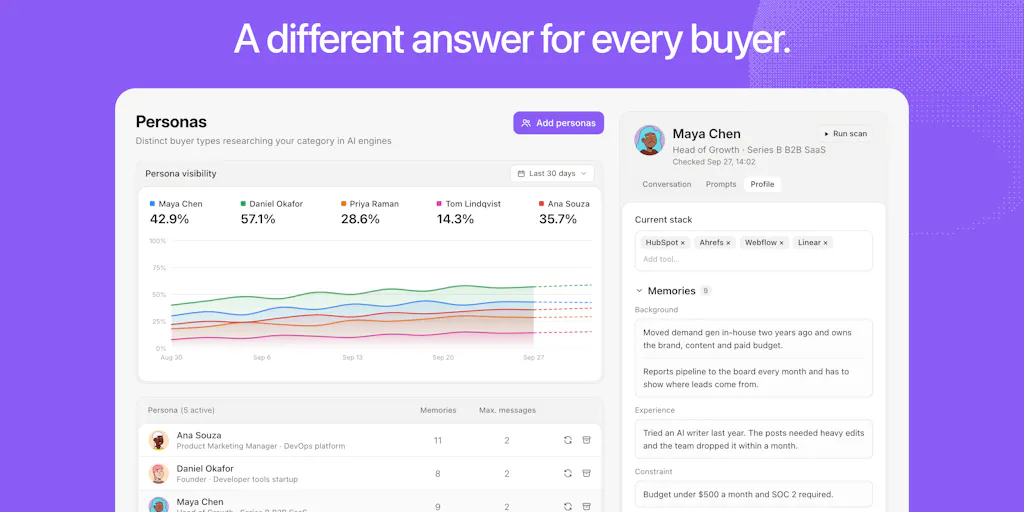
The mechanics, per the launch post: Notra queries ChatGPT, Claude, Gemini, Perplexity, and Grok with the questions your customers would ask, then shows which competitors get named instead of you. Conversations and personas “follow a realistic buyer through follow-up questions,” so you see visibility the way a buyer would experience it — not as a single snapshot. It identifies the questions and cited sites where you’re missing, then drafts articles to close those gaps in your brand voice. And there’s an AI Crawl Analytics layer showing which pages AI bots actually read on your site, which the team says is free for up to 1 million events a month.
That “follow-up questions” detail is the sharpest design choice in the whole product, and a commenter named Oleksii Sekundant nailed why: “Getting mentioned once doesn’t tell you whether you’re still in the conversation two questions later.” In my experience running content for B2B and dev-tool brands, that’s exactly the failure mode. You get name-dropped in the first answer, then the buyer asks “but is it good for teams under 20 people?” and the model pivots to a competitor. A single-prompt visibility check would have told you you were winning. The multi-turn model tells you the truth.
The part that matters for social specifically
Here’s where I’d push beyond the launch copy. The outputs Notra generates — gap-closing articles — are the raw material for social distribution, not the end product. A question where you’re invisible on Perplexity is a question worth answering in a LinkedIn carousel, a YouTube short, a Threads thread, and a Pinterest pin, because those surfaces feed the corpus that AI engines cite. If you’re a social manager who thinks GEO is “the SEO team’s problem,” you’re about to be handed a content brief you don’t know how to fulfill. The brands that win the AI-answer era will be the ones whose social and editorial teams share a single question-map. Notra is, functionally, a question-map generator.
How It Differs From the Incumbents You’d Actually Compare It To
The obvious question — and a commenter named Nitin Vinay asked it directly — is how this differs from tools like Profound or Scribble. The maker’s answer was refreshingly non-defensive: he pointed to a published comparison page rather than trash-talking. I respect that, and I’d tell any operator evaluating this category to read competitor comparisons skeptically but read them — the framing choices tell you what each vendor thinks the job is.
My take on the landscape: the GEO/answer-engine-optimization space is crowding fast, and the differentiators that will matter are (1) how many engines you’re actually querying, (2) whether you model multi-turn buyer journeys or single prompts, and (3) whether you close the loop from “you’re missing” to “here’s the draft that fixes it.” Notra claims all three. The five-engine coverage — ChatGPT, Claude, Gemini, Perplexity, Grok — is broader than most single-engine checkers I’ve tested, though I’d want to verify how fresh each engine’s responses are, since model versions and retrieval layers shift constantly.
The more interesting comparison isn’t to GEO startups at all. It’s to the general-purpose AI writing tools social teams already pay for — Canva’s Magic Studio, CapCut’s AI assists, or just a ChatGPT subscription. A reviewer named Will De Ath drew that line himself: “Sure you can ask any content gen AI tool to help you write a X post about a recent PR by sending it a link, but Notra actually does this in context and doesn’t miss a beat.” That “in context” claim is the whole ballgame. Generic tools write plausible content; context-connected tools write your content. Whether Notra’s context layer is genuinely better or just better-marketed is the thing I’d test before renewing anything.
Why this is a repurposing story wearing a GEO costume
Notra’s earlier launches tell you where the product’s DNA comes from. Before GEO, there was Notra Image Generation (“turn merged PRs into on-brand marketing visuals”), a Notra Framer Plugin for auto-syncing content to a site, and the original Notra (“turn your daily work into publish-ready content”). The throughline is unmistakable: take the exhaust of building — pull requests, changelogs, releases — and convert it into publishable marketing. GEO is the same engine pointed at a new output: articles designed to be cited by AI.
That’s a repurposing pipeline, and repurposing pipelines are exactly what social operators build by hand every week. When I mapped a 30-post, five-platform schedule last quarter, the hardest part wasn’t scheduling — Buffer and Later handle that fine — it was sourcing enough genuinely interesting raw material to fill the calendar without repeating myself. A tool that mines your engineering or product activity for story-worthy moments is solving the actual bottleneck. The reviewer Jan Burzinski said it removed “the hassle of writing changelogs completely,” running a weekly schedule with custom instructions so it “sounds just like i want it to sound.” That’s the repurposing dream: a system, not a scramble.
What Creators and Social Teams Should Steal From This Playbook
Even if you never buy Notra, three things in this launch are worth copying this week.
First, build a question map before you build a content calendar. Notra’s core move is asking “what would my buyer actually type?” and then checking whether you appear. Most social teams plan around formats (Reels, carousels, threads) and topics (product, culture, thought leadership). Flip it: list the 20 questions your ideal customer asks an AI assistant, check your visibility on each across two or three engines, and let the gaps dictate next month’s editorial. That’s a one-afternoon exercise with a free ChatGPT or Perplexity account, and it will reorder your priorities fast.
Second, treat multi-turn as the unit of measurement. The Sekundant observation — that being mentioned once doesn’t mean you’re still in the conversation two questions later — applies to social funnels too. A prospect who sees one of your TikToks isn’t converted; the question is whether you show up again when they search, when they ask a friend, when they prompt an AI. Map your presence across the sequence, not the single touch.
Third, close the loop from insight to draft. The reviewer Glenn Töws described using Notra output as “inspiration and baseline to then make edits” rather than pushing it live. That’s the correct operating model for any AI content tool in 2026, and it’s the opposite of what most “auto-post” features encourage. The maker himself confirmed the human-in-the-loop default when another commenter asked whether content publishes automatically: “You have to and should review content first, we do have auto publish features though!” Good. The tools that let you skip review are the ones that will get your brand ratioed.
Why TikTok and YouTube creators should care more than LinkedIn ones — for now
Here’s a counterintuitive read. The GEO panic is loudest among B2B and dev-tool teams, and LinkedIn is where they’ll first feel it. But the durable advantage belongs to creators who already own video and short-form. Why? Because AI engines increasingly cite and synthesize from transcripts, YouTube descriptions, and indexed short-form captions. If your YouTube library is well-titled, transcribed, and question-shaped, you’re building a citation surface that a text-only competitor can’t match. A LinkedIn text post is easy for a model to paraphrase from a hundred sources; a specific, well-structured 8-minute YouTube explainer with a clear transcript is a distinctive artifact. My bet: the creators who treat YouTube and TikTok as corpus-building exercises — not just reach exercises — will show up in AI answers before the brands that treat social as a broadcast channel. That’s opinion, not a sourced claim, but it’s the hill I’d plant a flag on.
Where I Think It Falls Short — and Who Shouldn’t Buy It
Now the honest part, because a launch page is a highlight reel and my job is to read the seams.
The fundamental measurement problem is unsolved, and the maker admits it. When Vijayanand Kailash asked whether the tool can tell you what content to create targeting the questions people actually ask in GPTs, Koch answered: “You can never know for sure if what you are checking is actually what people are prompting for, you try, check and repeat to make educated guesses.” That is an admirably candid answer and also the single biggest caveat in the entire product. You are optimizing against simulated buyer questions, not observed ones. There’s no disclosed integration with real prompt-volume data (because, to be fair, no one has reliable prompt-volume data — the engines don’t publish it). So GEO today is a disciplined guessing game. Anyone selling it as precision targeting is overselling.
The output quality question is unresolved. The launch doesn’t disclose pricing, model choice for drafting, or how the “brand voice” is trained. “Not disclosed” is the honest answer on all three. The image-generation feature that reviewers are excited about — De Ath calls the brand-guideline accuracy “unreal” — was, at the time of those reviews, still forthcoming; he wrote that it “needs to come out now.” So some of the enthusiasm on the page is anticipatory, not tested. Read reviews with that in mind.
It’s a content-generation tool at heart, and that’s a ceiling. Notra doesn’t schedule, publish to social natively at scale, or give you cross-platform analytics. If you’re hoping this replaces Metricool or Hootsuite for publishing and reporting, it doesn’t — and it isn’t trying to. It sits upstream of your scheduler, feeding it better raw material. That’s a fine place to sit, but it means Notra is a supplement to your stack, not a replacement, and the budget conversation should reflect that.
Who it’s not for: solo creators with no product or engineering surface to mine (the PR/changelog DNA won’t help a lifestyle creator much), teams without an editorial reviewer who can catch AI drafts before they ship, and anyone who needs hard attribution data today. If your boss wants a dashboard proving GEO drove revenue, this won’t give it to you — nobody can, yet.
Where the math breaks
One more operational caution. The free-tier AI Crawl Analytics caps at 1 million events a month per the launch post — generous for most sites, but if you’re a high-traffic publisher, you’ll blow through it and need to know what the paid tier costs, which isn’t disclosed. And the multi-engine querying model has a hidden cost: every check against five engines, across dozens of buyer personas and multi-turn conversations, is a lot of API calls. I’d want to see how the product handles rate limits and refresh cadence before I trusted a weekly visibility report. In my tests of similar multi-engine checkers, staleness is the silent killer — you’re often looking at a model’s answer from days ago presented as current.
What I’d Watch / Test Next
If you run social or content for a product company, here’s a concrete week-one plan. Pick ten questions your buyer would plausibly ask an AI assistant. Run each through ChatGPT, Claude, Perplexity, and Gemini yourself — free, manual, thirty minutes. Log whether you appear, who appears instead, and what sources get cited. Then take the three questions where you’re invisible and turn each into one LinkedIn post, one short-form video script, and one FAQ section on your site. That’s a GEO sprint you can run without buying anything.
Then, if the gaps are big enough to justify tooling, trial Notra against one named competitor from its own comparison page and judge on three things: freshness of engine responses, quality of the drafted articles in your voice, and whether the crawl analytics actually tell you something your existing Google Search Console data doesn’t. Watch the pricing page and the image-generation rollout — both were undisclosed or pending at launch. And keep one eye on the incumbents: if Semrush or Ahrefs bolt serious GEO tracking onto their suites, the standalone category gets crowded fast. My take: the winners in this space will be the tools that connect AI-visibility insight to a real publishing and repurposing workflow — which is exactly the bet Notra is making, and exactly the bet I’d be stress-testing before I signed an annual contract.


