The Automation Tool That Actually Understands the Browser Gap
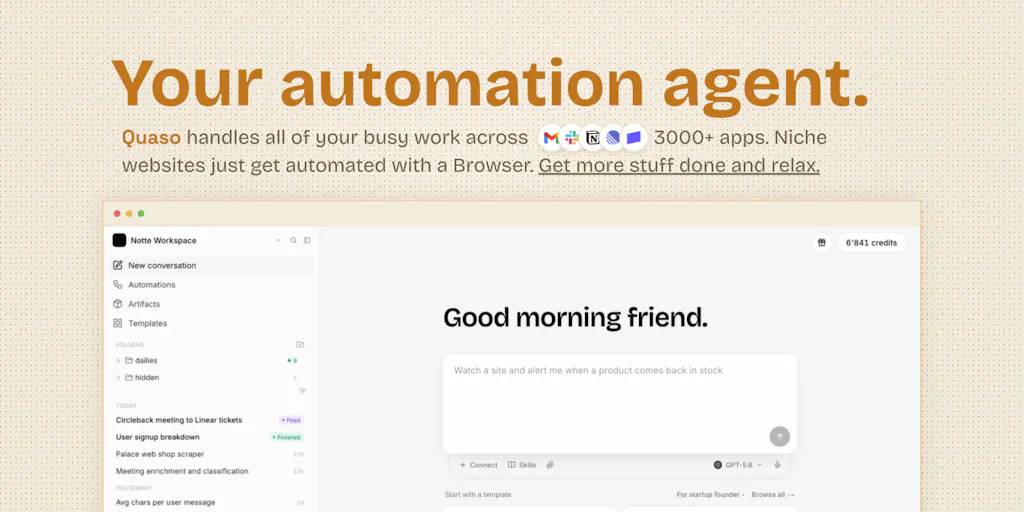
Every social media operator I know has a version of the same dirty secret: we spend more time moving data between platforms than creating content. I’ve personally burned afternoons manually pulling Instagram Reel metrics into a spreadsheet, cross-referencing them with Shopify sales, then stitching it all into a report that my boss wants in Slack by 9 a.m. The tools we already use—Zapier, Make, Hootsuite—handle the easy stuff: “when this happens, do that.” But they fall apart the moment a platform changes its API, hides a metric behind a login wall, or expects you to click through a Terms of Service update. That’s where the real friction lives, and it’s why I paid close attention when I saw the Product Hunt debut of Quaso from Notte. Quaso isn’t another scheduling app or a passive analytics dashboard. It’s an AI agent that blends API integrations with live browser automation—the kind of hybrid that might finally close the gap between “I want to automate this” and “it actually runs while I sleep.” For creators who manage multiple accounts across TikTok, Instagram, LinkedIn, and YouTube, that gap is the difference between scaling your output and drowning in context-switching.
The Real Pain: Integration Tools Hit a Wall, and Browser Automation Has a Roof
Most creator workflows rely on a handful of API-driven automations. When a new YouTube video publishes, a Zapier webhook posts it to Instagram and LinkedIn. When someone fills out a lead form, a Make scenario adds them to your CRM and sends a welcome email. Those are table stakes, and every major automation platform can do them—provided the API endpoint is available and stable. But the creator economy doesn’t live inside official APIs. Try pulling your TikTok Shop revenue data into a spreadsheet without using a third-party scraper that breaks every time ByteDance tweaks the front end. Try scheduling a cross-post to Threads when Meta hasn’t released a public API for it yet. Or try extracting the engagement rate of a competitor’s Reel when Instagram’s Insights API only returns aggregate numbers for your own account.
That’s where Quaso enters the picture. Instead of asking a platform to expose an endpoint, it sends a real browser to the page and reads the data directly. Lucas Giordano, Notte’s co-founder, explains in the Product Hunt comments that if an integration exists, Quaso prefers it—faster and more reliable. But when no integration can do the job, it falls back to browser automation automatically. The result is a single agent that can move seamlessly between an app like Linear (via API) and a browser-driven login to Facebook Ads Manager to pull a performance report. The team behind Notte has been building browser infrastructure specifically for AI agents for over a year, and they claim “200+ companies run their agents on it in production.” That’s not a guarantee, but it’s a stronger starting point than most AI agent tools that bolt browser control on as an afterthought.
I’ve tested similar hybrids before. Browserless.io gives you headless Chrome control but no app integrations. AutoGPT can theoretically browse the web, but its reliability on production workflows is laughable. Quaso’s differentiator is the durable session management and the self-repair logic. The team uses what they call “Notte profiles”—you log in once, and the browser state (cookies, session tokens) gets saved. When a run happens later, it reuses that state instead of prompting for credentials. If a session expires, the agent asks you to reauthenticate rather than silently failing halfway through a scheduled task. For any creator who has woken up to a broken automation that didn’t alert you, that alone is worth testing.
Why Multi-Platform Creators Should Care More Than Single-Platform Ones
If you only publish on YouTube and use YouTube Studio’s native analytics, you probably don’t need Quaso. But the moment you’re juggling Instagram Stories, TikTok posts, a LinkedIn newsletter, and a Pinterest board, you’re maintaining four different dashboards, each with its own login, its own data definitions, and its own rate limits. Quaso’s browser leg becomes your universal API—it can log into each platform, extract the metrics you define, and dump them into a single Google Sheet or Slack channel. I’ve seen agency operators do this manually with browser extensions and copy-paste, but they burn 10–15 minutes per account per day. Across five clients, that’s an hour of unpaid labor. Quaso could turn that hour into a scheduled agent that runs before you wake up.
How Quaso Differs from the Incumbents (and Why That Matters)
The automation landscape is crowded. Zapier and Make (formerly Integromat) dominate the API-first space. They are excellent for triggered workflows—send a Slack message when a new sale appears in Stripe, or create a Trello card when a form is submitted. But they don’t drive a browser. Pabbly Connect and n8n offer similar capabilities, with n8n giving you more control via self-hosting. None of them can log into TikTok and scrape your video-level performance data because TikTok’s API only returns account-level aggregates through the official Business Account API—and that requires manual approval.
On the browser automation side, tools like Puppeteer and Playwright are developer-friendly but not operator-friendly. You need to write and maintain selectors, handle dynamic content, and build a retry loop. UiPath and Automation Anywhere are enterprise RPA tools that cost thousands of dollars per license and are overkill for a solo creator.
Quaso sits in the middle. It uses Notte’s proprietary browser infrastructure—built over a year of stealth work—to handle the nasty parts: residential proxies to avoid detection, fingerprinting resistance, and session persistence. In the Product Hunt comments, Lucas notes that “heavy bot detection sites (aggressive fingerprinting, active challenge-response) can still trip it up,” but he also says the team has a “much stronger starting point than agent tools building browser automation for the first time on top of a launch.” That’s a fair and transparent take. Most AI agent startups wrap a headless browser with a single model call and call it done. Quaso’s infra was architected for production workloads from day one.
Where the math breaks. Let’s be honest about the browser leg. Every creator I know has tried to automate something on Instagram and hit a login challenge, a CAPTCHA, or a “Suspicious Login Attempt” block. The Notte team uses residential proxies and fingerprint masking, but Meta’s bot detection is world-class. I’d bet that Instagram and TikTok are the two platforms where Quaso will fail most often. The Product Hunt comments include a question from Noctis Leonard about bot detection, and Lucas admits “it’s not bulletproof.” If your workflow depends on daily extraction from Instagram Stories analytics, you’ll need a fallback plan—perhaps a manual check or a secondary tool. Quaso isn’t a silver bullet; it’s a better starting point than most.
What Creators and Social Media Teams Can Borrow from Quaso
Even if you don’t adopt Quaso tomorrow, the principles it demonstrates are directly applicable to how you think about your automation stack. Here are three takeaways I’m immediately borrowing:
1. The hybrid integration + browser pattern is the future. Any automation you currently run that requires manual data entry—checking analytics, pulling competitor prices, monitoring comments for keywords—should be reviewed for the “browser fallback” pattern. If an API exists, use it. If not, let a headless browser do the job. Quaso automates the decision between the two, but you can manually replicate this with Zapier + a browser automation tool like BrowserBear or ScrapingBee. The key is having a reliable session store so you don’t log in every time.
2. Durable scheduling with human-in-the-loop is more valuable than always-on automation. A lot of AI agents aim for total autonomy—they try to complete the task, and if they fail, they retry silently. That’s dangerous. Quaso’s model is better: it logs you in once, saves the state, and if a session expires or a critical decision is needed, it asks you. As a creator, I’d rather have an agent that pauses and says “I hit a pop-up I can’t dismiss—help me” than one that guesses and sends a broken report to my client. The team calls this “self-repair” for most breaks, but they acknowledge not all can be fixed automatically. That honesty is a trust signal.
3. Start with a single sticky workflow, not a grand automation. In the Product Hunt thread, Lucas says the first sticky workflow for Quaso is “closing the gap between conversation and execution”—specifically, using Slack as the interface to turn messages into Linear tasks, trigger customer support responses, and generate meeting prep. For creators, the analogue is: pick one recurring pain point that takes you 15 minutes every day. For me, it’s my morning briefing: I open Instagram, TikTok, YouTube, and LinkedIn, write down the top three metrics for each, and paste them into a Slack thread for my team. That’s a perfect candidate for Quaso—a scheduled agent that logs into each platform, extracts the data, and posts the summary. If it works for that, I’ll trust it for more complex flows.
The Slack-Centrism Problem
One limitation I see immediately: Quaso is built around Slack as the main interface. You can tag @Quaso in a Slack channel to trigger automations, get results streamed there, and manage sessions. That’s great if you work on a team that lives in Slack. But many solo creators don’t use Slack—they live in Instagram DM, or they use Discord communities, or they just work from a web browser. The Quaso team has not disclosed whether they plan to offer a standalone dashboard or web interface. For now, if you’re a solo operator who hates Slack, Quaso may not fit your workflow. The Product Hunt comments suggest it’s primarily a team tool, with features like “multiplayer” and team sessions. That’s fine, but it means Quaso won’t be the answer for every creator.
Where the Math Breaks: Open Questions and Limitations
I’m intrigued, but I have real reservations. Here’s what I’m watching:
Pricing is not disclosed. The Product Hunt page doesn’t list a price. Notte’s previous launches (Browser Arena, Anything API) suggest they operate on a usage-based model, but for Quaso they haven’t shared numbers. If it ends up costing $100/month for moderate use, a solo creator might balk. If it’s $20–30/month, it could be a no-brainer. We’ll have to wait.
Browser reliability on social platforms is unknown at scale. The Notte team built their infra for general web automation—forms, checkout flows, SaaS apps. Social media platforms are a different beast. They actively move elements around, inject dynamic ads that break selectors, and rotate passwords. The self-repair logic works for common UI changes (modals, loading spinners), but Lucas admits that “complex multi-step browser tasks may need a retry, and self-repair fixes most breaks, not all of them.” For a creator who needs to extract TikTok analytics at exactly 7 a.m. every day, a retry isn’t the same as reliability. I’d need to run a multi-week test before trusting Quaso with critical reporting.
No mobile browser automation. Quaso drives a desktop browser. That’s fine for Instagram and LinkedIn, but TikTok’s mobile-only features (like the in-app shop dashboard) might not render the same way in a desktop viewport. Creators who rely on mobile-first analytics may find the data incomplete. The team hasn’t mentioned mobile viewport emulation.
Limited non-English language support? Not disclosed. Many tools assume English-language UIs. If you manage accounts in Arabic, Japanese, or Spanish, the browser automation may struggle with locale-specific selectors. This is a common blind spot for AI agent tools.
What I’d Watch / Test Next
I’m not ready to recommend Quaso to my readers yet, but I am going to put it through a rigorous trial. Here’s my three-step plan for this week:
Pick a single, low-stakes workflow. I’ll set up a Quaso agent that, every morning at 8 a.m., logs into my Instagram business account, grabs the “Reach” and “Plays” numbers from the last 24 hours, and posts them into a private Slack channel. I’ll run it for seven days and manually check the accuracy each day. If it misses more than one day, I’ll stop and wait for the next iteration.
Test the browser fallback on a platform with heavy bot detection. I’ll ask Quaso to pull my TikTok Shop revenue from the desktop browser dashboard. If it triggers a CAPTCHA or login challenge, I’ll note how the agent handles it—does it prompt me, retry, or fail silently? That tells me whether I can trust it for day-to-day operations.
Compare against a manual Zapier+Puppeteer combo. I’ll build a parallel workflow using Zapier’s webhook trigger and a Puppeteer script on a DigitalOcean droplet. I’ll log the time spent setting it up and the maintenance cost (when Instagram changes its UI, I’ll have to update selectors). If Quaso’s self-repair saves me that maintenance, it might justify the subscription.
I’ll report back on my findings in a future post. For now, if you’re a creator who has a specific data-gathering pain point that crosses multiple platforms and you have $50–100/month to spare, Quaso is worth a sign-up. Just go in with eyes open: it’s an early-stage tool from a team that knows browsers, but social platforms are the hardest targets in the web automation game. The fact that the makers are transparent about that gives me more trust than any “10x your reach” claim ever could.