The Agent Infrastructure Nobody Wanted to Build Is Now the Thing Everyone Needs
If you run social media for a living, you’ve spent the last eighteen months watching AI go from “write me a caption” to “run my entire content calendar.” And somewhere in that shift, a quiet problem crept in: the tools that generate content are cheap and plentiful, but the infrastructure that actually runs an autonomous agent — safely, with a human in the loop, with a record of what it did and what it cost — is expensive, fragile, and mostly undocumented.
That’s the gap Opengeni is trying to close. It’s an open-source agent runtime from the team at Cloudgeni, launched on Product Hunt by Davlet Dzhakishev and André J. On its face it’s a developer tool — but the problems it solves are the exact problems that will decide whether your “AI-powered social workflow” is a real system or a demo that breaks the moment a worker restarts.
Let me explain why I think this matters more to creators than it first appears.
What Opengeni Actually Is (and Why It’s Not Another Chat Wrapper)
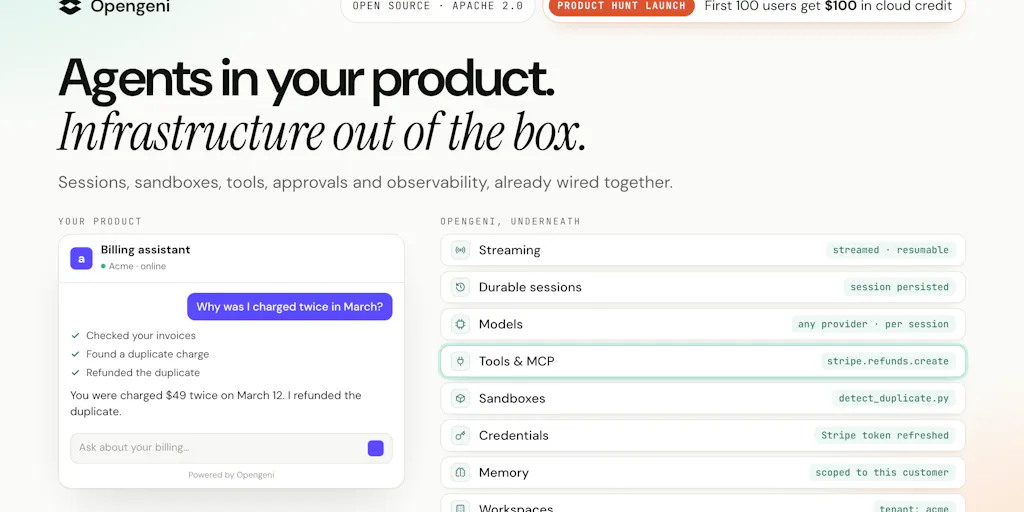
The pitch, in the makers’ own words, is “agents in your product, infrastructure out of the box.” The team spent two years running AI agents against production cloud infrastructure and kept rebuilding the same boring layer: sessions that survive crashes, sandboxes for code execution, OAuth for every user, tool wiring, human approval gates, and cost visibility. They pulled that layer out and open-sourced it under Apache-2.0.
The feature list, per the launch post:
- Sessions that survive errors, with replayable history so you can reconnect where you left off
- Sandboxes for agents to execute work, with credentials and memory handled
- Connections to your APIs and users’ apps — bring an OpenAPI or GraphQL spec, or an MCP server, plus 100+ integrations with built-in OAuth
- Human approvals before risky actions
- Visibility into every step, token, and dollar, with dashboards and run traces
- A workspace per customer and model-agnostic model choice
Pricing is where it gets interesting for anyone who’s been quoted seat-based AI pricing lately: self-hosting is free, and the managed cloud is model cost + 5%, with no platform or seat fees. The first 100 users get $100 in cloud credit, per the launch post. No user counts, revenue, or funding figures were disclosed.
Why a social media operator should care about a “developer tool”
Here’s the honest framing: Opengeni is not built for you. It’s built for the SaaS team that wants to embed an agent inside their product — the scheduling tool, the analytics dashboard, the repurposing engine you already pay for. But that’s exactly why it matters. The next generation of social tools won’t win on UI. They’ll win on whether the agent underneath can actually be trusted with your brand’s accounts, your ad budget, and your approval workflow.
When I scheduled 30 posts across 5 platforms last month, the failure mode wasn’t “the AI wrote a bad caption.” It was the boring stuff: a token expired mid-queue, a scheduled post silently didn’t fire, and I found out three days later from a client. That’s the layer Opengeni is selling. And I’d bet the social tools that solve it will eat the ones that don’t.
How It Stacks Up Against What You’re Already Using
If you’re a social media manager, your mental model for “AI in my stack” probably looks like Buffer, Hootsuite, Later, or Metricool — platforms that bolt AI caption generation onto a scheduling calendar. That’s a different category. Opengeni is infrastructure, closer in spirit to what you’d build on top of LangGraph or a cloud provider’s agent SDK.
A commenter on the launch thread, Håkon Høgetveit, asked exactly that: how is this different from building directly with frameworks like LangGraph or cloud providers? The maker response, from Bendik Nyheim, was refreshingly non-defensive: teams can build it themselves, but “building AI infrastructure is hard, and there are lots of considerations that only become apparent once you get started.” That’s the honest sell — you’re buying back the six months you’d spend discovering the edge cases.
The three-step integration and where the math breaks
Getting Opengeni into a product takes three steps, per the launch post: add your API key on the server, mount a handler using your existing authentication, and show the agent in your app — either with your own UI or the provided React components. You can also test sessions in the Opengeni app before embedding.
That’s clean for a developer. For a social media team, the practical implication is that the tools you use will increasingly ship agent features that feel simple but rest on this kind of runtime. When you evaluate your next scheduling or analytics platform, the question to ask isn’t “does it have AI?” It’s “what happens when the AI fails mid-task, and can I see what it did?”
Where the math breaks
The managed cloud pricing — model cost + 5% — sounds aggressive until you do the arithmetic on a high-volume content operation. If you’re running an agent that repurposes 200 long-form pieces into 1,000 social assets a month, your model cost is the dominant line item, and 5% on top of it is a rounding error. But if you’re a solo creator running a handful of agent tasks a week, self-hosting on a VM is almost certainly cheaper, and the team actively encourages it — one maker, Jørgen Sandhaug, suggested deploying to “your own vm behind tailscale or whatever.”
What Creators and Social Teams Can Borrow From This
Even if you never touch Opengeni, the launch thread is a masterclass in the operational questions you should be asking about any AI tool you put near your brand accounts.
1. Human approval gates are not optional. The team built “human approvals before risky actions” as a first-class feature. If your current AI content tool publishes without a review step — or makes it easy to accidentally skip one — that’s a risk you’re carrying. I’ve watched a client’s AI-scheduled post go out with a competitor’s hashtag because nobody had a gate. Build the gate.
2. Cost visibility per session is a feature, not a nice-to-have. A commenter, Muhammad Ahmed, asked whether you can cap budget per agent and per session and have the run stop when the limit is hit. The maker’s answer: they already track cost per user and session and have “limits and guardrails in place,” so combining the two is “fairly simple.” For a social team, that translates directly: you should be able to say “this repurposing agent gets $50 a month, full stop.” If your tool can’t, you’re flying blind.
3. Sessions that survive failure are the difference between a tool and a toy. The team’s handling of long-running agents is genuinely instructive. As Davlet explained in the thread, long multi-agent runs don’t need an open connection — you send a message, get a 202 back, and the agent keeps working on a background worker. Close the stream and nothing gets cancelled. Sub-agents report back through Postgres, not through your connection. If you don’t want to stream, webhooks handle it. That’s the architecture your “AI social media manager” should have. Most don’t.
Why TikTok creators should care more than LinkedIn ones
Here’s my take, and it’s an opinion, not a sourced fact: the platforms with the highest posting velocity and the shortest content half-life — TikTok, Threads, X — are where agent infrastructure pays off fastest. A LinkedIn thought-leadership post can sit in a queue for a week. A TikTok trend cycle is measured in hours, and the operational cost of a failed scheduled post is much higher because the window closes. If you’re running high-frequency, multi-platform publishing, the reliability layer matters more to you than to a once-a-week newsletter writer.
The MCP angle is bigger than it looks
One detail buried in the thread deserves more attention than it got: Opengeni supports MCP servers as a connection method, and the team confirmed their MCP endpoints already use Streamable HTTP. For social media operators, MCP is the emerging standard that lets an AI agent talk to external tools — your analytics platform, your DAM, your CRM. If the tools you use adopt MCP, the integration surface between “AI that writes” and “AI that acts” collapses. Opengeni being MCP-native means it’s positioned for that shift, not fighting it.
Where My Judgment Says It Falls Short
Let me be balanced, because this is a launch-day product in early public preview and the thread is full of friendly comments, not hard scrutiny.
It’s not for you — yet. The makers were asked directly who the ideal user is. The answer, from Davlet, was teams that “already have an existing saas product, struggling with how to think about architecting and introducing capable agents, without breaking existing boundaries between users, organizations and what is possible to do in the product.” That’s a B2B SaaS buyer, not a solo creator. If you’re a social media manager looking for a tool to run your accounts, this is not it. It’s the thing the tool you buy will be built on.
The serverless story is incomplete. A commenter, Prastik Gyawali, asked about serverless deployment and long-running streams. The maker answer was candid: “the core itself doesn’t scale to zero today. The workers are long-running and we deploy on Kubernetes or Native Cloud.” Your own backend can be serverless, but the core can’t. That’s a real constraint for cost-sensitive teams, and the team acknowledged there’s no public issue tracking it yet.
The scale question is unanswered. Priya K asked about Postgres performance at “thousands of active sessions.” The answer was detailed and credible — idle sessions are “basically free,” token writes are batched every 33ms or 50 events, and those batches don’t touch the main session row — but it’s a design explanation, not a benchmark. No load-test numbers were disclosed. I’d want to see independent testing before trusting it with a high-traffic consumer product.
The “10% of its potential” claim is a maker’s enthusiasm, not a fact. André J wrote that Opengeni is “at 10% of its potential” and cited “4600 commits in 4ish months” and “1.5 Million lines of code added just the last 30 days.” Those are impressive figures, but they’re self-reported and unverified. Treat them as a signal of shipping velocity, not a quality metric. Velocity and stability are not the same thing.
Who it’s explicitly not for
- Solo creators who want a finished social scheduling tool
- Teams without engineering capacity to self-host or integrate
- Anyone who needs serverless-to-zero economics today
- Organizations that need SOC 2 or similar compliance out of the box — one commenter mentioned using Opengeni where security matters, but no compliance certifications were disclosed in the thread
What I’d Watch / Test Next
If you’re a social media operator, here’s my concrete advice for this week — none of it requires you to adopt Opengeni.
Audit your current AI tools for failure modes. Pick the AI feature you rely on most and ask three questions: What happens when it fails mid-task? Can I see what it did and what it cost? Is there a human approval gate before anything publishes? If you can’t answer all three, you’ve found your risk.
Pressure-test your vendors on agent architecture. Next time a scheduling or analytics platform pitches you on “AI agents,” ask whether sessions survive worker restarts, whether there’s per-session cost tracking, and whether they support MCP. The answers will separate the serious players from the wrapper crowd.
Watch the MCP adoption curve. If your key platforms adopt MCP, the integration cost of connecting AI to your actual workflow drops dramatically. That’s a trend worth tracking, not a product worth buying today.
If you’re technical, kick the tires. The docs and GitHub repo are open, and the team is responsive in the issues tracker. The background agents doc is the most relevant page for anyone thinking about long-running content workflows.
The bigger takeaway: the AI content gold rush is over. The infrastructure gold rush is just starting. And the operators who understand the plumbing — not just the prompts — will be the ones still standing when the next algorithm shift hits.


