The Token Graveyard Is the Real Creator Stack Problem
If you run social for a living, your AI bill has quietly become a second rent payment. I’m not talking about the flashy stuff — the caption generators and thumbnail tools. I mean the invisible layer: the Claude subscription you use to draft carousel scripts, the OpenAI API key wired into your scheduling bot, the local Llama model on a spare Mac mini that you swear you’ll use for something. Every one of those sits in a different app, behind a different login, with its own rate limit that punishes you at the worst possible moment — usually 20 minutes before a launch post goes live. OpenLLM (from the team at openllm.sh) is a Product Hunt launch that tries to solve exactly this: one key, one memory, one fallback chain across every model you already pay for. It’s a developer tool, not a social tool — but the operational pattern it’s selling is one I think every content team should steal.
What OpenLLM Actually Does (and Why It’s Not Really a “Social Tool”)
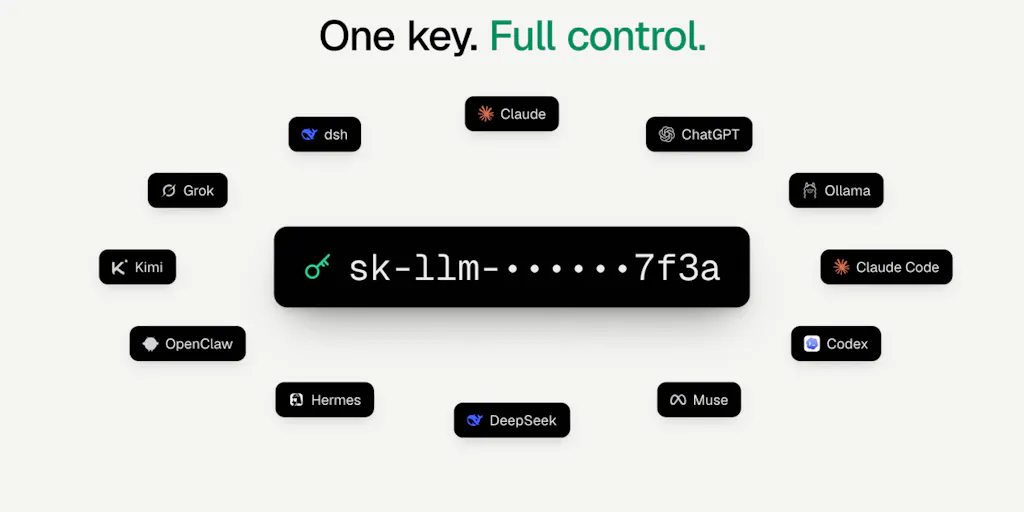
Let me be precise about what this is, because the framing matters. OpenLLM is a token-routing layer. You connect your existing AI subscriptions and API keys once, and you get a single OpenAI/Anthropic-compatible key that any coding agent — Claude Code, Codex, Cursor, Kimi Code, Grok, Muse Code — can point at. The founder, Jonathan Archer, describes the core pain bluntly: “I was paying for a lot of intelligence and could only use it in the box it came in.”
The feature list, per the launch post:
- Remote sessions — start a coding session on your home machine from your laptop, via web app or Mac app.
- Fallback chains — order your models, and when one hits a limit, the next picks up.
- One shared memory — save a decision or preference once, and every connected app can recall it. Available on every plan.
- The ChatGPT app on Mac can run on your OpenLLM models, so your subscriptions work inside an interface you already know.
- Free inference on DeepSeek and Qwen so your first request works before you connect anything.
- Observability — see which model answered and how many tokens you used, plus free context.dev credits for web reading.
- An MCP marketplace is “coming soon.”
Pricing is straightforward: free to start, Pro at $30/mo for up to 5 devices with a 3-day trial, macOS and Linux only. There’s a Product Hunt promo — code PHUNT for 50% off Pro for 6 months, first 100 people. Teams is “coming soon” with per-person token limits and shared memory across a team.
Here’s the honest part, and I want to flag it as my read rather than the maker’s claim: none of this is built for social media managers. There’s no Instagram API, no TikTok scheduling, no analytics dashboard, no content calendar. If you came here looking for a Buffer competitor, close the tab. What OpenLLM is selling is an infrastructure pattern — and that pattern is genuinely relevant to anyone running AI-assisted content operations at scale.
Why a content operator should care at all
Because the way most of us use AI for content is embarrassingly fragmented. In my own workflow, I’ve had a Claude subscription for long-form drafting, an OpenAI key for a repurposing script that turns YouTube transcripts into X threads, and a local model I spin up for anything I don’t want leaving my machine. Three logins, three billing relationships, three sets of limits that all seem to expire at the same time. When I scheduled 30 posts across 5 platforms last month, the bottleneck wasn’t the scheduler — it was that my caption-drafting bot died mid-batch because I’d hit an API ceiling, and I had to manually finish the last nine captions in a browser tab. A fallback chain would have caught that. That’s the concrete, unglamorous value proposition.
How It Differs From the Tools You Already Use
The comparison set here isn’t Buffer, Later, or Metricool — those are distribution and analytics layers. The closer analogues are the AI-routing and gateway tools: OpenRouter for model access, LiteLLM for proxy-style key management, and the native multi-model features creeping into Cursor and Claude Code. OpenLLM’s differentiator, per the launch, is the combination of subscription-based access (not just pay-per-token API keys), shared memory across apps, and remote sessions in one product. OpenRouter is API-key-centric; LiteLLM is a proxy you self-host; neither is trying to let you run your existing ChatGPT or Claude subscription through a coding agent.
I’d bet the shared memory is the sleeper feature. The launch comment thread is full of people asking exactly the right question — Aleksandar Perak asks whether a decision saved in Claude Code gets picked up by Codex mid-task, and Archer’s answer is telling: “Codex only picks up mid task if you ran out of usage with Claude, and it was placed below it on your fallback chain.” So memory propagates on fallback, not continuously. That’s a meaningful limitation, and I’ll come back to it.
The fallback chain is the feature, and the fine print is the story
Oleksii Sekundant raised the sharpest operational question in the thread: when a fallback happens halfway through a session, you want to know where the switch occurred. Archer’s reply — “There’s a ton of observability which is something we also love!” — is enthusiastic but not a direct answer. JC pushed further: if a session starts on a hosted model and falls back to a local one mid-task, does the local model get the full shared memory and enough conversation to continue, or does it restart from a summary? And can a local model sit first in the chain so hosted models only step in on limit? That question, as of the scrape, is unanswered. I’d treat mid-task fallback fidelity as the single most important thing to test before you trust this with anything production-critical.
What Creators and Social Teams Can Borrow From This
Even if you never install OpenLLM, the design philosophy is worth copying into your own content stack. Three patterns stand out.
1. Build a fallback chain for your content pipeline
Most creators run a single-model pipeline and treat an outage or rate limit as a force majeure event. That’s fragile. The better pattern — and the one OpenLLM formalizes — is to rank your tools by task: primary model for long-form drafting, secondary for caption compression, local model for anything sensitive (client NDAs, unreleased product info, personal data). When the primary hits a ceiling, the secondary picks up. You don’t need OpenLLM to do this; you need to write down the order and test the handoff. In my experience, the handoff is where things break — the second model doesn’t know the brand voice, doesn’t have the transcript, doesn’t know you already used that hook. Which is exactly why shared memory matters.
2. Treat memory as a first-class asset
The “one memory across all your models and apps” feature is the most interesting thing here for content teams, because brand voice is literally a memory problem. Your tone guidelines, your banned phrases, your recurring hooks, your client’s competitor list — that’s context you re-paste into every new chat window like a chump. A shared memory layer, even a crude one, beats re-pasting. The catch, again, is propagation: per Archer’s own answer, memory crosses over on fallback, not in real time. So if you’re mid-thread on a LinkedIn carousel and switch models manually, don’t assume the new model knows what the old one knew.
3. Observability beats vibes
“See which model answered and how many tokens you used” sounds boring until you’re trying to explain to a client why your AI spend tripled in a month. Token-level observability is the AI equivalent of UTM tracking — unsexy, essential, and the thing that lets you attribute cost to output. If you’re billing AI-assisted content to clients, you need this. Most creators don’t have it, and it shows up as margin erosion nobody can explain.
Where My Judgment Says It Falls Short
Now the part the launch post won’t tell you, and the part I’d want a fellow operator to tell me.
It’s macOS and Linux only. No Windows, no mobile. For a solo creator on a MacBook that’s fine; for a team with mixed hardware it’s a non-starter until Teams ships. Windows support is not disclosed.
The account-safety question is real and only half-answered. Archer flags that the most common question is “will this get my account banned?” and says he answered it “in the comment below” — but that comment isn’t in the scrape, so I can’t verify the substance. What the post does say explicitly is important: “It doesn’t make any subscription unlimited, and it isn’t account sharing. Your vendor’s limits and terms still apply.” That’s the honest framing, and I respect it — but “your vendor’s terms still apply” is doing a lot of work. Routing a consumer subscription through a third-party key is precisely the kind of thing that can run afoul of terms of service depending on the vendor. I’d want written clarity from each vendor before I put client work through it. My take: treat this as a personal-productivity tool until the ToS picture is unambiguous.
The memory propagation is conditional. As established, cross-app memory kicks in on fallback, not continuously. That’s a meaningful gap versus what “one memory across all your models and apps” implies at first read.
Pricing math is fine but not free. $30/mo on top of the subscriptions you’re already paying for is a real line item. The 50% promo softens it, but the value case depends entirely on whether you’re actually hitting limits often enough to care. If you’re a light user, you’re paying $30 to solve a problem you don’t have.
Who it’s NOT for: social media managers who just want to schedule posts and read analytics. Community managers who live in platform-native tools. Anyone on Windows. Anyone whose AI usage is casual enough that a single ChatGPT tab covers it. And anyone who needs vendor-blessed compliance — this is not that, yet.
Where the math breaks
The fallback chain only saves you if your models are interchangeable for the task at hand. They’re not. A Claude draft and a GPT draft of the same Instagram caption read differently — different rhythm, different em-dash habits, different willingness to be funny. So a mid-task fallback doesn’t just swap engines; it swaps voice. For a coding session that’s tolerable. For brand content it’s a quality risk. The shared memory helps, but memory of decisions isn’t the same as memory of style. I’d test fallback on low-stakes drafts before I let it touch a client deliverable.
What I’d Watch / Test Next
Here’s what I’d actually do this week if I were evaluating this for a content operation, in order:
- Test the fallback handoff on a real repurposing task. Take one YouTube transcript, run it through your primary model to draft an X thread, force a limit, and see what the secondary model produces. Compare voice. That single test tells you more than any feature list.
- Verify the memory propagation claim yourself. Save a brand-voice rule in one app, switch to another mid-session, and check whether it’s recalled. Archer’s own answer suggests it won’t be, mid-task, unless fallback triggered — confirm before you build a workflow on it.
- Get the ToS answer in writing. Whatever vendor subscriptions you’d route through it, read their terms on third-party key usage. Don’t rely on a comment thread.
- Watch for Teams and Windows. Per the post, Teams is “coming soon” with per-person token limits and shared memory — that’s the version a content team actually needs. Windows support is not disclosed, so don’t plan around it.
- If you’re not hitting limits, skip it. The honest test for whether you need this is simple: have you lost work to a rate limit in the last 30 days? If no, you’re paying $30/mo for insurance you don’t need. If yes, the fallback chain is worth a trial — and the
PHUNTcode makes the trial cheap.
The bigger lesson, though, isn’t about OpenLLM specifically. It’s that the creator stack is consolidating around routing — one key, many models, fallback, memory, observability. The tools that win the next two years won’t be the ones with the best single model. They’ll be the ones that make a dozen models behave like one reliable employee. OpenLLM is an early, developer-first bet on that thesis. Whether it becomes infrastructure or gets absorbed into the platforms themselves is the open question — and I’d bet on absorption.


