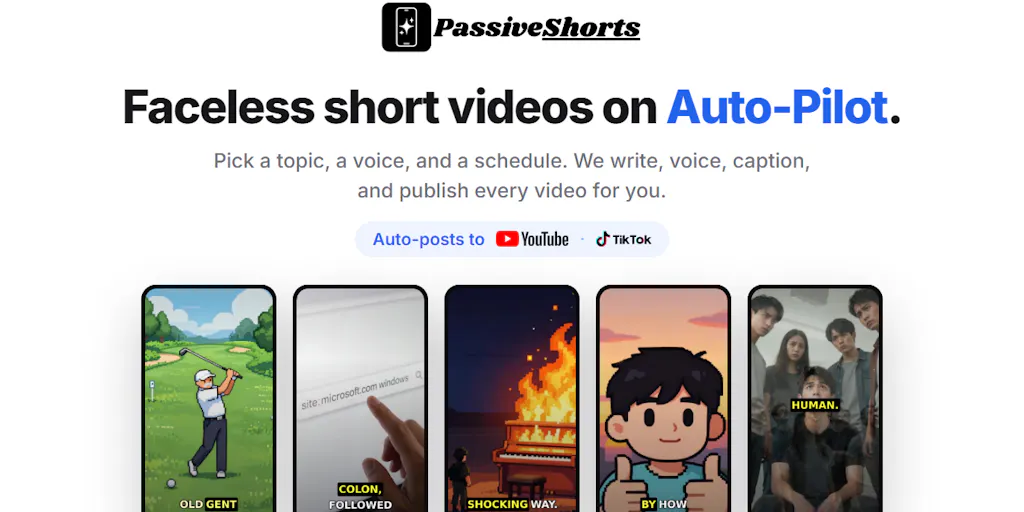
The faceless YouTube channel is the indie creator equivalent of a get-rich-quick scheme: the dream is passive income, but the reality is an operations treadmill. You script, you voice, you find visuals, you edit, you caption, you export, you upload — and if you stop for two weeks, the algorithm forgets you exist. PassiveShorts, a Product Hunt launch from maker Vijayabhaskar J, is built to remove that treadmill entirely: it writes, voices, visualizes, captions, and publishes videos to YouTube or TikTok automatically. For anyone running social accounts, that is a product worth studying, not because autopilot is a good idea, but because it exposes the real bottleneck in the creator economy — not content quality, but content operations. The question is whether an automated pipeline can survive the moment it posts something wrong.
The faceless-channel fantasy is a workflow problem, not a creativity problem
Anyone who has run a faceless niche channel knows the burnout curve. The first week is fun. You pick a niche, you research a few scripts, you play with a voiceover. By the end of week two, you are staring at a blank script doc while a queue of “find visuals for ten videos” mocks you. The maker of PassiveShorts puts it plainly: “Write a script, generate a voiceover, find visuals, edit it, add captions, export, upload, repeat. Most people (me included) burn out in the first two weeks, long before the algorithm ever rewards them.” That is exactly the churn I have seen in my own experiments. I have lost count of how many faceless channel ideas died on my hard drive because the gap between idea and published video was too wide.
The product does not solve creativity — it solves that gap. It treats the entire lifecycle as one continuous pipeline: topic selection, script generation, voiceover, visual generation, captioning, scheduling, and publishing. In my experience, this is the right mental model for social media operations. Most tools are islands. You use a script tool, a voice tool, a video editor, a scheduler, and then you manually move files between them. PassiveShorts compresses all of that into a single dashboard, and that is more meaningful than any individual AI feature.
It also matters for the algorithm. YouTube and TikTok reward consistency and watch time, not upload effort. A channel that posts daily for two months will usually outrank a channel that posts one polished video a month, all else equal. The maker’s whole bet is that the bottleneck is volume, and volume is a logistics problem. My take: he is mostly right. But logistics without editorial control is how you get a channel that looks like an abandoned AI farm.
What PassiveShorts actually automates — and what the maker claims
Here is the product recap, framed the way an operator would frame it: PassiveShorts is a configurable, autonomous content factory for short-form video. You set it up once. Pick a topic from five ready-made niches — Scary Stories, Jokes, Life Pro Tips, Today I Learned, You Should Know — or write your own. Pick a look from 19 visual styles, including photorealistic, cinematic, anime, Kurzgesagt, and claymation. Pick a voice from a library of natural AI voices, a caption style, a schedule, and connect YouTube or TikTok. After that, the maker claims, “we write the script, generate the voiceover, create the visuals, add the captions, and publish every video to your channel automatically.” No editing, no face, no manual uploads.
The details worth noting for operators:
- You can run up to 10 series at once, across different niches or channels, from one dashboard. That is a portfolio approach to content, not a single-channel tool.
- You can post public, private, or straight to TikTok drafts, which means there is a human-review on-ramp — but it is optional.
- The videos carry full commercial rights, according to the maker. That matters if you ever want to use the content beyond one platform.
When a commenter asked what results he had seen, the maker said he had been running three YouTube channels for a week: about half the videos got 1.5k+ views; the other half struggled to reach 10 views. Judging from comments, he said, reactions were “well received, just as any normal video would’ve received.” I would flag that as a small sample, not a performance guarantee. A week is not enough time for YouTube to decide what a channel is, and half of videos underperforming is common even for human-made channels. But at least it is an honest data point, and it tells you more than a dashboard screenshot ever would.
How it compares to the production and scheduling stack you already use
To understand where PassiveShorts sits, think about the stack a social media manager actually uses. Canva and CapCut are production tools: they help you make a video, but someone still has to export and upload. Buffer and Later are distribution tools: they help you schedule and publish, but they do not create anything. Metricool is an analytics layer that tells you what happened after posting. PassiveShorts is trying to be all of those at the low end, plus a writer, plus a voice actor, plus a motion designer, plus a publishing bot. That is a lot of surface area, and it is both the appeal and the risk.
The closest comparison is not Buffer or Canva; it is the AI content repurposing tools that promise “turn one blog post into twenty shorts.” Those tools still require you to review, edit, and upload. PassiveShorts skips that final human step by default, and that makes it categorically different. It is not a content assistant; it is a content operator. In my experience, that distinction matters more than any feature list. I can hand a one-click video generator to a junior editor and know the output will be rough. I cannot hand an autopilot publisher to someone who does not understand platform policy and expect the channel to survive.
Why TikTok creators should care more than LinkedIn ones
Faceless content is a discovery-platform game. TikTok and YouTube Shorts are built to surface unknown creators to strangers; the feed does not care who you are, it only cares whether people watch. LinkedIn, by contrast, is a professional graph. Your face, your name, and your credibility are the content. So the PassiveShorts model — anonymous, niche-based, volume-driven — makes sense on TikTok and YouTube in a way it never will on LinkedIn. If you are a LinkedIn creator, a tool that auto-publishes “Today I Learned” videos under your name is closer to a liability than a growth hack. Your audience is there for your judgment, not your upload cadence.
There is a deeper split for TikTok creators. TikTok’s algorithm is aggressive about testing content, but it is also sensitive to spam signals. A brand-new channel that suddenly publishes five videos a day, all with similar AI voices and stock-style visuals, is going to get a rough ride. The commenter Gal Dayan made exactly this point on the Product Hunt thread: “YouTube and TikTok have both been tightening enforcement against mass-produced, low-effort AI content this year, and ‘pick a topic and a schedule, we post everything’ sounds like it’s optimized to get a channel flagged rather than to build one that lasts.” I would go further: even if the platform does not flag it, the audience will. Comments are engagement, but hostile comments also teach the algorithm to push the video to people who argue with it. That is not necessarily bad — engagement is engagement — but it is not the passive income dream.
What creators and social teams can borrow without buying the tool
Even if you never open PassiveShorts, the design contains two lessons worth stealing.
First, batch your work into series. The “10 series at once” idea is more powerful than it sounds. Most creators treat each post as a one-off. That is exhausting. If you define five or ten recurring formats — “scary story,” “life pro tip,” “today I learned” — you are no longer deciding what to make; you are just filling in the blanks. The AI handles the fill-in, but you can do the same with a content matrix in a spreadsheet. In my own content workflow, I keep a “series bank” with each format’s hook structure, visual template, and caption formula. It cuts my creation time by a lot, and it gives me clear experiments to run.
Second, use approval queues deliberately. The maker’s point that you can post to private or TikTok drafts is not just a safety valve; it is a governance pattern. For a social media team, that is the difference between a tool that is usable and a tool that is a risk. You can let automation produce a first draft of everything, route it into a review queue, and only publish after a human signs off. That is how agencies should be using AI tools. The product’s default may be autopilot, but your workflow does not have to be.
There is also a tactical detail: full commercial rights. If you are building a content agency or managing client accounts, ownership is non-negotiable. The maker says the videos are yours. I cannot verify the terms beyond the Product Hunt statement, but it is the right thing to ask before you feed any AI tool into a client workflow.
Where I think the autopilot math breaks
This is where I stop being interested in the product as a tool and start being interested in it as a case study in trust. The most incisive comment on the thread came from Asad M.: “The risk here isn’t video quality, it’s that nothing in the loop has a human before publish. One Today I Learned script that states something false confidently goes out under the user’s channel name and they find out in the comments.” He suggested making “hold for review” the default for the first ten videos. The maker responded that users can write custom scripts, post to private or drafts, and that the slideshow creator is completely manual. Asad’s counter-response is the part I would want every creator to read: “Optional is doing a lot of work in that sentence. The people most likely to get burned are exactly the ones who never open settings.”
That is the whole product in miniature. The maker built a set of controls that protect the user, but he put autopilot first. In my experience, defaults are behavior. If a tool is designed to run itself, the user will let it run itself. The people who need the safety net the most are the ones who will never find the toggle that turns it on. I would bet that almost nobody in PassiveShorts’ early user base has changed that setting, and that is not a criticism of the maker’s intent — it is a critique of product design. The safety rail should be on by default, and the “run it yourself” switch should be the one that is optional.
There is also a factual accuracy problem that no amount of visual polish can fix. A “Today I Learned” video requires research. An AI script generator can produce confident nonsense, and once it is published under your channel name, the correction lives in the comments, not in the video. Retractions do not go viral. That is true for human creators too, but human creators at least have a built-in bullshit detector — most of the time. An automated pipeline does not, and the maker’s own “half my videos got 1.5k views, half got under 10” result suggests that the content quality is not yet consistently good enough to survive on pure distribution.
The human-in-the-loop problem isn’t solved by a settings toggle
There is a reason why compliance teams in every serious media operation insist on a human review step. It is not because the humans are better writers; it is because the cost of a false claim published under your name is asymmetrical. One bad video can tank a channel’s trust, and a new channel has no trust to spare. A settings toggle labeled “draft mode” is not a human-in-the-loop system unless the user understands why it matters. And a tool that promises “set it and forget it” is structurally teaching users not to look.
The maker’s response — that users can write custom scripts and choose private or draft mode — is true, but it misses the point. The people who need that protection are exactly the people who will not read the settings page. They are the ones who connected their channel, picked a niche, and walked away. That is the audience the product was built for, and that is the audience most likely to get hurt by it. If the product survives, I would expect the default to change. If it does not, I would expect the churn to be brutal.
Where the math breaks
Let us talk about the economics. The maker’s reported result — about half of videos at 1.5k+ views, half under 10 — is a very wide distribution. For a brand-new channel, that is normal: YouTube and TikTok are testing your content with small pools, and a small pool means extreme variance. But for a creator trying to build passive income, the arithmetic is cruel. Short-form views do not pay like long-form views. 1.5k views on a short might be a fraction of a cent per view; 10 views is nothing. If the tool costs a monthly subscription — pricing is not disclosed in the source — you need a lot of winning videos just to break even on the subscription, before you pay for anything else.
The other math is time. If I can set up 10 series and let them run, I have replaced hours of editing with minutes of setup. But I have also created a channel that is indistinguishable from thousands of other AI-generated content farms. The platforms are already flooded with “scary story” and “life pro tip” accounts. The marginal value of one more automated video is dropping. In my view, the real opportunity is not in the niches PassiveShorts picks for you; it is in using the pipeline to test a niche that you actually know something about. A custom-scripted “you should know” about your industry, run through the same automation, beats a generic scary story every time.
What I’d watch / test next
If I were evaluating PassiveShorts as an operator, I would do three things this week. First, set it up in private or draft mode — not public — and let it run for ten videos. Read every script. Watch every video. Ask: would I put my name on this? If the answer is no for even one out of ten, do not turn on autopilot. Second, compare the tool’s output against a human-made video in the same niche, side by side, with the sound off and the captions on. That will tell you whether the visual variety and caption pacing are actually competitive. Third, watch what the platform does to the channel in the first month: view distribution, swipe-away rate, comments, and any warnings. I would also watch whether the maker changes the default setting in response to the thread. If he makes draft mode the first-10-videos default, I would consider him a better product thinker than most founders. If not, I would bet the churn rate tells the story.