Every creator I know keeps a dirty secret in their phone: thousands of contacts and almost no context. We spend our days optimizing reach, watch time, and engagement rate, but the actual deals that keep the lights on — the brand collaboration, the podcast guest slot, the joint launch, the referral — still run through a DM thread, a text, or a “hey, we met at that event” email. That gap is why personal CRMs keep emerging as a category. Most fail because they ask you to leave the address book you already use and adopt a second system of record. Persodex takes the opposite bet: instead of replacing your contacts, it layers context on top of them. That might not sound like a social tool. For anyone who manages relationships as part of their content operation, it’s exactly the kind of infrastructure that makes or breaks a sustainable creator business.
The Relationship Layer Under the Content Graph
The content machine gets all the attention, but the relationship graph underneath it is what actually compounds. I’ve spent years running social accounts for clients and myself, and I’ve watched platform after platform squeeze organic reach until replying to a comment feels like a negotiation with a slot machine. The one asset that doesn’t get deprioritized is the relationship you can take off-platform: the brand manager who remembers your newsletter, the editor who slides into your DMs, the fellow creator who invites you into their community. That’s why a CRM for your personal contacts is not a productivity indulgence. It’s distribution infrastructure.
The maker of Persodex, Alexander Kaiser, describes the origin story in the launch thread: after 15 years of self-employment, his address book had become “little more than a list of names.” He could usually remember who someone was, but not where they met, what they talked about, which company they worked for, or why he saved the number in the first place. Context was scattered across notes, messages, Instagram, and his own memory. That is a deeply familiar pain for anyone who runs a social-facing business. Your audience metrics tell you how many people watched, but they don’t tell you who actually matters.
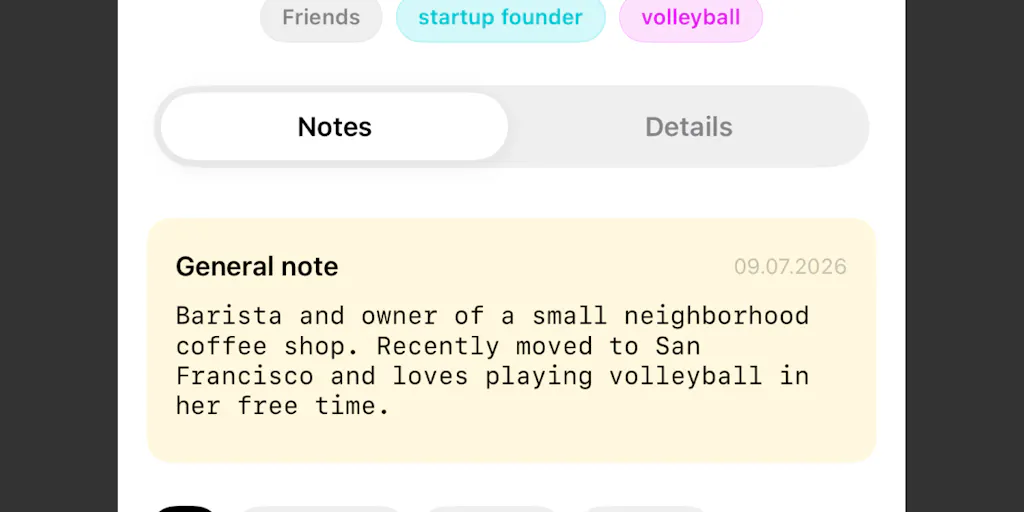
Persodex — Contacts with Context — approaches that problem from a deliberately small angle. It is a personal CRM that lives on top of your iOS contacts, not a separate database that asks you to import your life into another silo. It syncs natively with Apple Contacts instead of replacing them. The makers say they don’t even require an account. No import. No migration. No lock-in. For social media operators who have been burned by platform migration hell and tool shutdowns, that sentence is more valuable than another dashboard with fifty metrics.
The bigger point is that relationship maintenance is content strategy. The best video idea I ever had came from a phone call with a former client who casually mentioned a pricing objection she kept hearing from her own customers. That note never lived in my analytics tool. It lived in my head, and I almost lost it. The creator economy runs on serendipity, but serendipity has a memory problem. A tool that records the context around a person is, in effect, a content research system disguised as an address book.
Why Persodex Breaks the Personal CRM Pattern
Most personal CRMs fall into two camps. There are database-first systems built on Notion or Airtable templates, where you manage a table of people alongside a table of companies and a table of interactions. They are powerful, but they ask you to maintain a parallel universe. There are also network-first apps like Dex that try to become your relationship operating system. Both approaches create the same problem: the CRM becomes a place you go to do relationship admin, rather than a layer that lives where your relationships already happen.
Persodex is different because it treats Apple’s native contact database as the system of record. According to the Product Hunt launch page, notes are stored in the existing notes field, tags are saved as native contact groups, and your data remains accessible even without Persodex. That means the app is not importing your contacts so much as it is adding a context layer on top of the address book you already use. If you quit the app tomorrow, your contacts, your notes, and your groups are still sitting in your phone.
That might sound like a small implementation detail, but for creators it changes the adoption equation. When I’ve tested personal CRMs in the past, the death moment was always the same: I stopped entering new people because the friction of switching contexts was too high. With Persodex, the context attaches to the contact itself. If you already use Apple Contacts as your daily driver, the tool meets you where you are. You don’t have to build a new habit just to keep the CRM alive; you just have to write one good note after a call or a meeting.
The Native Layer Is the Feature
For social media operators, the most important decision in any tool is the system of record. If your contacts live in a proprietary CRM, every feature you use is debt you will pay later in migration. Persodex’s bet is that Apple’s Contacts framework is stable enough to build on, and it’s the one database you can trust not to disappear. That is a rare and honestly refreshing position in a product landscape full of AI-powered relationship tools that want to ingest your entire communication history.
One of the commenters on the launch page, Abdullah Javaid, raised a sharp technical question about iCloud sync: group membership through the Contacts framework has a history of showing up empty or duplicated on a second device after a sync. Kaiser’s answer was that Persodex creates groups and tags within the contacts database itself, which avoids the issue entirely. That’s the kind of implementation detail that matters in practice. I’ve seen “simple” contact tools break horribly when a client’s iPhone and Mac disagree about who belongs in which group. A tool that respects the native data model is less likely to corrupt your address book than one that tries to sync a separate database into it.
The other trust signal is privacy. Kaiser writes that privacy has always been extremely important to him — “perhaps that’s just my German side” — and that he deliberately did not want to create another platform people would feel locked into. That resonates in a creator economy where everyone is terrified of the next platform exodus. We already saw what happens when an algorithm changes overnight or a social network dies. The last thing a creator needs is a CRM that holds their network hostage.
Why TikTok Creators Should Care More Than LinkedIn Ones
The value of Persodex is not evenly distributed across platforms. On LinkedIn, the graph is semi-public and searchable. Your connections are a rough CRM already; you can search “marketing director at a beauty brand” and see their recent posts, their job history, and mutual connections. The platform does a lot of the remembering for you. On TikTok, the graph is almost useless for professional discovery. The algorithm doesn’t care who you know; it only cares who watches and for how long. That means a TikTok creator’s actual professional network has to be maintained manually, in DMs and comments and group chats.
For a TikTok creator, context like “met at VidCon, talked about UGC pricing, hates email, follows my Instagram” is the difference between a cold pitch and a warm one. The platform algorithm won’t surface that context, and neither will your analytics dashboard. The same logic applies on Instagram, where the DMs are full of opportunities but the app gives you almost no way to remember how you know the person on the other side. Persodex is more useful there than on LinkedIn because it replaces a graph the platform is not giving you.
What Social Teams Can Borrow Without Buying Anything
You don’t need to download Persodex to steal its core idea. The most valuable lesson from this launch is that your contacts are already a database; you just never labeled it that way. I’ve spent weeks of my life exporting contacts from one tool, cleaning them in a spreadsheet, and importing them into another. Persodex’s “no import, no migration” stance made me realize how much of that work is self-inflicted. The native contacts app on your phone can already hold notes, tags, and groups. The only missing piece is the discipline to use it.
Here is the workflow I would recommend to any social media operator, whether or not they try Persodex. First, create a contact group called “Key Relationships” and add the people you actually want to stay close to — not everyone you have ever met, but the twenty or thirty people who could change your business if they thought of you. Second, add a note to each contact after an interaction: what you talked about, what they are working on, what they asked for, what you promised. That note does not need to be long. It needs to exist before you forget. Third, set a recurring fifteen-minute weekly review where you open that group and send one message to someone you haven’t spoken to in a while. Treat it like a content calendar, but for relationships.
In my experience, this simple habit produces better returns than most social scheduling tools. When I’m scheduling posts across Buffer or Metricool, I’m optimizing for distribution, not memory. But the content that actually lands usually comes from a conversation with one person who said something surprising. If you record those conversations, you build a content library that no algorithm can take away.
Persodex also demonstrates the power of positioning around a single sharp idea: “Contacts with Context.” The product page does not try to be another all-in-one platform. It names the enemy — the business-y CRM with too many fields and too many features — and offers a smaller promise. For social media managers, the lesson is that your own toolkit does not need to be comprehensive. It needs to fit into your existing workflow so you actually use it.
Another thing creators can borrow is the “no lock-in” framing. In a crowded market, trust is a feature. When a tool promises that your data remains accessible even if you stop using the app, it removes the fear that you are building a house on rented land. That is especially important for independent creators who do not have an ops team to rescue them from a migration nightmare. I’d bet that “no lock-in” converts better than “powerful automation” for a certain segment of this audience, because it speaks to the anxiety that follows every creator in the platform age.
Where the Math Breaks: Manual Upkeep, Privacy, and Scale
Persodex is not magic, and its biggest weakness is visible right in the launch thread. A commenter named Artem Fedorovich asked the question that should be on every creator’s mind: “Does context enrich itself from where I actually interact with someone, or do I still have to feed it? That’s usually the line between a tool I keep and one I drop in a month.” Kaiser’s answer was honest: right now, you have to feed it. Apple does not allow the app to read from mail or messages, and the maker was not comfortable building an email-reading integration because of privacy concerns.
That immediately caps the product’s usefulness for people who are drowning in relationship data. If you are a creator doing a high volume of DM outreach, the last thing you want is another field to fill in after every conversation. A tool that requires manual notes is fine for a self-employed consultant who meets ten new people per month, but it will feel like homework for a social media manager who fields dozens of inbound messages per day. The maker says a Mac companion could solve some of that, but it’s a future possibility, not a current feature.
There is also a scale problem. Because Persodex lives on top of your iOS contacts, it is inherently single-user. No account means no shared team inbox, no client-specific views, no multi-user pipeline. If you’re running a social agency with multiple clients and a team of account managers, this is not a replacement for HubSpot or even a shared Airtable base. It’s a personal tool for personal relationships. That’s a feature, not a bug, but it means the addressable audience is narrower than the personal CRM category suggests.
The pricing is also not fully disclosed. The launch page offers a 25% discount on a Lifetime plan, but the actual price is not stated in the source material. If the Lifetime price is too high, the “no lock-in” promise starts to feel less compelling, because you are still paying for convenience, not for data ownership. I would want to know what the plan tier actually costs before betting my relationship system on it.
Who This Is Not For
Persodex is not for every creator. It is not for someone who wants fully automated relationship management, where the app reads your emails and messages and writes the context for you. It is not for teams that need a shared CRM pipeline. It is not for people who live outside the Apple ecosystem. And it is not for anyone who hopes a tool will fix a broken follow-up habit. The tool can hold context, but it cannot make you reach out to the person you keep postponing.
That is the honest trade-off. Most personal CRMs fail not because they lack features but because they ask you to change your behavior. Persodex reduces the behavior change to writing a note in a contacts app, which is still a behavior change. The “no lock-in” promise lowers the cost of trying it, but the maintenance cost remains. If you do not already add notes to contacts or review your relationship list on a regular cadence, this app will not magically make you a better networker. It will just give you a nicer place to store your guilt.
My take: this is a tool for people who have already learned that memory is unreliable and who want a low-friction way to capture context at the moment of contact. It is not a growth hack. It is a discipline amplifier.
What I’d Watch / Test Next
I plan to test Persodex with a deliberately small relationship set: the twenty people I actually want to stay in front of this quarter. My next step is simple. I will create a contact group called “Priority 25,” add context notes as I talk to each person, and set a weekly reminder to follow up. If the app stays out of my way and the native sync works on both my iPhone and my Mac, it has a chance to become a permanent part of my workflow.
I’d also watch two open questions. First, does the maker add a Mac companion or any optional enrichment feature? The launch thread already shows someone asking for auto-context, and if Persodex can solve that without compromising privacy, it becomes a much more serious contender against Dex and other network-first CRMs. Second, does the “no account” principle survive a future feature like team sharing or backup? The moment Persodex asks for an account, it loses part of its identity. I’d bet the founder will resist that as long as possible, and that resistance is exactly why the product is worth watching.
For any social media operator reading this, I’d suggest a simpler test before buying anything. Open your phone’s contacts app, pick five people you genuinely care about, and write one sentence next to each: where you met, what you talked about, or what they need. Do that for one week, and see how it changes the way you think about your network. You might not need a new product at all. But if you do, you’ll know exactly what you’re looking for.


