The Most Unserious App on Product Hunt Is the One Social Media Operators Should Study Closest
Let me start with a confession that might get me uninvited from the growth-marketing group chats: I am exhausted by serious tools. I schedule 40 posts a week across five platforms, I A/B test hooks until my eyes cross, I track UTM parameters like a forensic accountant. And when I open Product Hunt on a Tuesday morning, I am drowning in AI-powered content engines and “growth automation suites” that all promise the same thing — more output, less thinking, better metrics.
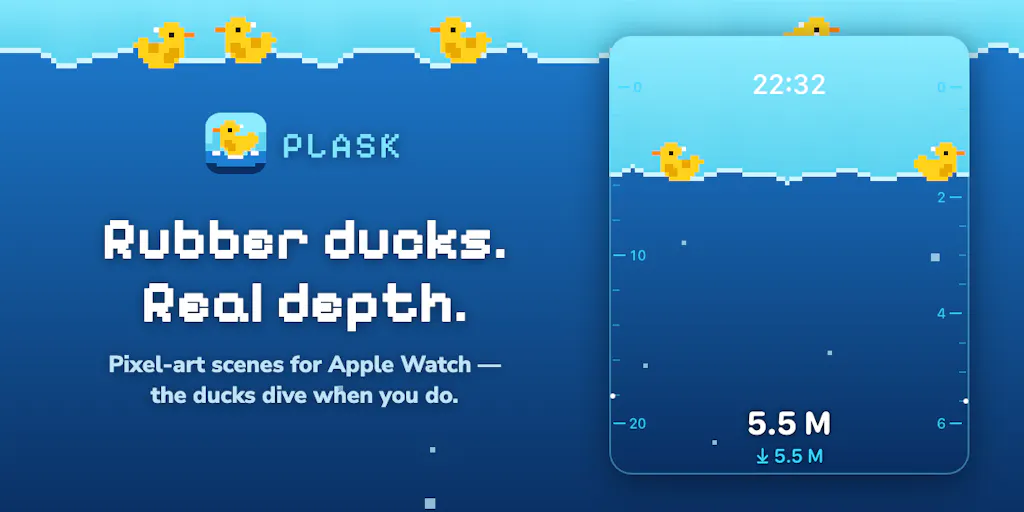
Then I saw Plask — an Apple Watch app that puts pixel-art rubber ducks in your bathtub. No subscription. No account. No data collection. A $1.99 one-time purchase that unlocks nine more scenes of sharks, jellyfish, aliens, and fermented Swedish herring. The depth sensor on your watch — the one Apple ships as a “serious dive instrument” — gets pointed at your actual bathtub, and the ducks dive when you do.
I clicked “visit” before I finished reading the description. And the more I sat with it, the more I realized this is the most strategically important launch I’ve seen this quarter — not because of its revenue potential, but because of what it reveals about the creator economy’s blind spot.
Here’s the thesis: we’ve optimized the distribution of content to death while starving the creation of joy. Plask is a masterclass in the opposite approach — a product built entirely around a moment of delight, with zero growth-hacking mechanics, that still managed to generate genuine community engagement on launch day. For social media operators drowning in AI slop and algorithm anxiety, this tiny bathtub app has more to teach us than another month of analytics dashboards.
The Problem Plask Actually Solves (And It’s Not the One You Think)
Let’s be precise about what this app does, because the mechanics matter. The maker, Danni Efraim, built Plask solo in Gothenburg, Sweden. The core feature uses the depth sensor on Apple Watch Ultra and Series 10+ models — hardware Apple markets for actual diving — and repurposes it for what the maker herself calls “deeply unserious” purposes. Pixel-art ducks swim on your wrist. When you submerge your hand, the ducks dive. The watch displays live depth, max depth, and water temperature. On depth-gauge models, the app auto-launches when your wrist hits water.
That’s the surface. But the actual problem Plask solves is more interesting: hardware features that ship with serious use-cases attached rarely get used at all.
I’ve seen this pattern play out across every platform I operate on. Remember when Instagram launched Reels and every brand account treated it like a chore? Or when LinkedIn started pushing newsletters and everyone scrambled to repurpose their blog posts into “thought leadership” without any genuine point of view? The platforms keep shipping features with impressive-sounding capabilities, and creators keep ignoring them because the effort-to-joy ratio is terrible.
Apple’s depth sensor is a perfect case study. It’s a genuinely impressive piece of hardware engineering — the kind of thing that gets featured in keynote demos and then forgotten in a drawer. Most Ultra owners, I’d bet, have never once opened the depth app outside of the first-week novelty period. Efraim’s insight was to recognize that the sensor’s real value isn’t diving logs — it’s the fact that it can detect something as mundane and universal as water in a bathtub.
This is the same logic that made Canva disrupt the design tool market. Professional tools like Adobe Photoshop were powerful but intimidating; Canva took the underlying capability and made it approachable for people who just wanted to make a birthday invitation without learning layer masks. Plask does the same thing for a hardware sensor — it takes a “serious” capability and makes it fun.
For social media operators, the lesson is uncomfortable: we’ve been building content like we’re designing dive instruments. Deep strategy documents. Multi-platform distribution matrices. Engagement-rate optimization frameworks. And our audiences are responding like people who bought an Apple Watch Ultra and never went diving.
What Plask Gets Right That Most Creator Tools Get Wrong
The Anti-Growth Growth Strategy
Here’s the part that made me actually laugh out loud while reading the Product Hunt page: the pricing model. Free with the yellow ducks, forever. One purchase at $1.99 — explicitly no subscription, no account, “it collects nothing.” Unlocks nine more scenes including sharks, jellyfish, aliens, Loch Ness, and surströmming (fermented Swedish herring, which the maker notes “felt right”).
Compare this to the standard SaaS playbook in the creator economy. Every tool I’ve tested in the last year wants my email, my credit card, and ideally my firstborn. Buffer starts free but pushes you toward paid tiers. Hootsuite has an enterprise sales team. Metricool gives you a trial and then starts the countdown clock. The entire category is built on the assumption that creators are a funnel to be converted.
Efraim inverted that assumption. The free version is genuinely useful — pixel ducks, real depth data, the core experience. The paid upgrade is a single $1.99 purchase with no recurring anything. There’s no “Pro” tier with advanced analytics. There’s no “Team” plan for agencies. There’s no data harvesting to subsidize the “free” tier. The maker explicitly states the app collects nothing.
In my experience running accounts for clients, this is the exact opposite of how every tool vendor pitches me. They want monthly recurring revenue, they want integration lock-in, they want my audience data. Plask wants nothing from me except the possibility that I’ll enjoy pixel-art ducks in my bathtub.
And here’s the kicker: that’s why it works as a launch. The Product Hunt comments are full of genuine enthusiasm — people asking about compatibility with older watches, suggesting scene ideas, sharing memories of classic Mac apps like the Talking Moose and Racter. One commenter, Claes Magnusson, put it perfectly: “We need more fun apps. Now everything is so effin serious.”
That’s not manufactured engagement. That’s the real thing — the kind of community response you can’t buy with a growth hack or a viral challenge.
The Demo Mode as a Distribution Strategy
One detail I want to highlight because it’s quietly brilliant: the demo mode. If you don’t have an Ultra or Series 10+ — if you’re like Gal Dayan, who commented with a Series 9 — you can still experience Plask by using the Digital Crown to drive the water. No real depth data, but the full visual experience.
This is a masterclass in removing barriers to trial. Efraim could have made Plask exclusive to the newest hardware and accepted a tiny addressable market. Instead, she built a demo mode that lets anyone with any Apple Watch get the core experience. The maker even suggests a workaround for older watches: open demo mode, turn on water lock, go for a swim — you just won’t get real depth measurement.
For social media teams, this maps directly onto content distribution strategy. How many times have we built content that’s only accessible to a narrow segment of our audience? A video that only makes sense if you’ve watched the previous 47 videos. A LinkedIn post that references an inside joke from a webinar. A newsletter that assumes deep familiarity with our product’s feature set.
The most successful creators I follow — the ones who actually grow — understand that every piece of content needs an entry point for the uninitiated. Plask’s demo mode is the content equivalent of a standalone clip that works even if you’ve never seen the channel before. It’s the difference between “you had to be there” and “you’re there now.”
The Lore Layer
I need to talk about Kungliga Badverket — the fictional Royal Swedish Bath Authority that issues 42 pixel-art certificates for your bathing career. First splash. Dips below five degrees. Stranger things. Earn enough and the duck gets a hat.
This is the kind of world-building that most creator tools completely miss. We’re all so focused on features and metrics that we forget the power of a compelling narrative universe. Notion has templates. Airtable has bases. Figma has frames. None of them have a fictional Swedish government agency issuing pixel-art certificates for bathing achievements.
Efraim understood something that most SaaS founders don’t: people don’t just use products, they inhabit them. The certificate system creates a progression loop that has nothing to do with engagement metrics or retention curves — it’s just delightful. The duck gets a hat. That’s the whole reward. And it’s more motivating than any gamification dashboard I’ve seen in a professional tool.
For content creators, this is a direct lesson in audience building. The accounts that win aren’t just publishing content — they’re building worlds. Think of MrBeast’s challenge universe, or the way Ryan Trahan turned a penny into a cross-country saga. The lore is the hook. Plask’s fictional Royal Swedish Bath Authority is the same principle applied to a $1.99 watch app.
Where Plask Falls Short (And Who Should Skip It)
I promised balanced judgment, so here it is: Plask is not for everyone, and there are real limitations to acknowledge.
Hardware exclusivity is the biggest constraint. The core experience requires an Apple Watch Ultra or Series 10+. That’s a tiny fraction of the smartwatch market. The maker confirmed in comments that older watches get demo mode only — no real depth data. If you’re on a Series 9 or earlier, you’re getting a shadow of the experience. This isn’t a flaw in execution; it’s a fundamental limitation of the hardware. But it means the addressable market is small, and the “wow” moment is gated behind a premium device purchase.
The novelty ceiling is real. Let’s be honest: how many times will you open an app that puts pixel ducks in your bathtub? I’d bet the median user gets a week of genuine delight, then moves on. The maker is planning updates — Midsommar scene, a duck hunt-themed scene (with a promise not to tell the ducks), something involving the Vasa warship, and a Norwegian Blue parrot “pining for the fjords” — but the core loop is inherently finite. This isn’t a daily-driver tool. It’s a party trick with surprising depth.
The monetization is intentionally tiny. At $1.99 one-time, even a wildly successful launch won’t generate meaningful revenue. The maker doesn’t disclose numbers, and I won’t invent them, but the math is straightforward: this is a passion project, not a business. If you’re looking for a sustainable creator-economy business model, Plask isn’t the template — it’s the exception that proves the rule.
Who should skip it: If you’re a social media manager who needs tools that integrate with your existing workflow, Plask isn’t for you. It doesn’t schedule posts, it doesn’t analyze engagement, it doesn’t generate content. If you’re an indie founder looking for a monetization playbook, this isn’t it. And if you’re on Android or don’t own an Apple Watch, you’re entirely out of luck.
But here’s the thing: the lessons of Plask are for everyone, even if the app itself isn’t.
Why TikTok Creators Should Care More Than LinkedIn Ones
I want to draw a specific distinction here, because the value of Plask’s approach varies dramatically by platform. On LinkedIn, the dominant content culture is still serious, professional, and metrics-obsessed. The platform rewards thought leadership, industry insights, and professional development content. A pixel-art duck app would be a curiosity, not a lesson.
On TikTok, the calculus is completely different. TikTok’s algorithm — and I’ve seen this play out across dozens of accounts I’ve managed — rewards uniqueness of experience over production polish. The platform’s entire culture is built on small, delightful moments that make people stop scrolling. A creator who films themselves opening Plask for the first time, watching ducks dive in their bathtub, has a genuine viral moment on their hands. It’s the kind of content that gets shared because it makes people feel something — even if that something is just “I want pixel ducks in my bathtub.”
The same logic applies to Instagram Reels and YouTube Shorts. The platforms that reward authentic, novel experiences are the ones where Plask-style thinking wins. The platforms that reward professional polish and thought leadership are the ones where it’s a harder sell.
This is a broader lesson about content strategy: match your approach to the platform’s cultural logic, not just its algorithmic mechanics. TikTok’s algorithm rewards watch time and completion rate, which means content that creates a genuine emotional reaction — even a silly one — outperforms content that’s merely informative. The depth sensor gimmick creates a reaction. The certificate system creates a reaction. The duck getting a hat creates a reaction.
What Creators and Social Media Teams Can Borrow Right Now
I’ve been running social accounts for clients across every major platform for the better part of a decade, and I’ve tested more scheduling tools and content engines than I care to count. Here’s what I’m taking from Plask and applying to my own workflow this week:
1. Audit your content for joy density. I’m going to go through my last 30 posts and rate each one on a simple scale: did it make me feel anything beyond “I should post this for engagement”? I suspect most of my content will score a zero. That’s a problem. The content that actually performs — the posts that get saved, shared, and screenshotted — is the content that creates a moment of genuine feeling. Plask is 100% joy density. My content is maybe 10% on a good day.
2. Build lore into your content universe. I’m not suggesting you invent a fictional government agency for your brand — though honestly, that might be more interesting than another “we’re excited to announce” post. But I am suggesting that the most successful accounts have a narrative layer that makes their content feel like a world, not a feed. A recurring character. A running joke. A certificate system for your audience’s achievements. The duck getting a hat is more memorable than any engagement-rate metric I’ve seen this quarter.
3. Remove every barrier between your audience and the experience. Plask’s demo mode is a masterclass in this. No compatible hardware? Here’s a workaround. No bathtub? Use the Digital Crown. The maker is actively engineering around objections instead of accepting them. How many of us have content that requires the audience to have watched our previous 20 videos, understood our industry jargon, or already be convinced of our value proposition? Every barrier is a lost viewer.
4. Question the subscription reflex. I’m not saying subscriptions are bad — they’re the backbone of the creator economy, and I rely on them myself. But Plask’s one-time purchase model is a reminder that not everything needs to be a recurring revenue stream. Sometimes the goal is a moment of delight, not a monthly billing cycle. For creators, this might mean occasionally publishing something that isn’t designed to drive subscriptions or memberships — just to create a moment of joy. The goodwill you generate is worth more than the engagement metric.
5. The “unserious” is strategically serious. This is the big one. We’ve spent years professionalizing content creation — and in the process, we’ve squeezed out the playfulness that made social media fun in the first place. Plask is a reminder that the most shareable content isn’t always the most strategic. Sometimes it’s just a duck in a bathtub.
Where the Math Breaks
I want to be clear-eyed about the economics here, because I don’t want to romanticize what is ultimately a passion project. Let’s do some rough math — and I’m flagging this as my own estimate, not sourced fact, because the maker doesn’t disclose numbers.
Assume Plask launches well and gets, say, 50,000 downloads. Even at a generous 20% conversion to the paid tier, that’s 10,000 purchases at $1.99 — about $20,000 gross. Apple’s App Store takes 15% for small developers, leaving roughly $17,000. For a solo developer in Gothenburg, that’s a nice bonus but not a living wage. And that’s a good launch scenario.
The point isn’t that Plask is a viable business — it isn’t. The point is that it’s a viable strategy for something else entirely: attention, goodwill, and the kind of authentic community engagement that money can’t buy. Efraim’s Product Hunt launch generated genuine conversation — people sharing memories of classic Mac apps, asking thoughtful questions about hardware compatibility, suggesting scene ideas. That’s worth more than a thousand “great launch!” comments on a typical SaaS product.
For creators, this is the deeper lesson: not everything needs to be a revenue engine. Sometimes the most valuable thing you can publish is something that costs you money, generates zero direct ROI, and creates a moment of genuine connection with your audience. The trust you build in that moment pays dividends across everything else you do.
What I’d Watch / Test Next
I’m not going to tell you to buy Plask — although at $1.99, there’s no real reason not to if you have a compatible watch. What I am going to suggest is a concrete experiment you can run this week, inspired by what Efraim built:
Test: Publish one piece of “unserious” content per platform. Not a strategic post. Not a thought leadership piece. Not an engagement-bait question. Something that exists purely to create a moment of delight. A pixel-art duck in a bathtub. A behind-the-scenes blooper. A joke that has nothing to do with your brand. Measure not just the engagement metrics, but how the comments feel. Are people actually enjoying themselves? Is the conversation different from your usual post?
Watch: How Plask’s community evolves. The maker is already taking scene suggestions and planning updates. Watch how she handles the community she’s built — the tone, the responsiveness, the willingness to engage with feedback. That’s a case study in creator-audience relationship building.
Track: The “fun app” revival. The comments on Plask’s launch page are full of people nostalgic for the era of playful software — the Talking Moose, Racter, apps that existed to make you smile. If this launch is any indication, there’s a hunger for that kind of software again. For creators, that’s a signal: the pendulum is swinging away from relentless optimization and toward genuine delight.
Experiment: Build lore into your next campaign. Even if it’s just a small running joke across three posts, see what happens when you give your audience a world to inhabit rather than a feed to consume. The duck getting a hat is more memorable than any metric I’ve tracked this year.
Here’s the uncomfortable truth I’m sitting with after writing this: I’ve spent the last year optimizing my content for algorithms, and I’ve forgotten to optimize it for humans. Plask isn’t a threat to the creator economy’s serious tools — it’s a reminder of why we started creating in the first place. Sometimes the most strategic thing you can do is put a pixel-art duck in a bathtub and see what happens.


