The Creator Economy’s Real QA Problem Isn’t Your Content — It’s Your Agent
If you run social accounts in 2025, you’re probably not just a content person anymore. You’re an operator of a stack: a scheduler, a repurposing pipeline, a handful of AI helpers, and — increasingly — a customer-facing agent that answers DMs, qualifies leads, or triages comments on your behalf. That last piece is where the wheels come off quietly. You can A/B test a hook, you can read your Instagram Insights, you can watch your TikTok retention graph dip at second three. But when your AI agent starts promising a discount it isn’t authorized to give, or forgets the third message in a Threads conversation, there’s no dashboard that screams at you. That’s the gap QAgent is trying to fill, and it’s worth a creator’s attention even if you’ve never written a line of Python.
Why a social media operator should care about agent QA
Here’s the uncomfortable parallel. Most creators I know treat their AI agent the way the maker of QAgent, Abhiram Reddy.K, describes his own early workflow: type a few prompts into a playground, watch the bot respond politely, ship it. He calls prompt regression “silent” — you fix one edge case in your system prompt, and three previously working flows break without throwing a single runtime error. That’s the same failure mode as editing your link-in-bio copy and forgetting it’s referenced in forty scheduled posts. Nobody notices until a customer does.
The difference is that a broken bio link loses you a click. A broken agent policy can lose you money, trust, or both. In my experience running DMs and comment automation for small brands, the failure that hurts most isn’t the bot saying something obviously wrong — it’s the bot saying something plausible but unauthorized. “Sure, I can extend that return window.” “Yes, we ship to your country.” Those read fine in a sample of three outputs. They read very differently in a screenshot.
What QAgent actually does, and where it sits in the stack
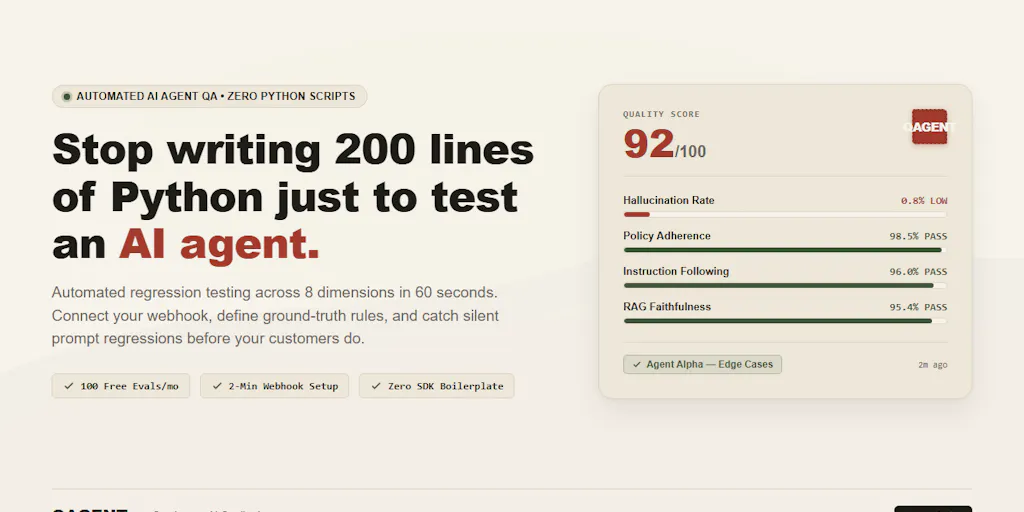
Strip away the launch-day framing and QAgent is a regression-testing layer for LLM agents. You connect your agent via webhook or API endpoint — the maker claims a two-minute setup with zero SDK boilerplate — and then run automated test suites against it. The output is a visual pass/fail scorecard with root-cause breakdowns, rather than the terminal JSON dumps the maker says existing eval tools force you into.
The evaluation dimensions are the interesting part, because they map surprisingly well onto what a social or support agent actually needs to get right. The launch lists eight: Answer Quality, Factual Groundedness, Policy Adherence, Escalation Correctness, RAG Faithfulness, Contextual Relevancy, Context Recall, and Multi-turn Context Memory. If you’ve ever built a RAG-powered FAQ bot on top of your own Notion docs, you already know why “RAG Faithfulness” and “Context Recall” are separate metrics — one asks whether the bot stayed inside your source material, the other asks whether it actually retrieved the right material in the first place. Those are different bugs with different fixes.
Pricing is straightforward as far as the source goes: a free tier of 100 evaluations per month, no credit card required. Paid tiers are not disclosed on the page. I’d treat the free tier as a genuine trial rather than a marketing hook — 100 evals is enough to catch the obvious regressions in a small agent, though probably not enough to run nightly suites across a dozen conversation flows. My take: for a solo creator with one agent, it’s a reasonable starting point. For a team running multiple agents across Instagram, TikTok, and a support inbox, you’ll hit the ceiling fast and need to talk to sales.
The multi-turn compounding problem nobody talks about
The single most useful line in the entire launch thread is buried in the maker’s follow-up comment: if your agent is 95% accurate per turn, the compounding failure rate means it has “barely a 35% chance of finishing a 20-turn conversation” without hallucinating or breaking rules. That’s not a QAgent statistic — it’s the maker’s own framing of the math — but the underlying arithmetic is real and worth sitting with. Per-turn accuracy multiplies. A bot that looks flawless in a one-shot demo can be a liability by turn fifteen.
For social media operators, multi-turn is exactly where the money is. Comment threads, DM back-and-forths, lead qualification conversations — these aren’t single-shot. A creator selling a course through DMs isn’t running a Q&A bot; they’re running a sales conversation that needs to remember what the person already said, respect the offer boundaries, and know when to hand off to a human. That’s precisely the territory QAgent claims to score, and it’s where I’d want to see real evidence before trusting the numbers.
How this compares to what creators already use
The honest answer is that most creators aren’t using dedicated agent eval tooling at all — they’re using the native analytics inside their scheduling and publishing stack. Buffer, Hootsuite, Later, and Metricool all give you post-level performance, and some now fold in AI caption or reply suggestions. What none of them give you is a regression suite for a conversational agent. That’s a genuinely different category.
If you’re comparing against the broader eval ecosystem, the usual names are tools like Braintrust, LangSmith, and Humanloop — all of which target engineering teams and generally assume you’re comfortable writing Python, wiring up SDKs, and living in a notebook or dashboard built for developers. The maker’s explicit positioning is against that: he says existing eval tools “forced us to write 300 lines of custom Python scripts” and maintain “an entire second Python codebase just to test our first one.” Whether that’s fair to every incumbent is debatable, but the friction is real. I’ve watched non-technical creators bounce off eval tooling in under ten minutes because the onboarding assumed a repo.
Where QAgent looks differentiated, based on the source alone:
- Webhook-first onboarding instead of SDK installation — the maker claims two minutes, zero boilerplate.
- Policy Adherence as a first-class metric — commenter Gal Dayan of Dial called this out as “the failure mode that’s hardest to catch by just reading a few sample outputs,” and I agree. It’s the metric most likely to save a creator from an embarrassing screenshot.
- Visual scorecards rather than raw JSON — small thing, big difference for anyone who isn’t a backend engineer.
Why TikTok and Instagram creators should care more than LinkedIn ones
This is a judgment call, not a sourced fact, but I’d bet the risk profile differs sharply by platform. A LinkedIn agent that misfires on a comment reply is annoying. A TikTok or Instagram agent that misfires in a public comment section — or worse, in a DM where someone screenshots a promise — is a brand problem that spreads. Short-form platforms reward speed and volume, which is exactly the environment where you’re tempted to let an agent run unsupervised. The higher your posting cadence and the more public your comment surface, the more a policy-adherence score actually matters.
LinkedIn operators, by contrast, tend to run lower-volume, higher-stakes conversations where a human is often still in the loop. If that’s you, QAgent’s value is lower — you’re probably fine with a checklist and a second pair of eyes.
What creators and social teams can borrow from this, tool or not
You don’t need to adopt QAgent to steal its operating logic, and honestly, the logic is the more valuable export.
Build a regression set, not a vibe check
The maker’s framing — “stop shipping on vibes” — is the whole lesson. Before you ship any agent that talks to customers, write down ten to twenty real conversation scenarios you care about: the refund question, the shipping question, the “are you a real person” question, the angry-comment escalations. Run them every time you touch the system prompt. This is exactly what QAgent automates, but you can do a crude version in a spreadsheet for the first month.
Separate “sounds fine” from “is compliant”
Dayan’s point about policy adherence is the sharpest thing in the thread. Reading a few sample outputs tells you whether the bot sounds human. It tells you nothing about whether it stayed inside your offer boundaries. Those are different tests. If you only have time for one, test compliance.
Treat prompt edits like code deploys
The maker’s core warning is that a one-sentence prompt tweak can silently break unrelated flows. In my own experience running repurposing pipelines, the same is true of caption templates and hashtag sets — you change one variable and three downstream posts break. The discipline is the same: version your prompts, note what changed, re-run your regression set. If you’re already using a tool like Notion or Airtable to track content, add a prompt-changelog tab.
Where my judgment says this falls short
Balance matters, so here’s the honest list.
The 35% figure is the maker’s framing, not an audited benchmark. It’s a useful mental model, not a measurement. Don’t quote it as fact.
Pricing beyond the free tier is not disclosed. For a solo creator, 100 evals a month is a real trial. For a team, it’s a question mark until you talk to them.
This is still a developer-adjacent tool. “Webhook or API endpoint” is easy if you’ve done it before and opaque if you haven’t. A creator who’s never touched a webhook will need help. The maker offers to help set up policy test suites directly, which is generous, but it’s not the same as a no-code onboarding.
It doesn’t touch your content pipeline. QAgent won’t schedule posts, won’t repurpose a TikTok into a Reel, won’t tell you why your watch time dropped. If you were hoping for an all-in-one, this isn’t it. It’s a specialist tool for one specific, high-stakes job.
Who it’s NOT for: creators whose “AI” is just a caption generator, anyone with no customer-facing agent, and teams that already have a mature Python eval harness they’re happy with. If any of those describe you, skip it.
What I’d watch / test next
Three concrete things I’d do this week if I were running an agent for a brand account.
First, audit your agent’s worst-case turns. Pull your last fifty DM or comment conversations and find the three where the bot said something you’d have to walk back. That’s your regression set. You don’t need QAgent to write it — you need it to run it repeatedly.
Second, if you do try QAgent, start with Policy Adherence only. Ignore the other seven metrics for week one. Connect your agent via webhook, write five policy tests around your actual offer terms, and see whether the scorecard catches something your eyeballs missed. That’s the cheapest possible test of whether the tool earns a paid seat.
Third, watch the multi-turn metric specifically. That’s where the maker’s own math says the risk concentrates, and it’s where I’d bet most creators are flying blind. If QAgent’s scorecard can reliably flag the turn where a conversation drifts, that’s a feature worth paying for. If it can’t, the whole category is still early.
My overall read: this is a sensible, narrow tool aimed at a real and under-served problem, launched by someone who clearly felt the pain firsthand. It won’t transform your content strategy. It might save you from one very bad screenshot — and in the creator economy, one bad screenshot is often the whole ballgame.