The Curation Filter Is the Product Now
Every social media operator I know is drowning in the same way. It isn’t a scheduling problem — Buffer and Later solved that years ago. It isn’t a design problem — Canva and CapCut flattened that one too. The problem is upstream of all of it: deciding what deserves to become content in the first place. When I ran a five-platform publishing calendar last quarter, the actual bottleneck wasn’t writing captions or cutting verticals. It was the hour and a half each morning spent scrolling RSS readers, Telegram channels, YouTube subscriptions, and X lists, trying to figure out which three items out of four hundred were worth a post. That triage layer is where taste lives, and almost no tool has tried to model it explicitly. Radaric, launching today from Kirill Oleinichenko, is a genuine attempt at exactly that — and even if you never subscribe, the way it frames the problem is worth borrowing.
What Radaric Actually Does (And What It Refuses to Do)
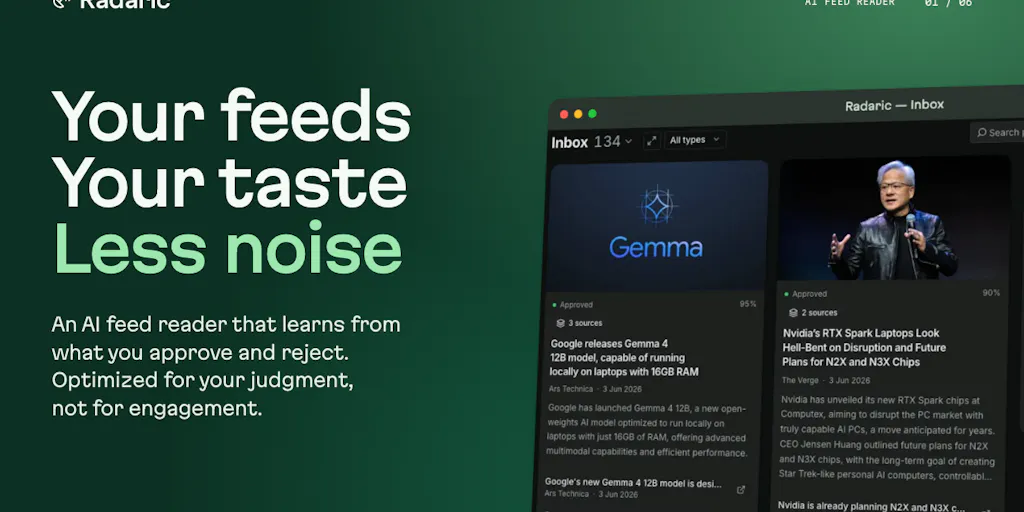
The pitch is deceptively simple: describe in plain language what matters to you, connect your sources, and let an AI filter decide which posts make the cut. The sources are RSS, Telegram (including private channels), and YouTube on the Lite tier, with X added on Pro. When multiple sources cover the same event, Radaric groups them into a single story with the original links preserved.
But the interesting part isn’t the feature list. It’s what Kirill says in the launch thread: “A topic like design is a starting point, but it doesn’t capture an editor’s taste. A practical case study, a minor product update and a piece of corporate PR can all match the same keywords.” That’s the whole thesis, and it’s correct. Keyword filters fail not because they’re imprecise but because they’re literal. They can’t tell that a case study and a press release about the same company are fundamentally different objects.
The mechanism Radaric uses to close that gap is worth understanding if you care about AI tooling at all. Instead of training on thousands of thumbs-downs, you write down your editorial rules up front — global rules plus per-source rules — and then the filter starts close to your taste from the first pass. Kirill’s answer to a commenter asking how many approve/reject decisions it took to match his taste is telling: “almost no training was needed. Before it ever saw my decisions I wrote down the rules I actually judge by.” After that, it’s small corrections, and crucially, a short written reason on a rejection does more than “a hundred silent thumbs down.”
That’s a design philosophy, not just a feature. Most “AI learns your taste” products are black boxes that require volume. Radaric asks for articulation. And that’s the part I’d bet most social media managers will either love or bounce off of entirely.
Why this matters more for newsletter and digest operators than for brand accounts
If you run a brand’s Instagram, your content sources are probably internal — product launches, campaign assets, UGC. Radaric’s value there is thin. But if you’re a solo creator running a weekly newsletter, a link roundup, a “what happened in AI this week” thread, or a curated Pinterest board, you’re doing editorial triage as a core job function. That’s the user Kirill built for — he edits Zhurnalus, a design digest with 500+ issues since 2016. The tool is a mirror of his own workflow, which is both its strength (it’s grounded in real use) and its limitation (it’s shaped by one editor’s habits).
How It Compares to the Tools You’re Probably Already Using
The obvious comparison set is Feedly with its AI “Leo” filters, Inoreader, and to a lesser extent Pocket or Readwise Reader. Feedly has had keyword and entity-based filtering for years, and Leo can do some topic clustering. Inoreader has rules-based automation that power users swear by. So what’s different?
My take: the difference is explainability as a first-class feature. Feedly’s AI tells you what it surfaced; Radaric, per the launch materials, lets you see the filter’s reasoning and revisit what it filtered out. That audit trail matters more than it sounds. When I’ve tested AI curation tools in the past, the failure mode that kills them isn’t bad suggestions — it’s invisible bad suggestions. You don’t know what you missed, so you stop trusting the filter and go back to scrolling manually. A filter you can inspect is a filter you can calibrate. A filter you can’t inspect is a slot machine.
The other differentiator is Telegram. Most Western social tools treat Telegram as an afterthought or skip it entirely. For anyone covering crypto, Eastern European tech, or niche communities that migrated off Discord, Telegram channels are where the signal actually is. Radaric supporting private channels on the base tier is a real operational advantage that Metricool and Hootsuite don’t offer in any meaningful way.
Where the math breaks
Here’s the honest accounting. Lite is $9/month; Pro is $59/month and adds X. The jump from $9 to $59 for one additional source is steep — a 6.5x multiplier for X access. Kirill’s explanation in the thread is that every post the filter reads costs real AI money, and X’s API pricing (which has been notoriously expensive since the 2023 changes) is presumably the driver. That’s a defensible cost structure, but it means Radaric is priced for people who know X is where their industry lives. If your audience is on LinkedIn and Instagram, you’re paying Lite prices for a tool that doesn’t touch your primary platforms at all.
And that’s the thing nobody in the launch thread said out loud: Radaric is not a social media tool. It doesn’t schedule, it doesn’t draft, it doesn’t publish, it doesn’t analyze engagement. It’s an input filter. The output is still a human writing a post. That’s fine — arguably honest — but it means the comparison isn’t Buffer vs. Radaric. It’s Radaric vs. the 90 minutes you spend scrolling every morning. Whether that math works depends entirely on what your time is worth and how much of that scrolling is actually productive versus performative.
What Creators and Social Teams Should Steal From This
Even if you never sign up, there are three operational lessons embedded in how Radaric is built that apply to anyone running content across multiple platforms.
1. Write your editorial rules down before you automate anything
The single most useful thing in the entire launch thread is Kirill’s admission that he wrote his rules before the AI saw any of his decisions. Global rules, then per-source rules. That’s a practice, not a feature. Most content teams I’ve worked with have their editorial standards in someone’s head or buried in a Notion doc nobody reads. If you can’t articulate why a post belongs in your feed in plain language, no AI filter — and no junior hire — will ever match your taste. The act of writing the rules is the value; the tool is just the executor.
Try this: before your next content sprint, write five global rules (“we don’t post funding announcements unless the company is a direct competitor”) and three per-source rules (“from this Subreddit, only posts with 50+ upvotes and a substantive comment thread”). You’ll be surprised how much of your “instinct” turns out to be unstated policy.
2. Rejection reasons are training data — treat them as such
The commenter Thami Benjelloun nailed the most useful feature: “Being able to explain why you rejected a post, not just thumbs down.” This applies far beyond Radaric. Every time you kill a draft, decline a pitch, or skip a trending topic, you’re generating signal. Most teams throw that signal away. The ones that capture it — even in a shared doc — build institutional taste that survives turnover. If you’re managing a team of content creators, a running “rejected and why” log is worth more than any style guide.
3. Deduplication is an underrated content operation
Radaric groups coverage of the same event into one story with original links attached. For anyone running a news-adjacent account or a link roundup, this is the difference between a feed that looks curated and a feed that looks like a wire service. I’ve seen brand accounts post the same TechCrunch story three times in a week because three different team members saw it in three different feeds. A dedup layer — whether it’s a tool or a Monday morning manual pass — is cheap insurance against looking lazy.
Why TikTok creators should care more than LinkedIn ones
Counterintuitive, but I’ll stand by it: if your primary platform is TikTok, your content is downstream of culture, not industry news. The inputs that matter are sounds, formats, memes, and creator drama — most of which live on TikTok itself and don’t surface well in RSS or Telegram. Radaric’s source coverage skews toward text-heavy, industry-news sources. A LinkedIn operator covering B2B SaaS has a much cleaner fit: their inputs are newsletters, company blogs, and X threads, all of which Radaric handles natively (X on Pro). A TikTok creator’s real filter is the For You Page, and no external tool can replicate that. Know which kind of operator you are before you pay for a filter.
Where I Think It Falls Short
Three honest concerns, in order of how much they’d affect my own workflow.
First, the cold-start problem is real even if Kirill says it isn’t. His answer — that writing rules up front means almost no training was needed — is true for him, because he’s been editing the same digest for nearly a decade and knows his taste cold. For a newer creator still figuring out what their feed should be, the “write your rules first” step is much harder than it sounds. The tool’s quality is bounded by the user’s self-knowledge. That’s not a flaw exactly, but it’s a filter on who gets value.
Second, the original-reporting-versus-press-release distinction is unsolved, and Kirill admits it. Commenter Sanya Singh asked the sharpest question in the thread: can Radaric tell a story from the press release behind it? Kirill’s answer: “Honest answer: not yet. Today Radaric merges coverage of the same event into one story… But telling original reporting from the press release behind it is still a human call.” That’s admirably transparent, and it’s also the exact distinction that separates a good digest from a mediocre one. Deduplication solves the volume of noise; it doesn’t solve the quality of noise. For now, that last mile is still yours.
Third, the free trial situation is messy. A commenter asked why money-back instead of a free trial; Kirill initially explained the cost rationale, then posted a correction: sign-ups from the Product Hunt link get 7 days free, no card required, and the 30-day money-back guarantee applies once you’re paying. That’s a good offer, but the fact that the maker’s first answer was outdated copy is a small yellow flag about launch-day operational polish. Not disqualifying — just worth knowing that the pricing page and the thread may not have matched on day one.
Who it’s not for: anyone whose content inputs are primarily visual platforms (Instagram, Pinterest, TikTok), anyone who needs scheduling or publishing in the same tool, and anyone who wants AI to write the content rather than just filter the inputs. Radaric is a reading tool for people whose job is reading. That’s a narrower market than the launch copy implies, and I respect that Kirill doesn’t pretend otherwise.
What I’d Watch / Test Next
If you’re curious, here’s what I’d actually do this week rather than subscribing blind.
- Audit your inputs first. For three days, log every source you actually check before publishing. If more than half are RSS, Telegram, YouTube, or X, Radaric’s coverage fits you. If most are Instagram saves and TikTok FYP, it doesn’t.
- Write your rules before you trial. Draft five global and three per-source editorial rules in a doc. Then sign up through the Product Hunt link to get the 7-day free Lite trial, no card, and paste those rules in. If the filter’s first-pass output doesn’t feel close to your taste, the problem may be your rules, not the tool — and that’s useful information either way.
- Test the rejection-reason loop deliberately. Reject ten posts with specific written reasons and see whether the next day’s feed shifts. That’s the core mechanic; if it doesn’t move for you, nothing else will.
- Watch the X pricing question. If Pro’s $59/month is the only path to X and your industry lives there, the value math depends on how many hours of scrolling it replaces. Run the trial on Lite first, then decide whether X access justifies the jump — Kirill’s cost explanation is plausible, but the multiplier is steep enough that I’d want a month of real use before committing.
The bigger thing I’m watching is whether “teach the filter” becomes a category. Every platform algorithm is moving toward personalization, and every creator is drowning in more inputs than ever. A tool that makes taste explicit — auditable, editable, explainable — is a more interesting bet than another scheduler. Radaric may or may not be the winner in that category, but it’s asking the right question. That’s more than most Product Hunt launches manage.