The Job-Search Lesson Social Media Operators Keep Relearning: Verified Evidence Beats Confident Vibes
Every social media manager I know runs the same broken workflow. We pull a claim from a platform blog post, a competitor’s case study, or a creator’s “I grew to 100K in 30 days” thread, and we build a content strategy on top of it — without ever checking whether the original source actually applies to our account, our audience, our niche, and this month’s algorithm. That gap between “the source says X” and “X applies to you” is where most bad social strategy is born. So when a product shows up on Product Hunt whose entire thesis is separating what public evidence actually establishes from what you merely wish were true, my ears prick up — not because I need a job-search tool, but because the underlying discipline is exactly what’s missing from most content operations. That product is Rolequiry, and the mechanism behind it is worth stealing even if you never apply for a job again.
What Rolequiry Actually Does (and Why the Mechanism Matters More Than the Use Case)
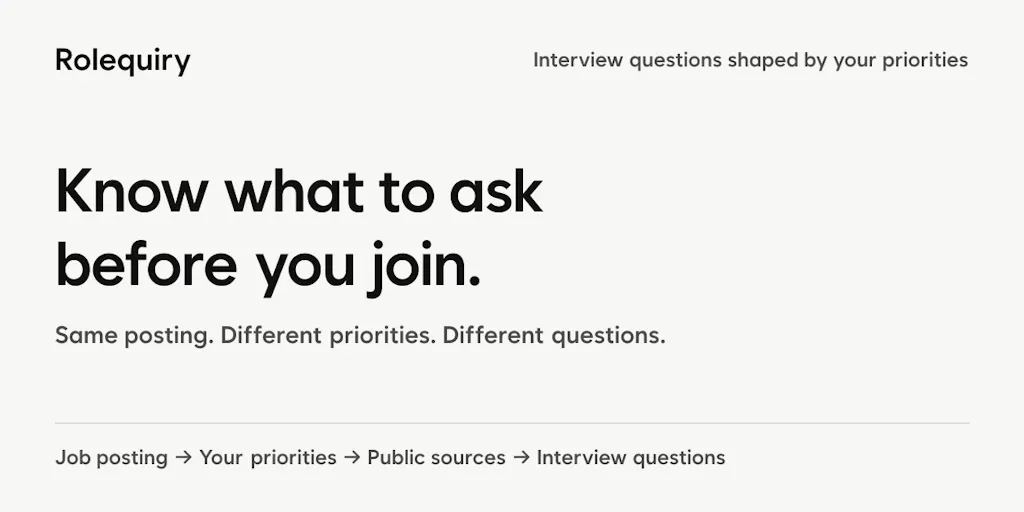
Rolequiry is a job-search tool built by Kim Hyoyeol that helps candidates prepare specific questions about a role based on their own career priorities. The maker’s framing is deceptively simple: the same job posting should generate different questions for different people, because priorities differ. The app searches public sources, fetches pages, and checks quotations against the original source text. When the initial evidence review is inconclusive, GPT-6 Astra re-examines the original public source to assess whether it applies to the specific company, role, team, location, and time period. Crucially, the maker describes a production run on an Automattic engineering posting where the workflow included Astra review and four source-verified quotations — and the sources still didn’t establish the role-specific travel policy, so Rolequiry kept the question open rather than guessing. That last detail is the whole ballgame. The tool’s selling point isn’t that it answers everything; it’s that it refuses to answer what the evidence doesn’t support.
I want to be precise about what the source does and doesn’t claim. The maker says the app “handles search and page fetching, checks quotations against the source text, and turns unresolved conditions into interview questions.” The featured demo uses fictional data so you can explore the interaction immediately, and you can try your own posting with one career priority — a resume is optional. Pricing is not disclosed. User counts are not disclosed. The team frames the output as “a clearer conversation with the hiring team, without a fit score or an unsupported claim of certainty.” If that sounds like an anti-product — a tool that deliberately withholds the satisfying verdict — that’s the point, and it’s the reason I think social media operators should study it.
The “Fit Score” Trap Is the Same Trap as the “Viral Score” Trap
Notice what Rolequiry explicitly refuses to produce: a fit score. Now look at the social tooling landscape. Buffer, Hootsuite, Later, and Metricool all increasingly surface some flavor of “predicted performance” or “best time to post” score. I use these tools and I’m not dunking on them — Metricool’s analytics have saved me hours. But a predicted engagement score is a fit score by another name: a single confident number that collapses a messy, context-dependent reality into a verdict you can act on without thinking. Rolequiry’s design choice — keep uncertainty visible, turn unresolved conditions into questions — is a direct rebuke to that pattern. In my experience, the operators who grow accounts fastest aren’t the ones who trust the score; they’re the ones who treat every metric as a question to investigate, not an answer to accept.
How This Differs From the AI Research Tools You Already Use
The obvious comparison is Perplexity or any AI search layer, and to a lesser degree ChatGPT with browsing enabled. Those tools will happily summarize a job posting or a platform blog post and hand you a confident paragraph. The difference Rolequiry is claiming is source verification: it checks quotations against the original pages rather than trusting the model’s paraphrase. That’s a meaningful distinction, because in my own tests of AI research tools, the failure mode is almost never “the model couldn’t find anything” — it’s “the model found something adjacent and presented it as directly applicable.” A tool that re-examines whether a source applies to the specific company, role, team, location, and time period is doing the scoping work that generic AI search skips.
The second comparison is to the emerging category of “evidence-first” AI tools — think Elicit for research papers or Consensus for scientific claims. Rolequiry is applying that same citation-discipline pattern to a domain (job hunting) where the stakes are personal and the temptation to overclaim is enormous. I’d bet the pattern generalizes. The question for us is whether it generalizes to content operations.
Why TikTok Creators Should Care More Than LinkedIn Ones
Here’s a counterintuitive read. You’d assume a job-search tool matters most to LinkedIn-native creators. I think the opposite. LinkedIn’s culture already rewards cautious, hedged, “it depends” framing — the platform’s audience expects qualifiers. TikTok and Instagram Reels, by contrast, run on confident, declarative hooks: “This one setting doubled my reach,” “Stop posting at 9am.” The gap between what a source actually establishes and what a 15-second hook asserts is widest on short-form video, which means that’s exactly where the verification discipline is most valuable and most absent. If you’re a TikTok creator who’s ever built a whole content pillar on a single platform blog line you never traced back to its original context, Rolequiry’s core logic — does this source actually apply to my situation? — is the audit you owe your own strategy.
What Social Media Teams Can Borrow From Rolequiry’s Workflow
Strip away the job-search skin and there are three operational habits here that transfer directly to content and growth work.
First: separate what the evidence says from how it relates to your needs. The maker draws this line explicitly — “Supporting evidence doesn’t automatically mean a role is right for you.” The content equivalent: a case study showing a brand grew via a particular tactic doesn’t mean that tactic fits your account size, niche, or platform mix. I’ve watched teams copy a Duolingo-style chaotic brand voice onto a B2B SaaS account and wonder why engagement cratered. The evidence (chaotic voice works for Duolingo) was real; its applicability to their context was never checked.
Second: keep uncertainty visible. Rolequiry’s production run kept the travel-policy question open rather than filling the gap. In content strategy, the honest version of this is writing “we don’t know whether this format works for our audience yet — here’s the test” instead of asserting a best practice you half-remember from a webinar. When I plan a repurposing workflow across five platforms, I now tag each assumption as verified, assumed, or unknown, and the unknown tags become the experiments for the next sprint. That’s a direct lift from this tool’s design philosophy.
Third: turn unresolved conditions into questions, not claims. The app converts open conditions into interview questions. For social teams, the analogue is converting open strategic questions into content briefs that explicitly test them. Instead of “we should post more carousels because carousels get reach,” the brief becomes “does carousel format outperform single-image for our audience? Test 4 carousels against 4 singles over two weeks, measure saves and shares, not just likes.”
Where the Math Breaks
I’d be a bad industry observer if I didn’t flag the obvious tension. Rolequiry’s value depends entirely on the quality of its source-checking — and “checks quotations against the source text” is a claim I can’t verify from a Product Hunt page. If the verification layer is loose, the tool becomes just another confident AI summarizer with extra steps. The maker’s transparency about the inconclusive Automattic run is a good trust signal, but a single described production run isn’t a track record. I’d want to see how it handles sources that are paywalled, dynamically rendered, or ambiguous — the messy reality of most web research. Not disclosed: how many sources it searches, what its latency looks like, or how it handles sources in languages other than English.
Where My Judgment Says It Falls Short
Three concerns, flagged as opinion rather than fact.
One: the scope is narrow by design, and that’s a ceiling. Rolequiry is built for one specific high-stakes decision (should I take this job, and what should I ask?). That focus is a strength for trustworthiness but a limit on how often you’d use it. A social media operator might open it once per job change. The underlying pattern is broadly useful; the product as described is not a daily driver for content teams. That’s fine — not every tool needs to be a daily habit — but don’t mistake it for a platform.
Two: “verified quotation” is not the same as “verified applicability.” This is the subtle one. A tool can correctly confirm that a source says exactly what it says, and still be wrong about whether that source applies to your situation. Rolequiry claims to handle this via the Astra re-examination step, assessing whether a source applies to the specific company, role, team, location, and time period. That’s the hard part, and it’s the part I can’t evaluate from the launch page. In my experience with AI research tools, quotation-checking is tractable; applicability-judgment is where models quietly hallucinate confidence. I’d bet this is where Rolequiry either earns its keep or doesn’t.
Three: the demo uses fictional data. The maker is upfront about this — “The featured demo uses fictional data so you can explore the interaction immediately.” Good transparency. But it means the most compelling evidence in the launch (the Automattic run) is described in prose, not shown in the demo. I’d want to run my own posting through it before trusting the applicability layer.
Who This Is NOT For
If you want a tool that tells you whether you’re a good fit for a job, this isn’t it — it deliberately won’t give you that verdict. If you’re looking for a content-scheduling or analytics platform, this is the wrong category entirely. And if you want fast, confident answers rather than a list of well-sourced open questions, Rolequiry will frustrate you. Its whole value proposition is the opposite of the reassuring-score pattern most SaaS defaults to.
The Bigger Pattern: Evidence Discipline Is Becoming a Competitive Advantage
Zoom out. The creator economy is drowning in confident claims — from platform PR, from course sellers, from AI tools that summarize without verifying. The operators who win the next two years won’t be the ones with the most tools; they’ll be the ones with the best filters for deciding which claims actually apply to their account. Rolequiry is a small, focused example of that filter applied to job hunting. The pattern — search, verify against original source, scope to your specific context, keep uncertainty visible — is the same pattern I’d want baked into every content research workflow I run. You don’t need this specific product to adopt the discipline. You need the discipline, and this product is a clean demonstration of what it looks like when someone builds software around it instead of around engagement bait.
What I’d Watch / Test Next
This week, run one audit on your own content strategy using Rolequiry’s logic, whether or not you touch the tool. Pick the single most load-bearing claim in your current plan — the one tactic or format you’re betting the most on. Then trace it to its original source and ask the scoping question the maker built this app around: does this source actually apply to my company, niche, audience, platform, and this time period? If you can’t verify it, tag it as unknown and turn it into a test brief rather than a strategy pillar. If you’re job-hunting or advising creators who are, try Rolequiry with one career priority and see whether the questions it surfaces are ones you’d have missed — the maker’s own prompt is worth answering for yourself: what’s one question you wish you’d asked before accepting a previous role? And watch whether the “evidence-first, uncertainty-visible” pattern spreads from tools like this into the scheduling and analytics platforms we live in daily. My bet: it will, because the operators who demand verified applicability instead of confident scores will simply out-execute the ones who don’t.