The inbox is the new homepage — and that should worry anyone whose growth model lives in DMs
If you run social for a living, you already know the dirty secret of the creator economy: the content gets the credit, but the conversations close the deals. The comment that turns into a DM, the DM that turns into a WhatsApp thread, the WhatsApp thread that turns into an invoice — that’s the actual funnel for most indie founders and solo operators. So when a tool launches that claims to pull WhatsApp, live chat, email, SMS, and social channels into one shared inbox with AI agents on top, I pay attention — not because I need another dashboard, but because the fragmentation tax is real and it’s eating hours I could spend making things. SalesRep.com, built by Mr. Echouafni and Zineb Ennatiji, is the latest entrant into that crowded “omnichannel inbox plus AI” category. Whether you should care depends entirely on where your conversations actually happen — and whether you trust an AI to have the third follow-up.
What problem SalesRep is actually trying to solve
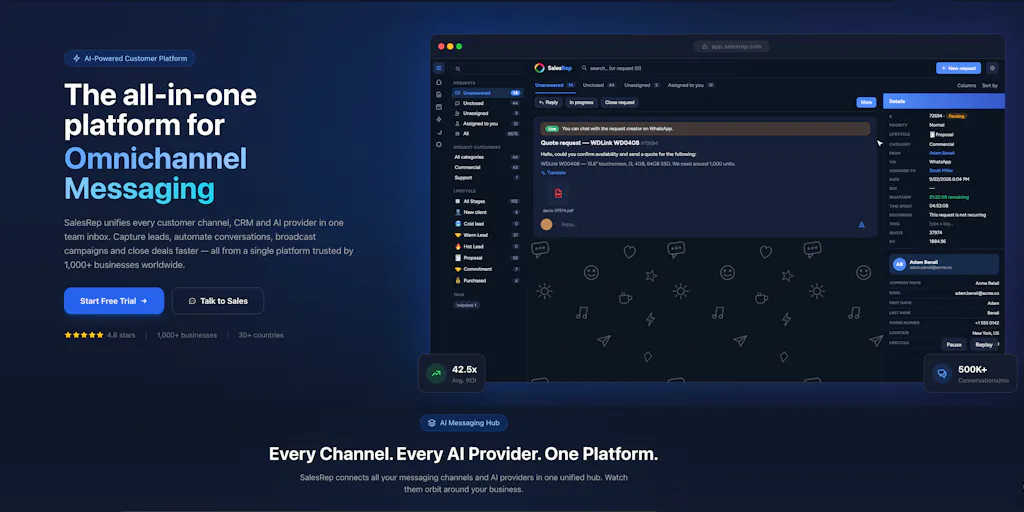
Strip away the launch-page language and the pitch is straightforward: customer conversations are scattered across WhatsApp, live chat, email, SMS, and social channels, and sales and support teams want one place to manage all of it. The team frames this as an omnichannel inbox with AI agents, workflow automation, team collaboration, and reporting layered on top, and they specifically call out making WhatsApp “a real part of the sales and support workflow, rather than treating it as a separate messaging tool.”
That last clause is the interesting one, because WhatsApp is where a huge chunk of small-business and creator commerce actually happens — especially outside the US. If you’ve ever tried to run a product drop through Instagram DMs and then migrate buyers to WhatsApp for payment coordination, you know the pain: two apps, two notification streams, zero shared history, and a spreadsheet duct-taped to the side. The promise of a unified thread is genuinely appealing. My take: the value isn’t the AI, it’s the consolidation. The AI is the upsell.
Why this matters more to WhatsApp-first operators than to LinkedIn-first ones
Here’s the operational reality that the launch page doesn’t spell out. If your audience lives on LinkedIn, your conversations are already in a reasonably searchable inbox, your CRM probably has a native integration, and the marginal gain from a tool like this is modest. If your audience lives on WhatsApp — which is the norm for a lot of Southeast Asian, Latin American, Middle Eastern, and Southern European markets — you’re likely running sales out of a personal phone number, manually copy-pasting order details, and losing track of who paid and who ghosted. That’s the gap SalesRep is targeting, and it’s a real one. In my experience, the operators who feel this most acutely aren’t enterprise sales teams at all — they’re one-person businesses doing high-touch, low-volume commerce through chat.
How it stacks up against the incumbents you already pay for
The honest comparison set here isn’t just one tool. It’s the stack most social media managers and small teams already assemble: a scheduling and analytics layer like Buffer or Later, a reporting layer like Metricool, a design layer like Canva, a video editing layer like CapCut, and then — awkwardly bolted on — some kind of inbox. For bigger teams, that inbox is often Hootsuite, which has been trying to own the “social plus conversations” space for years. SalesRep is entering that last slot, but with a WhatsApp-first angle and AI agents as the differentiator rather than social publishing.
The AI angle is where the category is genuinely shifting. Everyone from Intercom to Zendesk to a dozen YC-backed startups is racing to put an agent between the customer and the human. The pitch is always “respond faster, close more.” The counterargument — and it’s a strong one — is that automated follow-ups on messaging apps are a fast track to being blocked, muted, or reported. That tension showed up immediately in the launch comments, and it’s worth examining closely because it’s the single biggest risk factor for anyone deploying this.
The follow-up problem nobody wants to talk about
One commenter, Eldar Miensutov, raised the exact objection I had when I read the phrase “follows up until the deal closes”: on WhatsApp, the third unanswered follow-up is usually where people just block you. He asked whether you can cap how many messages the AI sends before handing the lead back to a human. The maker’s response was that yes, you can set how many messages it sends before handing off to an agent in the AI center.
That’s the right answer, but it also tells you something important: the default behavior is aggressive, and the guardrail is manual configuration. For a solo operator juggling thirty conversations, “you can cap it” is only useful if you actually remember to cap it before your AI annoys a prospect into a block. My take: any tool that automates outbound follow-up on a messaging app should ship with conservative defaults, not configurable maximums. The burden of restraint shouldn’t sit with the user.
What creators and social teams can actually borrow from this
Even if you never sign up, there are three transferable lessons here that apply to almost any social operation.
First, audit where your conversations actually close. Pull up your last twenty sales or client conversions and trace the channel path. I’d bet a meaningful share start on a public platform (Instagram, TikTok, X) and finish somewhere private (DM, WhatsApp, email). If you can’t name that path in one sentence, you have a measurement problem before you have a tooling problem. This is where UTM discipline pays off — if your bio link and story links carry consistent UTM parameters, you can at least see which platform drove the click, even if the close happened in a chat app.
Second, separate the inbox from the publishing stack. Most social media managers conflate the two because the incumbents bundle them. But scheduling and conversation management have completely different cadences and different success metrics. Publishing is about reach and engagement rate; the inbox is about response time and conversion. If your current tool is mediocre at one of those, you’re probably paying for a bundle you don’t fully use.
Third, treat AI agents as triage, not salespeople. The most defensible use of an AI layer in a social inbox isn’t “close the deal” — it’s “answer the twenty identical questions about shipping, sizing, and pricing so the human can focus on the five conversations that actually need judgment.” That reframing changes what you’d even want to buy.
The homepage problem is a positioning problem
Another commenter, Roger Kaleba, flagged something that matters more than it sounds: he came for the AI sales rep, but the homepage opens on a team inbox dashboard, and the AI demo is buried a couple of scrolls down. The maker’s response pointed him to the WhatsApp AI selling demo further down the page and shared a signup link.
This is a classic launch-page mismatch, and it’s a lesson for anyone building a product page or a landing page for their own offer. The thing that makes you different should be the first thing a visitor sees, not the third section down. If the AI rep is the hook, the hero should show the AI rep doing something specific — sending a product card, generating a quote — not a generic inbox screenshot. Positioning isn’t a marketing afterthought; it’s the difference between a visitor understanding your product in five seconds and bouncing because it looks like every other inbox tool.
Where my judgment says this falls short
Let me be direct about the gaps, because the launch page doesn’t address them and they matter for anyone evaluating this seriously.
Pricing is not disclosed on the launch page. There’s a signup link with a plan parameter, but no public pricing tier I can point to from the source. For a tool aimed at small teams and solo operators, that’s a friction point — I’d want to see the number before I invest time in onboarding.
Integration depth is unstated. “WhatsApp, live chat, email, SMS and social channels” is a list, not a specification. Which social channels? Does it connect to the Instagram Graph API for DMs, or only to public comments? Does it use the official WhatsApp Business API — which has per-conversation pricing and template message rules — or a lighter integration with real limitations? These distinctions determine whether the tool is viable for serious volume or just a nicer front-end for a personal number. The source doesn’t say, so I can’t tell you.
The AI follow-up risk is real and under-addressed. As the comment thread shows, the guardrails exist but they’re opt-in. There’s no mention of compliance considerations, opt-out handling, or how the tool behaves when a contact says “stop.” For anyone operating in a regulated market or selling to EU customers, that’s a question you’d need answered before deployment.
Who it’s not for: if your entire funnel runs through email and LinkedIn, or if you’re a large team already standardized on a full CRM like HubSpot or Salesforce, the switching cost probably isn’t worth it. This is a tool for WhatsApp-heavy, small-team, high-touch operations — and there’s nothing wrong with that, but it’s a narrower market than the launch copy implies.
Where the math breaks
Here’s a back-of-napkin concern. If you’re running, say, a few hundred conversations a month and your average order value is low, the time saved by consolidation has to exceed the subscription cost plus the setup and maintenance time. For solo creators, that math is often tight. The tool pays off when conversation volume is high enough that manual triage is genuinely the bottleneck — which is a different profile than most indie creators. I’d bet the sweet spot is small agencies, e-commerce shops, and service businesses with a real inbound flow, not individual content creators.
What I’d watch / test next
If you’re curious enough to poke at this, here’s what I’d actually do this week — and it’s the same test I’d run on any omnichannel inbox.
First, map your own conversation flow before you touch a new tool. Take your last twenty closed deals or client wins and write down the channel where each one started and the channel where it closed. That single exercise tells you whether consolidation would actually help you or just add a layer.
Second, if WhatsApp is a meaningful part of that flow, test SalesRep’s onboarding specifically on the WhatsApp side — not the generic inbox. Ask pointed questions: official Business API or not, how template messages and opt-outs are handled, and what happens when a contact goes cold. The launch page won’t answer these; a demo or trial will.
Third, set your AI guardrails before you let anything run. If you do deploy automated follow-ups, cap them low, write the handoff rule explicitly, and monitor the first week like a hawk. The block button is one tap away for your prospects, and there’s no undo.
Finally, watch the category, not just this product. The omnichannel-plus-AI inbox is going to get crowded fast, and the winners will be decided by integration depth and restraint, not by how aggressively their agents follow up. SalesRep’s WhatsApp focus is a smart wedge. Whether it becomes a real platform or a feature that gets absorbed depends on questions the launch page leaves open — which, for now, is the most honest thing I can tell you.