The B2B Data Playbook Social Operators Keep Ignoring
Most social media managers will scroll past a Product Hunt launch about government procurement data and think it has nothing to do with them. That instinct is wrong, and it’s costing you a competitive edge. The most interesting thing about Sell to State, a new search product from maker Vlad Nadymov, isn’t the government angle — it’s the underlying thesis about how niche B2B data products win: one query surface, flat pricing, API-first distribution, and radical honesty about coverage gaps. That’s the same playbook the smartest creator-economy tools are running right now, and it’s the same playbook you should be stealing for your own content operations. Here’s what I took away after digging through the launch thread.
What Sell to State Actually Is (and Why It’s Not an AI Agent)
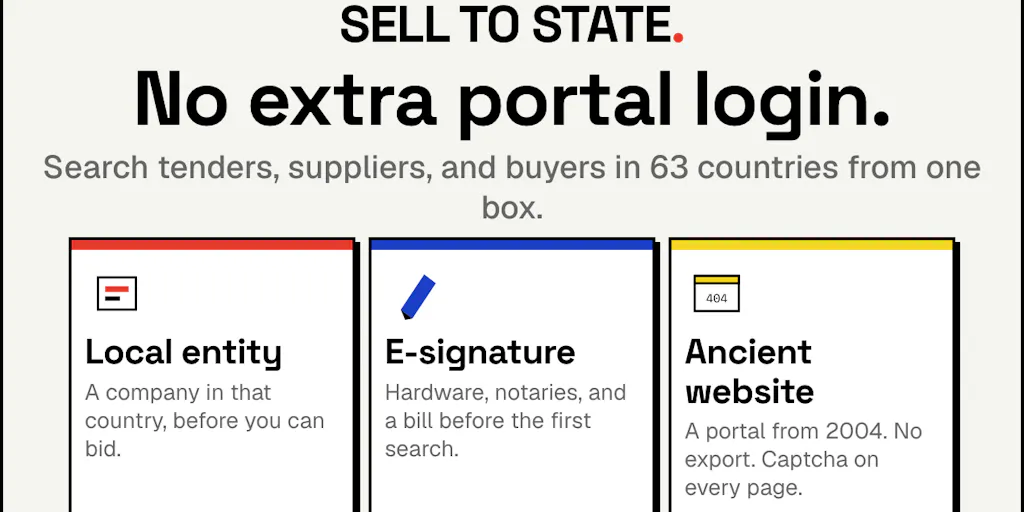
Nadymov’s pitch is refreshingly unglamorous. If you want to sell to a government that isn’t yours, he writes, “the work is ugly.” You incorporate a local entity, buy an e-signature tool, learn a portal that “last shipped a UI in 2009,” and a month later you still don’t know if there’s a contract worth the trip. Sell to State compresses that into one search across 63 markets — “not 63 logins,” as he puts it.
The corpus, per the launch post: 2.95 million tenders, 3.02 million award rows, 986 thousand suppliers, and 99 thousand buying agencies. One query returns the tender, the firm that won it, and the agency that paid. You can export CSV, or pipe the same corpus into a CRM, sheet, or agent via API or MCP. Pricing is flat — US$49/month or US$499/year, with a launch-week annual discount to US$349 using code PRODUCTHUNT.
The most important line in the whole post, for my money: “It is a search product. It is not an AI procurement agent.” That’s a positioning choice, and I’d bet it’s a smart one. The 2024–2025 wave of “AI agent for X” launches has trained buyers to expect magic and then get mad when the magic hallucinates. Nadymov is selling a database with a good query layer and letting the customer’s own LLM do the reasoning on top. In the comments, when asked whether users can compare procurement activity between countries, he says there’s no built-in dashboard but “any AI agent can do those calculations” via the MCP — plug in the raw data and ask Claude, Codex, Grok, or Qwen to crunch it.
Why this matters for social operators
If you run content for a B2B or SaaS brand, this is a template. You probably already have a corpus — your podcast archive, your webinar library, your customer case studies, your help center. The temptation is to bolt an “AI agent” onto it and call it a product. The better move, and the one Sell to State models, is to expose the raw corpus cleanly and let users bring their own reasoning layer. That’s also the difference between a content library that gets cited by Perplexity and one that gets ignored.
The Real Problem It Solves — and Who It’s Actually For
Let me be blunt about the audience. Sell to State is not for the creator who posts Reels about morning routines. It’s for the founder or BD lead at a company that already has a product governments might buy, and who is tired of paying for GovWin, Tenders.guru, or a stack of national portals that each want their own login and their own annual contract. The incumbents in this space — TED for the EU, SAM.gov for the US, and commercial aggregators layered on top — are either free-but-fragmented or expensive-but-deep. Sell to State is betting there’s a middle: cheap, flat, cross-border, and API-first.
The thread’s most useful comment comes from Konstantin Tikhaev, who makes a sharp point that anyone who’s built a data product will recognize. Month one, a keyword search across 64 countries pulls plenty of leads. Month two, obvious terms are exhausted and raw keyword monitoring stalls, because “procurement vocabularies diverge across borders.” EU portals lean on CPV codes; US and Asian agencies use completely different taxonomies. His suggested fix is tracking renewal cycles on historical awards — pulling awards.contractPeriod.endDate from the OCDS standard schema and filtering for contracts expiring in 60–90 days. That gets a sales team positioned before the formal tender notice is even published.
Nadymov’s response is honest: he doesn’t invent a new taxonomy, he just lets you search using OCDS, TED, and local codes. He calls the renewal-tracking tactic a good idea he hasn’t built yet.
Where the math breaks
Here’s my take, and I want to be careful because I haven’t run this tool myself. The renewal-signal play Tikhaev describes is the highest-value feature in the entire category, and it’s the one Sell to State hasn’t shipped. Keyword search on tenders is a commodity — every national portal does it for free. What’s defensible is timing: knowing that a Ministry of Health LTA expires in 75 days so you can start the relationship before the RFP drops. If Sell to State doesn’t build that, someone else will, and the flat $49/month becomes hard to justify against a free portal plus a spreadsheet.
What Creators and Social Teams Should Steal From This Launch
Three things, and I’ll be specific because I’ve run these plays myself.
First: flat pricing as a content hook. “63 markets, not 63 logins” is a positioning sentence, not a feature list. When I audited the landing pages of a dozen creator tools last quarter, the ones that converted best led with a single number that reframed the problem. Buffer has done this for years with its per-channel pricing. Metricool does it with a generous free tier. If you’re writing launch copy for your own product or even just a LinkedIn post about your workflow, find the “63 markets, not 63 logins” version of your story.
Second: the CSV-and-API escape hatch. Sell to State lets you take the data out. That sounds trivial, but it’s a trust signal. Tools that lock your data in — I’m thinking of certain Hootsuite and Later tiers where exports are gated — train users to resent them. If you run a content operation, audit every tool in your stack for whether you can get your data out in a usable format. If you can’t, that’s a risk, not a feature.
Third: the MCP angle. This is the one I’d watch most closely. Sell to State exposes its corpus via MCP so you can wire it into Claude, Codex, Grok, or Qwen. That’s the same pattern Zapier and Make have been racing toward, and it’s the pattern that will define the next two years of creator tooling. If you’re a social media manager, start experimenting now with MCP servers for your own data — your analytics exports, your content calendar, your comment archives. The operators who learn to chain these together will be doing in an afternoon what currently takes a week.
Why TikTok creators should care more than LinkedIn ones
Counterintuitive, I know. But the MCP-and-raw-data pattern matters more for high-volume, short-form operations. If you’re posting 30 TikToks a month across five accounts, your bottleneck isn’t strategy — it’s the mechanical work of pulling performance data, spotting patterns, and feeding those patterns back into the next batch. A raw-data-plus-agent workflow is the only thing that scales that. LinkedIn creators posting twice a week can do it manually. You can’t.
Where My Judgment Says It Falls Short
I want to flag three things clearly as opinion, not fact.
Coverage is uneven, and the maker says so. Nadymov writes plainly: “Some countries are fat (Singapore is a good demo: search for ‘hospital’ is 123 rows with values). Some countries are thin. We are filling those next. I will not pretend every market is equally deep.” That’s the kind of honesty I wish more launches had. But it also means if your target market is, say, a mid-size Latin American country, you need to test before you pay.
No dashboard, and the maker isn’t sure he wants one. When Denis Prodan asked directly whether a comparison dashboard is planned, Nadymov said it’s not in his backlog and he doesn’t “quite understand the use case.” That’s a defensible product decision — infinite ways to slice data, as he says — but it pushes real work onto the user. If you’re not comfortable prompting an LLM to do your analysis, this isn’t your tool yet.
The taxonomy problem is real and unsolved. Tikhaev’s point about CPV codes vs. US taxonomies vs. Asian systems is the kind of thing that kills cross-border data products. Nadymov’s answer — search using the local codes — is workable but puts the burden on you to know which code system applies where. That’s a research task, not a search task.
Who this is NOT for
If you’re a solo creator monetizing through Patreon or Substack, this product is irrelevant to you. If you run social for a DTC brand, also irrelevant. If you’re a growth marketer at a B2B company that has never sold to government and has no plans to, the $49/month is better spent on Canva Pro or a CapCut subscription. The value here is narrow and specific, and pretending otherwise would be dishonest.
What I’d Watch / Test Next
If you’re a B2B operator curious about this category — or if you’re building anything with a data corpus behind it — here’s what I’d do this week.
Open Sell to State, pick one country you actually care about, and run three searches: one broad category term, one specific product term, and one competitor name. Count how many rows come back with actual values. If two of the three are thin, you’ve learned the coverage answer for free and you can walk away. If they’re fat, export a CSV and try feeding it to your LLM of choice with a prompt asking for the top ten buyers by award volume. That’s the whole workflow in twenty minutes.
Then, separately, audit your own content stack. Which tools let you export raw data? Which ones give you an API or MCP endpoint? Which ones lock you in? The answers will tell you which parts of your operation are actually yours and which are rented. That’s the lesson from this launch that outlives the product itself.


