The voice layer is the next battleground for creators — and Sente is a useful stress test
Every social media operator I know has quietly become an AI power user. We keep a Claude tab open for captions, a Gemini tab for trend research, a GPT tab for hooks, and somewhere in the stack a transcription tool and a voiceover tool that never quite match the tone of the rest of the content. The tax isn’t the subscription cost — it’s the context-switching, the re-prompting, and the endless copy-paste between windows. So when a maker launches a tool that claims to collapse that stack into one terminal-and-phone agent that speaks in your own voice, it’s worth paying attention, even if the product itself isn’t built for social teams. That’s the frame I want to use for Sente, a Tokyo-built, open-source assistant from maker Yuki Hamada that showed up on Product Hunt recently. It’s not a scheduler, not an analytics tool, and not a Canva competitor. But the design decisions inside it — voice cloning, multi-model routing, terminal-first UX — tell us where the creator tooling stack is heading, and where it’s still fragile.
What Sente actually is, and the problem it claims to solve
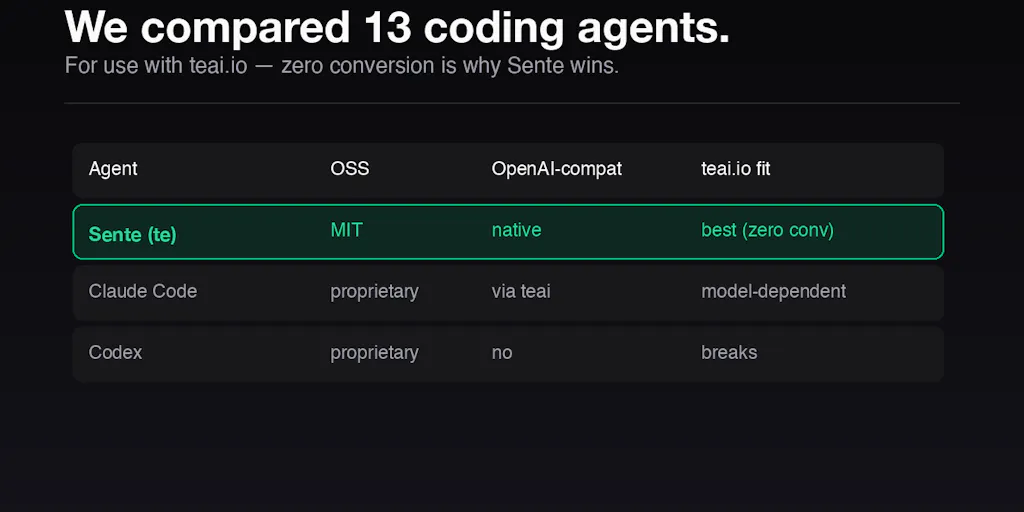
Strip away the launch-page framing and Sente is three things bolted together. First, a conversational agent that runs in your terminal and on your phone. Second, a voice layer that works both directions — you register your voice once with roughly a ten-second sample, and from then on you speak requests and hear replies in your own voice rather than a generic text-to-speech default. Third, a model-routing gateway: the maker says you get access to 404 models including Claude, GPT, Gemini, and DeepSeek through a single account, with an OpenAI-compatible and Anthropic-Messages-compatible API underneath so you can switch models per task without rewriting code.
The origin story is the most relatable part. Hamada says he was “paying for several AI subscriptions and still typing everything,” and built Sente to fix his own workflow. That’s the same complaint I hear from creators who run a CapCut + ChatGPT + ElevenLabs + Descript stack and spend more time shuttling files between them than actually editing. The pitch is consolidation: one agent, one bill, one interface, voice-native.
The code is open source under MIT on GitHub, and Hamada explicitly tells people to read the installer before running it and notes that a te privacy command prints exactly what leaves your machine. For a tool that touches your voice biometrics and your prompts, that transparency is not a nice-to-have — it’s the whole trust proposition. I’d treat that as the single most important line on the launch page.
Why the “your voice, both ways” claim matters more than it sounds
Most creators I know have already experimented with voice cloning for Reels and TikToks, usually through ElevenLabs or the built-in tools inside Descript and CapCut. The workflow is almost always one-directional: you type a script, the tool reads it in a cloned voice, you drop the audio into your edit. What Sente proposes is a loop — you talk to the agent, it talks back in your voice, and the whole interaction stays in one modality. For social operators who think out loud (which is most of us, honestly — I draft hooks by talking to myself in the car), that’s a meaningfully different interaction pattern than typing into a chat window.
The honest caveat from the maker: voice cloning requires your own consent and your own recording, and the team says they don’t clone anyone else’s voice. That’s the right line to draw, and it’s also the line regulators and platforms are increasingly watching. If you’ve been following the deepfake-labeling rules that Meta and TikTok have rolled out over the past year, you know why this matters.
How it stacks up against the tools you already pay for
Here’s where I have to be blunt about positioning, because the launch page doesn’t do this work for you. Sente is not competing with Buffer, Hootsuite, Later, or Metricool — those are scheduling and analytics platforms with publishing APIs, content calendars, and approval workflows. Sente doesn’t publish anything. It doesn’t track engagement rate, watch time, or UTM performance. It doesn’t know what a Reel is.
Where it does overlap is with the AI assistant layer of your stack: the ChatGPT/Claude/Gemini subscriptions you’re already paying for, plus the voice tools like ElevenLabs and the transcription features baked into Descript and CapCut. If you’re currently paying for two or three of those, the consolidation argument is real. The 404-model routing claim, if it holds up in practice, is the most operationally interesting piece — because model choice genuinely matters per task. In my own testing of similar multi-model gateways, I’ve found that hook generation, caption rewriting, and long-form repurposing each tend to favor different models, and being able to swap without re-plumbing your workflow is a real time saver.
Why TikTok creators should care more than LinkedIn ones
The voice loop is a much bigger deal for short-form video than for text-first platforms. If you’re a TikTok or Reels creator, your voice is the product — the cadence, the pauses, the way you say “okay so.” A tool that lets you draft, refine, and hear back a script in your own voice, without leaving the conversation, compresses the scripting-to-shooting gap in a way that a LinkedIn ghostwriter will never feel. On LinkedIn, the deliverable is text; voice is a nice-to-have. On TikTok, voice is the deliverable. That asymmetry should shape how you evaluate Sente.
What creators and social teams can actually borrow from it
Even if you never install Sente, three design ideas in it are worth stealing for your own workflow.
One: treat voice as a first-class input, not a post-production step. Most social teams I’ve worked with treat voiceover as something you add at the end. The Sente model inverts that — you speak the brief, the agent responds, and the audio is already in the right voice by the time you’re ready to edit. If you’re producing daily short-form, that’s a meaningful compression.
Two: model routing as a workflow primitive. The idea that you’d pick a model per task — Claude for long-form reasoning, a faster model for caption variants — is something you can approximate today with tools like OpenRouter or by just keeping multiple tabs open. Sente’s contribution is making that switch invisible. My take: within a year, “which model” will be as unremarkable a choice as “which font,” and tools that force you to think about it will feel dated.
Three: open-source + explicit privacy commands as a trust pattern. The te privacy command that prints what leaves your machine is a small thing, but it’s the kind of affordance I wish every AI tool shipped with. If you’re a creator handling client work or NDAs, “show me the data flow” should be a table-stakes feature, not a differentiator.
Where the math breaks
The maker is upfront that Sente is “not unlimited” — you get a monthly credit allowance and heavy use means topping up. That’s the same model as most AI subscriptions, and it’s fine, but it means the “404 models on one plan” pitch needs a caveat: you’re not getting unlimited access to all 404, you’re getting metered access to a rotating catalog. For a solo creator doing a few dozen prompts a day, that’s probably fine. For an agency running content for ten clients, the math gets murky fast, and you’d want to model your actual token burn before switching.
Where I think it falls short, and who shouldn’t bother
Three honest limitations, in order of how much they’d affect a social operator.
It doesn’t touch publishing, scheduling, or analytics. This is the biggest gap for anyone whose job is actually getting content out the door. Sente is upstream of your scheduler, not a replacement for it. If you were hoping for a Buffer-killer, this isn’t it.
The latency numbers are self-reported from Tokyo. Hamada is transparent about this — the site’s latency figures are “measured, not estimated,” but they’re his measurements from Tokyo. If you’re in New York or São Paulo, your real-world round-trip will differ, and for a voice-first tool, latency is the difference between feeling magical and feeling broken. I’d want to see independent benchmarks before trusting the experience.
Voice cloning in noisy environments is an open question. In the Product Hunt thread, a commenter named Audrey T asked exactly the right question: does the voice part work on a train or in a café, or is it a quiet-room-only tool? The maker hadn’t answered as of the scrape. That’s a real operational concern — most creators I know draft content in exactly those noisy in-between moments.
There’s also a sharper critique worth surfacing, from Gal Dayan of Dial, who runs Claude Code daily and reads every diff before approving it. His point: a spoken summary of a one-line typo fix is fine to approve by ear, but “refactor this function” approved the same way is the exact failure mode where a confident-sounding report substitutes for actually looking at the change. That’s a warning that applies well beyond code. If you’re using voice to approve anything with real consequences — a client-facing post, a paid ad, a brand reply — the ease of the voice loop can quietly erode your review discipline. My take: voice is a great input modality and a dangerous approval modality. Keep the two separate.
Who it’s not for: anyone whose primary need is scheduling, cross-platform publishing, analytics, or team collaboration. Also anyone who needs enterprise-grade compliance documentation — the MIT license and open-source installer are great for transparency, but they’re not a SOC 2 report. And anyone uncomfortable with the idea of a cloned voice of themselves existing on a server they don’t control, regardless of what the privacy command prints.
What I’d watch, and test next
If you’re a social operator curious about this category, here’s what I’d actually do this week — none of it requires committing to Sente specifically.
Test the voice loop against your current stack. Take one real task you’d normally do in ChatGPT or Claude — drafting three hook variants for a Reel, say — and try doing it by voice instead of typing. You don’t need Sente for this; your phone’s native assistant plus a voice memo app will tell you whether voice-native drafting fits how you think. If it does, the consolidation pitch gets more compelling.
Audit your AI subscription spend. List every AI tool you pay for monthly — assistants, transcription, voiceover, image gen — and total it. That number is the real benchmark against which any consolidation tool should be judged. Hamada’s origin story started with exactly this audit, and it’s the right first step.
Watch the noisy-environment question. If the maker answers Audrey T’s question in the thread, that’s a signal about how seriously they’re engaging with real usage conditions. If it goes unanswered, that’s a signal too.
Keep an eye on the routing layer, not the voice. My bet is that the multi-model gateway is the more durable part of this product. Voice cloning is becoming commoditized fast; intelligent routing across a shifting model landscape is a harder problem, and it’s the piece that will matter most to creators juggling five platforms and a dozen content formats. If Sente nails that, the voice layer is a bonus. If it doesn’t, the voice layer won’t save it.
The broader lesson for social teams: the AI assistant layer of your stack is consolidating, and the winners will be the tools that reduce context-switching without asking you to give up control over what gets published. Sente is an interesting early bet on that thesis. Whether it becomes your daily driver or just a useful experiment, the questions it forces — about voice, approval, and model choice — are the right ones to be asking right now.


