The interview-footage problem is quietly eating creator margins — and Supacut is betting AI can fix the front end, not the edit
If you have ever shipped a YouTube interview series, a founder-story podcast, or a customer-testimonial reel, you already know the dirty secret of “content repurposing”: the editing is not the bottleneck. The bottleneck is the 4–11 hours of raw, multi-speaker footage sitting on a drive before you even open a timeline. Transcription tools solved the reading problem. Clip-finders solved the surface problem. Almost nothing has solved the story problem — deciding which answers, from which speakers, in which order, actually constitute an episode. That is the gap Supacut is explicitly trying to own, and it is worth paying attention to because it sits upstream of every downstream workflow creators and social teams run: repurposing, clipping, captioning, scheduling, and distribution.
What Supacut actually is, stripped of launch-page gloss
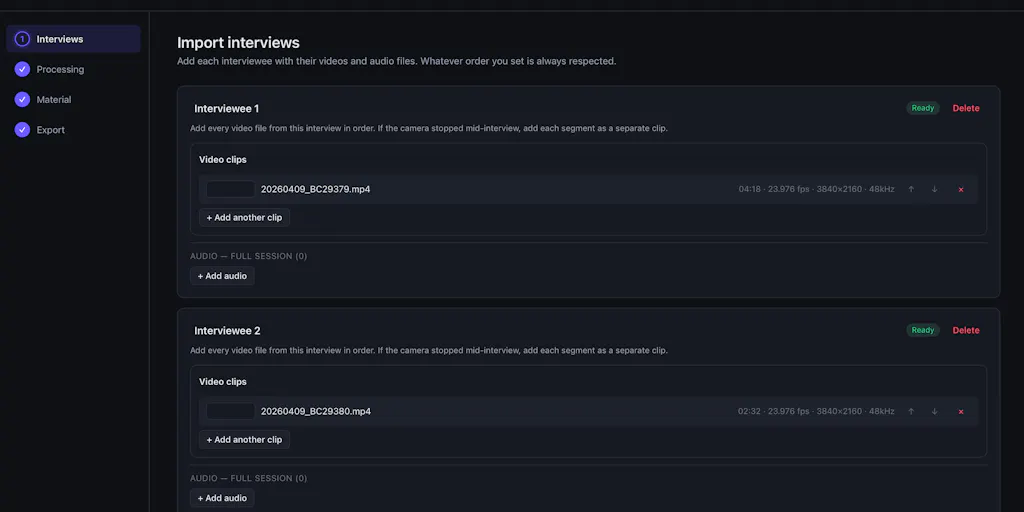
Supacut is a video tool built by jonathan muia for editors working with documentary and interview footage. In the maker’s own framing, the hard part “isn’t cutting, but figuring out what to do with hours of material before the edit even begins.” The product is organized around two modes:
- Find the Story — explore interviews by theme, compare answers across speakers, search the material, and build a shortlist of selects.
- Create the Story — let the tool analyze interviews, propose narrative directions, and generate an editable first rough cut.
That is the entire disclosed feature set. Pricing is not disclosed. User counts are not disclosed. The maker states the product “only launched about a month ago” and is offering Product Hunt readers private beta access. My take: read the marketing language carefully — “propose different narrative directions” and “editable first rough cut” are doing a lot of work, and I’ll get into where I think that promise bends under real production pressure later in this piece.
Why this matters more to social teams than to feature editors
Here’s the thing most social media managers miss when they see a “documentary editing tool” launch: the interview-footage problem is no longer a documentary problem. It is a creator-economy problem. The moment your brand started doing founder-led content, customer interviews, expert talking-heads, or podcast-to-shorts pipelines, you inherited the exact same workflow that documentary editors have struggled with for decades. You are now sitting on hours of multi-speaker footage and trying to extract a 45-second vertical clip, a 60-second YouTube Short, a LinkedIn text post built from a quote, and three X threads.
Every one of those downstream assets depends on the same upstream decision: which soundbite is the story? If that decision is slow or arbitrary, your whole repurposing engine stalls. Tools like Opus Clip and Descript have made the mechanical extraction cheap. What they have not made cheap is the editorial judgment call about narrative. That is the wedge Supacut is claiming.
How it differs from the incumbents you’re probably already paying for
Let me be precise, because “AI video tool” is now a meaningless category label. The relevant comparison set is not CapCut or Canva — those are finishing tools. The relevant comparison set is the transcript-first editing stack.
Descript made its name on text-based editing: you edit the transcript, the video follows. It is excellent at execution once you know what you want. Opus Clip attacks the opposite end — feed it a long video, get back ranked short clips with virality scores. Both are downstream of the “what is the story” decision. Riverside and Frame.io solve capture and review, not narrative assembly. Adobe Premiere Pro and DaVinci Resolve remain the ground truth for actual cutting.
Supacut’s differentiation claim, per the maker, is that it operates before the edit — on theme exploration, cross-speaker comparison, and narrative proposal. That is a genuinely different job. In my experience running a small interview-based content operation, the first pass through footage is where 60–70% of the total project time disappears, and it is the least tool-supported stage. If Supacut shaves that meaningfully, it is not competing with Descript — it is competing with the spreadsheet-and-markers workflow that most editors still use.
Where the comparison gets uncomfortable
Two honest caveats. First, “compare answers across speakers” is a feature that sounds trivial and is not — it requires accurate speaker diarization, topic clustering, and a UI that lets you scan 40 answers to the same question without drowning. The maker confirmed in the launch thread that you can “define your own topic pillars before the analysis” and that Supacut will return results “according to your specific needs.” That is the right answer, but it also means output quality is a direct function of how well you pre-structure your questions. Garbage pillars in, garbage themes out.
Second, the “editable rough cut” is the claim I’d stress-test hardest. A rough cut that ignores your brand’s pacing, your B-roll library, your music beds, and your platform aspect ratios is not a rough cut — it’s a paper edit with video attached. The maker’s response to Thomas Bennett — that editors can see which clips were chosen and which transcript portions were not selected — is the single most important trust feature in the whole product. Auditability is what separates a tool editors will actually use from a black box they’ll abandon after week two.
What creators and social teams can borrow from this — regardless of whether you adopt it
Even if you never touch Supacut, the launch is a useful mirror for how you should be structuring your own interview-to-content pipeline. Three transferable practices:
1. Define topic pillars before you shoot, not after
The maker’s confirmation that Supacut lets you pre-define topic pillars is the tell. The best interview-driven creators I’ve worked with do exactly this manually: they write 5–8 recurring thematic pillars for a series, then tag every answer against them. This turns a chaotic archive into a queryable database. If you’re running a founder-story series or a customer-testimonial program, build that pillar list this week. It costs you 30 minutes and it will save you hours on every future episode.
2. Treat “not selected” as first-class data
The most underrated feature in Supacut is the ability to see which transcript portions were not chosen. Most editing workflows treat discarded footage as dead. But for social teams, discarded answers are a goldmine: they become quote cards for LinkedIn, text hooks for X, carousel slides for Instagram, and short-form voiceovers for TikTok. If your current workflow doesn’t log rejected selects, you are throwing away repurposing inventory.
Why TikTok and YouTube creators should care more than LinkedIn-first operators
If your primary distribution is text-first — LinkedIn, X, Threads — the interview-footage problem is real but smaller, because your raw material is already text. The creators who will feel the biggest delta from a tool like this are those running video-native interview formats: YouTube long-form, podcast-with-video, TikTok talking-head series. For them, the front-end assembly cost is enormous and the downstream repurposing surface is huge. My take: if you’re a LinkedIn-first operator, bookmark Supacut and wait. If you’re shipping 20+ minutes of interview footage a week, this category is worth an hour of your time today.
3. Keep the human decision at the narrative layer
The maker’s own framing — that AI can transcribe, search, find clips, organize material, and build rough cuts, but the story decision is where editors want control — is the correct instinct. The launch thread is essentially a public debate about where to draw the line. Gal Dayan raised the sharpest question in the thread: does the tool need a clean transcript to work, or does it do its own transcription and speaker separation from raw footage, and is the proposed narrative shape inferred purely from the footage or from something you tell it up front? The maker did not answer that question in the visible thread — which, to me, is the single biggest open question about the product.
Where my judgment says this falls short (or at least, where I’d push back)
I want to be balanced here, because the launch thread is small and the product is a month old. But a few things stand out.
The trust surface is thin. The maker’s responses in the thread are helpful but brief. “Yes, they can see it” and “yes, you can also define your own topic pillars” are good answers, but they don’t tell me how the system handles messy real-world audio: crosstalk, overlapping speakers, accented English, non-English footage, or interviews recorded on a phone in a noisy room. These are the conditions under which most creator interview footage actually exists. Not disclosed.
Pricing is not disclosed. For a private beta, that’s normal. For a tool that a social team might want to standardize on, it’s a blocker. I’d bet the pricing model lands somewhere between “per hour of footage processed” and “per seat,” and I’d bet the per-hour model is what kills adoption for anyone with a large archive. But that’s a guess, not a fact.
The “editable rough cut” claim needs a stress test. In my experience with similar tools, “editable” often means “exportable to an XML that your NLE will import with 60% of the metadata intact.” That is not the same as a rough cut you can ship. Editors should test this specifically: import a Supacut-generated cut into Premiere Pro or DaVinci Resolve and see how much survives.
Where the math breaks
Here’s the operational math I’d run before adopting anything in this category. Suppose you shoot a 90-minute multi-speaker interview. Transcription and diarization take minutes. Theme clustering takes minutes. Narrative proposal takes minutes. But reviewing the proposed narrative — actually reading the selects, checking the rejected portions, deciding whether the AI’s story shape matches your editorial intent — takes real human time. If that review step takes 45 minutes, you’ve saved maybe 90 minutes versus a manual first pass. That’s a real win, but it’s not a 10x win. The maker’s implicit claim is that the review step is fast because the tool’s output is legible. Whether that’s true is the entire ballgame, and it’s the thing no launch page can tell you.
Who this is not for
If you’re a solo creator shipping one talking-head video a week with no interviews, this is overkill. If your content is scripted, this is irrelevant. If your footage is already short-form (under 5 minutes raw), the front-end assembly problem doesn’t exist. And if you’re on a tight tool budget and already paying for Descript plus Opus Clip plus a scheduler like Buffer or Later, adding a fourth subscription needs a clear ROI story — which Supacut hasn’t published yet.
What I’d watch / test next
Concrete steps for an operator this week:
- Request private beta access via the Supacut Product Hunt page and, if accepted, run one real project through it — not a demo file. Use your messiest recent interview set.
- Test the audit trail first. Before you test the rough cut, test whether you can see why clips were chosen and what was rejected. That feature is the difference between a tool you trust and a tool you fight.
- Benchmark against your current stack. Time your existing first pass (transcript + markers + selects) on a 60-minute interview. Then time Supacut’s output review on the same footage. If the delta is under 30%, the switching cost probably isn’t worth it yet.
- Ask the maker the unanswered question. Gal Dayan’s question about whether narrative direction is inferred from footage or specified by the user is the one that determines whether this is a tool for editors or a tool for producers. Get a clear answer before you commit.
- Watch the pricing announcement. For anyone with an archive larger than a few hours, the pricing model will decide adoption more than any feature.
My overall read: Supacut is pointed at a real, underserved problem — the front end of interview editing — and the maker is asking the right questions publicly. But it’s a month-old private beta with no disclosed pricing, no disclosed scale, and at least one core mechanic (narrative inference) still unexplained. Worth a test. Not yet worth a workflow rebuild.


