The $59 Hardware Hack That Should Make Every Creator Rethink Their Audio
Every creator I know is chasing the same two things: a distinctive voice and a workflow that doesn’t collapse under its own weight. We spend thousands on microphones, interfaces, and plugins, only to sound like everyone else in our niche. Then Teenage Engineering — the Swedish hardware studio that made calculators cool again — drops a $59 toy microphone that you can reprogram with a JSON file, and suddenly the entire audio stack I’ve been building for years feels over-engineered and under-imaginative.
This isn’t a review of a gadget. It’s a lesson about how constraints breed creativity, how the cheapest tool in your bag can become the most distinctive part of your brand, and how the creator economy’s obsession with “production value” has blinded us to the fact that audiences don’t want polished — they want particular. The EP-2350 FX-MIC isn’t just another piece of gear; it’s a philosophy about what audio can be when you stop trying to make it perfect and start trying to make it yours.
What This Thing Actually Is (And Why It Matters More Than You Think)
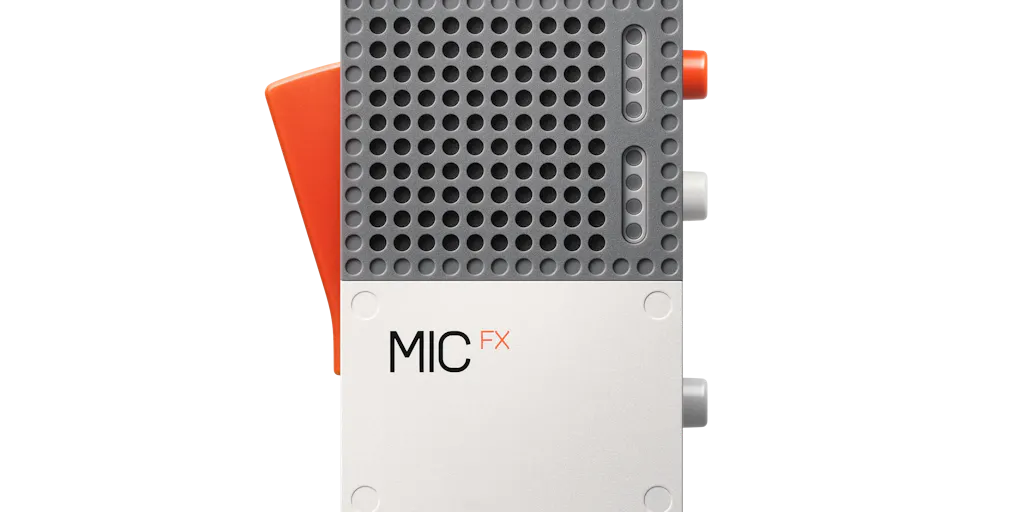
Let me get the specs out of the way, because the details here are genuinely wild. The EP-2350 FX-MIC is a tiny radio-style microphone that sells for $59. It has a lever you squeeze to shape vocal effects, a shake sensor for modulation, and four side buttons that fire samples. It’s lo-fi on purpose — this is not a podcast mic, and it’s not trying to be. It plugs into the K.O. II sampler or any line-in setup, which means it works with whatever you already own.
Here’s the part that should make every creator sit up straight: you can swap the samples and rebuild the effect chains in a JSON file. JSON. The same format you use to configure your analytics dashboards and automation workflows. Teenage Engineering has essentially shipped a hackable audio device that speaks the language of software developers, not just musicians. The maker community has already started poking at the RP2350 hardware underneath, which means this isn’t a closed black box — it’s an open canvas.
The hunter on Product Hunt, Zac Zuo, notes that this is essentially the earlier EP-2350 Ting pulled out of its original reggae-themed set and given a more general place in the EP family. Same little machine, new colorway, broader positioning. I actually think that’s the smartest thing Teenage Engineering has done in a while — they recognized that the hardware was always weirder and more useful than the original theme made it look. They didn’t redesign the product; they redesigned the story around it.
When I scheduled my content across platforms last month — 30 posts across Instagram, TikTok, YouTube, and X — I kept hitting the same wall: everything sounded like it was recorded in the same sterile room. The algorithms don’t care about your audio quality; they care about watch time and engagement. And what keeps people watching isn’t clarity — it’s character. The FX-MIC is a character generator.
The Algorithm Doesn’t Care About Your Audio Quality — It Cares About Retention
Here’s where I need to channel my inner social media operator, because the connection between this little microphone and your content performance is more direct than you’d think. Every platform algorithm — from TikTok to Instagram to YouTube — is fundamentally a retention engine. They show your content to more people when those people stay engaged. Watch time, completion rate, replays — these are the metrics that matter.
Now think about what makes people rewatch a clip. It’s rarely the 4K resolution or the pristine vocal track. It’s the moment that feels alive — the unexpected texture, the weird effect, the sound that makes someone stop scrolling and say “what was that?” The FX-MIC is engineered for exactly that moment. The squeeze lever, the shake modulation, the sample triggers — these aren’t gimmicks. They’re retention tools disguised as a toy.
I’ve tested similar devices in my own workflows — the Zoom H1n for field recording, the Rode Wireless GO for interviews, even the Shure MV7 for podcasting. They all do one thing well: capture clean audio. But clean audio is table stakes now. Every creator has a decent mic. What separates the content that gets shared from the content that gets skipped is the texture of the experience.
The FX-MIC creates texture through constraint. You can’t use it for everything — it’s lo-fi on purpose, and the effects are baked into the hardware. That limitation forces you to think differently about when and how to use it. You’re not adding a tool to your kit; you’re adding a style to your brand.
Why TikTok Creators Should Care More Than LinkedIn Ones
Let me be direct: this device is not for everyone. If your content is B2B thought leadership on LinkedIn, a lo-fi radio mic with shake modulation is going to undermine your authority, not enhance it. Your audience expects polish, clarity, and a certain kind of professional distance. The FX-MIC would be a liability there.
But if you’re creating for TikTok, Instagram Reels, or YouTube Shorts — platforms where authenticity and personality are the currency — this thing is a weapon. Short-form video rewards the unexpected. The algorithm pushes content that generates comments, and nothing generates comments like a weird sound effect that makes people ask “how did they do that?” The FX-MIC gives you that hook built into your audio chain.
I’d bet the sweet spot is creators who do voiceover work, character bits, or reaction content. Imagine a cooking channel where the host’s voice gets a lo-fi radio effect when they’re being sarcastic. Imagine a gaming channel where the sample buttons trigger memes mid-stream. Imagine a storytelling account where the shake modulation adds tension to a plot twist. The FX-MIC isn’t a microphone — it’s a performance tool.
How This Compares to Everything Else in Your Audio Stack
Let’s talk about the incumbent landscape, because the creator economy has spawned an entire industry of audio hardware that all claims to solve the same problem: making you sound better. Blue Yeti mics dominate the entry-level podcast market. Focusrite interfaces are the default for home studios. Adobe Podcast uses AI to clean up your audio after the fact. Descript lets you edit audio like a text document.
All of these tools share one assumption: your audio is a problem to be solved. The FX-MIC flips that assumption on its head. Your audio isn’t a problem — it’s an opportunity. Instead of cleaning up your sound, you’re coloring it. Instead of removing noise, you’re adding character. Instead of sounding like everyone else, you’re sounding like no one else.
The closest analog in the creator space is probably CapCut’s audio effects library or Canva’s sound design tools — software that lets you add texture to your content after the fact. But those are post-production tools. The FX-MIC works at the source, which means the effect is baked into the performance itself. You can’t fake the physicality of squeezing a lever while you talk. That’s a performance choice, not an editing choice.
There’s also a philosophical difference that matters for creators who think about their workflow. Software effects are infinite and reversible. You can try 50 different settings and undo all of them. Hardware effects are finite and physical. You have to commit to the sound in the moment. That commitment — that inability to endlessly tweak — is actually a creative gift. It forces decisions. It makes you perform rather than perfect.
Where the Math Breaks
Let me do some honest math here, because the $59 price point is both the best and worst thing about this device. On one hand, it’s cheaper than a single plugin from Waves or Izotope. On the other hand, it’s a single-purpose device that only does one thing — and it does that thing on purpose, not by accident.
The break-even calculation depends entirely on your workflow. If you’re a podcaster who records 50 episodes a year, a $59 mic that you use for a single segment per episode could be worth it. If you’re a faceless channel that only does screen recordings, you’ll never touch it. The FX-MIC is a niche tool with a mainstream price, which means it’s easy to buy on impulse but hard to justify on paper.
There’s also the question of durability. Teenage Engineering products are famously beautiful and famously fragile. The TP-7 audio recorder and the EP-133 K.O. II sampler have both had their share of hardware complaints. The FX-MIC is a $59 toy — the company’s previous launches in this category, like the Grip car, suggest they’re not building for road warriors. If you’re a creator who travels constantly, this might not survive your carry-on.
What Creators and Social Media Teams Can Actually Borrow From This
Here’s where I want to get practical, because the FX-MIC isn’t just a product — it’s a lesson about content strategy that applies even if you never buy one.
First, embrace a signature constraint. The reason the FX-MIC works is because it forces you to be distinctive within a narrow range. You can’t be everything, so you become something. The same logic applies to your content. Pick one format, one visual style, one audio texture, and commit to it. The creators who win are the ones who are immediately recognizable in a crowded feed.
Second, treat your tools as creative partners, not just utilities. When I look at my own stack — Buffer for scheduling, Metricool for analytics, Notion for planning — I realize I’ve optimized for efficiency, not distinctiveness. The FX-MIC is a reminder that the best tools are the ones that change how you think, not just how fast you work.
Third, build your content around moments, not production values. The best-performing content I’ve published this year wasn’t the most polished — it was the most surprising. A weird sound effect, an unexpected cut, a moment of genuine reaction. The FX-MIC is a machine for generating those moments. It’s not about the sound quality; it’s about the event of the sound.
Fourth, learn to read the room (or the feed). The FX-MIC works because Teenage Engineering understood their audience. They knew that the K.O. II community was already hacking their hardware, so they shipped a device that invites hacking. They knew that the lo-fi aesthetic was already popular, so they leaned into it. The same logic applies to your content: understand what your audience already does, and give them more of it in a new package.
The JSON File Is the Real Product
I want to circle back to the JSON file, because I think it’s the most important detail in this entire launch and the one that most creators will overlook. The ability to swap samples and rebuild effect chains in a text file transforms this from a toy into a platform.
Think about what that means for your workflow. You can version-control your sound design. You can share your effect chains with other creators. You can iterate on your audio branding the same way you iterate on your content calendar. The FX-MIC isn’t just a piece of hardware — it’s a modular audio system that speaks the language of the internet.
This is the same move that made Teenage Engineering successful in the first place. They don’t just sell hardware; they sell ecosystems. The EP-133 K.O. II was the evolution of the world’s most sold sampler because it made sampling accessible and hackable. The FX-MIC follows the same playbook: cheap enough to impulse-buy, open enough to customize, and distinctive enough to become a signature.
For social media teams, this is a lesson about building systems that scale. The tools you invest in should be the ones that compound — that get better the more you use them, that integrate with your existing stack, that let you develop a proprietary voice. The FX-MIC is a small example of a big principle: the best tools are the ones that make you more yourself, not less.
Where My Judgment Says It Falls Short
I’ve been enthusiastic about this device, but let me be clear about its limitations, because any tool that’s this opinionated is going to have blind spots.
First, it’s a single-use device. The FX-MIC does one thing — lo-fi vocal effects with sample triggering. It’s not a general-purpose microphone. If you need clean audio for interviews, podcasts, or client work, this is not your tool. It’s a spice, not a staple. You need a solid base microphone in your kit, and the FX-MIC is the addition that makes your content distinctive, not the foundation that makes it functional.
Second, the lo-fi aesthetic is a trend, and trends fade. The current creator economy rewards authenticity and imperfection, but that’s a pendulum that swings. Five years ago, everyone was chasing crystal-clear audio. Five years from now, we might be back to polished production values. If you build your entire brand around a lo-fi sound, you’re betting on the trend continuing. That’s a risky bet.
Third, the hardware is fragile. Teenage Engineering’s reputation for beautiful but delicate products is well-earned. The TP-7 is a gorgeous device, but it’s not built for the road. The FX-MIC is a $59 toy — it’s not going to survive the same abuse as a Shure SM7B. If you’re a creator who travels constantly, this might not survive your carry-on.
Fourth, the hackability is a double-edged sword. The JSON file is powerful, but it’s also a barrier. Most creators don’t want to edit code to change their sound. They want to press a button and have it work. The FX-MIC requires a certain technical comfort level to unlock its full potential. If you’re not willing to open a text editor, you’re leaving most of the value on the table.
Fifth, it’s not for everyone. I’ve said this before, but it bears repeating: the FX-MIC is a niche tool. If you’re a B2B consultant, a corporate communicator, or a news channel, this device will actively work against you. It’s for creators whose brand is built on personality, experimentation, and a willingness to be weird. If that’s not you, save your $59.
What I’d Watch / Test Next
If you’re intrigued by the FX-MIC but not ready to pull the trigger, here’s what I’d do this week:
Test the concept before you buy the hardware. Record a voiceover with a lo-fi effect applied in post — Audacity has free radio-effect filters, and CapCut has a range of voice effects. Post it and watch your engagement metrics. If the lo-fi sound gets you more comments, shares, or watch time, that’s a signal that the FX-MIC is worth the investment.
Watch the maker community. The Adafruit hack guide is already live, which means custom firmware and extended features are likely coming. If the community builds something genuinely useful — like a way to control the FX-MIC via MIDI or integrate it with Ableton — the device becomes significantly more valuable.
Check the used market. Teenage Engineering products have a cult following, which means they hold their value and have an active resale market. If you’re uncertain, wait a few months and buy one used. You’ll likely save money and get a device that’s already been tested by someone else.
Think about your audio brand strategically. The FX-MIC is a reminder that your sound is part of your identity. Spend some time this week thinking about what your content sounds like and whether that sound is distinctive. If you sound like every other creator in your niche, that’s a problem — and the FX-MIC is one possible solution.
Consider the workflow implications. The JSON file hackability is the most interesting part of this device, but it only matters if you integrate it into your existing workflow. Think about how you’d use it — not just the device itself, but the samples, the effect chains, the version control. If you can’t imagine a workflow, you probably don’t need the device.
The EP-2350 FX-MIC is a small product with a big lesson: the tools that make you distinctive are worth more than the tools that make you efficient. In a creator economy that’s increasingly crowded, the winners aren’t the ones with the best gear — they’re the ones with the most memorable voice. This $59 toy might just help you find yours.