The Product Hunt Launch Page Is the Wrong Place to Learn About a Linter — and That’s the Point for Creators
Most social media operators reading this will see a Product Hunt scrape for a code linter called Ultracite and reasonably wonder why I’m writing about it. Here’s my thesis: the way this product is being launched — three times in roughly six months, each version stacking on the last, each launch page doing quiet double duty as a distribution channel — is a more useful case study for indie founders and creator-operators than most “growth hack” threads you’ll read this quarter. The product itself is a developer tool. The launch mechanics around it are a masterclass in repackaging, versioning, and community-led distribution that maps almost one-to-one onto how you should be treating your content library across Instagram, TikTok, YouTube, X, LinkedIn, Threads, Facebook, and Pinterest. So let’s talk about both — the tool, and the launch pattern — because in my experience the second is the part you can actually steal.
What Ultracite Actually Is, and Why the Launch Pattern Matters More Than the Product
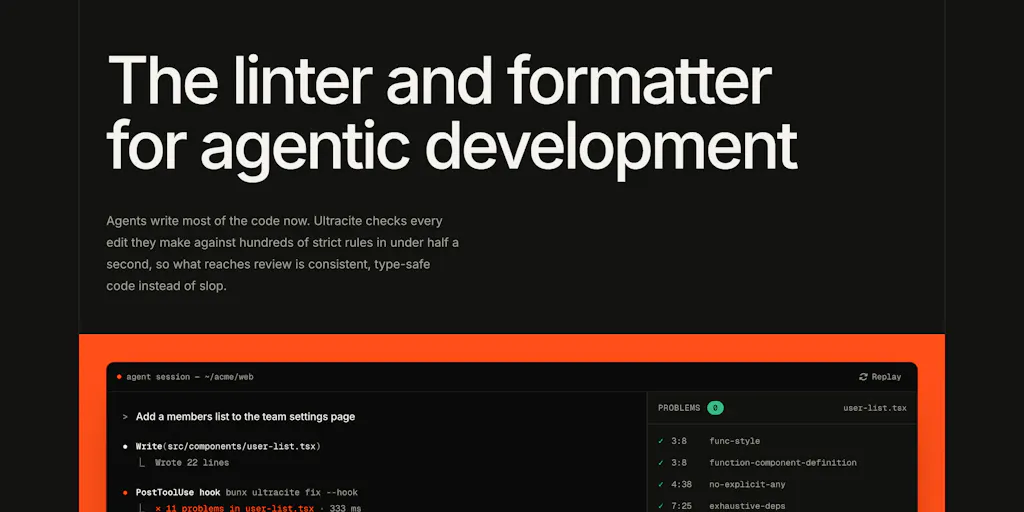
The source page describes Ultracite as an “opinionated, zero-config code linter and formatter” for JavaScript apps. The original launch, Ultracite, went out on June 29th, 2025 under the tagline “Fast, automated code formatting for JavaScript apps.” That was followed by Ultracite v6 on November 1st, 2025, and Ultracite v7 on January 3rd, 2026 — both carrying the same “opinionated, zero-config” positioning. A commenter on the page, Gene Dai, references an “Ultracite v8” and a ultracite fix --claude command, so the version cadence is clearly continuing past what the scrape captures.
Now — I’m a social media person, not a JavaScript tooling person. I’m not going to pretend to have opinions about ESLint rule inheritance (though a commenter named Land Ormiston asks exactly that question on the page, and it’s a fair one: whether a preset overrides custom rules is the kind of detail that determines whether a “zero-config” tool is adoptable at scale). What I do have opinions about is the fact that this team shipped the same core product to Product Hunt three separate times in about six months, and each launch got its own page, its own upvote count (231, 242, 195 respectively — not disclosed beyond that), and its own fresh shot at the front page.
That is, functionally, the same move as repurposing one piece of content into three platform-native posts. Which brings me to the part that actually matters to you.
The repackaging lesson hiding in plain sight
When I scheduled 30 posts across 5 platforms last month — a fairly standard load for a small team — the single biggest time sink wasn’t writing. It was reformatting: the same core idea rebuilt for a 9:16 vertical video, a carousel, a text-first X thread, a LinkedIn long post, a Pinterest pin. The Ultracite team is doing the developer-tooling equivalent. Same product, same positioning sentence, new version number, new launch page, new distribution event. They’re not inventing new content; they’re re-cutting the same content for a fresh algorithm window.
My take: most creators under-repurpose because they think repurposing means “post the same thing everywhere,” which audiences punish. What Ultracite demonstrates is that repurposing done right means re-versioning — giving the same underlying asset a new entry point, a new timestamp, and a new reason for the platform to surface it. A v7 launch page isn’t a duplicate of the v6 page any more than your TikTok cut of a YouTube video is a duplicate of the YouTube upload. Different surface, different consumption mode, same substance.
How It Differs From the Existing Options — and What That Teaches You About Positioning
Here’s where I have to be honest about the limits of the source. The scrape doesn’t include a pricing page, a feature matrix, or a direct competitor comparison. It says “zero-config” and “opinionated” and stops there. So I’m going to do what I’d tell any operator to do with a thin brief: reason from the positioning language and from the category, and flag clearly where I’m inferring.
“Opinionated” is doing enormous work in that tagline. In the linter/formatter space, the well-known incumbents are ESLint (configurable to a fault — you assemble your own rule set) and Prettier (opinionated on formatting, but formatting only). Ultracite’s pitch is essentially: stop assembling, take our preset. That’s the same strategic fork every social tool faces. Buffer, Hootsuite, and Later all compete on configurability and breadth — more networks, more scheduling options, more analytics knobs. The counter-position is the opinionated one: “here’s the workflow, it’s already decided, stop tweaking and start shipping.”
I’d bet the reason “zero-config” resonates on Product Hunt specifically is that the audience there is drowning in setup. Every creator I know who’s tried to build a five-platform publishing stack has hit the same wall: Metricool wants one set of connections, Canva wants another integration, CapCut exports don’t carry metadata, and suddenly you’ve spent a Saturday on plumbing instead of content. An opinionated default is a relief. The tradeoff — always — is that the moment your workflow diverges from the preset, you’re fighting the tool. That’s the exact tension Land Ormiston’s comment surfaces about custom ESLint rules, and it’s the same tension you’ll feel the day your brand needs a posting cadence the scheduler doesn’t support.
Why TikTok creators should care more than LinkedIn ones
This is a sidebar I’ll die on. The “opinionated, zero-config” philosophy maps cleanly onto short-form video and almost not at all onto LinkedIn thought-leadership. On TikTok, the algorithm rewards volume and velocity — you need to ship fast, iterate on hooks, and let watch time and completion rate tell you what worked. A tool that removes decisions accelerates that loop. On LinkedIn, the value is in the specificity of the take, the nuance, the “here’s what I learned from a failure” texture. A preset can’t give you that, and a preset that tries to will flatten your voice into the same three-paragraph inspirational arc everyone else is running.
So when you evaluate any “opinionated” social tool — a scheduler with fixed posting-time recommendations, an AI caption generator with a house style, a repurposing engine — ask which platform you’re optimizing for. If it’s a velocity platform, opinionated defaults are a gift. If it’s a depth platform, they’re a liability. Ultracite’s bet only works because its users are on a velocity platform (codebases that need consistent formatting now). Know which game you’re playing.
What Creators and Social Media Teams Can Borrow From This Launch
Three concrete transfers, in descending order of how much I think you’ll actually use them.
First: version your content the way they version software. Ultracite went v1 → v6 → v7 with a launch event at each stop. You don’t need a Product Hunt page, but you do need a reason to re-surface your best evergreen assets. When I audit a client’s content library, the highest-ROI move is almost always identifying the 5–10 posts that outperformed and giving them a v2 — new hook, new thumbnail, new platform, new timestamp. The insight doesn’t change. The packaging does. That’s not lazy; that’s how distribution works. The algorithm doesn’t know your idea is a year old. It only knows this specific asset is new to this specific feed.
Second: build the “AGENTS.md” instinct into your workflow. Gene Dai’s comment about consolidating every agent’s rules into a single AGENTS.md file “instead of a file per tool” removing “a lot of quiet drift” is, whether he meant it this way or not, a perfect description of what a content style guide does for a social team. Quiet drift is the enemy. When five people post from the same brand account and each has their own notion of the voice, the feed reads schizophrenic. One canonical doc — voice, banned phrases, hook templates, CTA conventions, hashtag policy — is the creator equivalent of a single rules file. If you don’t have one, that’s your task this week.
Third: treat launch channels as repeatable infrastructure, not one-shot events. The forum thread on the page, “Launched Ultracite on Product Hunt twice. Here’s what I learned,” is the kind of post-mortem that most operators never write and should. Different launches, different results — that’s the whole game. The same applies to your platform experiments. If you tried a Threads strategy in Q1 and it flopped, the failure wasn’t necessarily the strategy; it may have been the timing, the format, or the lack of a second attempt. Repeatable infrastructure beats heroic one-offs every time.
Where the math breaks
I want to be precise about where this analogy stops working, because I’ve watched creators over-index on launch mechanics and under-index on substance. Ultracite’s repeat launches work because there’s a real version increment underneath each one — v6 and v7 presumably ship actual changes, not just a new banner image. If you re-launch the same content with a new thumbnail and nothing else, audiences notice, and platform algorithms are increasingly good at detecting near-duplicate assets. The repackaging lesson is about giving the same idea a genuinely new entry point — new framing, new evidence, new format — not about laundering old posts through a reskin. The moment you’re shipping v7 with no v7, you’ve crossed from smart repurposing into spam, and the engagement rate will tell on you within two weeks.
Where My Judgment Says This Falls Short — and Who It’s Not For
Let me be transparent about what the source doesn’t tell me. There’s no pricing information on the page — not disclosed. There are no user counts, no revenue figures, no named customers beyond the maker, @haydenbleasel, and the hunter, fmerian. There are zero reviews (“No reviews yet,” the page says, with an invitation to be the first). The upvote counts are modest — 195 to 242 across the three launches — which tells me this is a respected niche tool, not a breakout phenomenon. I’d rather say that plainly than dress it up.
The open question I’d actually want answered before recommending it to anyone: what happens when your project’s conventions diverge from the preset? Land Ormiston asked it directly and, as of the scrape, there’s no visible answer. Gene Dai asked a sharper version — when the autofix can’t resolve something and hands off to an AI agent, what stops the agent from suppressing the diagnostic with an ignore comment rather than fixing the code? That’s the “anti-slop” question, and it’s the right one, because an opinionated tool that lets an AI paper over problems is worse than no tool at all. I’d bet the team has an answer; the page just doesn’t show it. That’s a documentation gap, and documentation gaps are a trust problem.
Who this is not for: teams with heavily customized linting setups and strong existing conventions — the “opinionated” part will fight you. Anyone who needs a comparison matrix before adopting — you won’t find one here. And, obviously, anyone who isn’t writing JavaScript; this is a developer tool, full stop. The transferable value for social media operators is the launch and repackaging pattern, not the product. Don’t confuse the two.
What I’d Watch / Test Next
Three things an operator can actually do this week, none of which require adopting a code linter.
Audit your library for v2 candidates. Pull your top 5–10 evergreen posts by engagement rate and watch time (not raw likes — those lie). For each, write one new hook and one new format. That’s your next two weeks of repurposed content, and it’s the highest-leverage work most accounts are ignoring.
Write your AGENTS.md. One page. Voice rules, banned phrases, hook templates, CTA conventions, per-platform format notes. Circulate it to everyone who touches the account. Watch how much “quiet drift” disappears in a month.
Run a deliberate repeat launch. Pick one platform where an earlier experiment underperformed. Re-run it with a genuinely new entry point — different format, different hook, different time slot — and log the delta. One data point isn’t a strategy, but two attempts is where learning starts. And if you want to watch how a small team does this in public, keep an eye on the Ultracite forum — the post-mortems there are worth more than most growth newsletters, and they’re free.