Why a 3D Character Generator Matters for Sellers Who Don’t Sell Characters
Every cross-border seller I know is drowning in the same paradox: product quality has never been easier to source, but product presence has never been harder to fake. A $2.50 widget from a factory in Yiwu can look like a $250 boutique item if you nail the lifestyle photography, the 3D spin, the AR try-on. But creating that visual depth—especially when your product involves humans wearing, holding, or interacting with it—still requires hiring models, renting studios, or mastering Blender. That’s where V2Fun enters the stage with a pitch that sounds almost too good: generate a 3D character from a single image or text prompt, apply 8K textures, and animate it with AI motion capture from a regular video—all in one pipeline. For the operator who’s been stitching together stock footage, Shopify AR plugins, and outsourced 3D rendering, the promise is a single tool that replaces half your creative stack. But the real question isn’t whether V2Fun can make a cool-looking character—it’s whether that character can sell your product, survive a returns policy, and justify its place in your tooling budget. I’ve spent the last week pulling apart the launch thread, the comments, and the maker replies to figure out where this fits in the cross-border e-commerce stack. The answer is nuanced, and it starts with understanding that V2Fun wasn’t built for product marketing—but that doesn’t mean you should ignore it.
The Problem V2Fun Actually Solves (and Why Sellers Feel It Most)
The maker, Tammy, frames the core friction bluntly: “Creating a usable 3D character is still too fragmented. You often need one tool for modeling, another for texturing, another for animation, and sometimes even a motion capture setup.” For a game developer, that fragmentation means wasted hours toggling between Maya, Substance Painter, and Rokoko. For a cross-border seller trying to produce a 30-second Amazon video ad featuring a person using your product, it means either hiring a full 3D studio (expensive, slow) or filming a real person (expensive, logistically painful across time zones). V2Fun collapses that pipeline: you upload an image or type “female model in red dress holding a blender,” and it spits out a rigged, textured 3D asset with motion data extracted from a video you filmed on your phone.
This is the killer use case for DTC brands that sell any kind of wearable, accessory, or product that requires a human context. Think sunglasses, hats, bags, jewelry, or even kitchen appliances that look better in someone’s hand than on a white background. Instead of flying a model to a studio or buying rights to stock footage of someone who doesn’t look like your target audience, you can generate a 3D character that matches your demographic, animate it with a simple video of yourself walking or gesturing, and drop the result into a Shopify product page or an Amazon A+ video module. The efficiency gain is real—if the quality holds.
But here’s the catch: V2Fun is explicitly built for “game makers, character creators, 3D printing hobbyists, and animation-driven creators.” The product’s assumptions about output quality are tuned for character art, not product photography. The photo-realistic 8K textures are a step in the right direction, but the tech is still learning how to handle hands, hair, and accessories—elements that are critical when your product is, say, a smartwatch on a wrist. In a comment thread, the maker candidly admits that “hands, hair, and accessories are still areas we’re actively improving.” That’s the honest answer you’d expect from a launch-day product, but it also means that if you’re selling a delicate ring or a precision-fit eyewear frame, you’re likely to get geometry that looks good from 50 feet but won’t pass a zoom-in on Amazon’s image checker.
How V2Fun Differs from the Existing 3D Arsenal
The incumbent landscape for 3D content creation is a graveyard of fragmented solutions. On the high end, you have Blender and Autodesk Maya—massively powerful, free or cheap, but with a learning curve that eats weeks. On the AI side, tools like Meshy and Luma AI generate 3D meshes from images or text, but they rarely include a built-in animation pipeline. If you want texture, you jump to Substance 3D; for motion capture, you buy a Rokoko suit or use Deepmotion. V2Fun’s differentiator is that it wraps generation, texturing, retopology, rigging, and mocap into one web-based flow. The retopology tool (converting messy triangle soup into clean quad geometry) is the unsung hero here—most AI 3D demos look gorgeous in the preview but hand you a non-animatable mess. V2Fun’s built-in quad remeshing, confirmed by the maker, is a design choice that prioritizes usability over hype.
For cross-border e-commerce, the closest competitor isn’t another 3D tool—it’s Klaviyo paired with a video production agency. But V2Fun can’t replace that. What it can replace is the $500–$1,000 per day you’d spend on a freelance 3D modeler to create a single character for an ad. The export formats—FBX, GLB, OBJ, STL, USDZ, BLEND—mean you can take the output straight into Shopify’s 3D viewer or Amazon’s AR view with minimal rework. That’s a strong technical alignment for marketplace sellers who want to enable virtual try-on without hiring a Unity developer.
Why Amazon Sellers Should Care More Than Shopify Ones
Let’s be blunt: Shopify has better built-in support for 3D models and AR, but Amazon has the conversion data to prove it works. Amazon’s Product Customization Tool and 3D Viewer are still underutilized by most sellers because the barrier to entry—creating a watertight, low-poly, textured 3D model—is high. V2Fun’s auto-rigging and mocap could address a different niche: creating lifestyle videos for Amazon’s Brand Story or A+ Content. If you can film a short video of a person wearing your product (even on a shaky phone cam), V2Fun can turn that video into an animated 3D character demonstrating the product from multiple angles—something Amazon’s algorithm rewards in conversion. Shopify sellers, meanwhile, have more flexible tooling and often prefer static 3D models for AR. Amazon’s stricter content requirements mean any AI-generated video needs to pass a quality bar that V2Fun is still approaching.
What Cross-Border Sellers Can Borrow from V2Fun (Without Using It)
Even if you decide not to adopt V2Fun today, the product reveals three strategic lessons for any e-commerce operator building a visual content pipeline:
The single-pipeline thesis is the future. Every time you bounce a file between a 3D modeler and a texture artist and a rigger, you lose fidelity and add lead time. V2Fun’s biggest insight is that consolidation beats best-of-breed for speed. If you’re sourcing product images, consider tools that combine generation and editing—like Canva for 2D or Vectary for 3D—rather than assembling a five-tool stack.
Video-to-3D animation is a cheat code for ad creative. The AI motion capture from regular videos is V2Fun’s standout feature. For sellers, this means you can shoot a model in your warehouse (or yourself) for 10 minutes, and then generate endless variations of that motion applied to different 3D characters. Pre-pandemic, that required a mocap suit and a studio. Now it’s a phone video and a subscription. Even if V2Fun’s character generation isn’t perfect for your product, the concept of extracting motion from a standard video is worth testing with any tool that offers it.
Clean geometry is table stakes for e-commerce. The maker response to “messy geometry” complaints is telling: V2Fun invested in retopology because they know that AI-generated “triangle soup” is useless for production. For sellers, this means any 3D asset you receive from an AI tool must pass a watertight test before you file for Amazon’s 3D model integration. If the tool doesn’t offer a built-in fix, plan to spend another 20 minutes in Blender cleaning it up—or budget for it.
Where the Math Breaks
Let’s talk about the hard limitations that matter to a bottom-line-focused operator. First, the maker explicitly says that V2Fun cannot generate “manufacturing-ready hardware assets” because outputs are “normalized to a generic scale.” That means you can’t use V2Fun to create a 3D model of your actual product for CAD or injection molding. The tool is for characters, not objects. Second, for 3D printing enthusiasts—whom Tammy calls out as a target audience—the meshes “may still need cleanup or watertight checks.” If a hobbyist can’t press “print” directly, a seller certainly can’t press “publish to Amazon.” Third, motion capture works best with stable video. Heavy camera movement, occlusion, or the subject leaving the frame will break tracking. That’s fine for studio-shot footage, but if you’re filming in a busy warehouse or a trade show booth, you’ll get glitches. Finally, the current mocap is “tuned strictly for humanoid characters.” Non-humanoid rigs (pets, cartoon mascots, or product-shaped objects) are off the table. For a seller of pet toys or novelty items, that’s a non-starter.
All of these caveats are standard for a 14-day-old product. But they also mean that V2Fun is not ready to be your primary tool for e-commerce 3D content—yet.
My Judgment: Use It for Concepting, Not Production (For Now)
I’ve tested AI 3D tools from Luma to NEON to the Meshy beta, and V2Fun’s pipeline integration is genuinely impressive for a launch-day product. The motion capture quality, especially on complex moves like breakdancing (as the maker notes in the thread), suggests the underlying model understands spatial kinematics rather than just pattern-matching keypoints. The quad remeshing inside the browser is a detail that fewer than 10% of AI 3D tools bother to implement. But for cross-border e-commerce, the use case is narrow: you can use V2Fun to quickly prototype a lifestyle scene for a B2B pitch deck, to create a repetitive animation loop for a social media ad, or to generate a 3D avatar for your brand’s virtual storefront on platforms like Decentraland. It is not ready for Amazon’s main image carousel or for Shopify’s AR try-on—the geometry and accuracy aren’t there.
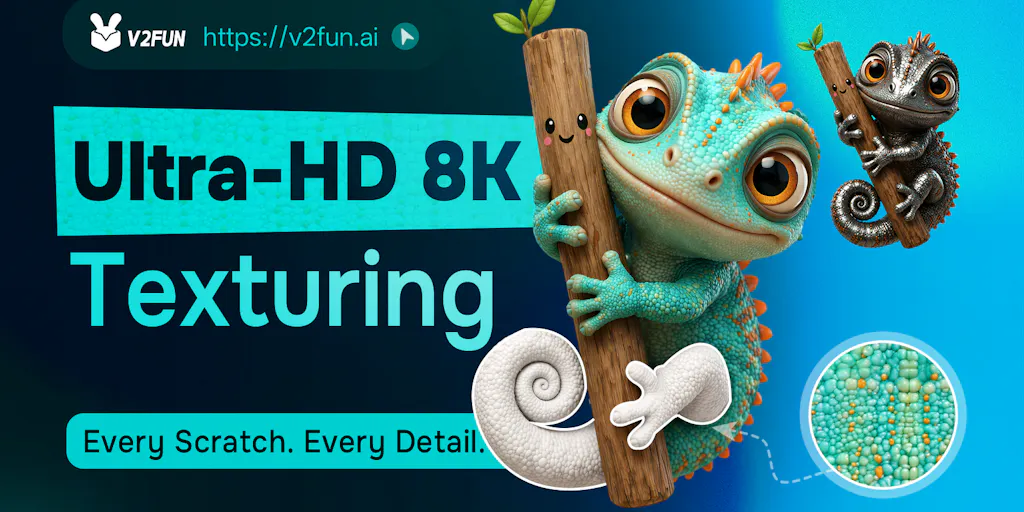
The 8K texture output, however, is a sleeper hit for product photography. If you’re able to generate a character wearing your product, you can then extract that texture map and composite it onto a real product shot in Photoshop. That workflow is niche but powerful for brands that sell clothing or accessories with complex patterns. The export to USDZ and GLB makes it trivial to drop into a 3D viewer; the issue is that the underlying mesh might not match your product’s exact dimensions. For a pair of earrings, that’s a dealbreaker. For a hoodie, it might pass.
What I’d Watch / Test Next
Here’s what I’m doing this week, and what I’d recommend any cross-border operator try:
Test one simple use case. Film a 20-second video of a person walking and turning while holding your product. Upload it to V2Fun and generate a 3D character in a neutral pose. Export as GLB and drop it into Shopify’s 3D viewer. Can you create a 360-degree rotatable model that looks presentable? If yes, that’s an incremental improvement over a static image for zero marginal cost.
Watch for the product-scanning roadmap. The maker confirmed they are “actively exploring” precise physical scaling and CAD-compatible workflows. When that ships, the calculator changes. Bookmark their Discord community and track announcements.
Compare against alternative pipelines. If you need a character-centric ad for TikTok Shop, try generating with V2Fun side by side with a real model. Measure production time, cost, and the resulting engagement rate. The data you gather now will inform your decision when the tool matures in 6–12 months.
Don’t build your entire visual strategy on a Product Hunt launch. Use V2Fun as a rapid prototyping layer before you commit budget to a professional 3D agency. If the concept works, you can always scale up.
The takeaway: V2Fun is a signal of where the market is going—AI-generated 3D characters that animate from your phone video will eventually become as mundane as AI-generated product descriptions. Today, it’s a promising but rough-around-the-edges tool that can save you time on concepting but will cost you time on cleanup. For a cross-border seller, time is the only currency you can’t arbitrage. Spend it wisely.