The real lesson from a $0.99 Japanese slang app: your audience wants the layer your competitors skip
Most social media operators I know are drowning in the same problem, and it isn’t reach. It’s specificity. You can schedule thirty posts across five platforms in an afternoon with Buffer or Later, you can batch-produce a month of CapCut edits in a weekend, and you can still watch all of it underperform because the content says nothing a thousand other accounts aren’t already saying. The interesting thing about YABAI, a small paid Android app from solo developer Yuichi Sato, is that it accidentally demonstrates the fix. It refuses to be a course, refuses streaks, refuses the pack model, and refuses to invent tidy etymologies. It just ships the 308 words that textbooks leave out — and that editorial discipline is exactly what most creator accounts are missing.
What YABAI actually is, and why it’s a strategy lesson wearing an app’s clothes
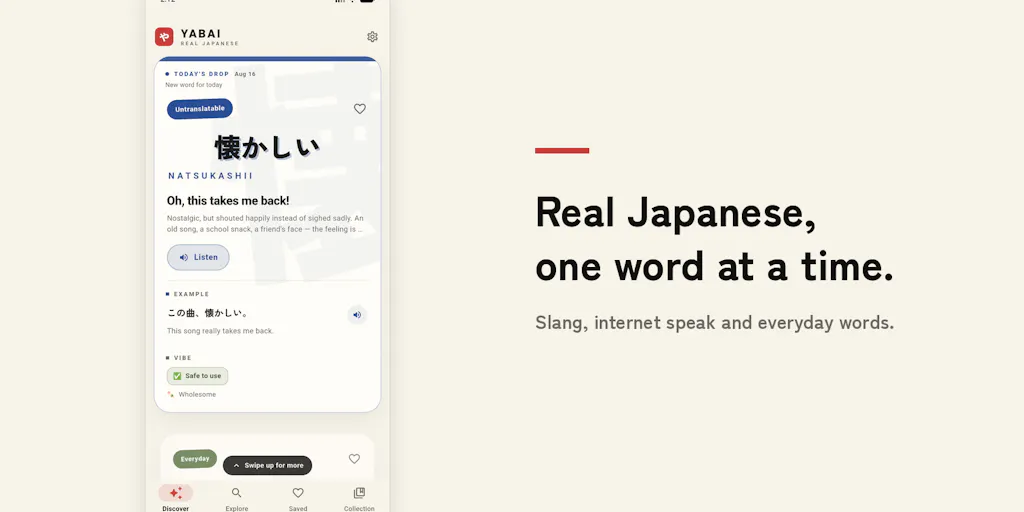
The Product Hunt launch thread is worth reading in full because the maker’s answers are unusually candid. The premise: people study Japanese for years and still can’t follow a group chat, because the vocabulary that carries everyday conversation — slang, internet speak, fandom words — is precisely what formal instruction omits. So YABAI is a swipeable card app: giant Japanese typography, one word per card, save what you like, no tests, no streak guilt. The team describes it as “built like a snack.”
Two production decisions stand out to me as a content person, not a language person.
First, every word is researched and written in Japanese first, then translated into 13 languages — explicitly not machine-translated out of English. That’s a workflow inversion most AI-assisted content operations get backwards. The default move in 2025 is to write the English hook, run it through a translation layer, and ship. YABAI does the opposite: source-of-truth language first, derivative languages after. (If you want to see why that matters mechanically, the Google Search Central documentation on translated and localized content is a decent starting point for how search engines treat thin translation layers.)
Second, where a word’s origin is genuinely disputed — the maker names yabai itself as an example — the app says “nobody agrees” rather than picking a tidy story. He calls out invented etymology as a plague in slang content and says he didn’t want to add to it. That is a trust decision, and it’s the single most transferable idea in this entire launch.
The “nobody agrees” move is a content strategy, not a disclaimer
Here’s what I mean. Creators are trained to resolve ambiguity because ambiguity reads as weakness. Pick a side, land the hook, move on. But in practice, the posts that earn saves and shares are often the ones that say “the honest answer is contested, here’s the two camps, here’s which one I lean toward.” That’s a higher-effort post. It also can’t be replicated by an AI summarizer scraping the top three results, because the top three results all picked a tidy story.
In my experience running accounts in niche categories, the “here’s what everyone gets wrong, and here’s what’s actually unresolved” format outperforms the confident-explainer format on saves, even when it underperforms on raw reach. Saves are the metric that compounds. Reach is the metric that resets to zero every morning.
How it differs from the tools you’re already paying for
If you’re a social media manager, your stack probably looks like a scheduling layer (Hootsuite, Metricool, Buffer), a design layer (Canva), an editing layer (CapCut, Descript), an analytics layer, and increasingly an AI drafting layer. YABAI sits in none of those categories. It’s a $0.99 one-time paid app, no ads, no tracking, no subscription — the maker was explicit about not wanting to “monetise your attention.”
That pricing model is the tell. Compare it to how most creator tools are sold. Notion moved to seat-based pricing that scales with team size. Jasper and Copy.ai sell AI writing on credit tiers. Even Taplio and similar LinkedIn growth tools bundle analytics, scheduling, and AI drafting into a monthly subscription that assumes you’re optimizing for volume. YABAI assumes the opposite: a small, fixed, curated set of things worth knowing, delivered offline, for less than a coffee.
I’d bet the reason this resonates on Product Hunt isn’t the language angle. It’s the anti-subscription angle. Creators and operators are exhausted by tools that charge monthly for the privilege of generating more content than anyone asked for.
Why TikTok and YouTube creators should care more than LinkedIn ones
The platform mechanics matter here. On LinkedIn, the distribution algorithm still rewards a certain polish and a certain length — you can get away with a generic-but-well-structured post because the feed is comparatively low-volume and the audience is comparatively forgiving. On TikTok and YouTube Shorts, watch time and rewatch rate dominate distribution, and generic content gets scrolled in under two seconds. Specificity is the only lever that reliably holds attention.
Which means: the “layer everyone skips” framing is a Shorts-native framing. A 45-second video that opens with “every Japanese textbook teaches you this word, and no Japanese person under 30 has used it since 2014” is a hook. A LinkedIn post that opens the same way is a curiosity gap that half the feed will scroll past. Same insight, different distribution math.
If you’re repurposing one idea across platforms — and you should be, that’s the whole game — the YABAI lens says: lead with the omission, not the inclusion. What did the standard treatment leave out? That’s your first three seconds.
What creators and social teams can borrow from this, operationally
Let me get concrete, because “be more specific” is useless advice without a workflow.
1. Run an exclusion rule on your content backlog. The maker’s rule was: every word had to be either in current use or evergreen — no dead slang, no words that only exist inside one show. Plenty got rejected on the way, and he names examples. That’s an editorial filter, and you can copy it verbatim. For any niche account, the rule becomes: every post must be something a practitioner would recognize as currently true or structurally true. Not “trending last quarter.” Not “only makes sense if you watched one specific drama.” I’ve started applying a version of this to my own content calendar and the immediate effect is that my backlog shrinks by about half — which is fine, because the half that survives is the half worth posting.
2. Build a tester-suggestion pipeline instead of a launch-and-abandon cadence. This is the part Gal Dayan flagged in the thread, and it’s the sharpest observation in the whole comment section: the tester-suggestion pipeline is what keeps a slang app from going stale, because “most slang apps ship once and rot within a year.” The maker confirmed two of the current 308 words came from tester suggestions. For a creator account, the equivalent is a standing “what should I cover next” mechanism — a pinned comment, a story sticker, a Discord channel — that feeds your calendar on an ongoing basis rather than you guessing. The audience tells you what’s missing. Your job is to filter, not to invent.
3. Decide your source-of-truth language and stick to it. If you publish in multiple languages or repurpose across regional accounts, the YABAI workflow says: write in the language your audience actually thinks in, then translate outward. Not the reverse. Machine-translating an English hook into five languages produces five pieces of content that all sound like they were written by the same person who has never used the product.
4. Treat “I don’t know” as a content format. The disputed-etymology decision is the highest-leverage move in this launch. If you’re a growth marketer or a tooling reviewer, the posts where you say “the data is contested, here’s what I’ve seen in my own tests, here’s what I’d want to see before I’m confident” build more authority than the posts where you assert a clean answer. Authority comes from calibration, not confidence.
Where the math breaks
I want to be honest about the limits of this analogy, because the temptation with any small indie launch is to over-extract a grand lesson.
YABAI is a $0.99 one-time app with 308 words, Android-only, no iOS build shipped yet despite the codebase being set up. It’s a solo developer project. It is not a business model you can copy into a social media operation, and the maker is explicit that it’s not a course and not a “you can follow native content now” set — “no list of 308 words could be.” That’s a narrower promise than most product launches make, and the narrower promise is the honest one.
The transferable part is the editorial stance, not the product. If you strip out the language-learning specifics, what’s left is: pick a narrow slice your competitors skip, apply a hard exclusion rule, be transparent about what’s unresolved, and build a feedback loop that keeps the slice fresh. That’s it. That’s the whole lesson. Everything else is Japanese slang.
Where my judgment says this falls short
A few things I’d want answers to before calling this a model worth emulating wholesale.
The 308 number is arbitrary and the maker admits it. When Dayan asked how the cutoff was chosen, the answer was refreshingly blunt: “308 isn’t a cutoff I chose — it’s what survived the rule.” That’s honest, but it also means there’s no coverage target, no roadmap to a defined completeness. For a language learner, that’s a real limitation. For a creator borrowing the method, it’s actually a feature — you don’t need to define completeness, you need to define your filter. But don’t confuse the two.
The tester-suggestion pipeline has an unspecified filter. Dayan asked the obvious follow-up: how are tester submissions vetted before they make the cut — run by other native speakers, or one person’s judgment call? As of the thread, that question is unanswered. If it’s one person’s judgment, the pipeline is only as good as that person’s ear, and it doesn’t scale. If it’s a panel, that’s a real editorial operation. Not disclosed.
Android-only is a real constraint. iOS is set up in the codebase but not shipped, and the maker says he’ll prioritize it “if there’s interest.” For a creator audience that skews heavily iPhone, that’s a meaningful gap. I’d bet the iOS build arrives if the launch gets traction, but that’s a guess, not a fact.
And the pricing is a double-edged sword. $0.99 one-time, no subscription, no ads, no tracking is a great story. It’s also not a business that funds ongoing curation at scale. If the word list is going to grow indefinitely under a strict rule, someone has to pay for that time. The maker hasn’t said how that math works. Not disclosed. Worth watching.
What I’d watch / test next
If you want to actually use this launch as a prompt rather than just read about it, here’s what I’d do this week.
Audit your last 30 posts against an exclusion rule. Write down the rule first — “currently true or structurally true, nothing that only makes sense inside one trend cycle” — then go through the backlog and mark what survives. If more than half survives, your rule is too loose. Tighten it and run it again.
Add one “here’s what’s unresolved” post to your calendar. Pick a topic in your niche where the conventional answer is contested. Write the post that names both camps, says which one you lean toward, and admits the uncertainty. Track saves and comments against your average. My prediction: saves up, reach roughly flat. If I’m wrong, tell me — I’d genuinely like to know.
Stand up a suggestion channel. A pinned comment, a story question sticker, a Discord thread. Ask your audience what your niche’s textbooks leave out. Then filter their answers through your exclusion rule instead of posting them raw. The filtering is the value-add.
If you publish in multiple languages, check your source order. Look at your last five translated or localized posts and ask honestly: was this written in the audience’s language first, or translated out of English? If it’s the latter, you’ve found a cheap quality win.
And if you’re curious about the app itself — it’s Android-only, $0.99, offline, no tracking — the launch thread is where the maker is answering questions directly. The interesting part isn’t the words. It’s watching a solo developer defend a narrow promise in public without inflating it. That’s a skill most creator accounts could stand to borrow.


