The creator economy has a trust problem, and it isn’t the one you think
Every social media operator I know has quietly become an AI operator. The last eighteen months pushed scheduling tools, caption generators, and repurposing engines into every workflow I touch, and the pitch is always the same: let the model do more, check it less. That’s fine when a hallucinated hashtag costs you nothing. It’s a different story when the model is acting on production systems at 3am, and that gap — between “AI that suggests” and “AI that executes” — is the most interesting thing happening in tooling right now. So when a launch like 3AM Super Intelligence crosses my desk, I don’t file it under “not my beat.” I file it under “this is the governance conversation creator teams will be forced to have next.” Here’s why a product built for on-call engineers should matter to anyone running brand accounts, and where I think it falls short.
What 3AM actually is, and the problem it’s really solving
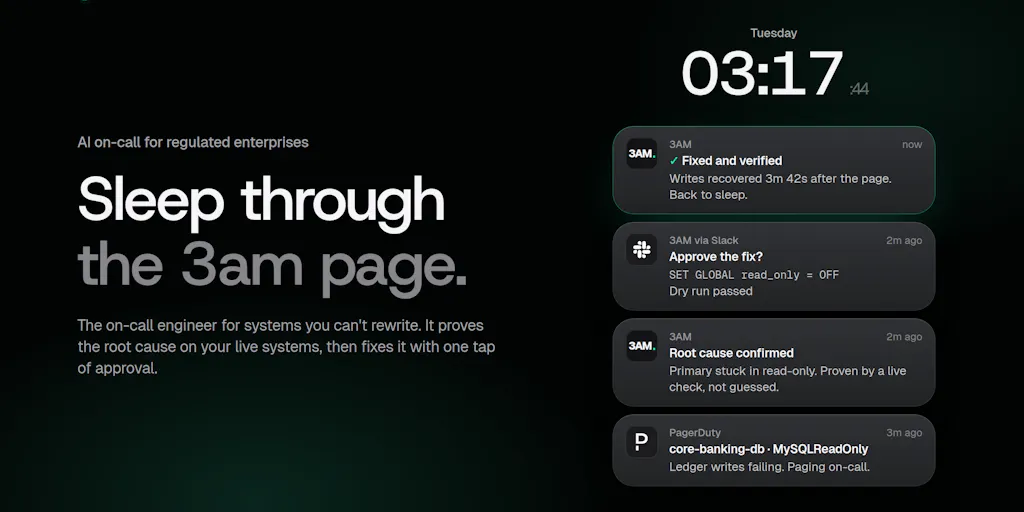
Strip away the launch-day framing and 3AM is an AI on-call engineer for infrastructure you can’t easily replace. The maker, Siddhesh Kulthe, frames it around three constraints that shaped the build: engineers need proof rather than a confident-sounding guess, regulated teams need the tool to run inside their own network, and humans need to stay in charge of any change to production. The product names a root cause only after a live check against your systems proves it; when it can’t prove one, it says so and hands over what it found. It runs inside your network with no inbound ports, works air-gapped, and the only thing that reaches the vendor is a signed licence check — that’s the maker’s claim, and it’s the kind of claim I’d want to verify in a security review rather than take at face value.
The workflow mechanics are the part worth stealing. Every proposed fix is rehearsed with a dry run first, then waits for human approval in Slack, Symphony, PagerDuty, xMatters, or email. It starts in shadow mode — watching, proposing, changing nothing — and granting it more autonomy requires two approvers. Every step lands in a hash-chained audit log. The team says it tests the product by deliberately breaking a real open-source core banking system — 244,000 lines of ten-year-old Java — in 67 different ways, and that zero harmful actions is a release gate rather than a target. Those are the maker’s numbers from the launch page, not independently verified figures, and I’d treat them as claims to interrogate.
Why this is a social-media story at all
Because the exact same architecture question is about to hit your stack. Right now your scheduling tool drafts a caption and you approve it. Tomorrow it reschedules a post, replies to a comment, and adjusts a paid budget. The moment an AI tool touches a live account rather than a draft folder, you inherit every governance problem 3AM is designed around: proof before action, human approval gates, an audit trail you can hand to a client or a legal team. The launch thread itself shows how sharp those questions get. When one commenter asked how the tool avoids creating more bugs than it solves, the maker’s answer was that any tool acting on production carries risk, so 3AM is designed to never act on a guess — shadow mode first, evidence second, human approval third. That’s a template, and I’d bet the next wave of social tools copies it whether or not they credit it.
How it differs from the incumbents you already pay for
The honest comparison set here isn’t Buffer or Later — those are publishing and scheduling layers, and 3AM doesn’t touch content. The closer analogues are the automation and observability tools that sit behind the scenes: PagerDuty for incident routing, Zapier for cross-tool automation, and the AI copilots bolted onto analytics platforms like Metricool. What separates 3AM from that crowd is the burden of proof. Most AI automation tools optimize for action volume — how many workflows fired, how many tasks completed. 3AM optimizes for the opposite: how many actions it can justify before it takes one. In my own tests of similar “agentic” tools, the failure mode is always the same — the model is right often enough that you stop checking, and then it’s wrong once in a way that costs you a day.
The regulated-industry angle is the other differentiator, and it’s more relevant to creator businesses than it sounds. Agencies handling financial or healthcare clients already face the “where does our data go” question every time they onboard a new SaaS tool. A product that runs air-gapped inside your own network, with no inbound ports and only a signed licence check leaving the building, is answering a procurement objection that kills a lot of deals. Whether that architecture holds up under real audit pressure is not disclosed on the launch page, and I’d want a security questionnaire answered before I’d stake a client relationship on it.
Where the math breaks
The 67-ways-to-break-a-banking-system testing story is compelling, but it’s also narrow. A core banking system is a well-understood domain with deterministic failure modes. Social platforms are the opposite: rate limits shift without notice, API permissions get revoked, algorithm distribution changes mid-campaign, and “correct” behavior is often a judgment call rather than a provable fact. A tool that demands proof before action works beautifully when the root cause is a lock waiter. It works less well when the “root cause” of a reach collapse is that TikTok changed its recommendation weights on a Tuesday. I’d bet the proof-first model is a genuine advantage in infrastructure and a genuine liability in anything creative or algorithmic.
What creators and social teams should borrow from this
Three operational patterns from the 3AM launch deserve to be lifted wholesale into your content workflow, regardless of whether you ever touch the product.
Shadow mode as a default. Before you let any AI tool publish, reply, or adjust spend on a live account, run it in a propose-only mode for at least two weeks. Log every suggestion, compare it against what you’d have done manually, and only then grant it write access. The maker’s point that every service starts in shadow mode and changes nothing is exactly the discipline most creator teams skip. I’ve watched agencies hand an AI captioning tool direct publishing rights on day one and spend the next month cleaning up tonal misfires.
Two-approver autonomy thresholds. The rule that giving the system more autonomy takes two approvers is a cheap, effective control. On a content team, that translates to: any AI-generated post that goes out without human editing needs a second set of eyes, and any automated reply to a customer needs a named owner. It’s not glamorous, but it’s the difference between an AI assistant and an AI liability.
Hash-chained audit logs as a client deliverable. The audit trail is the most underrated feature on the page. If you manage brand accounts for clients, an exportable, tamper-evident log of every AI action taken on their account is a sales asset, not just a compliance checkbox. When a client asks “what did the tool do to our account last month,” you want a verifiable answer, not a screenshot.
Why TikTok creators should care more than LinkedIn ones
The stakes scale with how fast the platform punishes a mistake. A poorly timed LinkedIn post from an AI tool is embarrassing; a mis-timed TikTok reply or a wrongly flagged comment can trigger a distribution penalty that takes weeks to recover from, because the recommendation system reads early engagement signals and amplifies whatever it sees. The faster the feedback loop, the more you need the proof-first, approval-gated model. If you’re running high-volume short-form across Instagram Reels and TikTok, the case for shadow mode and two-approver gates is stronger than it is for a once-a-week LinkedIn thought-leadership account.
Where my judgment says it falls short
The launch page is honest about the biggest limitation: 3AM is AI, and it’s in open alpha. That’s a significant caveat for anyone considering it, and the maker says so directly rather than burying it. Open alpha means the 67-way test suite and the zero-harmful-actions release gate are promises about intent, not proof of maturity. I’d want to see how the system behaves on a bad day before I’d trust it near anything that matters.
The second gap is scope. The product is built for infrastructure you can’t rewrite — banks, insurers, telcos — and the maker is explicit that the first 90 days are free as a feedback-collection exercise. That’s a smart go-to-market for a category where trust is everything, but it also signals the product isn’t yet positioned for the long tail of small creator businesses. If you’re a solo operator with a WordPress site and a scheduling tool, 3AM is almost certainly overkill, and the free trial is a way to gather feedback rather than a signal that it’s built for you.
The third gap is the one I keep coming back to: the proof-first model assumes failure modes are provable. In the comment thread, a user described a production freeze where every dashboard said the app was hung, but the real cause was a schema change waiting on a lock behind a long-running query — a waiter, not an error. The maker confirmed 3AM can inspect live database sessions and lock waiters to find what’s blocking things, but was careful to note that killing a blocking query is a different story, because it can roll back a transaction, so it would show evidence and get approval first. That’s the right answer, and it’s also a preview of the hard cases: when the fix is destructive, the proof-first model slows down exactly when speed matters most. The user’s own follow-up — that a short lock timeout on startup migrations fixed it for them, and that 3AM suggesting that prevention step would be nice — is the most useful piece of product feedback on the page, and it’s the kind of thing I’d want to see the team act on.
What I’d watch / test next
This week, before you adopt anything new, run one experiment on your own stack. Pick a single AI-assisted workflow — caption drafting, comment replies, or a repurposing pipeline — and put it in shadow mode for fourteen days. Log every output, compare it against your manual baseline, and count the near-misses. That exercise will tell you more about your tooling risk than any launch page can, and it’s the same discipline 3AM is selling to engineers.
Then watch three things about this product specifically. First, whether the open alpha produces a public post-mortem of a real failure — that’s the trust signal that matters more than any test count. Second, whether the approval integrations expand beyond Slack, Symphony, PagerDuty, xMatters, and email into the tools creator teams actually live in. Third, whether the proof-first architecture gets copied by the scheduling and analytics incumbents, because if it does, the governance conversation moves from the engineering on-call rota to the social media manager’s desk — and that’s a shift worth being early to.