The real lesson from this Product Hunt launch isn’t the product — it’s the data layer your content stack is missing
If you run social for a living, you’ve felt this specific pain: you’re staring at a spreadsheet of 400 prospects, a half-built Notion CRM, and a Claude tab that’s been “thinking” for ninety seconds while you try to figure out which of these people actually work at the companies you care about. Meanwhile your content calendar is on fire, your engagement rate is flat, and someone in leadership wants a “creator-led outbound” experiment by Friday. The launch of Anysite.io — and the unusually candid comment thread underneath it — is worth your attention not because it’s a social media tool (it isn’t), but because it exposes the plumbing that increasingly sits underneath creator-led growth, influencer prospecting, and community-led content ops. Let me explain why I think this matters more than another scheduler.
What Anysite.io actually is, in plain operator terms
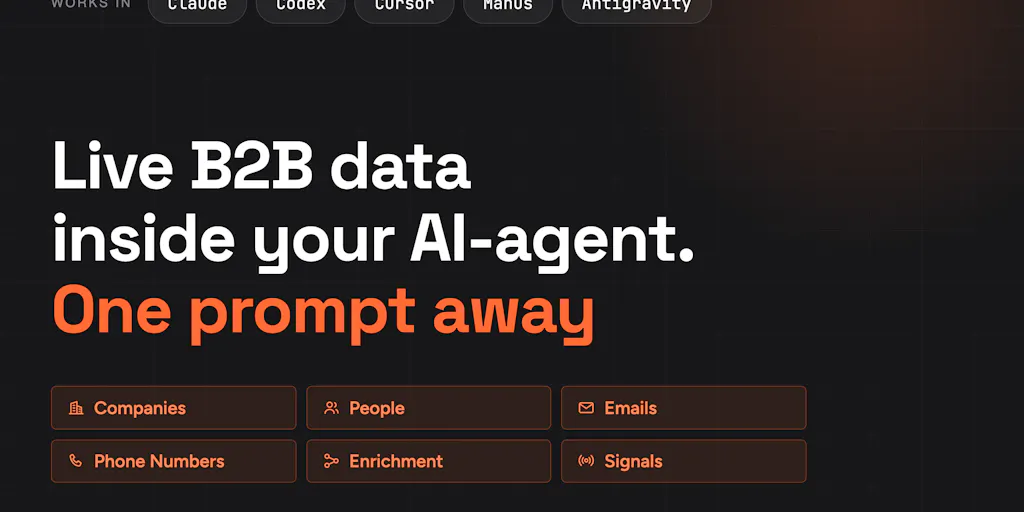
Strip away the launch-page vocabulary and here’s the honest description, drawn from the maker’s own words in the thread: Anysite.io is a structured-data API and MCP server that lets an AI agent query roughly 650–700 public web sources — LinkedIn pages, company websites, Crunchbase, Reddit, YouTube, app stores, company registries — and get back typed, structured results instead of a pile of scraped HTML. The maker, Andrey Kulikov, describes it as “700 sources with ready structured endpoints, mostly GTM stuff,” and explicitly frames the design choice: you don’t tell it where to go, you ask for the entity and get typed data back. The co-maker Sviatoslav Dvoretskii and Mike Smirnov round out the team visible in the thread.
The context is a broader essay Kulikov published on the same Product Hunt page: “In the first half of 2026, 3,869 products shipped on Product Hunt,” and his team ran the whole stream through LinkedIn and Crunchbase to analyze what people launch, who the founders are, and what actually improves your odds. That’s the meta-story — the launch of the data tool is itself a demonstration of the data tool.
Why a social media operator should care about a GTM data API
Here’s my take, and I want to be clear it’s a take, not a sourced claim: the creator economy has quietly merged with the GTM stack. The same person who runs your Instagram is increasingly the person sourcing the 50 micro-creators you’re seeding product with, building the LinkedIn thought-leadership list, and pulling the YouTube comment data that informs your next video hook. If your prospecting workflow is still “open 30 tabs and copy-paste into a spreadsheet,” you are the bottleneck. A tool that returns “companies in Berlin doing fintech, people there with title sales, their emails” as one query — which is literally the example Kulikov gives in the thread — is the kind of thing that compresses a two-hour research block into a coffee break.
How it differs from the incumbents you already pay for
The obvious comparison is Clearbit, which a commenter (fmerian) called out directly: “Anysite.io is the new Clearbit, built for modern GTM teams.” That’s a flattering framing but also an imprecise one, and I’d push back on it. Clearbit (now part of HubSpot) is fundamentally an enrichment layer — you feed it a domain or email, it returns firmographic and contact data. Anysite.io is closer to a query layer: you describe the entity you want, and it goes and reads the public web to assemble it. The distinction matters operationally. Enrichment assumes you already have a list. Query assumes you don’t.
The other comparison the makers themselves invite is TinyFish, a browser-agent infrastructure play. Kulikov’s response to that comparison is the most technically interesting part of the whole thread, and I’d encourage you to read it in full: “TinyFish is browser infrastructure, you give it a URL or a task and it navigates, renders, passes bot detection, logs in, fills forms. Horizontal, works on sites nobody mapped before… We went other way. 700 sources with ready structured endpoints.” He then gives the concrete scale example: ‘“500 companies by this ICP with decision makers and emails’ means 500 navigations for a browser agent, you pay per step and you wait per step. For us it’s one query.” And critically, he names where his own tool loses: “if you need to login into some portal and do something there, they are right tool and we are not.”
That kind of self-limiting is rare on Product Hunt and it’s the reason I’m writing about this at all.
Where the math breaks
If you’re a creator or a small social team, the “one query vs. 500 navigations” framing sounds like a no-brainer. It isn’t, and here’s where I’d stress-test it. First, structured endpoints only work when the underlying source is structured. If your ideal collaborator’s contact info lives in a Linktree, a Notion page, or a DM-only Instagram bio, Anysite.io almost certainly can’t help you — and neither can Clearbit. Second, “public web” is doing a lot of work in that sentence. Kulikov is explicit that they don’t buy leaked data and only read public pages, but public availability and permissible use are different questions, which brings us to the compliance thread.
The GDPR exchange is the most important part of the launch
A commenter named Muhammad Ahmed asked the question almost nobody asks on launch day: does GDPR/CCPA have provisions for compliance when extracting personal contact info like emails? Kulikov’s answer is the most trustworthy thing I’ve read from a data-tool founder in a while: “We collect only publicly available data, and we are processor, you are controller. So legal basis for your outreach sits on your side, we can’t hand it to you. Anyone telling you their tool makes you ‘GDPR compliant’ is selling you something.” He then lists what they do (no special category data, deletion requests honored, DPA on request) and what you must do (legitimate interest assessment, opt-out in every message).
If you’re doing influencer outreach or creator seeding in the EU or UK, that paragraph is your actual takeaway from this launch. Not the API. Not the MCP. The framing that compliance is a shared responsibility where the tool can’t absolve you. I’ve watched too many social teams treat “we found their email in a public directory” as a legal shield. It isn’t. It’s the start of a legitimate-interest assessment you probably haven’t done.
What creators and social teams can actually borrow from this
Even if you never touch Anysite.io, the launch thread is a masterclass in three things social operators should steal immediately.
1. The MCP-shaped workflow is coming for your content ops too
The comment from George Lov is the one that tells you where the puck is going: “love that it doesn’t dump tons of json into context like most of these. way cleaner.” The maker confirms this was deliberate: “We return the first page plus a cache key, and the agent pages or filters on top of the cache instead of re-fetching. Keeps the context small and the credits low.”
Now translate that to your world. Every content team I know is currently duct-taping Claude, ChatGPT, and Perplexity into their workflow for ideation, repurposing, and caption drafting — and every one of them is quietly burning context window and API credits on re-fetching the same brand guidelines, the same tone-of-voice doc, the same top-performing-post archive. The cache-key-plus-pagination pattern Kulikov describes is exactly what a well-designed content MCP server should do. If you’re building internal tooling, steal this. If you’re buying tooling, ask vendors whether they cache.
2. “We return typed data” is a brief for your content briefs
The single most repeated value prop in the thread is that Anysite returns structured results instead of raw scraped noise. I’d argue the same principle applies to how you brief creators. The reason so many brand-creator collabs underperform isn’t the creator — it’s that the brief is a Google Doc of vibes. If you can’t express your desired output as a schema (hook, format, length, CTA, disclosure placement, three reference posts, one thing to avoid), you don’t have a brief, you have a wish. Structured inputs produce structured outputs. This is the same lesson.
3. Self-limiting positioning builds more trust than feature lists
Kulikov’s “they are right tool and we are not” line about login-gated portals is worth studying as a positioning move. In a market where every AI tool claims to do everything, the founder who says “here’s exactly where we lose” is the one I’d bet on. If you’re a creator building an audience, apply this to your own niche: the fastest way to earn trust with a sophisticated audience is to publicly name what you’re not the right person for.
Why TikTok creators should care more than LinkedIn ones
Here’s a counterintuitive one. You’d think a GTM data API matters most to B2B LinkedIn folks. But in my experience running creator seeding programs, the TikTok and Instagram micro-creator tier is where data hygiene is worst and ROI is highest. LinkedIn prospecting tools have existed for a decade; the ability to query “creators in this niche, this follower band, this engagement floor, who’ve mentioned this competitor” across public sources is comparatively new and comparatively underserved. The catch: most of that data lives behind platform walls that Anysite explicitly can’t cross. So the practical use case is sourcing the business side of a creator partnership — the agency, the manager, the brand contact — not the creator’s private metrics. Know which side of the wall you’re on.
Where I think this falls short, and who it’s not for
I want to be balanced here because the launch thread is, unsurprisingly, mostly praise, and the praise comes from people with a stake in the outcome (Mike Smirnov is listed as a maker and describes himself using it daily; Mike Day says he’s used it “from its inception”). That’s fine and normal, but it means you should discount the enthusiasm accordingly.
Open questions the source doesn’t answer:
- Pricing is not disclosed anywhere in the scraped thread. For a tool whose whole pitch is “keeps the credits low,” the absence of pricing on the launch page is a real gap. Don’t assume it’s cheap just because the makers talk about credit efficiency.
- Accuracy and freshness rates are not disclosed. “700 sources” is a source count, not a reliability guarantee. If a company registry updates quarterly and your outreach depends on it, you need to know the refresh cadence. Not stated.
- The self-healing claim is unverified. Olia Nemirovski asked the sharpest technical question in the thread — how well does it handle sites that change often or have strong anti-bot protection? — and as of the scrape, I don’t see a maker response. That’s the question I’d want answered before committing a workflow to it.
- The “650” vs “700” source count discrepancy appears in two different maker comments. Probably a rounding artifact, but worth clarifying with the team.
Who this is not for: solo creators who just need to schedule posts. If your bottleneck is Buffer, Later, or Metricool territory — publishing cadence, analytics dashboards, UTM tracking — Anysite.io is irrelevant to you. It’s also not for anyone whose prospect data lives in gated platforms, DMs, or private communities. And it’s not for teams without a legitimate-interest framework for outbound, because as Kulikov himself says, the tool can’t give you one.
What I’d watch / test next
Concrete things I’d do this week if I were evaluating this for a creator-led growth motion:
- Run one real query against a list you already have. Take 50 creators or prospects you’ve already manually researched and see whether Anysite returns the same fields you found by hand. Measure the delta, not the demo.
- Ask the makers three questions directly (Kulikov invites this — “Ping me if you evaluate seriously”): What’s the pricing tier for API volume? What’s the refresh cadence per source category? How does the self-healing behave on anti-bot-protected sites?
- Audit your own compliance posture before you touch any contact data. Legitimate-interest assessment, opt-out language, deletion process. The tool is the easy part.
- Steal the cache-key pattern for whatever internal AI content workflow you’re running, regardless of whether you buy this.
- Watch the TinyFish comparison — if browser-agent infrastructure gets cheaper, the “one query vs. 500 navigations” math could flip, and you don’t want to have bet your stack on the wrong side of that curve.
My honest bottom line: this is a GTM tool, not a social media tool, and I’d be skeptical of anyone pitching it to you as the latter. But the patterns it demonstrates — structured queries over scraped noise, cache-aware agent design, self-limiting positioning, and unusually candid compliance framing — are the patterns your content and creator ops stack will be built on within eighteen months. Learn them now, even if you never sign up.