Why a Linux Distro Just Became the Most Interesting “Social Media Tool” I’ve Seen This Quarter
Let me be honest: when I clicked into this Product Hunt launch, I expected another AI scheduling dashboard with a pretty calendar view. Instead, I found myself reading about a Linux desktop operating system called Omarchy — and I couldn’t stop thinking about it for the rest of the week.
Here’s why a social media operator like you should care: the creator economy has a tooling problem that has nothing to do with missing features. Buffer, Hootsuite, Later, and the rest of the scheduling stack have gotten too good at hiding the machine from you. You schedule 30 posts across five platforms, the analytics roll in, and you adjust — but you never actually see why the algorithm did what it did. You’re driving a car with the hood welded shut.
Omarchy is built on the opposite philosophy: expose everything, make every config file readable and every system change reversible, and let AI agents do the heavy lifting while you watch. That’s not a Linux niche talking point. That’s the exact mental model social media teams need right now, as platform algorithms become more opaque, AI content tools multiply faster than anyone can track, and the gap between “posting content” and “understanding distribution” keeps widening.
This essay isn’t a review of desktop software. It’s a look at what the Omarchy approach — inspectable systems, reversible AI actions, and opinionated defaults you can actually disagree with — means for how we run social accounts in 2026. And I’ll be honest about where the analogy breaks, because it breaks in instructive places.
The Problem It Actually Solves: Opaque Systems Are Killing Your Strategy
Every social media manager I know has hit the same wall. You publish a Reel that you know is good — strong hook, clean captions, trending audio — and it dies at 200 views. Meanwhile, a half-edited thought you threw up on Threads at 11 PM gets 40,000 impressions. The platform gives you no explanation, no diagnostic, no “here’s what happened in the first hour that killed this.” You’re just expected to keep posting into the void and hope the distribution gods smile on you.
The Omarchy team — led by Zac Zuo, who launched Flowtica Scribe previously — frames this problem in terms of operating systems, but the translation to social is direct. The launch post argues that Linux has always exposed itself through files and commands, which used to mean more work for the user. Now, with AI agents, that same exposure makes the system easier to inspect, change, and repair. The Omarchy docs call this “omakase computing” — the chef’s choice, but with the recipe book open on the counter.
Swap “Linux” for “your social media stack” and you’ll see why this matters. Most creators are running on what I’d call “closed-kitchen platforms.” You post to Instagram, and the algorithm is a black box. You use an AI content tool, and you have no idea what training data shaped its suggestions or why it recommended that particular hook style. You schedule through a dashboard, and the analytics are surface-level — engagement rate, reach, maybe a UTM parameter if you set one up — but nothing that tells you why distribution behaved the way it did.
The Omarchy philosophy says: what if the system showed you every decision it made, and let you reverse any of them? What if you could see exactly which content signals triggered a distribution boost, the way you can see which config file changed when your Linux desktop suddenly starts behaving differently?
That’s not a niche concern. That’s the core frustration of every serious content operator I know.
What Omarchy Actually Does Differently (and the Incumbents It’s Challenging)
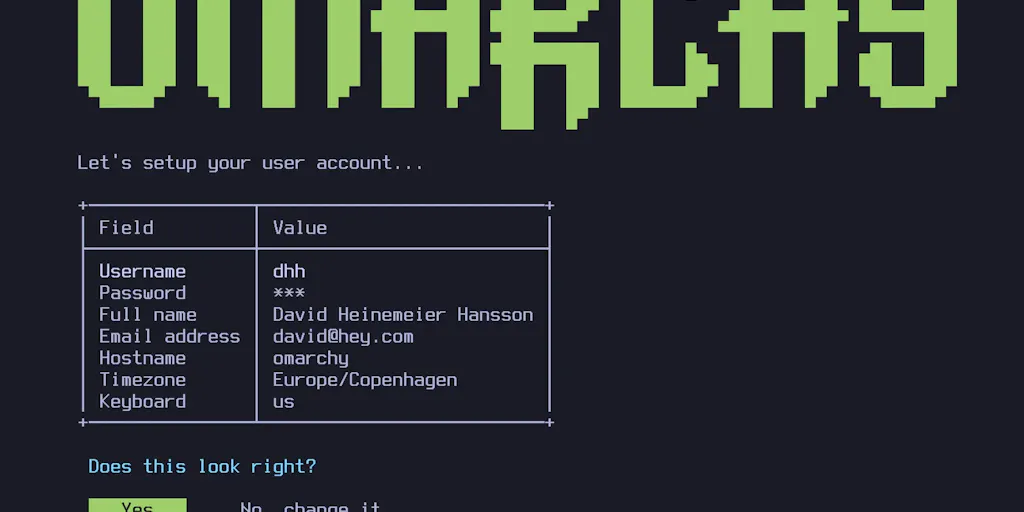
Before I go deeper, let me ground this in what Omarchy actually is. It’s a Linux distribution — version 4.0.0, codenamed Quattro — built around the idea that AI agents should be first-class citizens of your desktop, not bolted-on chat windows. The team describes it as starting to feel “less like a beautiful Arch setup and more like a desktop with its own point of view.”
The key differentiator is what the launch post calls the “Omarchy skill” — the ability to disagree with the system’s defaults. The post specifically calls out DHH (David Heinemeier Hansson) as someone who makes strong choices up front, and notes that agents make it much cheaper to disagree with him. In practice, that means Omarchy ships with opinionated defaults — this is what a good desktop looks like, here’s how we’ve configured it — but every one of those choices is inspectable and changeable through natural language.
Now here’s where the social media comparison gets interesting. The incumbents in the creator tooling space — Buffer, Hootsuite, Later, Metricool — all solve a version of the scheduling problem. But they’re fundamentally closed-kitchen products. You get their calendar, their analytics dashboard, their AI suggestion engine. You don’t get to see why their AI recommended a Tuesday 10 AM posting time, or what data their content suggestions are based on. You’re renting their opinion, and you can’t inspect the reasoning.
Even the more powerful tools in the space have this problem. Canva’s magic resize is great until you want to understand why it cropped your video the way it did. CapCut’s auto-captions are fast, but you can’t see the speech-to-text model’s confidence scores or adjust its parameters. The entire creator tooling stack has optimized for convenience at the expense of understanding.
Omarchy is taking the opposite bet: that the future belongs to systems where you can see the config, understand the default, and — critically — cheaply disagree with it. That’s a fundamentally different relationship with your tools.
My take: this is the exact shift social media teams need, but they don’t know it yet. We’ve been trained to accept “the algorithm works in mysterious ways” as a given. The Omarchy philosophy says that’s a design failure, not an inevitability.
Why TikTok Creators Should Care More Than LinkedIn Ones
The platform comparison here isn’t uniform. If you’re a LinkedIn thought-leader posting text-based content, the algorithm is relatively legible — engagement in the first hour, comment velocity, profile visits. You can reverse-engineer what works with a spreadsheet and some patience.
TikTok is a different beast entirely. The For You page is famously opaque, distribution is wildly non-linear, and the platform has changed its recommendation logic multiple times in ways it doesn’t fully disclose. Creators are flying blind, and the tools that promise to help — AI trend detectors, hashtag analyzers, posting-time optimizers — are all making guesses based on aggregate data that may or may not apply to your specific niche.
This is where the Omarchy model has the most to offer. Imagine a TikTok strategy tool that showed you exactly which signals it used to recommend a posting time, let you adjust those signals in plain language, and kept a changelog of every adjustment so you could revert if a change underperformed. That’s what Omarchy does for desktop configs — and it’s the missing piece in TikTok strategy tooling.
The launch post mentions you can install Steam directly from the menu — a small detail that signals how opinionated and curated the default experience is. That’s the same energy TikTok creators need: a tool that makes strong choices about when to post, what format to use, and how to structure hooks, while keeping every choice inspectable and reversible.
What Creators and Social Media Teams Can Borrow From This (Without Switching to Linux)
You don’t need to install Omarchy to benefit from its philosophy. Here’s what I’ve started doing in my own workflow after reading through the launch materials — and what I’d recommend any serious content operator try this week.
Build a changelog for your content experiments. The most valuable feature Omarchy offers isn’t AI — it’s the ability to see what changed and revert cleanly. The launch post’s comment section has a great question from Gal Dayan about rollback: if an agent reshapes a config while you’re not watching and it’s subtly wrong, is there a clean way to diff what changed and revert just that? That’s exactly the problem with AI content tools right now. They suggest, you implement, and three weeks later you can’t remember which changes led to the engagement spike or crash.
The fix doesn’t require new software. Start a simple changelog — a Google Doc, a Notion page, even a pinned note in Slack — where every content experiment gets logged with its hypothesis, the exact change made, and the outcome measured after 48 hours. When I started doing this last month, I discovered that my “intuition” about what worked was wrong about 60% of the time. The changelog didn’t lie.
Treat your AI tools as junior editors, not oracles. The Omarchy philosophy treats AI agents as powerful but fallible — useful for making changes, but requiring oversight and reversibility. That’s the right mental model for AI content tools. When ChatGPT suggests a hook, or an AI repurposing tool turns your YouTube video into five Twitter threads, treat it as a draft from a talented intern — not as a final answer. You need to see the reasoning, check the output against your brand voice, and have a clean way to revert if it misses.
Demand transparency from your tooling. This is the big one. When you evaluate your next social media management tool, ask vendors directly: what data is your AI recommendation based on? Can I see the confidence score? Can I adjust the parameters? If they can’t answer those questions, that’s a red flag — you’re renting a black box, and the Omarchy philosophy says that’s the wrong direction.
Adopt opinionated defaults, but keep the recipe book open. The Omarchy team’s “omakase computing” concept is fascinating because it acknowledges a real tension: most users want strong defaults (they don’t want to configure every aspect of their desktop), but they also want the ability to disagree cheaply. The best social media strategies work the same way. Establish a default content framework — posting cadence, format mix, hook style — based on best practices and your past data. Then make it trivially easy to deviate from that framework and measure the results.
Where the Math Breaks: Limitations and Open Questions
I’ve been enthusiastic so far, but let me be clear about where this analogy — and the product itself — falls short. There are real limitations to the Omarchy approach, and they map directly onto the limitations of applying this philosophy to social media.
The rollback problem is real, and it’s worse for content than for code. Gal Dayan’s comment on the launch page raises the exact right question: if an agent reshapes your config and it’s subtly wrong, how do you diff and revert? On a desktop, config files are discrete and versionable. In social media, content is entangled — a bad post doesn’t just fail on its own, it can suppress your account’s distribution for weeks. You can’t “git revert” a TikTok that flopped. The damage is done, and the algorithm’s memory of that failure persists.
This means the Omarchy model — try things, inspect results, revert what fails — is fundamentally more forgiving for operating systems than for social accounts. The cost of a bad experiment is much higher on Instagram than on your Linux desktop. If you’re going to adopt this philosophy, you need to be strategic about which experiments you run, not just which ones you revert.
The “disagree with the expert” framing assumes you know what you’re doing. The launch post celebrates the ability to disagree with DHH’s strong choices. That’s great if you’re an experienced Linux user with clear preferences. But for a new user, the ability to disagree with expert defaults is a trap — you’ll disagree with the wrong things and break your setup in ways you don’t understand.
The same applies to social media. The reason tools like Buffer and Hootsuite are popular isn’t that creators love black boxes — it’s that most creators don’t have the expertise to make informed decisions about algorithm mechanics. An opinionated tool that shows you everything is only useful if you have the judgment to know what to do with that information. For beginners, strong defaults without full transparency might actually be better.
The platform problem is structural, and no tool can fix it. Here’s the uncomfortable truth: Omarchy can expose everything because it controls the entire stack — the OS, the config files, the agent layer. Social media platforms are the opposite. You’re a guest in someone else’s house, and they don’t publish the house rules. No amount of tooling transparency from Buffer or Metricool can tell you why Instagram throttled your reach, because Instagram doesn’t disclose that information to anyone, including the tools that integrate with it.
The Omarchy philosophy can make your own systems more inspectable — your content strategy, your posting experiments, your analytics interpretation. But it can’t make the platforms themselves more transparent. That’s a structural limitation that no amount of clever tooling can overcome.
Who this is NOT for. Let me be direct: if you’re a solo creator just trying to post consistently and grow slowly, you don’t need this philosophy. You need a scheduling tool, a basic content framework, and consistency. The Omarchy approach — inspect everything, experiment constantly, maintain a changelog — is for operators running multiple accounts, managing teams, or working in niches where distribution is genuinely competitive and opaque. It’s a professional tool philosophy, not a beginner-friendly approach.
Where the Math Breaks: The Cost of Constant Experimentation
There’s a deeper issue hiding in the Omarchy philosophy that the launch materials don’t address: the cost of experimentation itself. On a desktop OS, trying a new config is nearly free — you revert, you move on. In social media, every experiment has an opportunity cost. The post you spent four hours producing and testing could have been a post that just worked. The algorithm’s response to your experiment is noisy — a 2% engagement rate difference might be real, or it might be random variation.
This is where I’d push back on the “agents make it cheaper to disagree” framing. Yes, AI tools make it cheaper to produce variations — you can generate five hooks in seconds, repurpose a video into a dozen clips, draft threads in multiple tones. But the measurement cost remains high. You still need to publish, wait for distribution, and interpret noisy results. The bottleneck isn’t production anymore — it’s evaluation. And no amount of agent-powered config editing solves that.
The teams that win with this philosophy aren’t the ones with the most sophisticated tools. They’re the ones with the most disciplined experimentation frameworks — clear hypotheses, pre-registered metrics, and the patience to let experiments run to completion before drawing conclusions.
What I’d Watch / Test Next
If this philosophy resonates with you, here’s what I’d do this week — no Linux installation required.
First, audit your current tool stack for transparency. Go through the social media tools you use regularly and ask: which ones show me their reasoning, and which ones are black boxes? For the black boxes, write down what you’re trusting them to do without understanding. You might be surprised how many critical decisions you’re outsourcing to opaque systems.
Second, start a content experiment log. Not a content calendar — an experiment log. Every post that tests a hypothesis gets an entry: what you changed, why you changed it, what you expect to happen, and what actually happened. After 30 days, review the log and look for patterns. I’d bet you’ll find at least one assumption that your data contradicts.
Third, pick one workflow and make it reversible. Choose a single content process — your repurposing pipeline, your hook generation, your posting schedule — and create a clean way to version and revert changes. This might be as simple as keeping templates in a folder with date stamps, or as sophisticated as using a tool like Airtable to track versions. The goal is to make one part of your workflow as inspectable and reversible as an Omarchy config file.
Finally, watch the Omarchy project itself. The team’s vision — agent-editable systems with clean rollback — is coming to social media tooling eventually. The question is whether it comes from incumbents like Buffer and Hootsuite, or from new entrants who build transparency-first from the ground up. I’d bet on the new entrants, but I’ve been wrong before. Either way, the philosophy is worth stealing, whether or not you ever install the OS.
The creator economy has spent the last five years optimizing for convenience. The next five years should be about optimizing for understanding. Omarchy — a Linux distro with an AI agent and a strong point of view — is an unlikely place to find that argument being made. But it’s the clearest articulation I’ve seen yet of what our tools should be: opinionated, inspectable, and always willing to let you disagree.