The Most Underrated Feature in Your Content Workflow Isn’t AI — It’s Forgetting
Let me paint a scene that every social media operator will recognize. It’s 11:47 PM, and you’re doom-scrolling through your own content calendar. That video you posted at 6 PM — the one you felt genuinely good about, the one where you articulated a point you’d been chewing on for weeks — is underperforming. Not a disaster, but soft. So you do what most of us do: you open the draft, you tweak the caption, you cut the hook, you re-upload. And in that moment, you’re not editing a video. You’re rewriting your own creative history based on a mood that will be gone by morning.
I’ve run accounts where I scheduled 30 posts across 5 platforms in a single week, and I’ve lost count of how many times I second-guessed a piece of content not because it was bad, but because the algorithm’s early returns bruised my ego. The problem isn’t the content. The problem is that every tool we use — every scheduler, every analytics dashboard, every AI assistant — is built to let us revise, optimize, and polish our way out of discomfort. We’ve optimized for editability at the expense of honesty.
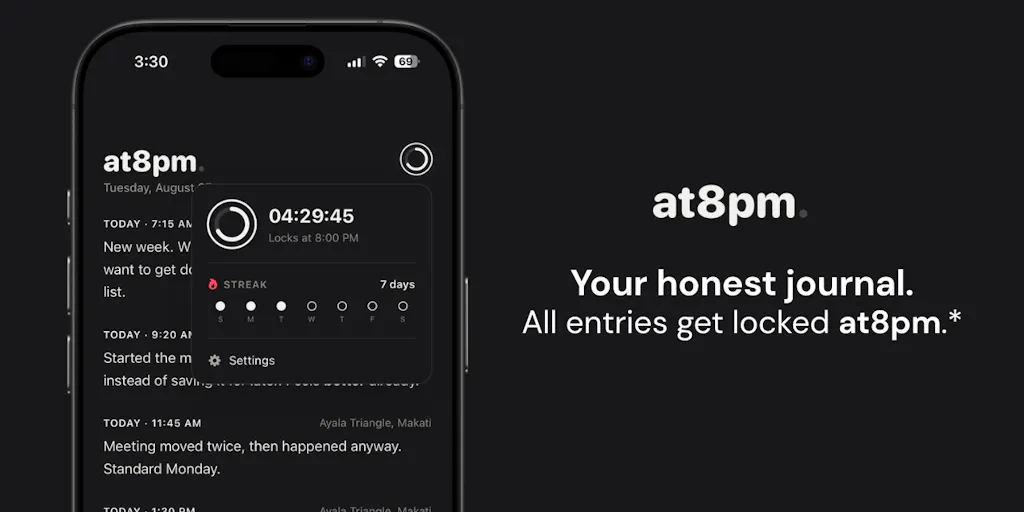
This is why I found myself unexpectedly fascinated by a small Product Hunt launch for an app called at8pm, created by Vince Urag. On its surface, it has nothing to do with social media. It’s a journaling app. But the core mechanic — the thing that makes it different — is that it locks your entries by default. You can’t edit, rewrite, or delete what you wrote. You’re stuck with your own words, captured in the moment, forever.
And I can’t stop thinking about what that constraint would do to the way creators operate.
The Problem: Every Content Tool Lets You Rewrite Your Own History
The maker’s own framing is worth sitting with. Urag writes that most journaling apps let you edit, rewrite, or delete anything, and while that’s useful, it also makes it “too easy to unintentionally rewrite your own history.” He wanted to build something that captures how he actually felt in the moment, not how he remembered feeling later.
That’s a profound insight for anyone who publishes content for a living, because the creator economy runs on a paradox: we’re told to be authentic, but we’re given tools that make authenticity optional. Every platform rewards consistency, so we schedule. Every algorithm rewards performance, so we optimize. Every analytics dashboard rewards growth, so we revise. And somewhere in that loop, the original impulse — the thing you actually wanted to say — gets sanded down into something safer, something that tests well, something that’s less you.
I’ve felt this acutely in my own workflow. Last month, I was repurposing a long-form YouTube video into a thread for X and a carousel for LinkedIn. The YouTube video had a take that was slightly spicy — a criticism of a popular scheduling tool that I genuinely believed was overhyped. When I sat down to adapt it, I softened the language. I added caveats. I made it more “professional.” The result was a piece of content that was technically correct but emotionally hollow. And the engagement reflected it.
The problem isn’t that I made a bad call. The problem is that the tools I use made it trivially easy to make that call without ever noticing the cost. When you can edit anything at any time, you edit everything. You optimize the life out of your own voice.
This is where at8pm’s constraint becomes a thought experiment for creators: what would your content look like if you couldn’t revise it after publishing? What if the first draft was the only draft?
How at8pm Actually Works (and Why the Lock Matters More Than the Journal)
Let me be precise about what this product is, because the details matter. at8pm is an iOS journaling app that locks your entries. The name suggests a nightly ritual — you write at 8 PM, and then the entry is sealed. The mechanic, as described by the maker, is that entries are locked by default rather than unlocked. You’re not tempted to edit later because you can’t.
A commenter, Anas Chhilif, notes they’ve been trying to journal in Obsidian and would find it helpful to have a phone app that locks entries — they also ask about Android plans, which the source doesn’t address. Another commenter, Amelia, highlights the privacy approach: entries are kept in personal iCloud rather than sent to another server, which makes it feel more comfortable for private thoughts. That’s a meaningful architectural choice, and it’s worth unpacking.
Most journaling apps — and most content tools, for that matter — default to cloud sync because it enables cross-device editing and collaboration. But that convenience comes with a cost: your data is on someone else’s server, subject to their terms, their security, their business model. For a journal, that’s a privacy risk. For a creator, it’s a strategic risk. When your content lives in someone else’s infrastructure, you’re at the mercy of their API rate limits, their pricing changes, their algorithm updates.
The iCloud approach is a signal that at8pm is built for the individual, not for the platform. And in an era where creators are increasingly aware that they don’t own their audience — that Instagram can change its algorithm overnight, that TikTok can be banned, that X can pivot to a subscription model — owning your own data is a feature, not a footnote.
But the real innovation, the thing that Gal Dayan from Dial zeroes in on, is the lock mechanic itself. Dayan asks a sharp question: if you’re traveling across time zones, does the configured lock time follow your phone’s local time automatically, or does it stay anchored to whatever time zone you set it up in? That’s not disclosed in the source, and it’s a legitimate gap in the product’s documentation. But the deeper point Dayan makes is worth quoting: “the fact that it locks by default instead of tempting you to edit later is the whole product, and most journaling apps go the opposite direction.”
That’s the thesis. Most tools — Buffer, Hootsuite, Later, Metricool — are built to maximize flexibility. They let you schedule, reschedule, edit, and delete. They’re designed for the operator who wants control. And that’s fine for tactical content — promotional posts, announcements, evergreen pieces that genuinely benefit from iteration. But for the content that matters — the takes, the essays, the personal stories that build a real audience — editability is a liability.
Why TikTok Creators Should Care More Than LinkedIn Ones
The lock mechanic matters differently across platforms. On LinkedIn, the culture rewards considered, polished takes. The algorithm doesn’t punish you for editing a post an hour after publishing — in fact, it might reward you for catching a typo or clarifying a point. The audience is professional, and the expectation is competence.
On TikTok, the calculus is different. The algorithm rewards authenticity and velocity. The most successful creators are the ones who post in the moment, who capture a raw reaction, who don’t overthink. When you edit a TikTok after posting, you’re not fixing a typo — you’re signaling to the algorithm that your content wasn’t good enough on the first pass. And the audience can feel it. The comment section is brutal about creators who clearly “optimized” their content after the fact.
I’d bet that a creator who adopted an at8pm-style lock for their TikTok drafts would see a measurable shift in their content’s energy. Not because the lock itself improves the content, but because it forces you to commit. You can’t chase the algorithm’s whims after the fact. You have to trust your initial instinct.
What Creators and Social Media Teams Can Borrow From at8pm
I’m not suggesting you should lock your content calendar and never revise a caption again. That would be absurd — the operational reality of running multiple accounts across platforms requires iteration. But there are three specific practices from at8pm’s philosophy that I think every creator and social media team should steal:
1. Separate “locked” content from “draft” content.
In my own workflow, I’ve started categorizing content into two buckets. The first bucket is “evergreen” — content that benefits from iteration, like SEO posts, tutorials, and reference guides. These live in a tool like Notion or Airtable where I can revise freely. The second bucket is “moment” content — takes, reactions, personal stories that are time-sensitive and emotionally specific. These get a hard deadline: once I publish, I don’t touch them.
This is a discipline, not a feature. But it’s a discipline that at8pm makes visible. The app’s default is to lock, not to unlock. You have to actively choose to make something editable. Most content tools have the opposite default — everything is editable until you archive it. Flipping that default, even just mentally, changes how you approach publishing.
2. Use the “first draft is the only draft” rule for high-stakes personal content.
The content that builds audience trust — the vulnerable posts, the contrarian takes, the behind-the-scenes stories — is exactly the content that suffers most from over-editing. When you revise a personal story, you tend to sand off the rough edges that made it relatable. You make it safer, and safety is the enemy of connection.
I’ve started writing these posts in a single sitting, publishing them immediately, and refusing to look at the analytics for at least 24 hours. The early returns are almost always misleading anyway — the algorithm needs time to distribute. And by the time the data is meaningful, the moment has passed. You can’t un-publish a feeling.
3. Treat your content calendar as a journal, not a ledger.
This is the meta-lesson from at8pm. The maker’s insight is that journaling apps let you “rewrite your own history.” Content calendars have the same problem. When you look back at what you posted six months ago, you’re not seeing what you actually thought at the time — you’re seeing what you thought after the algorithm told you what worked.
I’ve been guilty of this. I’ve deleted posts that underperformed, rewritten captions that didn’t land, and retroactively changed my positioning to match what the data said was popular. The result is a content history that looks coherent but isn’t honest. It’s a curated version of my thinking, not the real thing.
A locked content calendar — one where you can’t delete or revise after publishing — would be a forcing function for intellectual honesty. It would show your audience (and yourself) the evolution of your thinking, including the missteps. And that’s exactly the kind of content that builds deep trust.
Where the Math Breaks
There’s a reason most tools don’t default to locking, and it’s not just because it’s easier to build an editable system. It’s because the creator economy runs on iteration. The platforms themselves are built on the assumption that content is a living thing — that you’ll post, measure, and adjust. The algorithm rewards creators who respond to feedback. A locked system is, in some ways, fighting the platform’s own logic.
Consider the math of a typical social media operation. You post 10 pieces of content across 5 platforms in a week. Maybe 3 of them underperform. In a flexible system, you can revise those 3, change the hooks, adjust the CTA, and potentially salvage some of the reach. In a locked system, those 3 are dead. You’ve lost the opportunity to optimize.
That’s a real cost. And it’s why I don’t think at8pm’s lock mechanic should be applied to everything. It should be applied to the content that matters — the content where authenticity is the differentiator. For the rest, keep the flexibility.
Where at8pm Falls Short (and Who Should Skip It)
I want to be balanced here, because the Product Hunt comment section is predictably enthusiastic, but there are real limitations. First, the time zone question that Gal Dayan raised is genuinely unresolved. If you’re a creator who travels — and many of us do, for conferences, retreats, or just because remote work makes it possible — a lock time that’s anchored to a single time zone is a liability. You might find yourself locked out of your own journal at 8 PM in a hotel in Bali because the app thinks it’s 8 AM.
Second, the Android gap is real. Anas Chhilif’s comment about using Obsidian highlights a broader trend: many creators and operators are moving toward local-first, plain-text tools that work across platforms. An iOS-only journal app, no matter how well designed, is a non-starter for anyone who’s invested in the Android ecosystem or in cross-platform workflows.
Third, and this is my biggest concern: the lock mechanic is a one-way door. If you write something in a moment of intense emotion — a fight with a collaborator, a bad day with the algorithm, a moment of self-doubt — you can’t go back and add context. The entry stays raw, and raw entries can be misleading when you revisit them later. The maker’s philosophy is that this is a feature, not a bug — it captures how you actually felt, not how you remember feeling. But for a journaling app, that’s a defensible choice. For a content tool, it would be dangerous. You need the ability to add context to your own past.
In my experience, the best content operations are built on a hybrid model: locked for the emotional core, flexible for the tactical execution. at8pm is a useful thought experiment for the first category, but it’s not a model for the second.
What I’d Watch / Test Next
If you’re a creator or social media operator who wants to test the at8pm philosophy without abandoning your existing workflow, here’s what I’d do this week:
1. Pick one platform and one content type for a “no-edit” experiment. Choose something low-stakes — maybe a weekly Twitter thread or a LinkedIn post where you share a behind-the-scenes lesson. Write it in one sitting, publish it immediately, and commit to not revising it for 48 hours. Track not just the engagement metrics but your own emotional response. Did you feel more exposed? Did the content feel more honest? Did the audience respond differently?
2. Audit your last 30 days of content for “history rewriting.” Go through your published posts and identify any you edited after publishing. Ask yourself: was the edit fixing a genuine error, or was it responding to early performance anxiety? If it was the latter, flag it. That’s a signal that you’re optimizing for the algorithm instead of trusting your own voice.
3. If you’re a journaling app user, try the lock mechanic for a week. at8pm is currently iOS-only, but you can replicate the constraint in any tool. Write your entry, then don’t open it again for 30 days. The point isn’t the tool — it’s the discipline of committing to your own words.
4. Watch for the inevitable wave of “locked” content tools. The creator economy has a pattern: a constraint-based product launches on Product Hunt, gets attention, and then the major platforms adopt the mechanic as a feature. I’d bet we’ll see scheduling tools add a “lock after publish” option within the next 12 months. When they do, you’ll already know whether it’s a feature you need.
The broader lesson from at8pm isn’t about journaling. It’s about the value of constraints in a creative economy that has optimized for unlimited flexibility. We’ve spent a decade building tools that let us edit, revise, and optimize everything. And in the process, we’ve made it too easy to rewrite our own creative history — to sand off the edges that made our content worth following in the first place.
The question isn’t whether you should lock your content. It’s whether you’re brave enough to leave your own words alone.


