The Messaging Channel Your Social Stack Is Still Ignoring
Most social media managers I know are fighting a distribution war on platforms that keep moving the goalposts — reach throttled on Instagram, watch time gamed on TikTok, link suppression on X, and a LinkedIn feed that rewards a very specific flavor of earnest career posting. Meanwhile, the one channel where audiences actually open nearly everything they receive — messaging — sits outside the social tooling stack entirely. That’s why Blooio’s relaunch caught my attention. It’s not a scheduling tool or an AI caption generator. It’s an API for having verified, customer-initiated conversations inside Apple’s Messages app, now positioned as an Apple Messaging Service Provider. For creators and small teams who’ve built their whole funnel on broadcast social, that’s a genuinely different distribution model worth understanding — even if it’s not a tool most of you should rush to adopt.
What Blooio actually is, and the problem it solves
Strip away the launch-day gloss and here’s the substance: Blooio is a unified messaging API. Per the maker, David Harvey, the original product let developers send and receive iMessages without owning physical Apple hardware. This iteration pivots from “send blue bubbles from anywhere” to something more defensible: verified business messaging through Apple Messages for Business, plus support for RCS, SMS, and WhatsApp through a single platform.
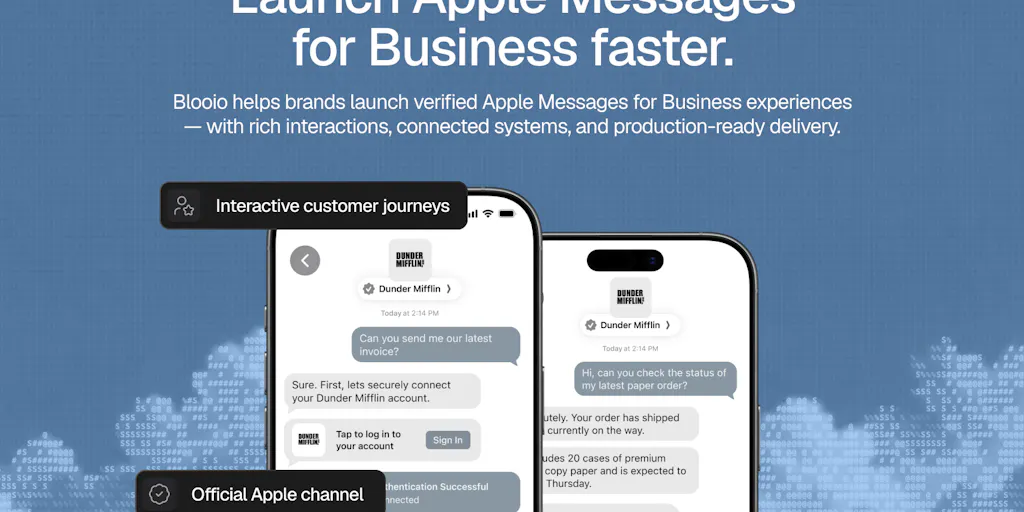
The mechanics matter here, so let me be precise about what the source says versus what it implies. The maker states Blooio is now “an Apple Messaging Service Provider” and that customers “see your verified business name and logo directly inside the Messages app.” It supports quick replies, appointment pickers, interactive forms, rich media, and Apple Pay inside the conversation thread. It exposes an API and webhooks for connecting AI agents, CRMs, and existing workflows, with human handoff. Critically, the maker is explicit that this is a verified, customer-initiated channel with “an approved invitation flow for opted-in customers” — a deliberate contrast to the original iMessage API, which did not carry that verification layer.
That distinction is the whole ballgame. The original “send iMessages without Apple hardware” pitch was a developer curiosity with obvious compliance and deliverability risk — gray-area territory that made growth marketers nervous. Apple Messages for Business is a sanctioned channel. The trade-off is that you can’t just blast messages at a scraped list; customers have to initiate or opt in through an approved flow. For anyone who’s watched an SMS list get torched by carrier filtering, that constraint is a feature, not a bug.
Why this matters more to some creators than others
If you’re a TikTok-first creator whose entire business is top-of-funnel reach and brand deals, Blooio is largely irrelevant to you — your monetization runs through the platform, not a CRM. But if you’re an indie founder or a creator-operator running a direct-to-audience business — a course, a community, a productized service, a newsletter with a paid tier — the messaging layer is where retention actually lives. Email open rates are a shadow of what they were a decade ago, and every social platform sits between you and your audience. A verified, opt-in messaging thread is the closest thing to a direct line that a small operator can get without building an app. That’s the strategic frame I’d use to evaluate this, not “cool iMessage API.”
How it differs from the tools already in your stack
The honest comparison here isn’t Buffer or Later — those are publishing and scheduling tools, and Blooio doesn’t do that. It’s not Metricool or Hootsuite either; those are analytics and inbox-management layers for public social. Blooio competes in the business messaging category, alongside the customer-support and conversational-marketing players.
The closest well-known incumbents are Twilio for programmable SMS/WhatsApp, Intercom and Zendesk for support inboxes, and the various “SMS marketing” platforms like Klaviyo and Attentive. Where Blooio tries to differentiate is the Apple Messages for Business layer specifically — the verified logo, the native rich interactive elements, Apple Pay in-thread — combined with a single API across Apple, RCS, SMS, and WhatsApp. Twilio gives you SMS and WhatsApp programmability but not Apple Messages for Business natively; Intercom gives you a support inbox but not the Apple-native verified channel. So the pitch is “one API, all the messaging channels, including the Apple one nobody else makes easy.”
My take: that’s a real gap in the market, but it’s a developer-facing gap, not a creator-facing one. If you’re a growth marketer who wants to add a messaging channel to your funnel, you’re not going to wire up webhooks yourself — you’ll wait for a no-code tool built on top of this, or you’ll use an existing SMS platform that already has a friendly UI. Blooio is infrastructure, and infrastructure products win by being embedded in tools operators already use, not by being adopted directly.
The AI-agent angle is the real story
The maker’s framing — “built for AI and automation,” connect AI agents and CRMs via API and webhooks with human handoff — is where I’d bet the actual growth is. Conversational AI agents that live inside a customer’s messaging app, with a verified business identity, are a much more natural fit for support and transactional conversations than a chatbot bolted onto a website widget. If you’re building an AI support agent for a small brand, the Apple Messages for Business channel is a differentiated surface because customers trust it more than a random web chat. That’s the wedge. The “send blue bubbles” nostalgia is marketing; the AI-agent infrastructure is the business.
What creators and social teams can borrow from this
Even if you never touch Blooio, the launch is a useful mirror for how you think about owned channels. Three things I’d take away:
1. Verification is becoming table stakes for trust. The whole reason Apple Messages for Business works is the verified name and logo — customers know it’s actually you. Compare that to the wild west of DMs on Threads or Instagram, where impersonation is a constant problem. If you’re running a brand account, audit how verifiable you are across channels. A verified messaging presence is a trust asset, and trust is the thing algorithms can’t manufacture for you.
2. Customer-initiated beats broadcast. The opt-in invitation flow is a constraint, but it’s also a template. The channels that survive tightening regulation and platform filtering are the ones where the audience chose to hear from you. Email, SMS, and now verified messaging all reward the same discipline: earn the opt-in, then don’t abuse it. If your social strategy is 100% broadcast, you’re renting reach. Building any owned, opted-in channel — even a simple email list — is the hedge.
3. Interactive, in-thread experiences beat link-outs. Quick replies, appointment pickers, forms, Apple Pay — all inside the thread, no app switch. That’s the same principle behind why Instagram and TikTok keep pushing native checkout and in-app forms: every tap-out is a drop-off. When you design a social campaign, ask how much of the conversion you can keep in-platform versus how much you’re leaking to a browser. The messaging model just makes that principle explicit.
Why TikTok creators should care less than indie founders
I want to be blunt about audience fit. If your income is ad revenue and brand deals tied to reach, none of this touches you — your job is to feed the algorithm, and the algorithm doesn’t care about your CRM. But if you’re a creator with a product, a paid community, or a service business, the messaging channel is where repeat revenue lives, and the verified Apple channel is a legitimate differentiator for a small brand that can’t afford to look sketchy. The line is transactional relationship vs. broadcast reach. Know which business you’re in before you get excited about an API.
Where my judgment says it falls short
I’ll be the skeptic here, because the launch page is understandably promotional and there are real open questions.
Pricing is not disclosed. The source says nothing about cost, rate limits, or per-message fees. For an API product, that’s the single most important variable for a small operator, and its absence means you can’t evaluate fit from the launch page alone. I’d want to see the pricing page and the actual Apple Messages for Business onboarding requirements — Apple’s approval process for that channel is not trivial, and “approved invitation flow” implies a review gate that could slow a small team down.
It’s infrastructure, not a tool. The maker is clear this is an API for “developers, startups, and businesses.” If you’re a social media manager who lives in a scheduling dashboard, this is not built for you — you’d need engineering resources or a no-code layer on top. That’s a real adoption barrier, and I’d bet most creator-economy operators will experience Blooio indirectly, through whatever CRM or support tool eventually integrates it, rather than directly.
The channel is customer-initiated, which caps its use for growth. You can’t use this for cold outreach or list-blasting — and that’s by design, but it means it’s a retention and support channel, not an acquisition channel. If you were hoping for a new top-of-funnel lever, this isn’t it. The original “send blue bubbles from anywhere” framing was more exciting precisely because it was less constrained; the verified version is more legitimate but narrower.
Competitive pressure is real. Twilio, Intercom, and the SMS marketing platforms all have distribution and existing integrations. Blooio’s edge is the Apple-native verified channel, and that’s a genuine moat only as long as the incumbents don’t build the same integration. My take: the AI-agent angle is the defensible part, and I’d watch whether the team leans into that or gets pulled into generic SMS/WhatsApp commoditization.
What I’d watch / test next
This week, if you’re an operator, do three concrete things. First, audit your owned channels — count how many of your audience relationships are broadcast-only versus opted-in and direct. If the answer is “all broadcast,” that’s your strategic gap, regardless of Blooio. Second, if you run a product or service business, read up on Apple Messages for Business and the verified onboarding requirements so you understand what a sanctioned messaging presence actually demands — even if you don’t build it yourself. Third, watch the integration layer: the tell for whether Blooio matters to creators is whether a mainstream CRM or support tool adopts its API, because that’s how infrastructure reaches non-developers. I’d also keep an eye on the pricing page once it’s published — that’s the number that decides whether this is a small-team tool or an enterprise one. The messaging channel is real and underused; whether Blooio is the vehicle most creators touch is still an open question, and I’d rather flag that honestly than pretend a launch page answers it.