The creator economy has quietly shifted from posting to conversing. Algorithms reward replies, comments, and DMs more than raw reach, and the most valuable audience actions happen outside the feed. The next frontier is voice. Bolcho AI, a multilingual voice-agent platform built for India, might look like a telephony product rather than a social tool. I’d argue it’s the opposite. Its launch page exposes a problem every creator with a non-English audience will eventually have to face: AI voice agents fail at the exact moment real people start code-switching, dropping regional accents, or reading numbers in English inside a Hindi sentence. If your content reaches India — or any multilingual market — this is not a niche engineering complaint. It’s the new localization strategy.
The problem: voice agents fail where real conversations live
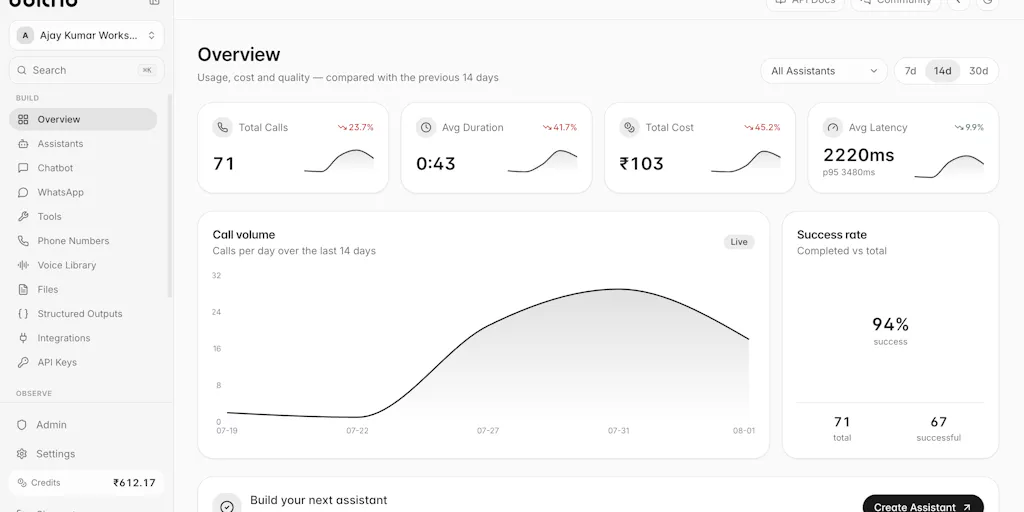
I spent part of last year helping a creator-business build a “book a call” path from Instagram Reels to a sales line. The content was never the hard part. The hard part was the moment a DM conversation became a phone conversation: real callers blurred language boundaries, switched between Hindi and English in one sentence, and expected the person on the other end not to blink. That is the gap Bolcho AI is built to close. The product page describes an AI voice platform for building, deploying, and scaling multilingual AI phone and web agents, with native language support, ultra-low latency, telephony integrations, and the option to bring your own LLMs, STT, and TTS providers. The maker, Kumar Ajay, says the team built it because most voice AI platforms are still Western-first and struggle with Indian languages, regional accents, telephony complexity, and the latency that natural conversations need. That framing matters far beyond India.
For social media operators, voice agents have quietly become conversion infrastructure. A comment section can drive thousands of leads, but those leads still need to be qualified, booked, and supported. If you run a coaching business, a membership community, or a service brand online, the phone call is where trust turns into revenue. An AI voice agent that mishears a phone number or responds with a stiff English script will burn that trust faster than a typo in a caption ever could. This is why I watch voice-AI launches even though they are not “social tools.” They are the next layer of social funnels.
The launch page’s comment section is more honest than most product copy. A commenter named Artem asks how Bolcho handles code-switching, because in his experience most voice agents fall apart when someone mixes Hindi and English mid-sentence. Another commenter, Igor, says latency and natural turn-taking are the two hardest things to get right. And a commenter named Jernej raises the sharpest point: in a support call, the hard part is not the sentence but the identifier inside it — an order number, a phone number, a pin code, a spelled-out email. A language model can clean up grammar, but it cannot repair a misheard digit, and that failure is silent. Those are the exact failure modes that determine whether a creator-business can automate trust or not. The reviews thread is worth reading for that alone.
Why short-form creators should care more than LinkedIn personal brands
Short-form content runs on spoken language and community dialect. When you publish Instagram Reels or YouTube Shorts to a global audience, you are already dealing with accents, slang, and code-switching. A viewer in Delhi does not consume your content the way a viewer in Ohio does. If your automation stack assumes every conversation happens in textbook English, your lead capture and customer support will have a language ceiling. My take: short-form creators are already living in the voice-agent problem; written-word personal brands can keep ignoring it for a while longer. If your audience comments are mostly English, this launch is a curiosity. If your comments contain Hinglish or Tanglish, it is a roadmap.
Where the math breaks: confidence isn’t validity
Speech-to-text confidence scores are not the same as correctness. I have seen marketing automation fail in the same way: a lead form captures a mistyped email, the follow-up sequence sends to the wrong address, and nobody notices until the campaign report looks odd. Voice is worse because the caller hears a wrong confirmation and says “yes” to end the call. The commenter Jernej’s point is that the right fix is validity: check the captured string against the customer’s real data before the agent promises anything. An order number is either in the system or it is not. A pin code either matches a city or it does not. Confidence tells you the model is sure; validity tells you the model is right. If Bolcho builds that kind of mid-call validation, it will be more useful than any multilingual TTS demo. If it simply returns whatever the STT produced, the code-switching success story matters less.
How Bolcho is different from the voice AI you already know
By now, most technical indie founders have seen the same name plates: ElevenLabs, Vapi, AssemblyAI, Retell AI, and YourGPT. They are not identical. ElevenLabs is the voice generation powerhouse; Vapi is a developer-first voice agent API; AssemblyAI is speech-to-text infrastructure; Retell AI positions itself as an AI call center; YourGPT sells support, sales, and operations agents. What makes Bolcho a different bet is not the existence of voice agents. It is the claimed depth of the India layer: native language support, telephony integrations, and awareness of regional accents.
My take: the “bring your own LLM, STT, and TTS providers” feature is not unique. Vapi and others already let developers plug in their own models. What would be unique is if Bolcho has actually solved the messy part of Indian telephony: carrier integration, audio quality on mobile calls, real-time language detection, and natural turn-taking in code-switched conversations. The page does not disclose carrier names, latency benchmarks, or a supported language list. The maker answered “Yes” when asked whether it covers all Indian languages, but “all” is a strong word, and Product Hunt comments are not production documentation.
The bigger point for creators: the difference between a generic voice agent and a regional voice agent is the same difference between an English-only caption and a properly localized post. One reaches people. The other reaches people where they actually live.
What creators and social media teams can borrow from Bolcho’s approach
The first lesson is to treat localization as a conversational behavior, not a translation job. A creator can post the same video in English and Hindi, but the people who reply with “loved it bhai, next video kab?” are showing you how they actually talk. You should talk back the same way. When I run social accounts, I look at the comment section for language patterns before I write canned replies. Bolcho’s pitch is essentially the same idea applied to voice: if your audience says “sir, mera order abhi tak nahi aaya,” a voice agent cannot respond with a formal English sentence and expect to sound trustworthy. It has to understand the mix, not just translate it.
The second lesson is to build validation into every automated conversation. Lead forms, DM funnels, and voice agents all have the same flaw: they capture what the user said, not what the user meant. The fix is a lookup. If someone books a call through an Instagram DM bot, check the phone number against your calendar system before you promise a time. If a voice agent captures an order number, check it against the actually existing orders before confirming. The distinction between confidence and validity is a design principle, not a feature.
The third lesson is to own your stack. Bolcho’s BYO approach is appealing because it keeps the maker from locking users into one model forever. Social media operators should borrow that mindset. Your content calendar should live outside any given scheduling tool; your best-performing posts should be copied into your own database; your analytics should be exported before the tool changes its pricing or dies. The tools you use for distribution should be interchangeable. The relationship with your audience is the product.
The “bring your own stack” tradeoff
BYO is a double-edged sword. For a technical founder, it means flexibility: you can swap a bad speech-to-text model without switching platforms. For a non-technical creator, it means you now own a stack with multiple API keys, separate billing lines, and latency questions. If you are a solo creator with no developer support, “bring your own models” is not a feature; it is a job. The page says you can launch production-ready voice agents, and maybe that is true for builders. For a social media manager who just wants a number where fans can call and book a slot, there is still a missing layer of abstraction. That layer will come, but this launch does not prove it exists yet.
Where my judgment says it falls short
I have not tested Bolcho with a live phone line, so I am not going to pretend the launch page is a review. It is a strong direction, not a proven product. The missing details matter. Pricing is listed only as “Free Options” on the Product Hunt page, so cost per minute is not disclosed. The page does not list supported Indian languages, carrier integrations, or latency numbers. It does not mention compliance, data residency, or privacy controls — important if you want to use voice agents for healthcare or government services. And it does not mention human handoff, which is the safety net every automated conversation needs. The team claims you can launch production-ready voice agents in minutes; my take is that “production-ready” depends heavily on which languages, which telephony providers, and which failure modes you are prepared to handle.
There is also the competition problem. ElevenLabs, Vapi, and Retell already have developer mindshare and documentation. A Product Hunt launch can create momentum, but it cannot create a moat. Bolcho’s moat will have to be the depth of its India-specific telephony layer, and that depth is still under-documented at launch.
Who Bolcho is not for
This is not a product I would recommend to a solo creator who just wants to publish content. There is no social-native integration mentioned — no Instagram DM, no YouTube comments. It is also not for teams that need compliance proof before a pilot. The launch page does not describe a visual drag-and-drop builder; if you cannot read a telephony API reference, you will likely struggle. It is for technical indie founders, agencies, and small businesses in India that need a multilingual voice agent and are comfortable managing the underlying models. If that does not describe you, treat Bolcho as something to watch rather than something to adopt this week.
What I’d watch / test next
Here is what I would do this week if I were building a creator business with an Indian audience. Go to Bolcho’s website, sign up, and run a short scripted call in Hinglish, one regional mix, and one clean English pass. Ask the agent for a phone number or email, deliberately say digits in the other language, and see what it captures. Then ask the team four questions: which Indian languages are production-ready, not just “supported in principle”; what is the real latency on a mobile network; can captured identifiers be validated against my own CRM or database mid-call; and what happens when the agent is uncertain — does it escalate to a human? I would also check the PH alternatives page in a month to see whether users report actual code-switch success or just praise the vision. The broader point is not to buy the hype. The next competitive edge for creators is conversational infrastructure, and it will be won by tools that handle real speech — code-switching, misheard digits, and all. Test that first. Everything else is a demo.