Why Every Social Media Operator Needs a Single Source of Truth for Their AI Tools
If you’ve spent any time this year prompting ChatGPT to write a caption, asking Claude to repurpose a YouTube script into a TikTok hook, or handing an “agent” your brand guidelines only to watch it ignore them three tasks later, you already feel the pain that Creed is trying to solve. The problem isn’t that AI tools lack capability—it’s that every session starts at zero. You re-explain your brand voice, your content pillars, your posting cadence, your audience’s slang, your no-fly zones (“we never use emoji overload,” “don’t mention competitors,” “keep links UTM-tracked to our Google Analytics property”). And the moment you switch tools or start a new conversation, all that context evaporates. The result? Inconsistent output, manual copy-paste overhead, and a quiet erosion of the one thing social media operators cannot afford to lose: a coherent brand presence across platforms.
This is why the concept behind Creed — a portable, editable file that serves as “one source of truth” about you, your role, your projects, and your preferences, readable by any connected AI — is immediately relevant to anyone running accounts at scale. It’s not a scheduling tool, not a repurposing engine, not another analytics dashboard. But it scratches an itch that every creator who has tried to chain AI tools together knows intimately: the silent friction of re-onboarding your brand every single time.
The Real Problem: Context Fragmentation in Your Content Workflow
Social media operators today don’t just post to one platform. We queue up 30 posts across five networks — Instagram, TikTok, YouTube, X, LinkedIn, Threads, and sometimes Pinterest and Facebook — and each one expects a slightly different tonal register. A YouTube title needs SEO robustness; a TikTok caption needs brevity and hook speed; a LinkedIn post rewards thoughtful commentary, not punchy call-to-actions. The dream is to have an AI that knows all these nuances without being reminded of them in every prompt. But the reality is that most of us still maintain a Frankenstein’s monster of context: a Google Doc titled “Brand Bible v7,” a Notion database of “Content Rules,” a private Slack channel where we paste instructions before copying them into ChatGPT’s custom instructions box, and maybe a .claude.md file in our code repo if we’re technical. And none of these sources talk to each other. Worse, they go stale at different rates. You update the brand Bible but forget to paste the revision into the custom instructions, and suddenly your AI assistant is pulling from a version that still lists “use #throwbackThursday” as a tactic you abandoned six months ago.
This fragmentation is what I’d call the context tax. Every time you switch tools or start a new session, you pay it again. In my own workflow, I’ve estimated I spend about 15–20 minutes per week rewriting the same “who I am” and “how I work” preamble into various AI interfaces. That doesn’t sound like much, but multiply it across a team of three social managers and you’re losing an hour of editorial attention per week. Worse, the inconsistency cost—having to audit every AI-generated caption for brand voice drift—eats into the time you’d rather spend on strategy or community engagement.
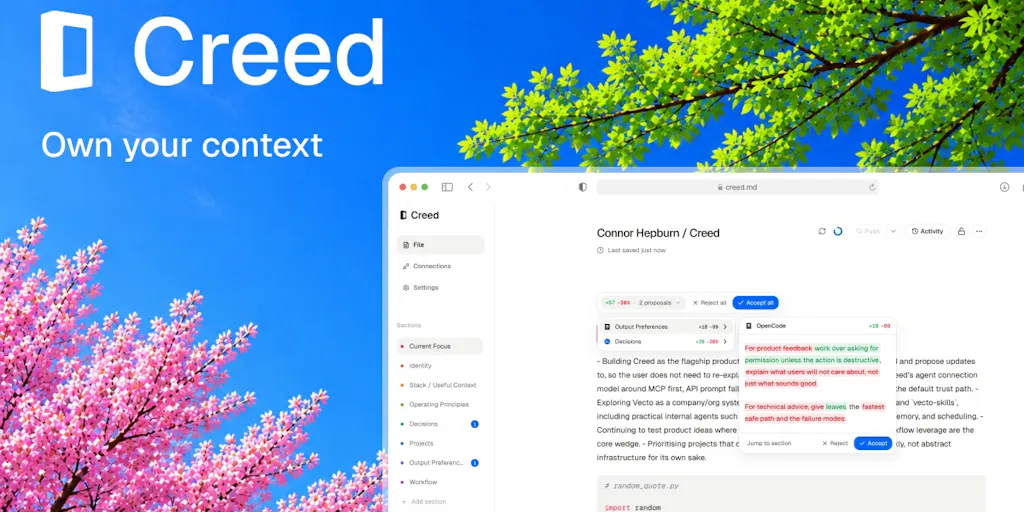
Creed directly targets this inefficiency. Maker Connor Hepburn frames it as “one source of truth about you, your role, your projects, your preferences, how you work, that every connected AI can read.” Instead of copying your context into ten different tools, you set it once in a portable file and let each agent pull it at session start. That’s elegant on paper. But the devil, as always, is in the sync timing and the scope control.
How Creed Differs from the Current Workarounds
Right now, the most common workaround for context fragmentation is the custom instructions feature inside tools like ChatGPT and Claude. You write a few paragraphs about your role and preferences, and the model reads them before every response. It’s better than nothing, but it’s walled inside one tool. A second common hack is to maintain a plain-text file (often called AGENTS.md or .claude.md) inside a project folder and manually paste it into each new conversation. The community comments on the Creed product hunt page confirm this pattern — one user said they “hand-copied the same claude.md into every new agent and watched it go stale the second I changed one copy.” That’s the drift problem.
Creed aims to replace those manual silos with a single, hosted file that multiple agents can reference via MCP (Model Context Protocol). The MCP pull is significant: it means the agent fetches the context file before generating an answer, rather than having it pasted into the prompt. That should, in theory, keep the file outside the conversation window, reducing token waste and making it easier to update centrally. But it also introduces a new question: how often does each agent re-fetch? If the fetch happens once at session start and then caches, you’re back to the stale-snapshot problem that a commenter named Noctis Leonard flagged: “When I edit my Creed, does each agent pull it live at session start, or does it sync on a schedule and risk serving a stale snapshot mid-task?” The source doesn’t disclose the answer, but from my experience building similar integrations, I’d bet the default is a per-session fetch, not a real-time WebSocket push. That’s okay for most social media workflows—you’re unlikely to edit your brand voice mid-morning—but it could cause issues if you toggle a campaign-specific preference and then immediately run a series of AI tasks.
Compared to incumbents in the “AI memory” space — like Mem, Rewind, or even Notion AI — Creed’s emphasis on a user-owned, editable file (as opposed to a black-box learned profile) is a deliberate trust signal. One commenter praised that aspect: “Making it something you own and edit rather than a black-box profile is the part I like most.” For social media operators who need to audit exactly what the AI knows about their brand, transparency is non-negotiable. You cannot afford an AI that quietly learns “we post memes” because it saw a single meme in your chat history, when your actual strategy is thought-leadership.
What Creators and Social Media Teams Can Borrow From Creed — Even If They Don’t Use It
You don’t have to adopt Creed tomorrow to benefit from the thinking behind it. Here are three operational habits I’m already borrowing from this product’s philosophy, regardless of whether I connect it to any agent.
1. Create a “BrandContext.md” file for your team.
Write down the stable identity facts: brand mission, tone of voice (professional vs. conversational), audience demographics, content pillars, posting schedule preferences, and any absolute rules (e.g., “never post unmarked sponsored content,” “always use UTM parameters from our Google Analytics property”). Store it in a shared drive or Notion. Then, before you prompt any AI tool, paste the relevant section into custom instructions or include it as a system prompt. This gives you a single source of truth to update, and it forces discipline about what actually matters.
2. Separate stable context from fast-moving project context.
Commenter Hung Tran asked a design question that applies directly to our workflows: “Do you separate stable identity context (role, preferences) from fast-moving project context? The first I set once; the second changes weekly.” In social media, your identity context (voice guidelines, brand colors, content pillars) is static for months. But project context (a campaign’s key message, a product launch date, a specific hashtag strategy) changes every week. If you stuff them into the same file, you either have to edit the file constantly (risking drift) or you end up paying for stale tokens on every call. I now keep two files: one long-lived brand-context.md and one ephemeral campaign-context.md that I generate for each new campaign and replace when the campaign ends.
3. Audit your AI tools for “context adhesion.”
Commenter Kenneth John Saracho pointed out the real failure mode: “The agent has the file in context and still doesn’t follow it three files deep into a task, and nothing flags that it happened.” This is the silent drift. In my own tests of custom instructions with Claude, I’ve seen it ignore explicit directives to “keep sentences under 20 words” after a few exchanges. The tool has no way to verify adherence. As a workaround, I now include a verification prompt at the end of every batch of AI output: “For each of the five captions above, confirm that it follows the brand guideline about avoiding emoji and keeping tone professional. List any violations.” That at least surfaces non-adherence so I can decide whether to re-prompt.
Why TikTok Creators Should Care More Than LinkedIn Ones
The value of a unified context file scales with the volume and speed of your content output. A LinkedIn thought-leader posting three times a week can get away with manual context copy-paste. But a TikTok creator or an Instagram Reels operator who needs to produce 20+ posts per week — each requiring a unique hook, platform-appropriate format, and consistent brand voice — cannot afford to re-explain their identity to an AI helper every day. The opportunity cost in lost time and inconsistent tone is measurable. TikTok’s algorithm, in particular, punishes inconsistency in style and pacing because it’s built to surface content that feels “of a piece” with a creator’s previous hits. If your AI captions start sounding robotic or off-brand for three Reels in a row, your engagement rate will dip. A synchronized context file could help maintain the fractal consistency that the algorithm rewards. For LinkedIn, where the audience is more forgiving of tonal variation (and where personal voice is often celebrated over brand polish), the same need is less acute.
Where the Math Breaks: Limitations, Open Questions, and Who This Is Not For
I want to be clear: I’m not endorsing Creed as a must-use tool for every social media operator today. The product hunt page is a launch, not a shipping product with a proven track record. Based on the source material, here are the critical open questions.
Token bloat and the deletion problem.
Commenter Abdullah Javaid made the sharpest observation: “Both diffs in your own screenshots add lines and remove none, +18 and +9 with a zero on the other side, and that is the shape every memory product drifts into.” If your Creed file only ever grows, you’re paying for tokens on every AI call to read instructions that may no longer be true. For a social media workflow where you’re making dozens of API calls for caption generation, those token costs add up. The source doesn’t address whether Creed proposes any mechanism for deletion or expiry (e.g., “this instruction has not been true for four months, delete it”). Until it does, you risk the file becoming a bloated preamble that degrades AI performance and eats your budget.
Scope control is absent.
Multiple commenters asked whether you can limit which connected agents see which parts of the file. Uddipta Mahanta said, “My coding agent, an email assistant, and some random marketing tool don’t all need the same slice of ‘who I am.’” For a social media operator, the equivalent is: your scheduling tool (say, Buffer) doesn’t need to know your coding preferences, and your content repurposing tool (like CapCut or Canva) doesn’t need your email assistant’s rules. If every connected tool reads the entire identity doc, you’re either leaking irrelevant context or you have to manually curate which sections are included. Creed’s current design seems to be all-or-nothing, which is a dealbreaker for anyone with a multi-tool stack.
No verification of adherence.
As I mentioned earlier, the tool has no way to verify that the agent actually used the context. For high-stakes brand content, that’s a trust gap you cannot ignore. If your AI assistant produces a caption that violates your “no first-person plural” rule, and you publish it because you trusted the context file, you own the mistake. Until Creed can surface a log or a compliance check, it’s just a passive file — not a guardrail.
Who should skip this for now.
If you are a solo creator posting fewer than 10 times a week and you already use custom instructions inside ChatGPT or Claude, you probably don’t need another layer of complexity. The overhead of setting up and maintaining a separate context file might outweigh the time saved from re-pasting. Similarly, if you work in a highly regulated industry (healthcare, finance, legal) where AI usage requires strict audit trails and versioned approvals, a user-editable file that can be changed without logging is a liability, not a feature.
What I’d Watch / Test Next
If you’re intrigued by the concept, here’s what I’d do this week — without committing to a new SaaS tool.
Test your own
AGENTS.mdacross two tools. Write a single brand-context file (200–300 words) that covers your voice, audience, content pillars, and absolute rules. Paste it into ChatGPT’s custom instructions and into Claude’s project knowledge base. Generate five captions for the same post idea in each tool. Compare the outputs for consistency. Then update one rule in the file and see how long it takes before both tools reflect the change. That experiment will teach you more about your own fragmentation pain than any product page can.Measure your context tax. For one week, log every time you have to re-explain something to an AI assistant — including manually altering a generated output because the AI got the brand voice wrong. Compute the time cost. If it’s more than 30 minutes a week, you have a strong case for adopting a central context file.
Keep an eye on Creed’s scope-control and deletion roadmaps. The community comments are sharp, and the maker seems responsive. If they ship per-agent permissions and a way to automatically prune stale entries, this tool could become genuinely useful for social media teams. I’ll be checking their product updates and re-evaluating in three months.
For now, the most valuable takeaway isn’t the product — it’s the reminder that context fragmentation is a real cost, and the right infrastructure is the one that lets you own and edit your data, not lock it into a tool you don’t control. That’s a principle worth borrowing, even if you write the file in a plain-text editor and paste it by hand.