The “billboard internet” problem is now a social-media problem
Every social platform sold us the same promise: build a following, and the following becomes a destination. What actually happened is that we built audiences on rented land, pointed them at landing pages nobody lingers on, and watched a decade of “link in bio” traffic behave like commuters on a highway — passing through, never stopping. So when a maker launches something that reframes the website itself as a place people can walk into, I pay attention, because the underlying question is the one every social media operator is quietly wrestling with: how do you turn passive reach into an actual room full of people?
That’s the lens I want to use for cubicles.lol, a browser-based multiplayer world from solo maker Matthew Schapiro. It’s not a scheduling tool or an analytics dashboard. It’s a provocation about what a “link” could be in 2025 — and provocation is often where the next workflow gets invented.
What cubicles.lol actually is (and what it isn’t)
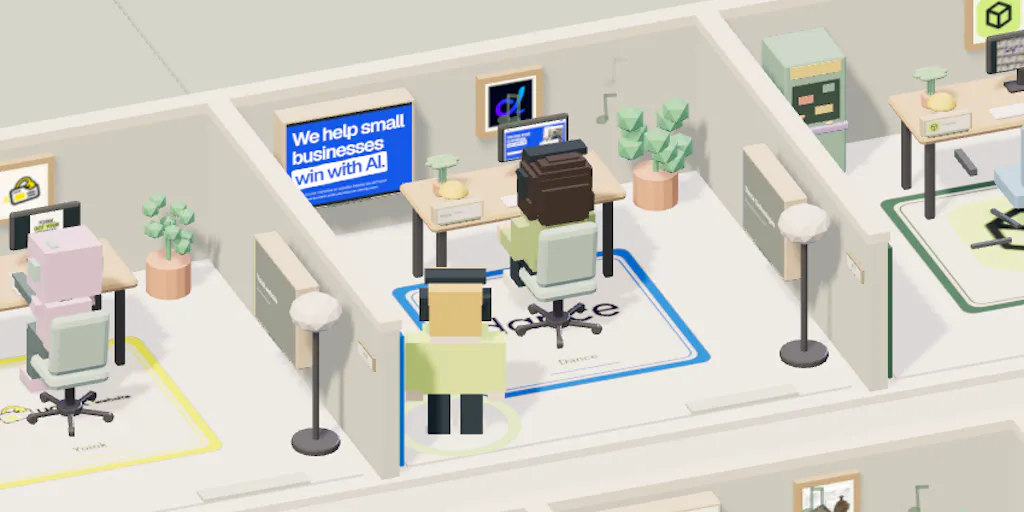
Strip away the marketing and the mechanics are simple. You drop in your website, you get a branded cubicle — a small 3D room that represents your presence — inside a shared multiplayer world. Other people’s cubicles sit next to yours. You can walk around, look at what your neighbors are building, and then, per the maker’s own framing, “steal their car” or challenge them to a typing speed contest. There are skateboards, boats, and a blimp you can hijack. It runs free in your browser with no download and no account required.
That last detail matters more than it sounds. The maker explicitly calls out “no download, no account” as a deliberate choice, and a commenter on the launch — Likely AI — flagged it as “the right call,” noting that friction at the signup wall is “usually where these multiplayer web experiments lose people before they even see the point.” That’s a product decision I’d steal for any creator funnel: the first interaction should cost nothing, not even an email.
The most striking claim in the launch is about how it was built. Schapiro says he “solo-built an entire metaverse in four days” using over 6 billion tokens, and credits OpenAI’s Astra model for making it possible — specifically the ability to “follow my curiosity,” iterating from “what if the cars could also be amphibious vehicles?” to a working 3D model and animation in about ten minutes. I want to be careful here: that’s the maker’s claim, not an independently verified benchmark, and “6 billion tokens” is a number I can’t audit. But the shape of the claim — that AI collapsed the distance between idea and prototype — is the part that should interest anyone who ships content for a living.
A note on what the source doesn’t tell us
There’s no pricing beyond “free to explore,” no user count, no retention data, no stated concurrency limits. When a commenter asked whether performance holds up “once a bunch of cubicles fill in with real neighbors,” the maker didn’t answer in the thread. That’s not a knock — it’s a two-day-old launch — but it’s the kind of open question I’d flag before betting a campaign on it. Not disclosed is not the same as “fine.”
Why this matters to social media operators specifically
Here’s my take, and I’ll flag it as opinion: the interesting thing about cubicles.lol isn’t the metaverse. It’s the distribution model. For years, the creator economy has been optimizing the same three-step loop — post content, drive a click, convert on a page. Every tool in the stack, from Buffer to Later to Metricool, exists to make that loop tighter. But the loop itself is leaking. Organic reach on Instagram and Facebook has been compressing for years as Meta prioritizes recommended content over followed accounts. TikTok’s algorithm rewards watch time over follower count, which means your “audience” is really just a set of people the algorithm briefly rented you. X and Threads reward replies and dwell time. LinkedIn rewards comments and shares. Pinterest rewards saves. None of them reward “clicked through to your website.”
So what does a creator do with the traffic that does click? Historically: a link-in-bio page, a newsletter, a landing page. All of them are one-directional. You talk, they read, they leave. cubicles.lol proposes something stranger — that the destination is a place with other people in it, and the social proof comes from proximity rather than a testimonial section.
Why TikTok creators should care more than LinkedIn ones
If you’re a TikTok creator, your content is already performative, spatial, and chaotic. A world where your followers can walk into your branded room, hijack a blimp, and challenge you to a typing contest is a native extension of the format, not a departure from it. The maker is even running a promotion on this: beat him at the typing speed game and he’ll give you a free cubicle. That’s a content hook, not a feature — and hooks are what TikTok rewards.
If you’re a LinkedIn creator, the fit is thinner. Your audience is at work, on desktop, in a hurry, and the value proposition of “walk into my cubicle” is much less obvious than “read my 400-word post about pipeline management.” I’d bet the LinkedIn use case is a recruiting or culture play — a virtual office tour — rather than a content-distribution play. That’s a narrower wedge, and I’d want to see it work before recommending it.
The repurposing angle nobody’s talking about
Here’s where I get genuinely interested as an operator. If cubicles.lol becomes a place where people hang out, it becomes a source of content, not just a destination for it. Think about what that means for a repurposing workflow: you record a screen capture of your cubicle, cut it into CapCut or Canva for a YouTube Shorts clip, screenshot a funny moment for an Instagram carousel, write a thread about the interaction for X. The world generates raw material. That’s a fundamentally different relationship with a “link” than a static landing page has — and it’s the kind of thing that makes a tool sticky for creators who are already exhausted by the content treadmill.
How this stacks up against the incumbents
I don’t want to overstate the comparison, because cubicles.lol isn’t competing with your scheduling stack. But it is competing for a slot in your bio link, and that slot has incumbents.
- Linktree and its clones own the “one link, many destinations” job. They’re utilitarian, fast, and boring — which is exactly why they work. cubicles.lol is the opposite: slow to load, weird, memorable. My take: they serve different moments. Linktree is for conversion; cubicles.lol is for curiosity.
- Discord and Circle own the “community destination” job. They’re where your superfans go to talk to each other. cubicles.lol is more ambient — you don’t join a server, you wander into a room. That’s a lower-commitment social layer, and lower commitment is often what you want at the top of a funnel.
- Gather and similar virtual-office tools own the “team presence” job. They’re built for coworkers, not audiences. cubicles.lol inverts this: it’s built for strangers to bump into each other, which is a much harder social design problem.
The honest read: cubicles.lol is not yet a replacement for any of these. It’s a new category trying to form — “ambient social presence for creators” — and the category only works if enough people show up to make the world feel alive. That’s the cold-start problem every multiplayer product faces, and it’s the thing I’d watch most closely.
Where the math breaks
Let me do the unglamorous operator math. If you’re running a campaign and you drive 10,000 clicks to a landing page, you might get a 2–5% conversion on a good day. If you drive 10,000 clicks to a multiplayer world, you get… what? A bounce rate that depends on whether the world loads fast enough, whether there’s anyone else there when you arrive, and whether the novelty survives the first 30 seconds. Those are three variables you can’t control from a scheduling dashboard. That’s the risk. The reward is that the people who do stay have a memory of your brand that a landing page can never produce.
What creators and social teams can borrow from this launch
Even if you never touch cubicles.lol, there are three transferable lessons in this launch thread that are worth stealing this week.
1. Frame the problem before you frame the product. The maker’s line — “the internet is starting to feel like everyone bought a billboard and nobody came to town” — is the single best sentence in the entire source. It’s a diagnosis, not a pitch. Every creator bio, every content series, every newsletter intro should do the same thing: name the feeling your audience already has before you offer the fix. That’s how you earn the next 10 seconds of attention.
2. Remove the signup wall from the first interaction. “No download, no account needed” is a growth decision disguised as a UX decision. If your lead magnet requires an email, test a version that doesn’t. If your community requires a Discord join, test a version that lets people lurk first. Friction is the enemy of curiosity.
3. Treat your destination as content, not just a conversion point. The most underrated move here is that the world itself is shareable. If you’re a creator, ask yourself: is my link-in-bio page something anyone would ever screenshot? If not, you’re leaving repurposing fuel on the table.
The AI-building angle is the real story
I’d be burying the lede if I didn’t say this plainly: a solo maker claiming to have built a multiplayer world with vehicles, physics, and games in four days is a signal about where AI tooling is heading, not just a fun launch. The maker says OpenAI’s Astra model let him go from “what if the cars could also be amphibious?” to a working model and animation in about ten minutes. If that workflow is even directionally real, it changes the economics of side projects — and by extension, the economics of content experiments. The barrier to trying a weird format used to be “can I build it?” Now it’s increasingly “can I get people to show up?” That’s a shift every social media manager should be tracking, because it means the bottleneck in your job is moving from production to distribution.
Where I think this falls short
I want to be balanced, because the launch thread is overwhelmingly positive and that’s a bias worth naming.
- The social cold-start problem is unsolved. A multiplayer world with nobody in it is just a 3D screensaver. The maker hasn’t disclosed concurrent user numbers, and until there’s a critical mass of cubicles, the “walk into your neighbor’s room” promise is theoretical.
- Performance under load is an open question. A commenter asked directly whether the physics and rendering hold up “once a bunch of cubicles fill in with real neighbors.” No answer in the thread. That’s not a red flag, but it’s a “test before you commit” flag.
- Open source is “considering,” not committed. When asked, the maker said he’s “considering open sourcing it.” Until then, you’re building on someone else’s platform — the exact rented-land problem cubicles.lol claims to solve. There’s an irony there worth sitting with.
- It’s not a marketing tool. No analytics, no UTM support, no scheduling, no CRM. If you’re a social media manager looking for measurable ROI, this is not your tool yet. It’s a brand-experience play, and brand-experience plays are hard to justify in a quarterly review.
Who this is not for
If you run paid acquisition and need attribution, skip it. If your audience is B2B and time-poor, skip it. If you need accessibility compliance and screen-reader support out of the box, the source says nothing about it — assume it’s not there yet. This is for creators with a playful audience, a tolerance for jank, and a willingness to experiment in public.
What I’d watch / test next
If you’re a creator or social operator and this sparked something, here’s what I’d actually do this week — concrete, low-cost, and reversible.
- Audit your link-in-bio for “screenshot-ability.” Ask: would anyone share this page unprompted? If not, that’s your first experiment.
- Test a frictionless entry point. Pick one campaign and remove the email gate or account requirement from the first step. Measure the delta in completion rate, not just clicks.
- Watch cubicles.lol’s concurrency. Spend 10 minutes in the world at different times of day. Is it alive? Is it empty? That tells you more than any launch comment.
- Track the AI-prototyping story. Follow the maker’s account and see if he actually open sources it. If he does, that’s a template for your own side experiments.
- Steal the framing. Write your next content series intro as a diagnosis of a problem your audience feels, not a description of what you’re about to say.
The billboard internet isn’t going away. But the creators who win the next cycle will be the ones who figure out how to build a town around their billboard — and right now, that’s an open question worth experimenting with, not a solved one worth outsourcing.